
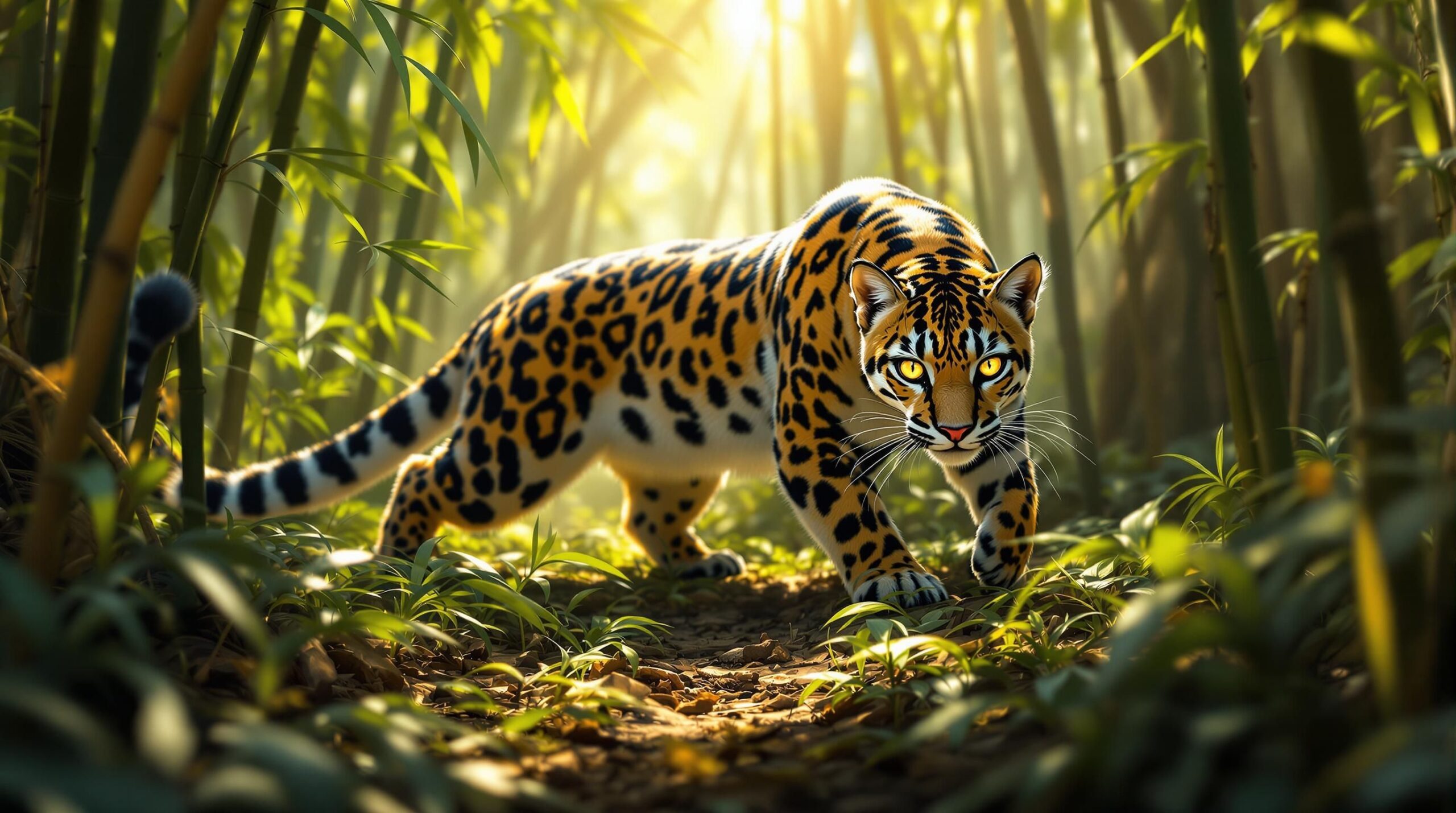
The Mainland Clouded Leopard: Specter of the Southeast Asian Forest
In the shrouded canopy of Southeast Asia’s tropical rainforests, where sunlight filters in scattered beams and silence rules beneath a cloak of greenery, there lives a cat unlike any other. Mysterious, solitary, and incredibly agile, the Mainland Clouded Leopard, scientifically known as Neofelis nebulosa, is a predator that seems conjured from mist. With its beautifully patterned coat, piercing eyes, and gravity-defying prowess in the treetops, the clouded leopard is one of the world’s most unique and fascinating wild cats. Despite its name, it is not a true leopard, but something older, more primitive, and arguably even more extraordinary. Often called the “modern-day sabertooth” due to its elongated canine teeth, the clouded leopard occupies a unique branch of the feline family tree. As elusive as it is enchanting, it remains one of the least understood big cats, living its life mostly out of human sight in remote jungles stretching from the Himalayan foothills to Indochina and southern China. This animal’s mystique is not just in its beauty or biology—it’s in the way it disappears into the shadows of a world few ever enter.
An Enigmatic Species
The Mainland Clouded Leopard is part of the genus Neofelis, which diverged from other big cats millions of years ago. While it shares some traits with leopards, panthers, and other felids, its lineage is ancient and distinct. There are two recognized species within the Neofelis genus—the Mainland Clouded Leopard (Neofelis nebulosa) and the Sunda Clouded Leopard (Neofelis diardi), which inhabits Borneo and Sumatra. The mainland species ranges across Nepal, Bhutan, Northeast India, Myanmar, southern China, Thailand, Laos, Cambodia, and Vietnam. What sets Neofelis nebulosa apart is its mesmerizing coat, marked with large, irregular cloud-shaped patterns bordered in black, blending seamlessly into the forest understory. These patterns not only give the cat its common name but also serve as ideal camouflage in the dappled light of dense foliage. Males and females exhibit similar appearances, with males typically larger. Adults usually measure between two and three feet in body length, with tails nearly as long, providing essential balance for a life spent among the branches.
Taxonomy And Identity
Often called the “modern-day sabertooth” due to its elongated canine teeth, the clouded leopard occupies a unique branch of the feline family tree. An Enigmatic Species The Mainland Clouded Leopard is part of the genus Neofelis , which diverged from other big cats millions of years ago. There are two recognized species within the Neofelis genus—the Mainland Clouded Leopard ( Neofelis nebulosa ) and the Sunda Clouded Leopard ( Neofelis diardi ), which inhabits Borneo and Sumatra.
Often called the “modern-day sabertooth” due to its elongated canine teeth, the clouded leopard occupies a unique branch of the feline family tree. An Enigmatic Species The Mainland Clouded Leopard is part of the genus Neofelis , which diverged from other big cats millions of years ago. The mainland clouded leopard is best understood through its anatomy, habitat, diet, behavior, and place in its ecosystem.
Identification And Appearance
With its beautifully patterned coat, piercing eyes, and gravity-defying prowess in the treetops, the clouded leopard is one of the world’s most unique and fascinating wild cats. There are two recognized species within the Neofelis genus—the Mainland Clouded Leopard ( Neofelis nebulosa ) and the Sunda Clouded Leopard ( Neofelis diardi ), which inhabits Borneo and Sumatra. What sets Neofelis nebulosa apart is its mesmerizing coat, marked with large, irregular cloud-shaped patterns bordered in black, blending seamlessly into the forest understory.
These patterns not only give the cat its common name but also serve as ideal camouflage in the dappled light of dense foliage. Adults usually measure between two and three feet in body length, with tails nearly as long, providing essential balance for a life spent among the branches. Body form, markings, movement, and habitat work together to separate this animal from close relatives and lookalikes.
Anatomy And Adaptations
Often called the “modern-day sabertooth” due to its elongated canine teeth, the clouded leopard occupies a unique branch of the feline family tree. These patterns not only give the cat its common name but also serve as ideal camouflage in the dappled light of dense foliage. With short, powerful legs, large feet, and sharp, retractable claws, it can climb trees with astonishing skill.
This species possesses the longest canine teeth relative to body size of any living cat—a trait reminiscent of prehistoric sabertooths. These elongated teeth are thought to aid in quickly dispatching prey with a deep, precise bite. The clouded leopard’s flexible ankles can rotate backward, allowing it to climb down trees headfirst—a rare trait among cats.
Range And Wild Habitat
The mainland species ranges across Nepal, Bhutan, Northeast India, Myanmar, southern China, Thailand, Laos, Cambodia, and Vietnam. In some parts of its range, it has also been observed feeding on domestic livestock, a behavior that occasionally brings it into conflict with humans. Males have larger home ranges than females, and interactions between individuals are rare outside of mating.
It cannot roar like a lion or tiger, but it can produce a range of vocalizations including growls, hisses, meows, and low snorts. Mating can occur year-round but may peak during certain seasons depending on the region. Across its range, forests are being cleared at an alarming rate for agriculture, logging, mining, and human settlement.
Wild Diet And Feeding
It stalks through the trees and along the forest floor, ambushing prey with precision. Its diet includes arboreal and terrestrial animals such as birds, monkeys, deer, squirrels, and wild pigs. These reveal a cat that prefers thick, undisturbed forests, is mostly nocturnal or crepuscular, and covers large areas in search of food and mates.
These elongated teeth are thought to aid in quickly dispatching prey with a deep, precise bite. A Vanishing Habitat The greatest threat facing the Mainland Clouded Leopard is habitat loss. As trees fall and roads slice through the wilderness, the clouded leopard’s once-continuous habitat becomes fragmented, reducing its ability to find food, mates, and shelter.
Behavior
Mysterious, solitary, and incredibly agile, the Mainland Clouded Leopard, scientifically known as Neofelis nebulosa , is a predator that seems conjured from mist. In some parts of its range, it has also been observed feeding on domestic livestock, a behavior that occasionally brings it into conflict with humans. The clouded leopard’s solitary nature and stealthy movements make it difficult to study in the wild.
Mysterious, solitary, and incredibly agile, the Mainland Clouded Leopard, scientifically known as Neofelis nebulosa , is a predator that seems conjured from mist. In some parts of its range, it has also been observed feeding on domestic livestock, a behavior that occasionally brings it into conflict with humans. Behavior is easiest to understand when daily movement, social contact, communication, and risk avoidance are considered together.
Reproduction And Life Cycle
Males have larger home ranges than females, and interactions between individuals are rare outside of mating. Mating and Reproduction Very little is known about the reproductive habits of wild clouded leopards due to their elusive nature. Mating can occur year-round but may peak during certain seasons depending on the region.
After a gestation period of around 85 to 95 days, the female gives birth to a litter of one to five cubs, typically two to three. In captivity, clouded leopards have proven difficult to breed successfully due to aggression between potential mates. Captive breeding programs, while not a substitute for wild conservation, remain an important tool.
Ecology And Role In The Environment
Mysterious, solitary, and incredibly agile, the Mainland Clouded Leopard, scientifically known as Neofelis nebulosa , is a predator that seems conjured from mist. In its forested realm, the clouded leopard is a predator without equal. It stalks through the trees and along the forest floor, ambushing prey with precision.
These elongated teeth are thought to aid in quickly dispatching prey with a deep, precise bite. Its long limbs, low-slung body, and powerful musculature make it an ideal predator in a three-dimensional world of tree trunks, vines, and narrow branches. The lowland tropical and subtropical forests it prefers are among the most endangered ecosystems in Asia.
Conservation Status And Threats
These efforts are critical for maintaining healthy captive populations, which could serve as a genetic reservoir for future reintroduction efforts if needed. A Vanishing Habitat The greatest threat facing the Mainland Clouded Leopard is habitat loss. The lowland tropical and subtropical forests it prefers are among the most endangered ecosystems in Asia.
Because these cats are solitary and reproduce slowly, even small losses can have a significant impact on local populations. Conservation Efforts and Hope Despite these challenges, there is hope for the Mainland Clouded Leopard. Conservation organizations across Asia are working to protect forests, strengthen anti-poaching efforts, and raise awareness about this elusive cat.
Human Relationship
As elusive as it is enchanting, it remains one of the least understood big cats, living its life mostly out of human sight in remote jungles stretching from the Himalayan foothills to Indochina and southern China. In some parts of its range, it has also been observed feeding on domestic livestock, a behavior that occasionally brings it into conflict with humans. These elongated teeth are thought to aid in quickly dispatching prey with a deep, precise bite.
Across its range, forests are being cleared at an alarming rate for agriculture, logging, mining, and human settlement. Its daily life is shaped by where it moves, what it eats, how it avoids danger, and how it interacts with other animals. Its daily life is shaped by where it moves, what it eats, how it avoids danger, and how it interacts with other animals.
Captive Care
Mainland Clouded Leopard is best treated as a wild animal whose needs depend on large habitat space, natural diet, social conditions, and specialist veterinary knowledge. Public education, rescue, rehabilitation, or accredited conservation work may be relevant in some cases, but casual private care is not an appropriate frame. The safest human role is to support habitat protection, responsible viewing, and professional wildlife care when intervention is truly needed.
Wild And Captive Variation
In some parts of its range, it has also been observed feeding on domestic livestock, a behavior that occasionally brings it into conflict with humans. In captivity, clouded leopards have proven difficult to breed successfully due to aggression between potential mates. These efforts are critical for maintaining healthy captive populations, which could serve as a genetic reservoir for future reintroduction efforts if needed.
Similar Species
Males and females exhibit similar appearances, with males typically larger. In some traditional medicine practices, body parts of the clouded leopard are mistakenly believed to hold healing properties, further driving demand. Its daily life is shaped by where it moves, what it eats, how it avoids danger, and how it interacts with other animals.
Common Misconceptions
In some traditional medicine practices, body parts of the clouded leopard are mistakenly believed to hold healing properties, further driving demand. A Cat of Many Cultures Throughout its range, the clouded leopard has inspired myth and reverence. Its daily life is shaped by where it moves, what it eats, how it avoids danger, and how it interacts with other animals.
FAQ
Additional Natural History Notes
Mainland Clouded Leopard is best interpreted through habitat, seasonal food supply, movement, social behavior, breeding timing, and the pressures created by predators, competitors, and people. Coat color, limb shape, ears, teeth, and body size connect to how the animal travels, finds food, avoids danger, and raises young. Wild behavior also differs from observations made in parks, zoos, farms, rescue settings, or neighborhoods, where space, diet, risk, and human influence can change daily activity.
A complete account also benefits from scale and season. Many animals change their movements, calls, feeding choices, or visibility as weather, water, prey, nesting sites, or shelter change through the year. Those rhythms can make the same species look secretive in one setting and bold in another. By connecting anatomy, habitat, and seasonal behavior, the animal becomes easier to understand as a living part of its ecosystem rather than a list of isolated facts.
Regional history adds another layer. Islands, mountains, deserts, forests, rivers, and grasslands can isolate populations long enough for small differences in size, color, diet, or behavior to matter. Local names, field reports, museum records, and modern genetic work often fit together slowly, especially when the animal is rare, nocturnal, migratory, or difficult to observe. The strongest interpretation treats those clues as part of one natural history rather than separate trivia.