
The Secret Amphibian Beneath the Soil
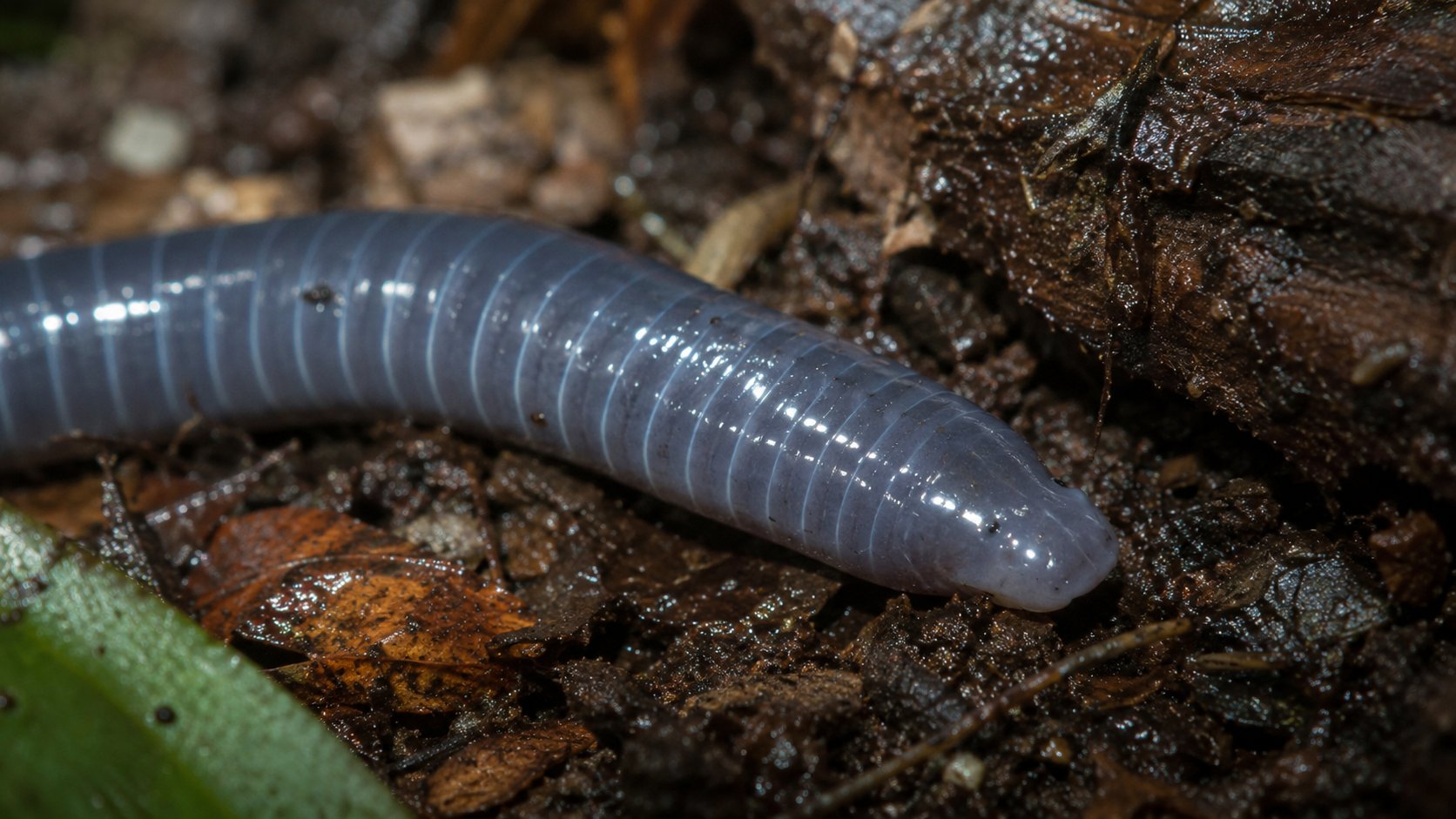
The Caecilian Worm, known scientifically as Boulengerula spp., is one of those animals that makes nature feel larger, stranger, and more imaginative than any myth. At first glance, it may look like a worm, a tiny snake, or a piece of living root, but it is actually a limbless amphibian built for life underground. The genus Boulengerula belongs to the order Gymnophiona, the caecilian order, and to the family Herpelidae, a group commonly associated with African caecilians. Modern taxonomic references list Boulengerula as a genus with nine recognized species, including Boulengerula boulengeri, Boulengerula taitana, Boulengerula fischeri, Boulengerula niedeni, Boulengerula spawlsi, and the recently described Boulengerula endauensis. This makes the “Caecilian Worm” a perfect example of why common names can be useful for curiosity but scientific names are essential for accuracy. It is not a worm at all; it is a hidden amphibian lineage with its own deep evolutionary story.
For general readers, Boulengerula caecilians are exciting because they invite us to look beneath the obvious wildlife of forests, farms, and mountains. They do not sing from ponds like frogs, bask on rocks like lizards, or parade across trails like colorful salamanders. Instead, they live in a dim, damp world of soil particles, roots, leaf litter, termite tunnels, and rotting logs. Their bodies are smooth, slender, and ringed, with small eyes that may be concealed under skin or bone and a compact shape suited to burrowing. AmphibiaWeb describes Herpelidae caecilians as slender African caecilians, mostly no more than about 35 centimeters long, and notes that much of their natural history is still poorly known. That mystery is part of their appeal: Boulengerula is not just an animal to identify, but a reminder that entire dramas of survival are happening just below our feet.
A: No. Boulengerula caecilians are amphibians, even though their smooth, limbless bodies can look worm-like.
A: They live in East Africa, especially in moist soil, forests, leaf litter, mountain habitats, and some cultivated areas.
A: They have very small eyes, but underground life makes touch, smell, and chemical sensing far more important.
A: Adults eat small soil animals such as termites, earthworms, ants, insect larvae, and other invertebrates.
A: No. They are shy, secretive amphibians that avoid people and are best left undisturbed in their soil habitat.
A: Some Boulengerula species, including B. taitana, are egg-laying and develop directly without a free-swimming tadpole stage.
A: They spend most of their time underground and are usually noticed only during digging, heavy rains, or careful scientific surveys.
A: In Boulengerula taitana, young feed on a special fatty outer skin layer produced by the brooding female.
A: No. Snakes are reptiles, while Boulengerula are amphibians with very different anatomy and life history.
A: They help reveal the hidden biodiversity of soil ecosystems and show how unusual amphibian evolution can be.
A Name That Can Mislead and Fascinate
The phrase “Caecilian Worm” is understandable because Boulengerula species are long, limbless, moist-skinned, and often found where people expect earthworms. In parts of Kenya, Boulengerula taitana is associated with the local name “ming’ori,” meaning earthworm in the Kitaita language, which reflects how easily these amphibians can be mistaken for soil worms. That mistake is not foolish; it is a practical response to an animal that has evolved a worm-like shape for a worm-like environment. Yet the similarities are superficial, because caecilians have backbones, skulls, specialized amphibian skin, and reproductive behaviors that separate them sharply from true worms. Their scientific identity matters because it connects them to frogs and salamanders, not to annelids. Once a reader understands that, the animal becomes much more intriguing than its first appearance suggests.
The word caecilian itself is often linked to the idea of blindness, and that association fits the lifestyle of animals that spend most of their lives in darkness. Boulengerula does not need the wide, alert eyes of a tree frog or the sharp visual world of a hunting bird. Its life is tactile, chemical, and close-range, shaped by tunnels, moisture, vibrations, and contact with the soil. The head is made for pushing, probing, and navigating rather than for dramatic facial expression. This is one reason caecilians can feel alien to people who are used to judging animals by faces, limbs, and visible movement. Their beauty is quieter: a polished body, hidden senses, and a design so specialized that every curve seems to say “underground.”
Where Boulengerula Lives in East Africa
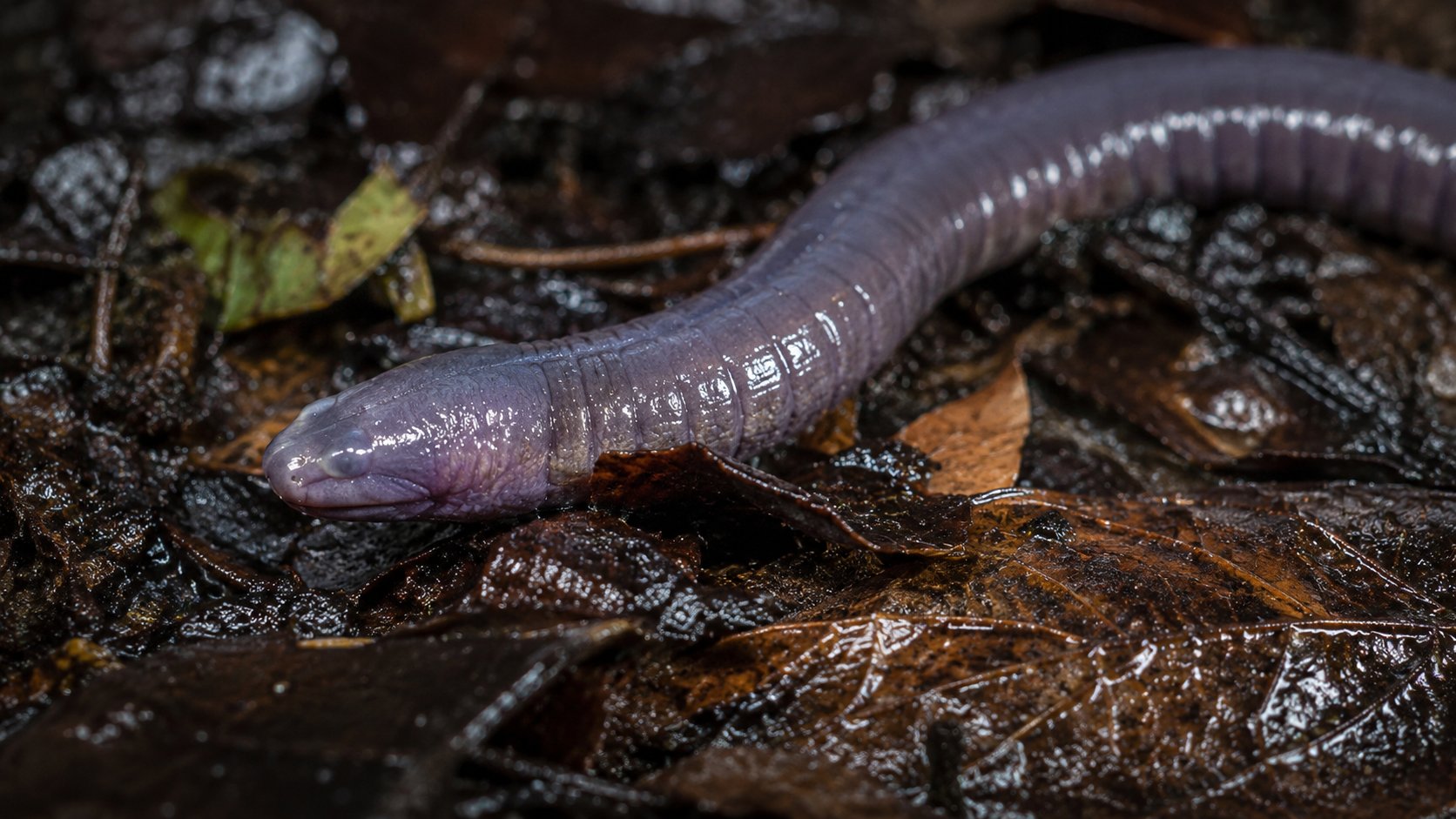
Boulengerula species are East African caecilians. The American Museum of Natural History’s Amphibian Species of the World lists the genus from Tanzania, Kenya, Rwanda, and Malawi, with possible occurrence expected in parts of nearby central and southern African countries. This distribution matters because East Africa contains a striking range of habitats, from coastal lowlands to forested mountains and agricultural landscapes. Some species are narrow endemics, known from limited areas, while others are part of broader regional patterns that scientists are still working to clarify. Boulengerula taitana, for example, is endemic to Kenya’s Taita Hills and has been recorded at roughly 1,000 to 2,000 meters elevation according to taxonomic and species-account sources. The result is a genus that feels both regional and highly local, tied to the hidden geography of particular soils and hillsides. The best-known details often come from Boulengerula taitana because it has been studied more closely than many of its relatives. In the Taita Hills, it has been found in small private agricultural plots known as shambas, especially in soil around plant bases, trees, and areas rich in leaf litter. It has also been recorded in evergreen moist forest, under rotting logs, in deep leaf litter, and in loose soil near rocks. These details are important because they show that the animal is not simply a “deep wilderness” creature. It can exist in human-influenced landscapes when the soil remains moist, shaded, organic, and structurally suitable. That does not make habitat change irrelevant, but it adds nuance to the story and keeps the conservation discussion grounded rather than overly dramatic.
Built Like a Living Burrow
A Boulengerula caecilian’s body is a masterpiece of underground engineering. It is slender, cylindrical to slightly flattened depending on the species, and marked by ring-like folds called annuli that can make it look segmented. Those rings are not worm segments in the strict biological sense, but they give the animal grip and flexibility as it moves through soil. The skin is smooth and moist, which is typical of amphibians, but it may also appear glossy, bluish, gray, brownish, pinkish, or pale depending on the species, age, and lighting. Boulengerula taitana adults have been described with a blue hue and contrasting annulation, while newly hatched juveniles are unpigmented. These colors are not flamboyant in the way of poison frogs, yet they can be startlingly beautiful in close view.
The head of a caecilian is not built for show; it is built for work. Eyes may be hidden, the skull is sturdy, and the animal can press forward through tight spaces where legs would only get in the way. Caecilians also possess sensory tentacles near the head, a distinctive feature of the group that helps them investigate their environment chemically and mechanically. For an underground predator, this kind of sensing is more useful than long-distance vision. Imagine trying to hunt inside a packed, dark, wet maze where the “air” is soil and the landmarks are roots, prey trails, and moisture gradients. Boulengerula is designed for exactly that world, and its oddness becomes elegance when seen in the right context.
Diet in the Dark Soil
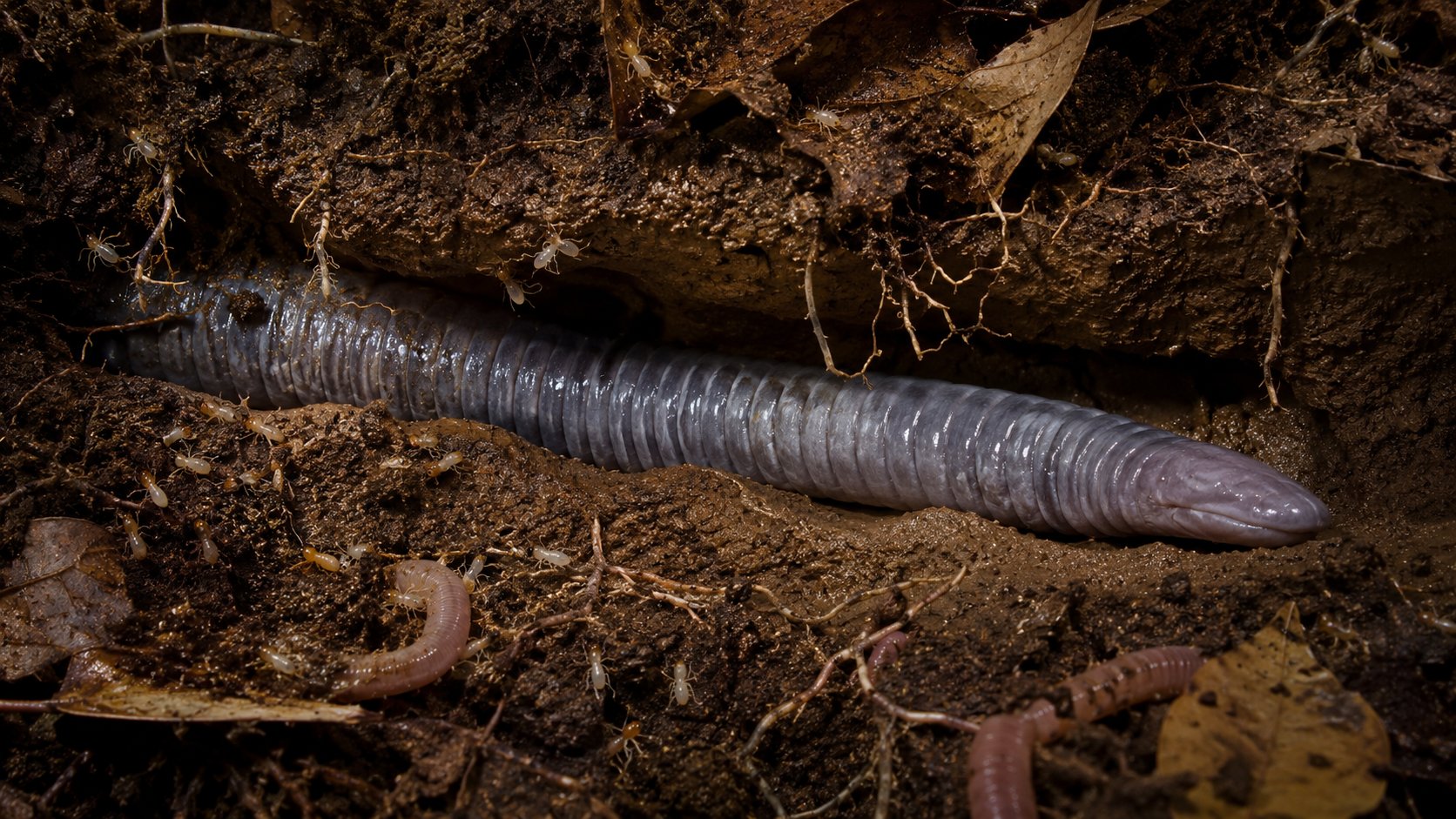
Adult Boulengerula feed on small soil animals, making them part of the quiet food web beneath forests and farms. AmphibiaWeb reports that Boulengerula taitana feeds on termites, earthworms, ants, and other soil macrofauna once the young have matured beyond the skin-feeding stage. Other sources summarize the diet of Boulengerula taitana as including earthworms, termites, dipteran larvae, and other soil invertebrates, which fits the expectations for a small fossorial predator. This diet places Boulengerula in the living machinery of soil health, where decomposers, roots, fungi, insects, and predators interact constantly. It is not a dramatic chase predator in the way a hawk or lion is, but it is a hunter all the same. Its prey is hidden, soft-bodied, and often abundant in damp organic soils. Because caecilians are difficult to observe in the wild, many feeding details remain less familiar than those of more visible amphibians. Still, the broad picture is clear enough for general readers: Boulengerula is a small underground carnivore that eats the animals it encounters in soil and litter. Its body plan suits close-contact feeding, where smell, touch, and movement through tight spaces matter more than speed across open ground. Termites and ants connect it to social insect colonies, while earthworms and larvae connect it to the decomposing plant material that fuels soil life. In that sense, Boulengerula is part of a circular system where fallen leaves become food for soil organisms, and soil organisms become food for caecilians. The animal may be hidden, but its ecological role is not empty.
Reproduction and the Famous Skin-Feeding Mothers
One of the most remarkable facts about Boulengerula involves parental care. Boulengerula taitana is oviparous, meaning it lays eggs, and it undergoes direct development rather than passing through a free-swimming tadpole stage. Females construct underground nest chambers, attend their eggs and young, and provide a form of nourishment that sounds almost unbelievable to anyone new to caecilians. In this species, brooding females develop a greatly thickened, lipid-rich outer skin layer, and the young use specialized temporary teeth to consume that maternal skin directly. This behavior is called dermatotrophy or maternal skin-feeding, and it made Boulengerula taitana especially famous among amphibian researchers. It is a reminder that parental care in amphibians can be far more varied and surprising than the simple image of eggs laid in water.
The details are as intimate as they are strange. AmphibiaWeb notes that Boulengerula taitana females may lay clutches of two to nine eggs, with a mean clutch size of about five, and that eggs and juveniles are attended by the female parent. The young hatch in a helpless state, initially pale and poorly mobile, then develop as they feed and grow. The mother’s body, in effect, becomes a first food source, not through milk as in mammals, but through a specialized amphibian skin adaptation. This does not make caecilians mammals, of course; it makes them caecilians, with their own evolutionary route to parental investment. For a reader searching for the most astonishing caecilian worm facts, this is usually the moment when the animal stops being obscure and becomes unforgettable.
Life Without the Spotlight
Boulengerula caecilians are secretive because their world rewards secrecy. They are fossorial, meaning they live by burrowing, and Boulengerula taitana has been reported throughout the year but is more commonly found during rainy periods when it moves closer to shallower soil. That behavior makes practical sense because moisture softens the ground, protects amphibian skin, and brings many soil invertebrates into more active layers. A person might live near caecilians for years and never knowingly see one unless digging soil, lifting a rotting log, or walking after heavy rains. Even scientists often need careful fieldwork to find them. Their hiddenness is not rarity by itself; it is a lifestyle. This is why Boulengerula makes such a powerful ambassador for overlooked biodiversity. Many people think of wildlife as something visible, loud, large, or colorful, but some of the planet’s most fascinating animals are quiet and concealed. A caecilian does not need antlers, wings, or bright feathers to be extraordinary. Its drama is compressed into damp tunnels, clutch chambers, sensory tentacles, and the patient searching of the soil. It expands our definition of what counts as charismatic. The more we learn about animals like Boulengerula, the more the ground beneath an ordinary footpath begins to feel alive with hidden stories.
Species Variety Within Boulengerula
The genus Boulengerula includes multiple species, and that variety should be respected whenever writing about the “Caecilian Worm” as a group. Amphibian Species of the World currently lists nine species in the genus, including Boulengerula endauensis, which AmphibiaWeb connects to a 2023 species description from Endau Hill in southeastern Kenya. This is a useful reminder that taxonomy is not frozen; scientists continue to find, describe, revise, and reinterpret caecilian diversity. Some species are known from specific mountains or limited regions, while others have records that suggest wider or still uncertain distributions. Boulengerula fischeri, for example, is associated with Rwanda, while Boulengerula taitana is strongly tied to Kenya’s Taita Hills. The group is unified by its East African identity and fossorial life, but each species has its own range, appearance, and conservation context.
For general readers, the abbreviation “spp.” after Boulengerula means that the article is discussing multiple species in the genus rather than one single species. That matters because not every fact applies equally to every member. Skin-feeding is especially well documented in Boulengerula taitana, but it should not be casually assumed in the same detail for every species unless research supports it. Likewise, exact length, color, elevation, and conservation status vary from one species to another. A responsible reference article can still speak broadly, but it should flag the best-known examples. Boulengerula is a genus of real animals, not a single cartoon creature, and that makes it richer.
Why Moist Soil Matters
Moisture is central to caecilian life because Boulengerula are amphibians with permeable skin and underground habits. Dry, compacted, exposed soil is far less suitable than shaded, organic, damp soil filled with roots, leaf litter, and invertebrate prey. In Boulengerula taitana habitat, individuals have been found in clay loam soil, deep leaf litter, under rotting logs, near plant bases, and in agricultural plots with crops such as bananas, avocados, guavas, sugar cane, yams, maize, and mangos. That description may surprise readers who imagine rare amphibians only in untouched forest. Instead, some Boulengerula can persist in small-scale agricultural mosaics when the soil retains the right structure and moisture. The key is not simply whether humans are present, but whether the underground habitat still functions. This also explains why heavy rains can influence encounters. Rainfall changes soil texture, humidity, prey activity, and the depth at which a burrowing amphibian can safely move. During wetter periods, a caecilian may come nearer to the surface and be noticed by people who would otherwise never see it. During drier conditions, retreating deeper into the soil can reduce dehydration risk. For farmers and gardeners in caecilian regions, seeing one should be treated as a sign of a living soil community, not as a reason for alarm. These animals are not crop pests or dangerous intruders; they are part of the underground biodiversity that healthy landscapes quietly support.
Are Caecilian Worms Dangerous?
Boulengerula caecilians are not dangerous animals to people. They are small, secretive amphibians that avoid exposure and depend on moist soil for survival. They do not chase, sting, or threaten humans, and they are not venomous snakes. If handled roughly, any wild animal may struggle, and delicate amphibian skin can be harmed by dry hands, chemicals, sunscreen, soap residue, or unnecessary stress. The best response to finding a caecilian is usually simple: observe briefly, avoid injuring it, and return it gently to damp cover close to where it was found. In areas where people mistake them for worms or snakes, basic awareness can help reduce accidental killing.
The greater concern is not what caecilians do to people, but what people unknowingly do to caecilian habitat. Digging, soil compaction, pesticide use, removal of leaf litter, deforestation, and drying of shaded ground can all affect the underground conditions these animals rely on. That said, the conservation story should be kept balanced. Boulengerula taitana, despite being listed as Endangered, has been found abundantly in certain agricultural areas of the Taita Hills, showing that human-modified landscapes can sometimes support them when conditions remain favorable. AmphibiaWeb notes both the major historical loss of forest in the Taita Hills and the species’ apparent abundance in agricultural areas there. This is not a simple doom story; it is a more interesting story about land use, soil care, and hidden resilience.
Conservation Without the Drama
Some Boulengerula species have conservation concerns because they may be known from small ranges, specialized habitats, or landscapes facing ongoing change. Boulengerula taitana is listed as Endangered in AmphibiaWeb’s species account, and Boulengerula niedeni, the Sagalla caecilian, has been described as an endangered amphibian endemic to Sagalla Hill in the Taita Hills region. Narrow endemism can make any species more vulnerable because a change in one small area may affect a large share of its known population. However, caecilian conservation is also complicated by how hard these animals are to survey. A species can be overlooked not because it is absent, but because it is underground. A practical, toned-down conservation message is best: protect moist soils, maintain leaf litter where possible, reduce unnecessary chemical use, preserve forest patches, and value small farms that keep shade and organic ground cover. These actions benefit more than caecilians; they also support insects, fungi, roots, amphibians, and the broader health of the landscape. For Boulengerula, conservation does not always require dramatic public attention or giant protected areas, though those can matter. It often begins with recognizing that soil is habitat, not just dirt. Once people see the ground as a living layer, an animal like the Caecilian Worm becomes easier to respect.
A Hidden Star for Nature Education
The Caecilian Worm is a powerful teaching animal because it breaks expectations immediately. It looks like a worm but is an amphibian, lives underground but has complex parental care, seems simple but belongs to a lineage with specialized anatomy and behavior. For children and adults alike, Boulengerula can open conversations about taxonomy, evolution, soil ecology, African biodiversity, and how much remains unknown even in the modern scientific age. It is also a useful reminder that not every important animal is large, cute, colorful, or famous. Sometimes the most memorable wildlife story begins with a slender body in a handful of wet soil.
For SEO and reader interest, topics such as “caecilian worm facts,” “Boulengerula habitat,” “are caecilians worms,” “skin-feeding amphibian,” and “East African caecilian” all point toward the same fascinating subject. The most accurate answer is also the most exciting one: Boulengerula spp. are secretive, limbless amphibians of East Africa that have adapted to a buried life in remarkable ways. Their senses are tuned to darkness, their bodies are shaped for soil, and at least one species shows a form of maternal care that sounds almost impossible until the science is explained. They turn the underground world into a wildlife stage. In doing so, they prove that nature’s most astonishing creatures are not always hiding in remote jungles or deep oceans; sometimes they are just below the leaf litter, waiting for rain.
Animal Product Reviews
Dive into Animal Streets’ Animal Product Reviews — your guide to the best gear, gifts, books, and gadgets inspired by the animal kingdom. From land-roaming lions to ocean-gliding whales, from household pets to prehistoric giants, we explore top-rated products for enthusiasts, educators, and animal lovers alike. Whether you’re shopping for toys, decor, field gear, or fun collectibles, we’ve sniffed out the best so you can discover it all in one wild place!