
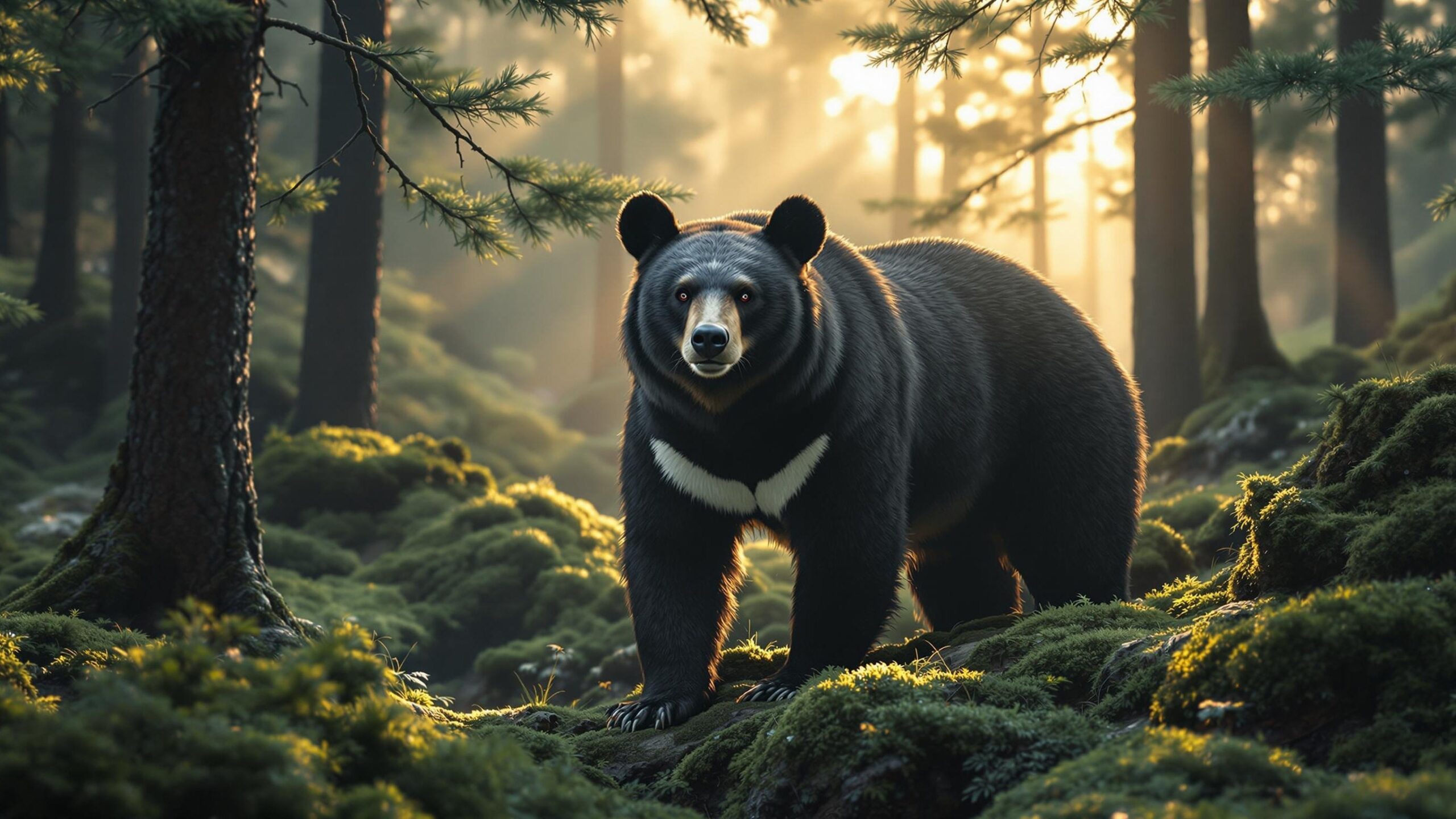
Asian Black Bear: The Moon Bear of Asian Forests
The Asian black bear, also called the Asiatic black bear or moon bear, is Ursus thibetanus. It is a medium-sized bear of Asian forests, often recognized by glossy black fur and a pale crescent or V-shaped chest mark. The species is listed as Vulnerable.
What Is an Asian Black Bear?
The Asian black bear is a bear species native to Asia. The IUCN SSC Bear Specialist Group lists the scientific name as Ursus thibetanus and notes that the species is also called the Asiatic black bear, moon bear, or Himalayan black bear.
The “moon bear” name comes from the pale crescent or V-shaped marking on the chest. Not every individual looks identical, but the contrast between dark fur and a light chest patch is one of the species’ most familiar field marks.
Range and Habitat
The IUCN SSC Bear Specialist Group describes the range as extending from Iran across the Himalayan foothills to Southeast Asia, north through China to the Russian Far East. Across that range, the species is strongly associated with forested and mountainous landscapes.
Asian black bears use forests for food, cover, denning, travel, and escape. Habitat fragmentation can separate populations and push bears into closer contact with farms, orchards, villages, and garbage sources.
Appearance and Tree Skills
Asian black bears have rounded ears, powerful limbs, short tails, and strong claws. They are often black with the pale chest mark, though size and coat details vary by region, sex, age, and season.
Animal Diversity Web describes Asian black bears as adept climbers. Trees can provide food, rest, safety from danger, and sunning sites. Their climbing ability also helps them reach fruits, nuts, and other seasonal foods.
Diet
Asian black bears are omnivores. Their diet shifts with season and local food availability. They may eat fruits, nuts, acorns, seeds, grasses, herbs, insects, larvae, honey, carrion, and other animal foods.
This flexible diet helps them survive across varied Asian forests, but it can also create conflict when bears are attracted to crops, livestock feed, orchards, bee boxes, garbage, or food waste around people.
Behavior and Reproduction
Like many bears, Asian black bears are generally solitary outside mating and family groups. Females raise cubs and teach them how to find food, shelter, and safe travel routes.
Seasonal behavior varies across the range. In colder regions, bears may den through winter, while in warmer regions they may remain active for more of the year depending on food and weather.
Conservation
The Asian black bear is listed as Vulnerable. The IUCN SSC Bear Specialist Group identifies hunting as a primary threat, especially because bile and gallbladders are sought in traditional medicine markets. Bears may also be killed for other body parts.
Habitat loss, road building, fragmentation, and human-bear conflict add pressure. Conservation requires forest protection, law enforcement against illegal trade, conflict prevention, research, and community-based coexistence strategies.
Quick Facts About the Asian Black Bear
- Scientific name: Ursus thibetanus
- Family: Ursidae
- Other names: Asiatic black bear, moon bear, white-chested bear
- Range: Parts of western, southern, eastern, and southeastern Asia
- Diet: Omnivorous, strongly seasonal
- Conservation status: Vulnerable
- Main threats: Poaching, bile/body-part trade, habitat loss, fragmentation, and conflict killing
Sources
- IUCN SSC Bear Specialist Group: Ursus thibetanus
- Animal Diversity Web: Ursus thibetanus
- International Association for Bear Research and Management: Ursus thibetanus, Asiatic Black Bear