
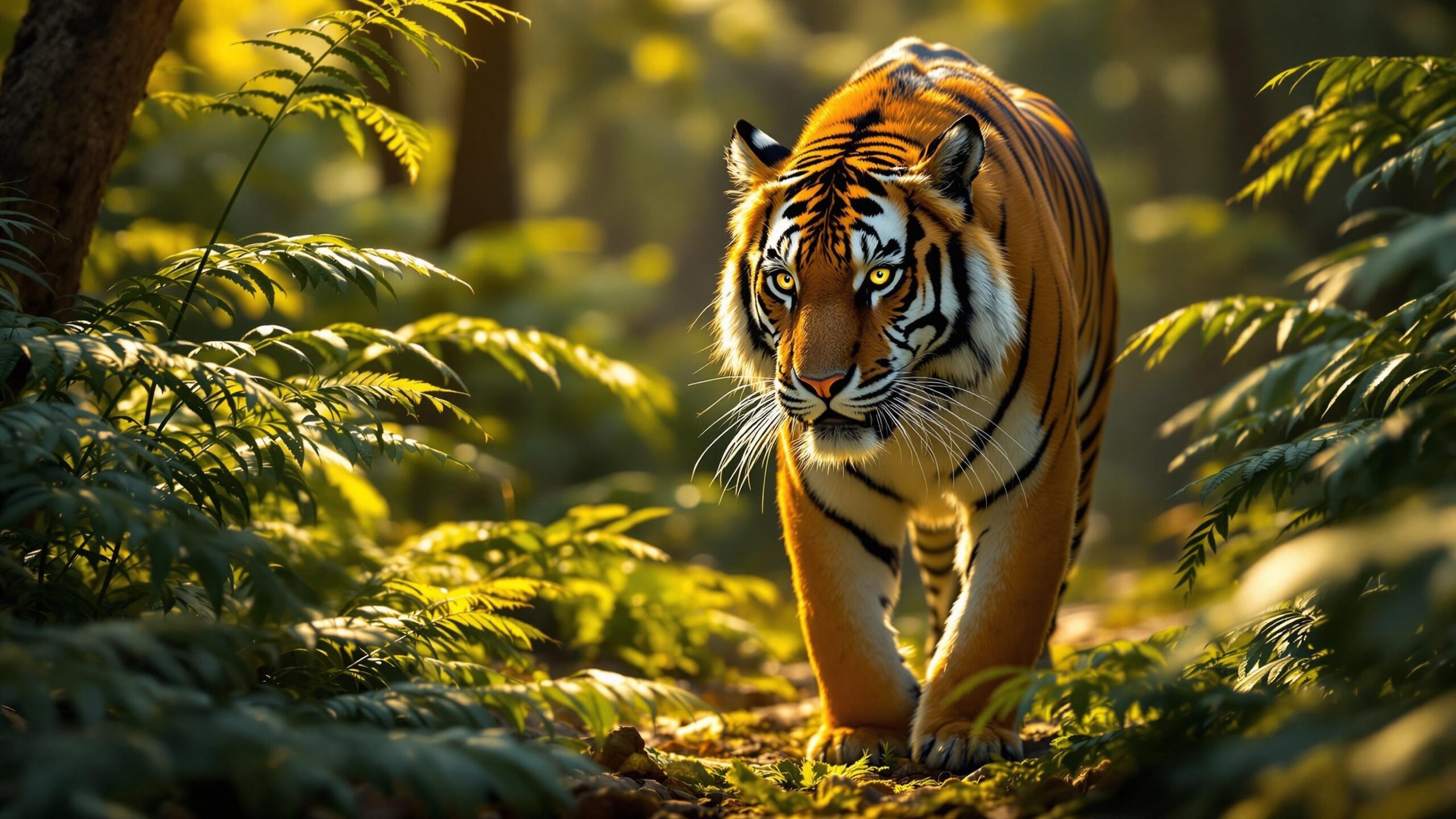
Tigers: Striped Shadows of the Wild and Emperors of the Forest
Few animals command awe quite like the tiger. With its flame-colored coat, black stripes, and intense gaze, the tiger embodies both elegance and power. It stalks silently through dense jungles, snowy forests, and swampy mangroves, the very image of a perfect predator—rare, elusive, and utterly mesmerizing. For centuries, tigers have been symbols of strength, fearlessness, and mystique. They are not just the largest of all cats; they are also among the most endangered, making their conservation a global priority and their story one of both wonder and urgency. Tigers belong to the genus Panthera and are scientifically classified as Panthera tigris. As apex predators, they sit at the top of their ecosystems, controlling prey populations and maintaining the delicate balance of the food chain. Unlike lions, tigers are solitary creatures, operating with stealth and strategy rather than teamwork. They’re masters of camouflage, relying on their environment to conceal themselves until the perfect moment to strike. Their territories can stretch across hundreds of square miles, and within those bounds, they shape the rhythms of the natural world. This page explores the vast world of tigers—starting with their biological traits and ecological roles, followed by an in-depth look at each of the major tiger subspecies. These sub-categories are distinct not just in geography, but in appearance, behavior, and conservation status. From the snowy ranges of Siberia to the swamps of the Sundarbans, the tiger’s story is one of fierce survival, evolutionary adaptation, and enduring legacy.
Taxonomy And Identity
Tigers belong to the genus Panthera and are scientifically classified as Panthera tigris. Tigers is best understood through its anatomy, habitat, diet, behavior, and place in its ecosystem. Tigers is best understood through its anatomy, habitat, diet, behavior, and place in its ecosystem.
Identification And Appearance
With its flame-colored coat, black stripes, and intense gaze, the tiger embodies both elegance and power. Body form, markings, movement, and habitat work together to separate this animal from close relatives and lookalikes. Body form, markings, movement, and habitat work together to separate this animal from close relatives and lookalikes.
Anatomy And Adaptations
They’re masters of camouflage, relying on their environment to conceal themselves until the perfect moment to strike. From the snowy ranges of Siberia to the swamps of the Sundarbans, the tiger’s story is one of fierce survival, evolutionary adaptation, and enduring legacy. They are excellent swimmers and frequently bathe in rivers to cool off in the heat.
In India’s Sundarbans region, a unique population of Bengal tigers has adapted to life in a tidal swamp, becoming adept at swimming long distances and hunting in muddy, shifting terrain. Native to the Russian Far East and parts of northeastern China, this magnificent cat has adapted to life in one of the planet’s harshest environments. With temperatures often plunging below -30°F, the Siberian tiger endures by growing a thicker coat and storing more fat beneath its skin.
Range And Wild Habitat
From the snowy ranges of Siberia to the swamps of the Sundarbans, the tiger’s story is one of fierce survival, evolutionary adaptation, and enduring legacy. Native to the Indian subcontinent, this powerful feline has captivated imaginations for centuries with its raw beauty, fierce strength, and enigmatic presence in the dense forests, grasslands, and mangroves it calls home. With its stealthy movements, vibrant orange coat patterned with black stripes, and piercing amber eyes, this elusive big cat captures the imagination of wildlife enthusiasts, conservationists, and researchers alike.
Tigers are territorial animals, marking their range with scent, claw marks, and vocalizations. Native to India, Bangladesh, Bhutan, and Nepal, this tiger inhabits a range of environments, from dense tropical forests and mangroves to grasslands and marshes. Native to the Indian subcontinent, this powerful feline has captivated imaginations for centuries with its raw beauty, fierce strength, and enigmatic presence in the dense forests, grasslands, and mangroves it calls home.
Wild Diet And Feeding
As apex predators, they sit at the top of their ecosystems, controlling prey populations and maintaining the delicate balance of the food chain. Tigers are capable of leaping over 30 feet in a single bound and can take down prey several times their own size. Their diet includes deer, wild boar, buffalo, and even young elephants or rhinos in rare cases.
After a successful hunt, they drag the kill into cover and often eat over the course of several days, guarding their prize from scavengers. They are excellent swimmers and frequently bathe in rivers to cool off in the heat. Bengal tigers are top predators in their habitats, preying on animals like chital deer, nilgai, gaur, and wild boar.
Behavior
Unlike lions, tigers are solitary creatures, operating with stealth and strategy rather than teamwork. These sub-categories are distinct not just in geography, but in appearance, behavior, and conservation status. Tigers are territorial animals, marking their range with scent, claw marks, and vocalizations.
Unlike lions, tigers are solitary creatures, operating with stealth and strategy rather than teamwork. These sub-categories are distinct not just in geography, but in appearance, behavior, and conservation status. Behavior is easiest to understand when daily movement, social contact, communication, and risk avoidance are considered together.
Reproduction And Life Cycle
Some efforts are underway to breed them in captivity and potentially reintroduce them into secure habitats, but success remains uncertain. Most white tigers in captivity are the result of selective inbreeding, which can lead to genetic defects and health problems. Its daily life is shaped by where it moves, what it eats, how it avoids danger, and how it interacts with other animals.
Ecology And Role In The Environment
As apex predators, they sit at the top of their ecosystems, controlling prey populations and maintaining the delicate balance of the food chain. Tigers are capable of leaping over 30 feet in a single bound and can take down prey several times their own size. Its daily life is shaped by where it moves, what it eats, how it avoids danger, and how it interacts with other animals.
Conservation Status And Threats
They are not just the largest of all cats; they are also among the most endangered, making their conservation a global priority and their story one of both wonder and urgency. As apex predators, they sit at the top of their ecosystems, controlling prey populations and maintaining the delicate balance of the food chain. These sub-categories are distinct not just in geography, but in appearance, behavior, and conservation status.
With its stealthy movements, vibrant orange coat patterned with black stripes, and piercing amber eyes, this elusive big cat captures the imagination of wildlife enthusiasts, conservationists, and researchers alike. Known scientifically as Panthera tigris jacksoni, this subspecies of tiger is one of the smallest and most threatened in the world. They are the poster animal for tiger conservation and cultural pride in South Asia, featuring in national emblems and folklore alike.
Human Relationship
They are not just the largest of all cats; they are also among the most endangered, making their conservation a global priority and their story one of both wonder and urgency. Their night vision is six times better than that of humans, and their hearing is finely tuned to detect the faintest rustle or cry in the forest. Tigers are ambush hunters, relying on patience and position.
They are not just the largest of all cats; they are also among the most endangered, making their conservation a global priority and their story one of both wonder and urgency. Their night vision is six times better than that of humans, and their hearing is finely tuned to detect the faintest rustle or cry in the forest. Its daily life is shaped by where it moves, what it eats, how it avoids danger, and how it interacts with other animals.
Captive Care
With temperatures often plunging below -30°F, the Siberian tiger endures by growing a thicker coat and storing more fat beneath its skin. Responsible care depends on matching space, diet, social conditions, climate, and veterinary oversight to the animal’s biology. Responsible care depends on matching space, diet, social conditions, climate, and veterinary oversight to the animal’s biology.
Wild And Captive Variation
It was only recently recognized as separate from the Indochinese tiger, based on genetic and morphological differences. Some efforts are underway to breed them in captivity and potentially reintroduce them into secure habitats, but success remains uncertain. Most white tigers in captivity are the result of selective inbreeding, which can lead to genetic defects and health problems.
Similar Species
Unlike lions, tigers are solitary creatures, operating with stealth and strategy rather than teamwork. Its daily life is shaped by where it moves, what it eats, how it avoids danger, and how it interacts with other animals. Its daily life is shaped by where it moves, what it eats, how it avoids danger, and how it interacts with other animals.
Common Misconceptions
FAQ
What is a Tigers?
Tigers belong to the genus Panthera and are scientifically classified as Panthera tigris. They are not just the largest of all cats; they are also among the most endangered, making their conservation a global priority and their story one of both wonder and urgency. As apex predators, they sit at the top of their ecosystems, controlling prey populations and maintaining the delicate balance of the food chain.
How can someone identify a Tigers?
With its flame-colored coat, black stripes, and intense gaze, the tiger embodies both elegance and power. They’re masters of camouflage, relying on their environment to conceal themselves until the perfect moment to strike. From the snowy ranges of Siberia to the swamps of the Sundarbans, the tiger’s story is one of fierce survival, evolutionary adaptation, and enduring legacy.
Additional Natural History Notes
Tigers is best interpreted through habitat, seasonal food supply, movement, social behavior, breeding timing, and the pressures created by predators, competitors, and people. Coat color, limb shape, ears, teeth, and body size connect to how the animal travels, finds food, avoids danger, and raises young. Wild behavior also differs from observations made in parks, zoos, farms, rescue settings, or neighborhoods, where space, diet, risk, and human influence can change daily activity.
A complete account also benefits from scale and season. Many animals change their movements, calls, feeding choices, or visibility as weather, water, prey, nesting sites, or shelter change through the year. Those rhythms can make the same species look secretive in one setting and bold in another. By connecting anatomy, habitat, and seasonal behavior, the animal becomes easier to understand as a living part of its ecosystem rather than a list of isolated facts.
Regional history adds another layer. Islands, mountains, deserts, forests, rivers, and grasslands can isolate populations long enough for small differences in size, color, diet, or behavior to matter. Local names, field reports, museum records, and modern genetic work often fit together slowly, especially when the animal is rare, nocturnal, migratory, or difficult to observe. The strongest interpretation treats those clues as part of one natural history rather than separate trivia.