
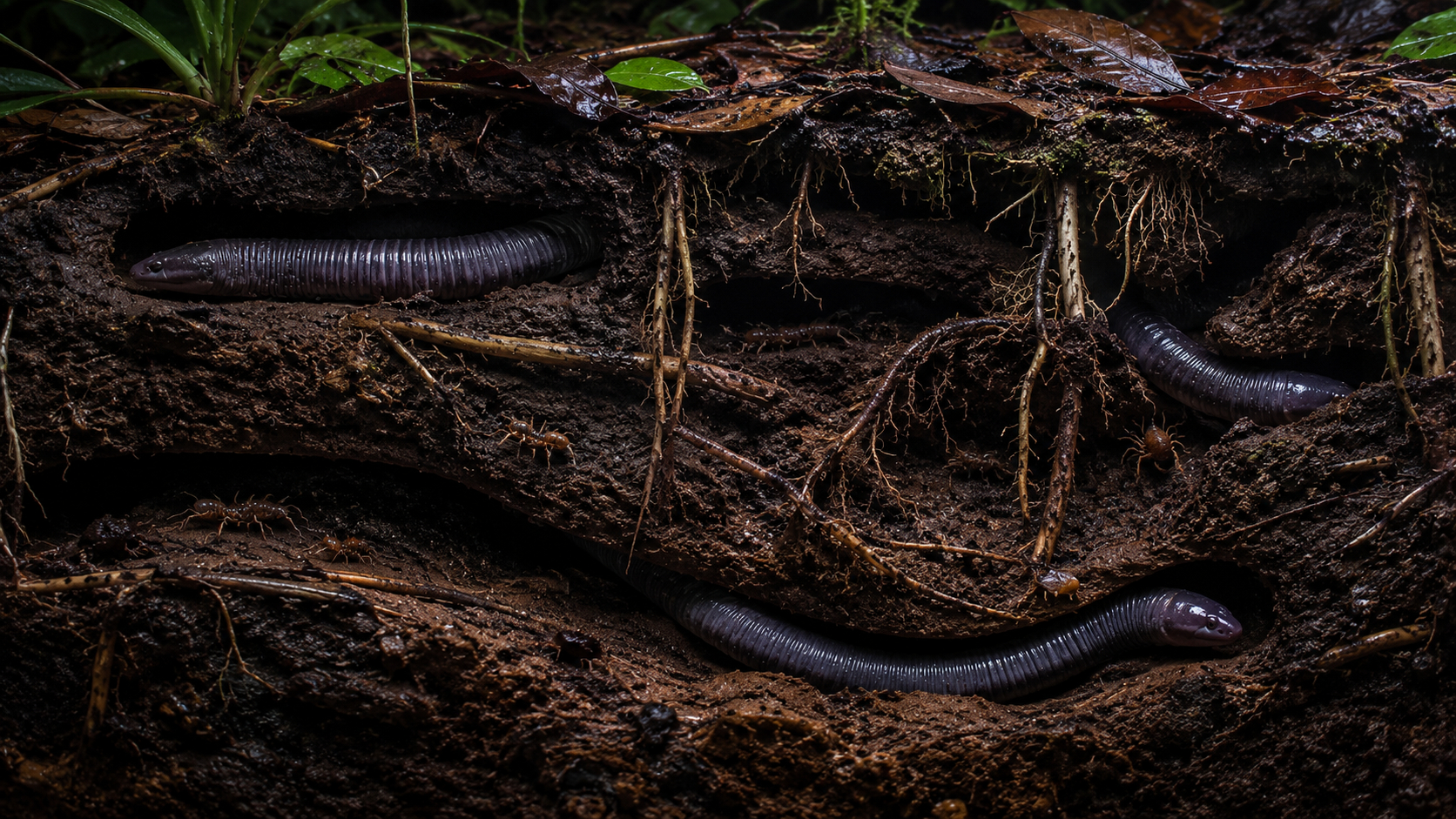
Caecilians are among the strangest and least understood animals on Earth. Hidden beneath rainforest floors, buried in muddy riverbanks, or gliding silently through tropical streams, these limbless amphibians remain invisible to most people throughout their entire lives. Their long, segmented bodies often cause them to be mistaken for snakes or giant worms, yet caecilians belong to a completely different branch of the animal kingdom. They are amphibians, closely related to frogs and salamanders, though their appearance and lifestyle make them feel almost alien compared to their more familiar relatives. For millions of years, caecilians have thrived in environments where darkness, moisture, and secrecy dominate daily life. They inhabit tropical regions across South America, Africa, and Asia, occupying underground ecosystems that few animals can successfully navigate. Their remarkable adaptations for burrowing, hunting, and surviving in hidden environments have made them evolutionary specialists unlike nearly any other vertebrate. Although they rarely appear in documentaries or mainstream wildlife discussions, caecilians represent one of nature’s most extraordinary success stories. Exploring their world reveals not only bizarre biology and surprising behaviors, but also the hidden complexity of ecosystems beneath our feet.
A: No, they are amphibians related to frogs and salamanders.
A: Most inhabit tropical forests, wetlands, and underground environments.
A: No, modern caecilians are completely limbless.
A: They feed on worms, insects, larvae, and small underground animals.
A: No, they are generally harmless and highly secretive.
A: Living underground reduces the need for strong vision.
A: Yes, aquatic species are excellent swimmers.
A: Specialized organs that help detect chemicals and movement underground.
A: Some species lay eggs while others give live birth.
A: Most spend their lives hidden beneath soil or underwater.
A World Built for Burrowing
Caecilians possess bodies perfectly engineered for life underground. Most species are long, cylindrical, and limbless, allowing them to move through soil with surprising efficiency. Their skin is often smooth and shiny, covered in mucus that helps reduce friction while tunneling through dense earth or submerged sediment. Many species display ring-like folds called annuli along their bodies, giving them a segmented appearance similar to earthworms. This unusual structure increases flexibility and helps them navigate narrow underground passages.
Unlike snakes, caecilians typically have extremely small eyes that are sometimes hidden beneath skin or bone. Vision is far less important in dark underground habitats than touch and chemical detection. Many species possess specialized sensory tentacles located between the eyes and nostrils, which help them detect vibrations, prey, and environmental cues while moving through darkness. Their skulls are compact and heavily reinforced, acting almost like biological shovels capable of forcing through packed soil. These adaptations make caecilians some of the most specialized burrowing vertebrates alive today.
The Ancient Evolutionary Legacy of Caecilians
Caecilians belong to the order Gymnophiona, one of the three major groups of amphibians alongside frogs and salamanders. Fossil evidence suggests their lineage stretches deep into prehistoric history, potentially dating back more than 200 million years. Over immense spans of evolutionary time, these amphibians gradually adapted to underground lifestyles that protected them from predators and environmental instability. Their secretive behavior helped them survive dramatic changes in climate, geography, and ecosystems throughout Earth’s history. Scientists consider caecilians especially important for understanding amphibian evolution because they represent such a distinct evolutionary path. While frogs evolved powerful jumping legs and salamanders retained more traditional lizard-like forms, caecilians abandoned limbs entirely in favor of underground specialization. Their anatomy combines primitive amphibian traits with highly advanced burrowing adaptations, creating a fascinating blend of ancient and modern evolutionary solutions. Even today, researchers continue discovering new species and learning more about their genetic relationships, suggesting the caecilian family tree is still far from fully understood.
Tropical Rainforest Caecilians
The majority of known caecilian species inhabit tropical rainforests, where warm temperatures and constant moisture create ideal conditions for underground life. Rainforest soils remain soft and humid throughout much of the year, allowing these amphibians to tunnel easily while preventing their skin from drying out. In places such as the Amazon Basin, Central Africa, and Southeast Asia, caecilians quietly move beneath dense jungle floors that teem with insects, roots, fungi, and microorganisms.
Rainforest caecilians play an important ecological role as hidden predators within underground food webs. They feed on insects, worms, termites, and other invertebrates that live within the soil. By regulating populations of small underground creatures, they help maintain balance within delicate rainforest ecosystems. Their tunneling may also improve soil aeration and nutrient movement, indirectly supporting plant health. Though they rarely appear above ground, rainforest caecilians contribute to ecological stability in ways scientists are only beginning to understand.
Aquatic Caecilians and Wetland Specialists
While many caecilians spend most of their lives underground, some species have adapted to aquatic habitats such as rivers, swamps, wetlands, and slow-moving tropical streams. Aquatic caecilians possess streamlined bodies and stronger swimming abilities that allow them to move gracefully through murky water. These species often inhabit environments rich in decaying vegetation, submerged roots, and soft sediment where they can hide from predators while searching for prey. Aquatic caecilians demonstrate how flexible this amphibian group can become under different environmental pressures. Some species retain stronger sensory systems for navigating underwater, while others develop behaviors suited to hunting fish, worms, or aquatic invertebrates. Their dark coloration helps camouflage them within muddy environments, making them nearly invisible beneath submerged debris. Because aquatic habitats often remain poorly studied in tropical regions, scientists continue discovering new behaviors and even entirely new species associated with freshwater ecosystems.
Giant Caecilians and the Largest Species
Among the many caecilian species found worldwide, some reach impressive sizes that surprise even experienced wildlife researchers. The largest species can exceed five feet in length, transforming them into powerful underground predators capable of consuming substantial prey. These giant caecilians inhabit tropical regions where stable environmental conditions and abundant food allow them to grow to remarkable dimensions. Their muscular bodies enable them to force through dense soil or submerged sediment with surprising strength.
Large caecilians often inspire fear or confusion among people who encounter them unexpectedly. Because they resemble giant snakes or enormous worms, local legends sometimes emerge around their appearance. In reality, giant caecilians are typically shy and secretive animals that avoid confrontation whenever possible. Their existence highlights the incredible diversity hidden beneath tropical ecosystems, where even massive vertebrates can remain largely unnoticed for centuries.
The Strange Feeding Habits of Underground Hunters
Caecilians are carnivorous predators that rely on stealth, touch, and chemical detection rather than vision. Most species hunt underground insects, earthworms, termites, ants, larvae, and other small animals hidden within the soil. Their sharp teeth help grip slippery prey in narrow tunnels where quick escapes are difficult. Some larger species can consume small vertebrates such as frogs or fish, especially in aquatic environments. Because underground habitats are dark and confined, caecilians have evolved highly efficient feeding behaviors. They often detect prey through vibrations or chemical traces left in the soil. Once close enough, they strike rapidly with powerful jaws. Their muscular bodies allow them to pin prey against tunnel walls while swallowing it whole. In many ecosystems, caecilians serve as important underground predators that help regulate populations of small invertebrates and maintain ecological balance beneath the surface.
Remarkable Reproduction and Family Care
One of the most fascinating aspects of caecilian biology is their extraordinary reproductive diversity. Some species lay eggs in underground nests near water, while others give birth to fully developed live young. In egg-laying species, females may coil protectively around their eggs for weeks, guarding them from predators and environmental threats. This level of parental care is relatively advanced compared to many amphibians.
Even more remarkable are species in which young caecilians feed on the outer layer of their mother’s skin after hatching. The mother develops a nutrient-rich skin layer that offspring scrape away using specialized teeth. Scientists view this behavior as one of the most unusual forms of parental care among vertebrates. In live-bearing species, developing young may feed on secretions within the reproductive tract before birth. These complex reproductive strategies reveal that caecilians possess far more sophisticated biology than their simple appearance might suggest.
Blindness, Senses, and Underground Navigation
Living underground means that eyesight becomes far less valuable than other sensory systems. Most caecilians possess tiny, reduced eyes capable of detecting light and darkness but offering little detailed vision. Instead, they depend heavily on touch, smell, and vibration sensing to navigate through their hidden environments. Their sensory tentacles are among their most distinctive features, functioning as advanced chemical detectors that help locate food and interpret surroundings. Scientists believe caecilians may possess sensory abilities far more refined than previously understood. Underground environments require constant awareness of moisture levels, obstacles, prey movement, and tunnel structures. By combining chemical detection with physical sensitivity, caecilians can move confidently through complete darkness. Their nervous systems and sensory organs remain active areas of scientific research because they may reveal new insights into how animals adapt to extreme environments.
African Caecilians and Their Diverse Habitats
Africa hosts a wide variety of caecilian species occupying forests, wetlands, riverbanks, and tropical lowlands. African caecilians display remarkable diversity in size, coloration, and habitat preference, reflecting millions of years of regional evolution. Some species inhabit dense rainforests where moist soil remains stable year-round, while others tolerate more seasonal environments with fluctuating rainfall patterns.
Researchers studying African caecilians often face major challenges because the animals spend so much time underground. Many species remain poorly documented, and entirely new discoveries continue emerging from remote regions. African caecilians also demonstrate how adaptable these amphibians can become across different ecosystems. Their presence beneath tropical soils reveals a hidden layer of biodiversity rarely seen by casual observers.
Asian Caecilians and Monsoon Ecosystems
Asia contains some of the most diverse caecilian habitats on Earth, particularly within India, Sri Lanka, Indonesia, and Southeast Asia. Monsoon rains create soft, water-rich soils that allow underground amphibians to flourish. During rainy seasons, some species briefly emerge closer to the surface where they may disperse, reproduce, or exploit temporary food abundance. Asian caecilians often inhabit landscapes shaped by dramatic seasonal cycles. Heavy rainfall can flood underground tunnels, forcing animals into new habitats or temporary aquatic lifestyles. Their ability to survive these environmental shifts demonstrates extraordinary resilience and flexibility. Scientists continue uncovering unique species within Asian rainforests and mountain regions, suggesting the continent may contain many undiscovered caecilian lineages.
The Ecological Importance of Hidden Amphibians
Although they remain largely unseen, caecilians contribute significantly to ecosystem health. By consuming insects and other small organisms underground, they help regulate soil food webs and maintain ecological balance. Their burrowing behavior may improve soil structure, aeration, and nutrient movement, indirectly benefiting plant communities and microorganisms. In many tropical ecosystems, caecilians represent important mid-level predators hidden beneath the surface.
Because amphibians are often sensitive to environmental changes, caecilians may also serve as indicators of ecosystem health. Pollution, habitat destruction, and climate shifts can affect underground moisture and soil quality, placing pressure on species adapted to stable environments. Protecting tropical forests, wetlands, and freshwater systems helps preserve not only visible wildlife but also the hidden biodiversity represented by caecilians and countless underground organisms.
Why Caecilians Continue Fascinating Scientists
Caecilians remain one of the least studied groups of vertebrates on Earth. Their underground lifestyles make them difficult to observe, capture, and monitor in the wild. Many species are known from only a handful of scientific encounters, while others remain completely undiscovered. Advances in DNA analysis, underground imaging, and environmental sampling are gradually helping researchers understand these mysterious amphibians more clearly. Scientists are especially interested in caecilians because they challenge traditional assumptions about amphibian biology. Their reproductive strategies, sensory systems, and evolutionary adaptations differ dramatically from those of frogs and salamanders. Each new discovery expands scientific understanding of vertebrate evolution and biodiversity. In many ways, caecilians represent one of the final hidden frontiers of amphibian research.
The Secret Wonders Beneath Our Feet
Caecilians remind us that some of Earth’s most extraordinary creatures remain hidden just beneath the surface of the natural world. While birds soar through skies and mammals roam open landscapes, these remarkable amphibians spend their lives in darkness, carving silent tunnels through tropical soils and wetlands. Their strange anatomy, ancient history, and highly specialized behaviors reveal how adaptable life can become when shaped by unusual environments.
For curious readers and wildlife enthusiasts, caecilians open the door to an entirely different perspective on nature. They encourage exploration beyond the obvious and remind us that ecosystems contain countless hidden layers waiting to be discovered. As you continue exploring the fascinating world of caecilians, each sub-category and species offers its own story of survival, adaptation, and evolutionary creativity. Beneath every rainforest floor or muddy riverbank may lie another secret chapter in the incredible story of these hidden amphibians.
Animal Product Reviews
Dive into Animal Streets’ Animal Product Reviews — your guide to the best gear, gifts, books, and gadgets inspired by the animal kingdom. From land-roaming lions to ocean-gliding whales, from household pets to prehistoric giants, we explore top-rated products for enthusiasts, educators, and animal lovers alike. Whether you’re shopping for toys, decor, field gear, or fun collectibles, we’ve sniffed out the best so you can discover it all in one wild place!