
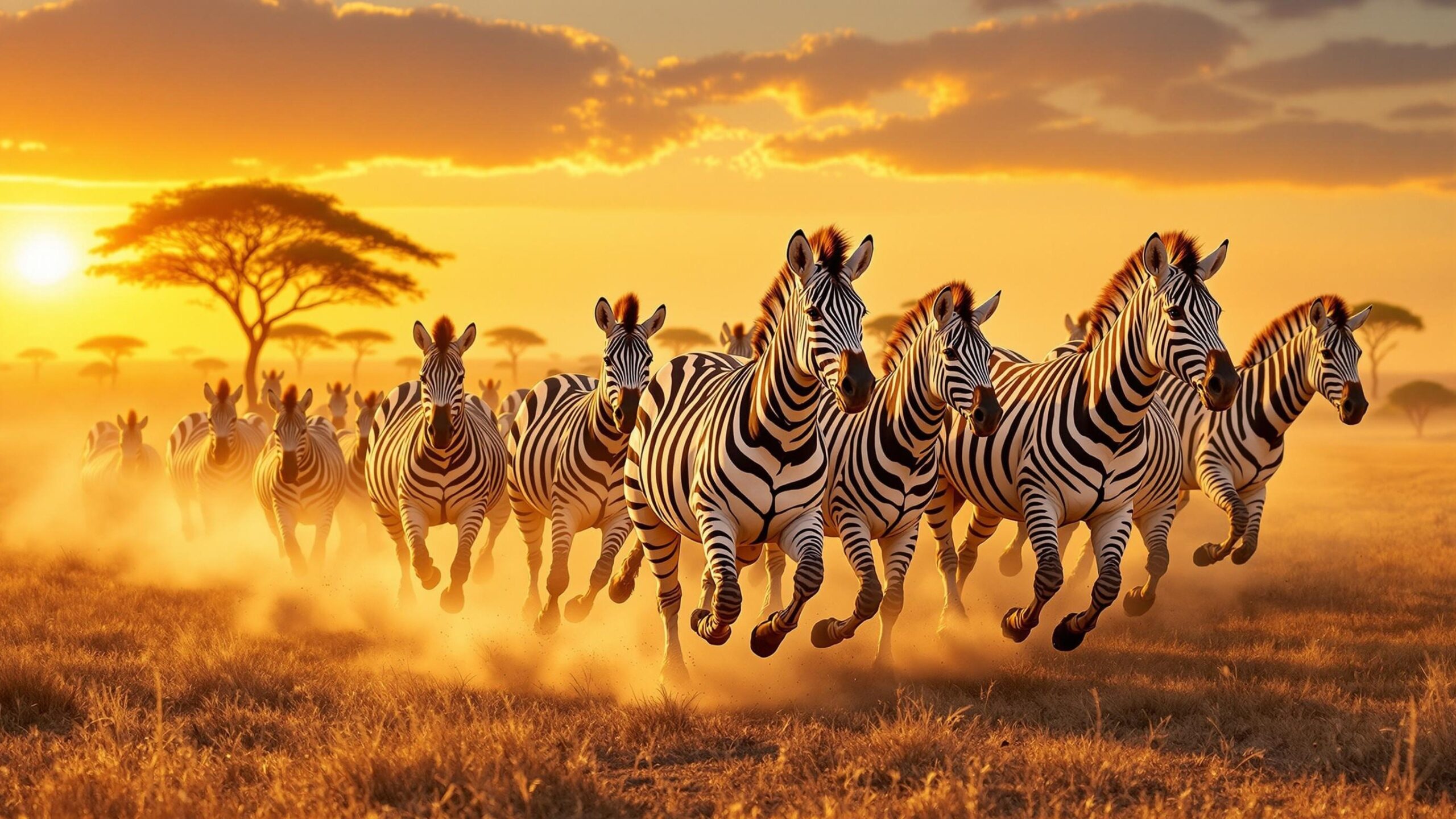
Zebras
Zebras are African wild equids in the genus Equus, the same genus that includes horses, donkeys, and wild asses. They are famous for black-and-white striping, but zebras are not one single species. Living zebras are usually grouped into Plains Zebra, Mountain Zebra, and Grevy’s Zebra, each with its own range, body form, social life, and conservation status.
The most familiar zebra in many wildlife films is the Plains Zebra, Equus quagga. Mountain Zebra, Equus zebra, lives in southwestern African mountain and dryland habitats. Grevy’s Zebra, Equus grevyi, is the largest zebra and the most threatened of the living zebra species.
For Animal Streets, Zebras is a parent guide. It explains the living species, stripe questions, range, behavior, conservation differences, and how zebras relate to other equids without treating them as striped horses or domestic animals.
What Makes A Zebra
Zebras belong to the family Equidae and order Perissodactyla, the odd-toed ungulates. They have single-hoofed feet, large grinding teeth, long legs, strong senses, and hindgut digestion suited to grass and other fibrous plants. Their closest living relatives are other members of Equus.
Unlike domestic horses and donkeys, zebras were never fully domesticated. They can be kept in managed facilities by experienced professionals, but they remain wild animals with strong escape responses, powerful kicks, sharp bites, and complex social behavior. A zebra is not a beginner horse with stripes.
Every zebra has a unique stripe pattern. Stripes vary by species and individual. Plains Zebras often have broader stripes and may show shadow striping. Mountain Zebras have a grid-like rump pattern and a dewlap on the throat. Grevy’s Zebras have narrow stripes, a white belly, large rounded ears, and a tall elegant build.
Zebras also differ from domestic equids in how people can safely relate to them. Horses and donkeys have been shaped through generations of selection around human use. Zebras evolved under predation pressure in open African landscapes. That history helps explain why they can be reactive, powerful, defensive, and unsuitable for ordinary domestic handling.
It is tempting to treat stripes as the whole story, but zebra identity is also teeth, hooves, gut, movement, group structure, predator awareness, water needs, and landscape use. A zebra is a complete wild equid, not a pattern placed on a horse-shaped body.
The Living Species
Plains Zebra is the most widespread and numerous living zebra species. It ranges across parts of eastern and southern Africa, especially savannas, grasslands, open woodlands, and protected landscapes where grazing and water are available. It includes several regional forms, and the extinct quagga is now treated as an extinct subspecies of Plains Zebra.
Mountain Zebra lives mainly in Namibia, South Africa, and nearby southwestern African landscapes. It includes Cape Mountain Zebra and Hartmann’s Mountain Zebra forms in many treatments. Mountain Zebras use rocky, dry, hilly habitats and are generally smaller than Grevy’s Zebra, with distinctive striping and a throat dewlap.
Grevy’s Zebra lives mainly in Kenya and Ethiopia today. It is the largest living wild equid, with narrow stripes, a white belly, and very large ears. It is more arid-country adapted than many Plains Zebra populations and often faces intense competition around water and grazing.
These three species also guide the site structure. A parent Zebras page can explain the whole group, while individual pages can go deeper into Plains Zebra migration, Mountain Zebra recovery and dryland specialization, and Grevy’s Zebra conservation. That separation keeps the facts sharper for readers.
Why Zebras Have Stripes
Zebra stripes have attracted many explanations. Researchers have studied camouflage, social recognition, thermoregulation, predator confusion, and biting-fly deterrence. The best answer may involve more than one factor, and different effects may matter in different places or situations.
Biting-fly avoidance has strong support in modern research, especially because horseflies and related insects can carry disease and drain energy. Stripes can interfere with landing behavior in some biting flies. That does not mean stripes have only one purpose, but it does make fly pressure part of the serious discussion.
Social recognition may also matter because zebra groups live in close visual contact. Individual stripe patterns can help animals recognize one another, especially in social species. For readers, the safest wording is that stripes likely serve multiple functions and remain an active research topic.
Stripe discussions also benefit from humility because different hypotheses are not always mutually exclusive. A pattern can influence insects, heat, visual signaling, and predator perception at the same time. Natural selection often works through layered advantages rather than one tidy explanation.
Behavior And Social Life
Zebra social life differs by species. Plains Zebras often live in stable family groups, or harems, made up of a stallion, mares, and their young. These family groups can join large herds during migration or when grazing conditions bring many animals together.
Grevy’s Zebras have a different system. Stallions may defend territories near important resources, while females move according to food and water needs. This makes conservation around dry-season water especially important because movement is part of the species’ survival strategy.
Mountain Zebras also form social groups and use rugged terrain. Their behavior is shaped by dry-country movement, water, forage, predators, and group bonds. Across all species, zebras communicate with calls, ear position, facial expression, scent, grooming, and body posture.
Predators matter too. Lions, hyenas, wild dogs, leopards, and crocodiles may prey on zebras depending on region and age class. Zebra defense includes vigilance, speed, group awareness, strong kicks, biting, and staying near other herbivores that can add extra eyes and ears.
Diet And Habitat
Zebras are primarily grazers. They feed on grasses, but they may also take leaves, bark, herbs, or other plant material depending on species, season, and habitat. Their digestive system allows them to process large amounts of lower-quality forage, which helps them live alongside other grazers.
Plains Zebras are strongly associated with grassland and savanna systems. They may move long distances to follow rainfall and fresh grass. Their grazing can influence plant structure and create opportunities for other herbivores that prefer shorter or different growth stages.
Mountain and Grevy’s Zebras often face drier, more fragmented habitats. Water access, fencing, livestock competition, and drought can become defining pressures. A zebra species that looks sturdy in photographs may still be vulnerable when movement routes and dry-season refuges disappear.
Zebras also interact with other grazers. In some systems, zebras take taller or coarser grasses and open feeding opportunities for wildebeest, gazelles, or other herbivores that prefer shorter regrowth. Their grazing is part of the larger rhythm of savanna and dryland ecosystems.
Conservation Status
Zebra conservation status is species-specific. Grevy’s Zebra is Endangered and has suffered major range and population declines. Mountain Zebra is generally treated as Vulnerable at the species level, with important recovery history and subspecies nuance. Plains Zebra is the most common zebra, but current assessments commonly treat it as Near Threatened rather than risk-free.
The main threats include habitat loss, fencing, water competition, livestock pressure, hunting, drought, disease, fragmentation, and disturbance. Grevy’s Zebra is especially affected by competition for water and grazing in arid landscapes. Mountain Zebra populations can be vulnerable to drought and fragmentation. Plains Zebra remains widespread but has lost ground in many places.
The extinct quagga is an important warning. It was a southern form of Plains Zebra driven to extinction in the nineteenth century. Its loss shows that even a familiar zebra type can disappear when hunting, settlement, and livestock pressure become overwhelming.
Conservation success stories are mixed with caution. Some Mountain Zebra populations improved under protection after severe historic decline, but recovery does not remove future risk from drought, small population size, or fragmented habitat. Grevy’s Zebra still needs focused work around community conservancies, water access, and reduced competition. Plains Zebra remains comparatively numerous, yet local declines and range loss are real.
Zebras And People
Zebras appear in tourism, art, conservation campaigns, traditional knowledge, national parks, private reserves, research projects, and wildlife conflict discussions. They attract attention easily, but attention alone does not protect grassland, water, or migration routes.
Responsible wildlife tourism means staying on roads where required, giving animals space, avoiding harassment for photos, and respecting water and breeding areas. Off-road driving or crowding can block access to resources, especially for animals already under pressure.
Zebras also live beside pastoral communities and livestock in many regions. Conservation works best when it includes local people, grazing realities, water planning, disease awareness, and benefits from living wildlife. A zebra-friendly landscape is also a landscape where movement is still possible.
Human-wildlife coexistence is practical. If zebras damage crops, compete for water, or bring no local benefit, tolerance can fade. If wildlife tourism, community conservancies, employment, and grazing plans bring real value, zebras have a better chance of remaining part of shared landscapes.
How To Tell Zebra Species Apart
Plains Zebra usually has broader stripes, a more familiar savanna-zebra shape, and often shadow stripes in some populations. It is the species most people picture first. Range and herd structure help confirm identification in the field.
Mountain Zebra has a throat dewlap, a grid-like pattern over the rump, and a white belly with striping that differs from Plains Zebra. It is tied to southwestern African rocky and mountainous dry habitats. Cape and Hartmann’s forms add more local detail.
Grevy’s Zebra is taller, narrower-striped, larger-eared, and more white-bellied than the others. Its head is long and mule-like, and its body can look especially elegant and upright. It is the zebra most associated with arid northern Kenya and Ethiopia today.
Young animals can complicate identification because foals may show softer brownish stripes before the coat darkens. Distance, dust, angle, and mixed herds can also confuse quick judgments. Range, body shape, stripe width, ear size, belly pattern, and rump pattern together give a stronger answer than any one clue.
Why Zebras Matter
Zebras matter because they are central grazers in African ecosystems. They shape grasslands, feed predators, move nutrients, use water, and join migrations and mixed herbivore communities. Their presence can signal that open landscapes still function.
They also matter because they show the diversity inside Equus. Horses, donkeys, wild asses, and zebras share ancestry, but their bodies, behavior, ranges, and relationships with people are very different. Zebras are not failed horses or decorative donkeys. They are wild equids in their own right.
For Animal Streets readers, the essential idea is this: zebras are three living wild equid species, not one generic animal; their stripes are complex; their conservation statuses differ; and protecting them means protecting grassland, dryland, water, movement, and local coexistence.
That idea keeps the page useful. Readers who arrive for stripes leave with the bigger picture: zebra diversity, wild equid behavior, species-specific risk, and the landscapes that keep these animals moving.