
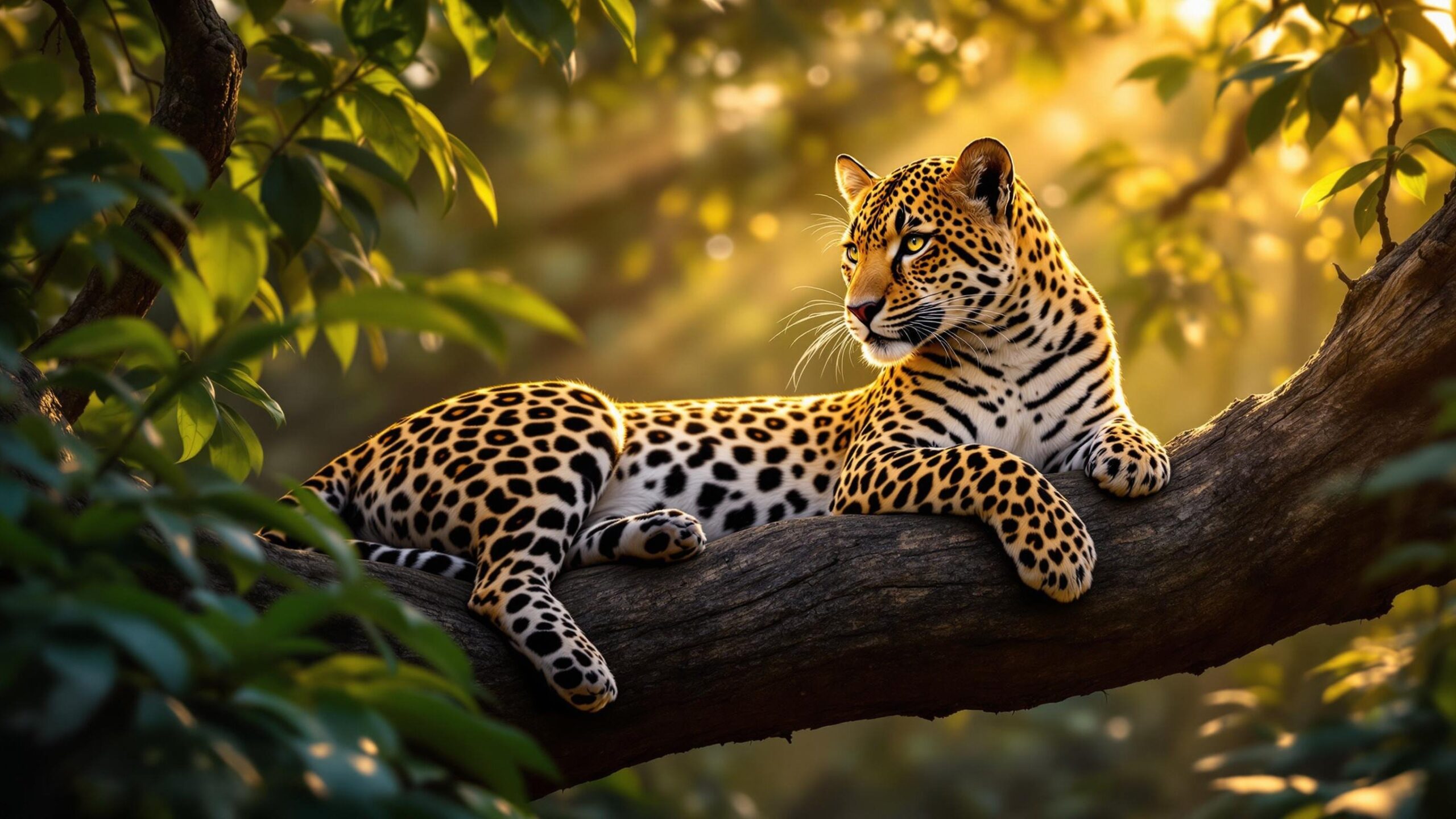
Leopards: The Stealthy Shadows of the Wild That Rule from the Trees to the Ground
In the flickering twilight of the African savanna, a spotted ghost silently weaves through the tall grass. Muscles ripple beneath its golden coat as it climbs a tree with supernatural ease, dragging prey twice its size with barely a sound. It is the leopard—an enigma cloaked in rosettes, an apex predator that has conquered forests, deserts, and mountains. Leopards are not just one of the world’s most beautiful big cats—they are among the most adaptable, elusive, and mysterious animals ever to stalk the wilderness. From the humid jungles of Sri Lanka to the snowy slopes of Central Asia, leopards have carved out a domain that stretches wider than any other big cat, and they have done so while rarely being seen. To understand leopards is to glimpse into the heart of wild nature itself—a realm of stealth, survival, and sublime power.
Taxonomy And Identity
Muscles ripple beneath its golden coat as it climbs a tree with supernatural ease, dragging prey twice its size with barely a sound. It is the leopard—an enigma cloaked in rosettes, an apex predator that has conquered forests, deserts, and mountains. Leopards are not just one of the world’s most beautiful big cats—they are among the most adaptable, elusive, and mysterious animals ever to stalk the wilderness.
A master of stealth and survival, this big cat reigns as one of Africa’s most iconic yet mysterious predators. Sleek, spotted, and supremely adaptable, the African leopard roams a range of habitats across the continent—from sun- scorched savannahs to dense rainforests, misty highlands, and rocky deserts. Known for its ghost-like ability to vanish into the wilderness, this rare subspecies of leopard is not just a symbol of the wild’s resilience but also evidence of nature’s incredible beauty and adaptability.
Identification And Appearance
Muscles ripple beneath its golden coat as it climbs a tree with supernatural ease, dragging prey twice its size with barely a sound. What sets the leopard apart is not sheer size—it is smaller than the lion and tiger—but its unmatched versatility. A full-grown male can weigh between 80 to 200 pounds, and yet it can haul prey three times its weight up into trees to avoid scavengers.
Muscles ripple beneath its golden coat as it climbs a tree with supernatural ease, dragging prey twice its size with barely a sound. What sets the leopard apart is not sheer size—it is smaller than the lion and tiger—but its unmatched versatility. Body form, markings, movement, and habitat work together to separate this animal from close relatives and lookalikes.
Anatomy And Adaptations
Muscles ripple beneath its golden coat as it climbs a tree with supernatural ease, dragging prey twice its size with barely a sound. Leopards are not just one of the world’s most beautiful big cats—they are among the most adaptable, elusive, and mysterious animals ever to stalk the wilderness. Sleek, spotted, and supremely adaptable, the African leopard roams a range of habitats across the continent—from sun- scorched savannahs to dense rainforests, misty highlands, and rocky deserts.
Known for its ghost-like ability to vanish into the wilderness, this rare subspecies of leopard is not just a symbol of the wild’s resilience but also evidence of nature’s incredible beauty and adaptability. Body form, markings, movement, and habitat work together to separate this animal from close relatives and lookalikes. Body form, markings, movement, and habitat work together to separate this animal from close relatives and lookalikes.
Range And Wild Habitat
Sleek, spotted, and supremely adaptable, the African leopard roams a range of habitats across the continent—from sun- scorched savannahs to dense rainforests, misty highlands, and rocky deserts. Here, they share their range with tigers and humans, yet they remain unseen for days or weeks, a confirmation to their elusive behavior. Smaller and lighter than their African and Indian relatives, Arabian leopards have adapted to dry climates and mountainous terrain, hunting ibex, rodents, and birds in isolated, inhospitable ranges.
It is the leopard—an enigma cloaked in rosettes, an apex predator that has conquered forests, deserts, and mountains. Sleek, spotted, and supremely adaptable, the African leopard roams a range of habitats across the continent—from sun- scorched savannahs to dense rainforests, misty highlands, and rocky deserts. This habitat context helps separate the animal’s natural setting from zoo, aquarium, farm, or private-care conditions.
Wild Diet And Feeding
Muscles ripple beneath its golden coat as it climbs a tree with supernatural ease, dragging prey twice its size with barely a sound. A full-grown male can weigh between 80 to 200 pounds, and yet it can haul prey three times its weight up into trees to avoid scavengers. Acute hearing, exceptional night vision, and a stealthy gait allow them to approach prey undetected.
As apex predators, they regulate herbivore populations, indirectly shaping vegetation patterns and maintaining balance. But in many rural areas, they are revered or tolerated, especially when they prey on feral dogs or keep herbivore populations in check. Muscles ripple beneath its golden coat as it climbs a tree with supernatural ease, dragging prey twice its size with barely a sound.
Behavior
Leopards are solitary by nature, preferring to hunt and live alone, only coming together to mate or during a mother’s care for her cubs. Their senses are sharply tuned for nocturnal activity. Behavior is easiest to understand when daily movement, social contact, communication, and risk avoidance are considered together.
Reproduction And Life Cycle
Conservation programs led by local governments and global NGOs are racing against time to protect these leopards through captive breeding, protected areas, and cross-border cooperation. Its daily life is shaped by where it moves, what it eats, how it avoids danger, and how it interacts with other animals. Its daily life is shaped by where it moves, what it eats, how it avoids danger, and how it interacts with other animals.
Ecology And Role In The Environment
Muscles ripple beneath its golden coat as it climbs a tree with supernatural ease, dragging prey twice its size with barely a sound. It is the leopard—an enigma cloaked in rosettes, an apex predator that has conquered forests, deserts, and mountains. A master of stealth and survival, this big cat reigns as one of Africa’s most iconic yet mysterious predators.
Muscles ripple beneath its golden coat as it climbs a tree with supernatural ease, dragging prey twice its size with barely a sound. It is the leopard—an enigma cloaked in rosettes, an apex predator that has conquered forests, deserts, and mountains. Its daily life is shaped by where it moves, what it eats, how it avoids danger, and how it interacts with other animals.
Conservation Status And Threats
The Arabian leopard (Panthera pardus nimr) is not only the smallest and rarest of all leopard subspecies, but also one of the most critically endangered big cats on Earth. Known scientifically as Panthera pardus melas, this secretive subspecies of leopard is as elusive as it is endangered. With eyes like amber fire and a coat marked by a constellation of rosettes, the Persian leopard (Panthera pardus tulliana) reigns as one of the most enigmatic and endangered big cats on Earth.
As apex predators, they regulate herbivore populations, indirectly shaping vegetation patterns and maintaining balance. Despite this, human conflict and habitat encroachment have placed many populations under pressure, making conservation efforts more crucial than ever. But in many rural areas, they are revered or tolerated, especially when they prey on feral dogs or keep herbivore populations in check.
Human Relationship
The Arabian leopard (Panthera pardus nimr) is not only the smallest and rarest of all leopard subspecies, but also one of the most critically endangered big cats on Earth. Known scientifically as Panthera pardus melas, this secretive subspecies of leopard is as elusive as it is endangered. Its daily life is shaped by where it moves, what it eats, how it avoids danger, and how it interacts with other animals.
Captive Care
Leopards are solitary by nature, preferring to hunt and live alone, only coming together to mate or during a mother’s care for her cubs. Responsible care depends on matching space, diet, social conditions, climate, and veterinary oversight to the animal’s biology. Responsible care depends on matching space, diet, social conditions, climate, and veterinary oversight to the animal’s biology.
Wild And Captive Variation
From the steamy rainforests of the Congo to the dry brushlands of the Kalahari, these cats thrive in a staggering variety of environments. Conservation programs led by local governments and global NGOs are racing against time to protect these leopards through captive breeding, protected areas, and cross-border cooperation. Its daily life is shaped by where it moves, what it eats, how it avoids danger, and how it interacts with other animals.
Similar Species
Unlike lions that rely on group coordination or cheetahs that use raw speed, leopards are ambush predators. Its daily life is shaped by where it moves, what it eats, how it avoids danger, and how it interacts with other animals. Its daily life is shaped by where it moves, what it eats, how it avoids danger, and how it interacts with other animals.
Common Misconceptions
One of their most fascinating traits is their ability to co-exist near human settlements while rarely being seen, a behavior that has made them central figures in African mythology—often as spirits, tricksters, or mysterious guardians of the night. Explore their forests, their myths, their ranges. Its daily life is shaped by where it moves, what it eats, how it avoids danger, and how it interacts with other animals.
FAQ
How does the Leopards behave?
Leopards are solitary by nature, preferring to hunt and live alone, only coming together to mate or during a mother’s care for her cubs. Their senses are sharply tuned for nocturnal activity. Its daily life is shaped by where it moves, what it eats, how it avoids danger, and how it interacts with other animals.
Additional Natural History Notes
Leopards is best interpreted through habitat, seasonal food supply, movement, social behavior, breeding timing, and the pressures created by predators, competitors, and people. Coat color, limb shape, ears, teeth, and body size connect to how the animal travels, finds food, avoids danger, and raises young. Wild behavior also differs from observations made in parks, zoos, farms, rescue settings, or neighborhoods, where space, diet, risk, and human influence can change daily activity.
A complete account also benefits from scale and season. Many animals change their movements, calls, feeding choices, or visibility as weather, water, prey, nesting sites, or shelter change through the year. Those rhythms can make the same species look secretive in one setting and bold in another. By connecting anatomy, habitat, and seasonal behavior, the animal becomes easier to understand as a living part of its ecosystem rather than a list of isolated facts.
Regional history adds another layer. Islands, mountains, deserts, forests, rivers, and grasslands can isolate populations long enough for small differences in size, color, diet, or behavior to matter. Local names, field reports, museum records, and modern genetic work often fit together slowly, especially when the animal is rare, nocturnal, migratory, or difficult to observe. The strongest interpretation treats those clues as part of one natural history rather than separate trivia.