
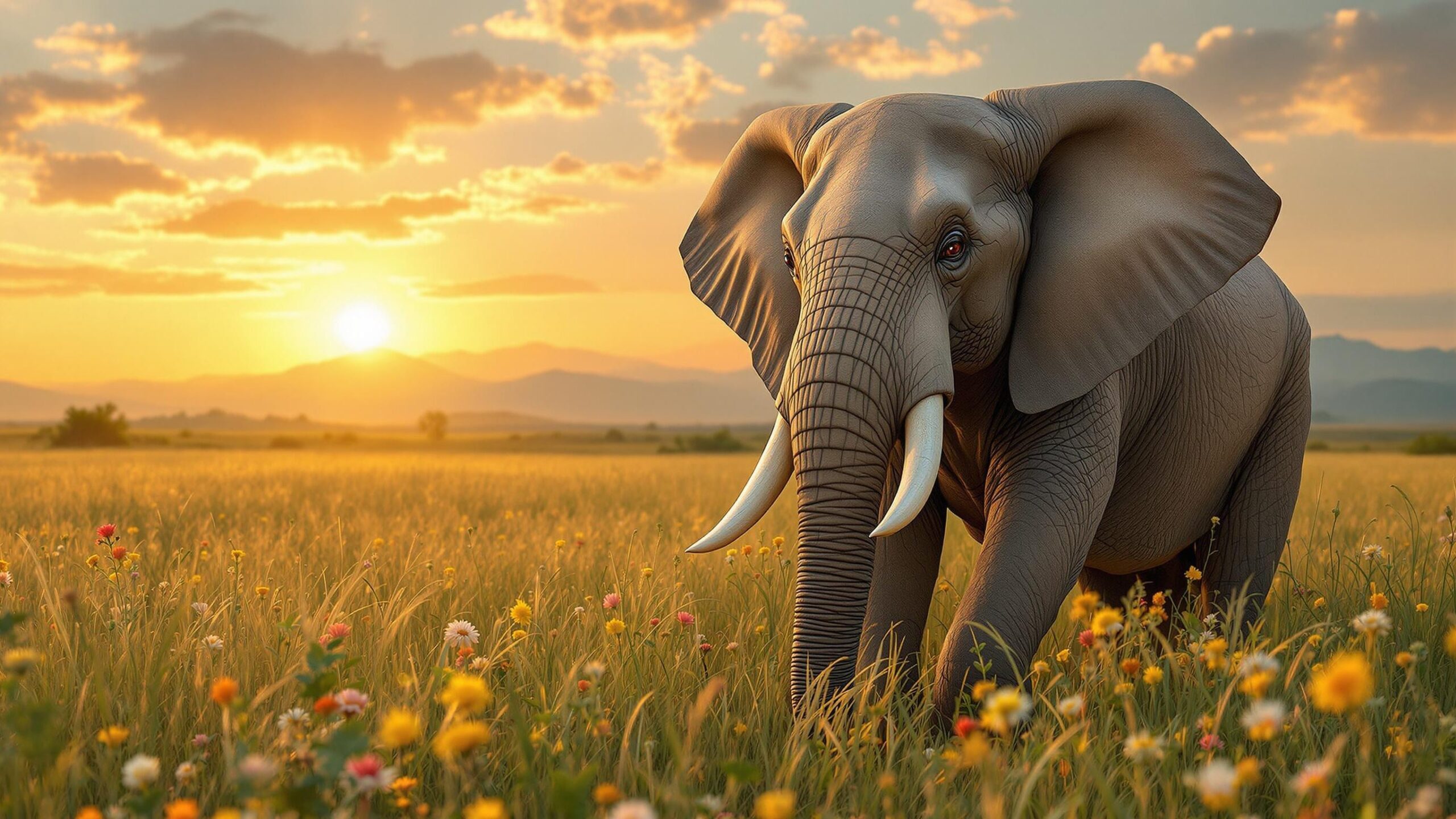
Introduction: The Ancient Majesty of Elephas maximus
Across the diverse landscapes of Asia, from steamy rainforests to grassy plains, there roams a gentle giant whose very presence evokes awe, reverence, and curiosity. The Asian Elephant—scientifically known as Elephas maximus—is one of the most iconic creatures of the animal kingdom. Distinguished by its intelligence, rich social life, and deep connections to human cultures, the Asian Elephant stands as a symbol of wild Asia. These remarkable animals have inspired legends, driven history, and now, face a future that hinges on our collective care. Journey with us into the world of the Asian Elephant, where ancient traditions meet the pressing needs of the present and hope for the future endures.
Taxonomy And Identity
These groups are led by a matriarch—the oldest and often wisest female—who guides her family through the complexities of forest life. These communications help coordinate movements, warn of danger, and reinforce family bonds. Elephants show empathy, rescue each other from danger, and are known to mourn their dead—standing vigil over the bones of lost family members.
These groups are led by a matriarch—the oldest and often wisest female—who guides her family through the complexities of forest life. These communications help coordinate movements, warn of danger, and reinforce family bonds. Asian elephants is best understood through its anatomy, habitat, diet, behavior, and place in its ecosystem.
Identification And Appearance
Known as the Bornean elephant, or Elephas maximus borneensis, this subspecies of the Asian elephant stands apart not only for its more docile nature and smaller size but also for the mysteries that surround its origins. With thick gray skin, a sensitive trunk, and soulful eyes, the Sumatran elephant (Elephas maximus sumatranus) stands as both a symbol of the wild beauty of Sumatra and a poignant reminder of the fragile balance between nature and modern development. The trunk, a marvel of evolution, has one finger-like tip (unlike the two found in African elephants) and is capable of astonishing feats of strength and delicacy, from uprooting trees to gently lifting a peanut.
Known as the Bornean elephant, or Elephas maximus borneensis, this subspecies of the Asian elephant stands apart not only for its more docile nature and smaller size but also for the mysteries that surround its origins. With thick gray skin, a sensitive trunk, and soulful eyes, the Sumatran elephant (Elephas maximus sumatranus) stands as both a symbol of the wild beauty of Sumatra and a poignant reminder of the fragile balance between nature and modern development. Body form, markings, movement, and habitat work together to separate this animal from close relatives and lookalikes.
Anatomy And Adaptations
What really sets Elephas maximus apart are its physical adaptations. There are three recognized subspecies of the Asian Elephant, each adapted to its home region: Indian Elephant (Elephas maximus indicus): The most widespread, found across mainland Asia, particularly in India, Nepal, Bangladesh, and parts of Southeast Asia. Sumatran Elephant (Elephas maximus sumatranus): The smallest of the three, adapted to the lush rainforests of Sumatra, with distinct genetic and physical traits.
Their ability to adapt their diet to local conditions is a key reason for their survival across diverse habitats. They are excellent swimmers, using their trunks as snorkels and sometimes crossing rivers or even narrow sea channels. Body form, markings, movement, and habitat work together to separate this animal from close relatives and lookalikes.
Range And Wild Habitat
A subspecies of the Asian elephant, it roams the forests and grasslands of India and surrounding regions, playing a vital ecological role while also inhabiting deep mythological and spiritual significance. The trunk, a marvel of evolution, has one finger-like tip (unlike the two found in African elephants) and is capable of astonishing feats of strength and delicacy, from uprooting trees to gently lifting a peanut. Still, these elephants occupy a patchwork of habitats across 13 countries, including India, Sri Lanka, Nepal, Bhutan, Bangladesh, Myanmar, Thailand, Laos, Cambodia, Vietnam, Malaysia, Indonesia (on the island of Sumatra), and China.
There are three recognized subspecies of the Asian Elephant, each adapted to its home region: Indian Elephant (Elephas maximus indicus): The most widespread, found across mainland Asia, particularly in India, Nepal, Bangladesh, and parts of Southeast Asia. Sri Lankan Elephant (Elephas maximus maximus): Native to the island of Sri Lanka, these elephants tend to be the largest and darkest-skinned, with relatively small or absent tusks. A subspecies of the Asian elephant, it roams the forests and grasslands of India and surrounding regions, playing a vital ecological role while also inhabiting deep mythological and spiritual significance.
Wild Diet And Feeding
The head is domed with twin bulges and smaller, rounded ears—less necessary for heat dissipation in the shadier forests of Asia. The trunk, a marvel of evolution, has one finger-like tip (unlike the two found in African elephants) and is capable of astonishing feats of strength and delicacy, from uprooting trees to gently lifting a peanut. Families are made up of related females and their young, with group sizes usually ranging from five to twenty individuals, though temporary gatherings can be much larger where food and water are plentiful.
Elephants use low-frequency rumbles, trumpets, squeaks, and even seismic vibrations that travel through the ground to stay in touch over great distances. Their diet varies by region and season, but generally includes grasses, leaves, bamboo, bark, roots, fruit, and cultivated crops. Elephants are often described as “ecosystem engineers.” As they browse and forage, they open up forest paths, spread seeds through their dung, and help maintain the structure and diversity of their environment.
Behavior
Distinguished by its intelligence, rich social life, and deep connections to human cultures, the Asian Elephant stands as a symbol of wild Asia. Males, upon reaching adolescence (around 12-15 years old), gradually leave their natal herds and lead more solitary lives or form loose bachelor groups. Communication within and between herds is highly sophisticated.
Distinguished by its intelligence, rich social life, and deep connections to human cultures, the Asian Elephant stands as a symbol of wild Asia. Males, upon reaching adolescence (around 12-15 years old), gradually leave their natal herds and lead more solitary lives or form loose bachelor groups. Behavior is easiest to understand when daily movement, social contact, communication, and risk avoidance are considered together.
Reproduction And Life Cycle
During the breeding season, mature bulls enter “musth,” a period marked by elevated hormones, increased aggression, and a drive to seek out females for mating. Females typically give birth for the first time between the ages of 14 and 17, after a gestation period of about 22 months—the longest of any land mammal. Males, upon reaching adolescence (around 12-15 years old), gradually leave their natal herds and lead more solitary lives or form loose bachelor groups.
During the breeding season, mature bulls enter “musth,” a period marked by elevated hormones, increased aggression, and a drive to seek out females for mating. Females typically give birth for the first time between the ages of 14 and 17, after a gestation period of about 22 months—the longest of any land mammal. Its daily life is shaped by where it moves, what it eats, how it avoids danger, and how it interacts with other animals.
Ecology And Role In The Environment
A subspecies of the Asian elephant, it roams the forests and grasslands of India and surrounding regions, playing a vital ecological role while also inhabiting deep mythological and spiritual significance. Elephants are often described as “ecosystem engineers.” As they browse and forage, they open up forest paths, spread seeds through their dung, and help maintain the structure and diversity of their environment. In tropical forests, many tree species rely on elephants to disperse their seeds, making these animals crucial to the health and renewal of their habitats.
A subspecies of the Asian elephant, it roams the forests and grasslands of India and surrounding regions, playing a vital ecological role while also inhabiting deep mythological and spiritual significance. Elephants are often described as “ecosystem engineers.” As they browse and forage, they open up forest paths, spread seeds through their dung, and help maintain the structure and diversity of their environment. Its daily life is shaped by where it moves, what it eats, how it avoids danger, and how it interacts with other animals.
Conservation Status And Threats
A fourth, sometimes-recognized population is the Bornean Pygmy Elephant, which is the smallest of all, and thought by some scientists to be a distinct subspecies. Addressing these conflicts with creative, humane solutions is one of the great challenges of modern conservation. Wild populations are estimated at fewer than 50,000 individuals, with perhaps half living in India.
The greatest threats are habitat loss, fragmentation, and conflict with humans. As forests are cleared for agriculture, roads, and settlements, elephant habitat shrinks and becomes fragmented, separating populations and limiting genetic diversity. Its daily life is shaped by where it moves, what it eats, how it avoids danger, and how it interacts with other animals.
Human Relationship
Distinguished by its intelligence, rich social life, and deep connections to human cultures, the Asian Elephant stands as a symbol of wild Asia. This trait, while visually distinctive, has implications for how elephants interact with their environment and with humans. Elephants use low-frequency rumbles, trumpets, squeaks, and even seismic vibrations that travel through the ground to stay in touch over great distances.
These communications help coordinate movements, warn of danger, and reinforce family bonds. Its daily life is shaped by where it moves, what it eats, how it avoids danger, and how it interacts with other animals. Its daily life is shaped by where it moves, what it eats, how it avoids danger, and how it interacts with other animals.
Captive Care
These remarkable animals have inspired legends, driven history, and now, face a future that hinges on our collective care. Play is frequent, and elephants are famous for their gentle trunk caresses, reassuring rumbles, and touching displays of affection and grief. Alloparenting—where other females help care for and protect young—is common and vital to calf survival.
Wild And Captive Variation
During the breeding season, mature bulls enter “musth,” a period marked by elevated hormones, increased aggression, and a drive to seek out females for mating. Captive elephants sometimes suffer from inadequate conditions or harsh treatment, and the debate over their use in tourism and entertainment is ongoing. Its daily life is shaped by where it moves, what it eats, how it avoids danger, and how it interacts with other animals.
Similar Species
Distinguished by its intelligence, rich social life, and deep connections to human cultures, the Asian Elephant stands as a symbol of wild Asia. Compared to its African cousins, the Asian Elephant is slightly smaller, with females weighing between 5,000 and 8,000 pounds and males reaching up to 12,000 pounds. The trunk, a marvel of evolution, has one finger-like tip (unlike the two found in African elephants) and is capable of astonishing feats of strength and delicacy, from uprooting trees to gently lifting a peanut.
Distinguished by its intelligence, rich social life, and deep connections to human cultures, the Asian Elephant stands as a symbol of…. Its daily life is shaped by where it moves, what it eats, how it avoids danger, and how it interacts with other animals. Its daily life is shaped by where it moves, what it eats, how it avoids danger, and how it interacts with other animals.
Common Misconceptions
A subspecies of the Asian elephant, it roams the forests and grasslands of India and surrounding regions, playing a vital ecological role while also inhabiting deep mythological and spiritual significance. Its daily life is shaped by where it moves, what it eats, how it avoids danger, and how it interacts with other animals. Its daily life is shaped by where it moves, what it eats, how it avoids danger, and how it interacts with other animals.
FAQ
Sources
- https://animalstreets.com/mammals/land-mammals/elephants/asian-elephants/ Organization: animalstreets.com Source type: Live page or linked source URL: https://animalstreets.com/mammals/land-mammals/elephants/asian-elephants/ Information verified: Used for current-page extraction and source discovery; independent fact verification may still be required. Date checked: 2026-08-27 Reliability notes: Current page / internal source; use for audit context, not independent verification
- https://animalstreets.com/mammals-product-reviews/land-mammals-product-reviews/ Organization: animalstreets.com Source type: Live page or linked source URL: https://animalstreets.com/mammals-product-reviews/land-mammals-product-reviews/ Information verified: Used for current-page extraction and source discovery; independent fact verification may still be required. Date checked: 2026-08-27 Reliability notes: Current page / internal source; use for audit context, not independent verification
- https://animalstreets.com/mammals/land-mammals/elephants/african-elephants/bornean-elephant/ Organization: animalstreets.com Source type: Live page or linked source URL: https://animalstreets.com/mammals/land-mammals/elephants/african-elephants/bornean-elephant/ Information verified: Used for current-page extraction and source discovery; independent fact verification may still be required. Date checked: 2026-08-27 Reliability notes: Current page / internal source; use for audit context, not independent verification
- https://animalstreets.com/mammals/land-mammals/elephants/asian-elephants/indian-elephant/ Organization: animalstreets.com Source type: Live page or linked source URL: https://animalstreets.com/mammals/land-mammals/elephants/asian-elephants/indian-elephant/ Information verified: Used for current-page extraction and source discovery; independent fact verification may still be required. Date checked: 2026-08-27 Reliability notes: Current page / internal source; use for audit context, not independent verification
- https://animalstreets.com/mammals/land-mammals/elephants/african-elephants/sri-lankan-elephant/ Organization: animalstreets.com Source type: Live page or linked source URL: https://animalstreets.com/mammals/land-mammals/elephants/african-elephants/sri-lankan-elephant/ Information verified: Used for current-page extraction and source discovery; independent fact verification may still be required. Date checked: 2026-08-27 Reliability notes: Current page / internal source; use for audit context, not independent verification
- https://animalstreets.com/mammals/land-mammals/elephants/african-elephants/sumatran-elephant/ Organization: animalstreets.com Source type: Live page or linked source URL: https://animalstreets.com/mammals/land-mammals/elephants/african-elephants/sumatran-elephant/ Information verified: Used for current-page extraction and source discovery; independent fact verification may still be required. Date checked: 2026-08-27 Reliability notes: Current page / internal source; use for audit context, not independent verification
- https://animalstreets.com/animal-product-reviews/ Organization: animalstreets.com Source type: Live page or linked source URL: https://animalstreets.com/animal-product-reviews/ Information verified: Used for current-page extraction and source discovery; independent fact verification may still be required. Date checked: 2026-08-27 Reliability notes: Current page / internal source; use for audit context, not independent verification