
A Hidden Amphibian Beneath the Forest Floor
The Mexican caecilian, known scientifically as Dermophis mexicanus, is one of the most fascinating amphibians many people have never seen. At first glance, it may look like a large earthworm or a small snake, but it belongs to a very different and ancient group of limbless amphibians called caecilians. These animals live mostly underground, moving through damp soil, leaf litter, plantations, and forest edges with a quiet skill that makes them nearly invisible to casual observers. The species is currently placed in the class Amphibia, order Gymnophiona, family Dermophiidae, and genus Dermophis. Its accepted scientific name, classification, common name, and broad distribution are listed by Amphibian Species of the World, which places it among the Mesoamerican caecilians of Mexico and Central America. What makes the Mexican caecilian so exciting is the way it challenges expectations about amphibians. Most people imagine frogs, toads, salamanders, or newts when they hear the word amphibian, yet caecilians reveal a completely different branch of the amphibian story. They have no legs, no obvious ears, reduced eyes, and a body built for pushing through soil rather than leaping, swimming, or climbing. Their lifestyle is secretive, but not simple, because they rely on specialized senses, strong muscles, and a remarkable reproductive strategy. For general readers, the Mexican caecilian is a perfect reminder that some of nature’s most extraordinary animals are not flashy, loud, or easy to find.
A: No, it is a limbless amphibian, not a reptile.
A: No, it has a backbone, skull, jaws, teeth, and amphibian anatomy.
A: It lives in parts of Mexico and Central America, mostly in moist soil and leaf litter.
A: It eats small soil animals such as worms, termites, insects, slugs, and snails.
A: They have reduced eyes, but they rely heavily on touch and chemical sensing.
A: The tentacles help it detect chemical clues in dark underground environments.
A: No, this species gives birth to live young.
A: It is not considered dangerous, though wild animals should not be handled unnecessarily.
A: It spends most of its life underground and usually avoids open surfaces.
A: Sightings are most likely after rain, when the ground is moist and surface activity increases.
What the Mexican Caecilian Looks Like
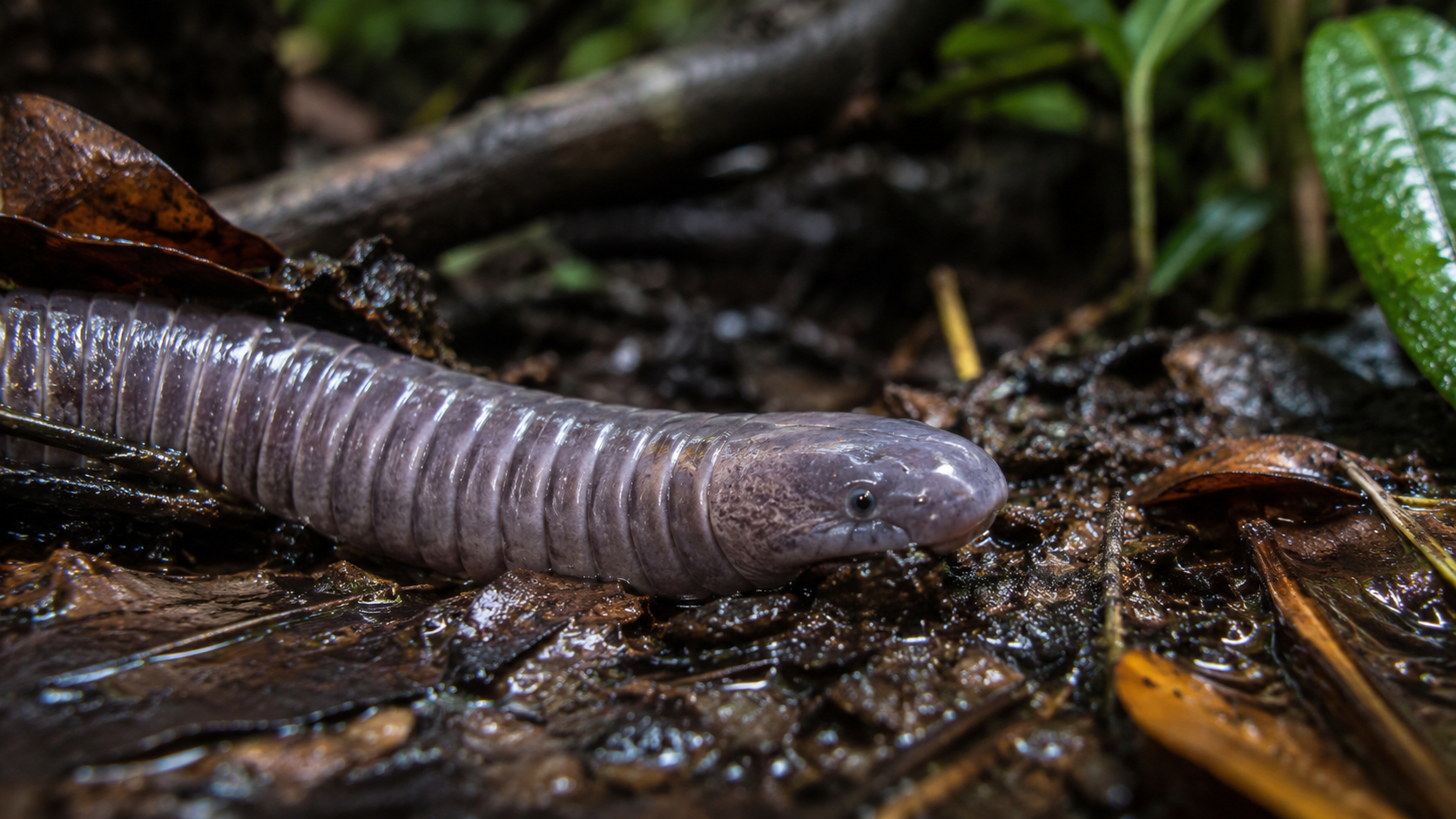
The Mexican caecilian has a long, cylindrical body marked by ring-like grooves called annuli, which give it a segmented appearance. These grooves can make the animal look wormlike, but its internal anatomy, skull structure, teeth, and reproductive biology clearly identify it as an amphibian. Adults are often described as relatively robust for a caecilian, with a smooth, moist body that may appear dark gray, brownish gray, or lead-colored above and paler below. Its skin is not scaly like a reptile’s; instead, it is glandular, sensitive, and suited to life in humid soil. AmphibiaWeb describes adults as large for caecilians, with some specimens reaching impressive lengths for a burrowing amphibian.
One of the most unusual features of the Mexican caecilian is its head. It has small eyes that are visible but reduced, and those eyes are not used in the same way as the eyes of a frog or lizard. The animal also has sensory tentacles located between the eye and nostril, a defining feature of caecilians that helps them investigate their underground world. These tentacles can detect chemical cues, allowing the caecilian to find prey, recognize surroundings, and move through dark soil where vision is of limited use. A 2024 distribution note on Dermophis mexicanus describes the genus Dermophis as having visible eyes not covered by bone and tentacles positioned between the eye and nostril.
Where It Lives and Why Moist Soil Matters
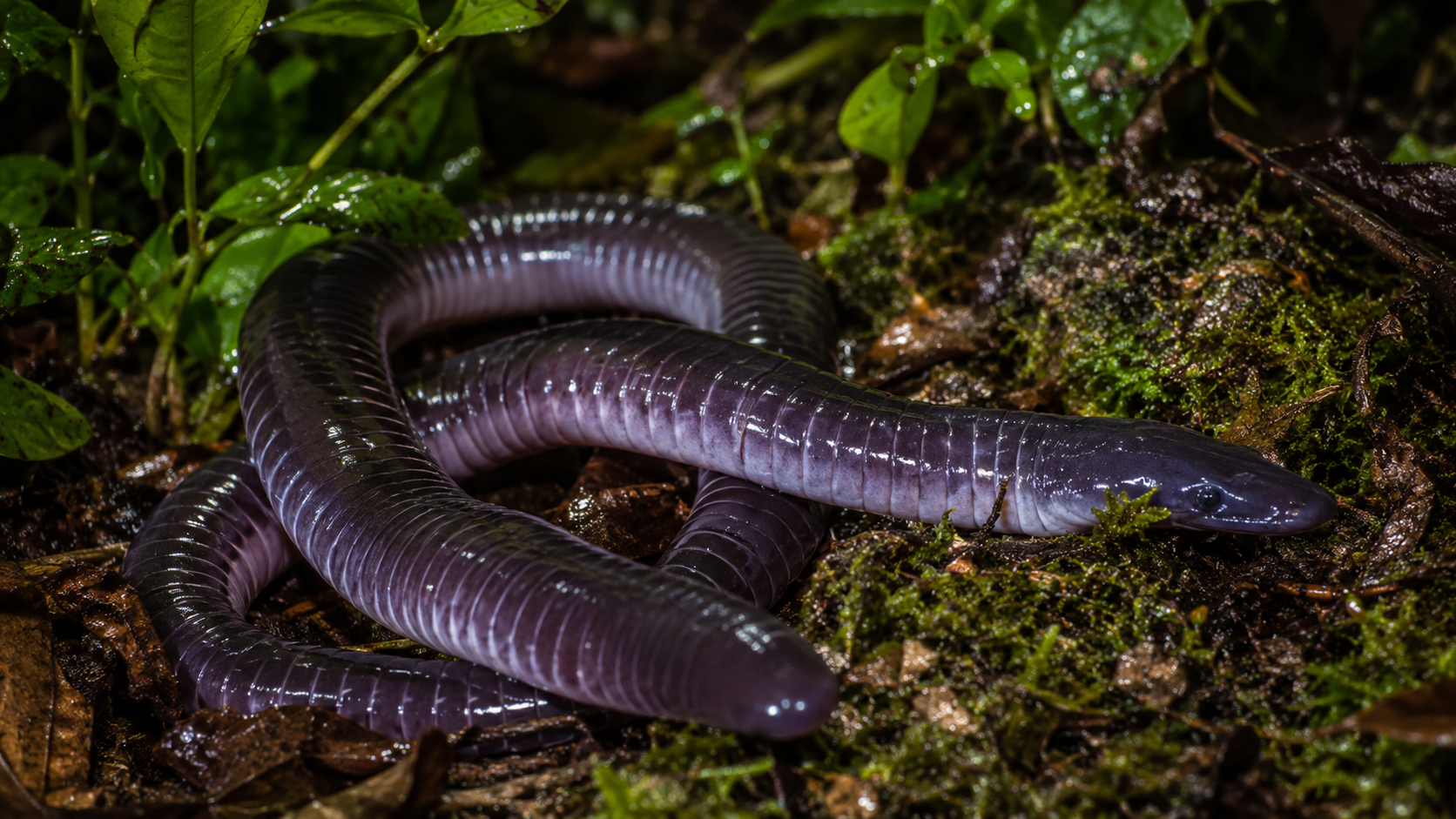
The Mexican caecilian is native to parts of Mexico and Central America, with records across several countries and slopes. Amphibian Species of the World lists its distribution from south-central Veracruz and eastern Oaxaca through parts of Mexico and Central America, including natural occurrence in Costa Rica, El Salvador, Guatemala, Honduras, Mexico, and Nicaragua. The same source notes both Atlantic and Pacific slope records, including a genetically confirmed record from Las Delicias, Puntarenas, Costa Rica. This does not mean the animal is easy to find across that whole region, because its underground habits make it difficult to survey. It may be present in suitable soil for years without being noticed by most people. Moist soil is essential to the Mexican caecilian because its body is built around a hidden, humid lifestyle. It is commonly associated with forest floor habitats, leaf litter, rotting vegetation, gardens, and agricultural landscapes such as coffee, banana, or sugar cane areas when the soil conditions are suitable. The species can inhabit both natural and altered environments, especially where shade, organic material, and moisture remain available. It is not a desert animal, and it is not a fully aquatic creature; it depends on soft, workable earth that allows it to burrow and avoid drying out. The 2024 Costa Rica record notes that the species can occur in dry forests and savanna-like conditions, as well as secondary habitats, provided the microhabitat remains usable for a fossorial amphibian.
A Life Designed for Burrowing
Everything about the Mexican caecilian points toward life below the surface. Its body is smooth, elongated, and muscular, allowing it to push through soil with movements that are very different from the walking, hopping, or swimming of other amphibians. Instead of relying on limbs, it uses body compression, side-to-side motion, and powerful internal muscular action to move through narrow tunnels. The head is shaped for pressing forward, while the body follows through the soil like a living cable. This way of moving is efficient in a world where open space is rare and every inch must be made or widened by force.
Living underground offers several advantages, but it also creates major challenges. The caecilian is protected from many surface predators, harsh sunlight, and sudden changes in temperature, yet it must find food, mates, and safe shelter without the visual cues surface animals rely on. Its reduced eyes are enough to detect some light and shadow, but chemical sensing and touch are far more important. The tentacles, skin, and head all help it read its environment through contact and scent. This sensory world is quiet, close, and richly textured, making the Mexican caecilian a specialist in a habitat most humans barely notice.
What Mexican Caecilians Eat
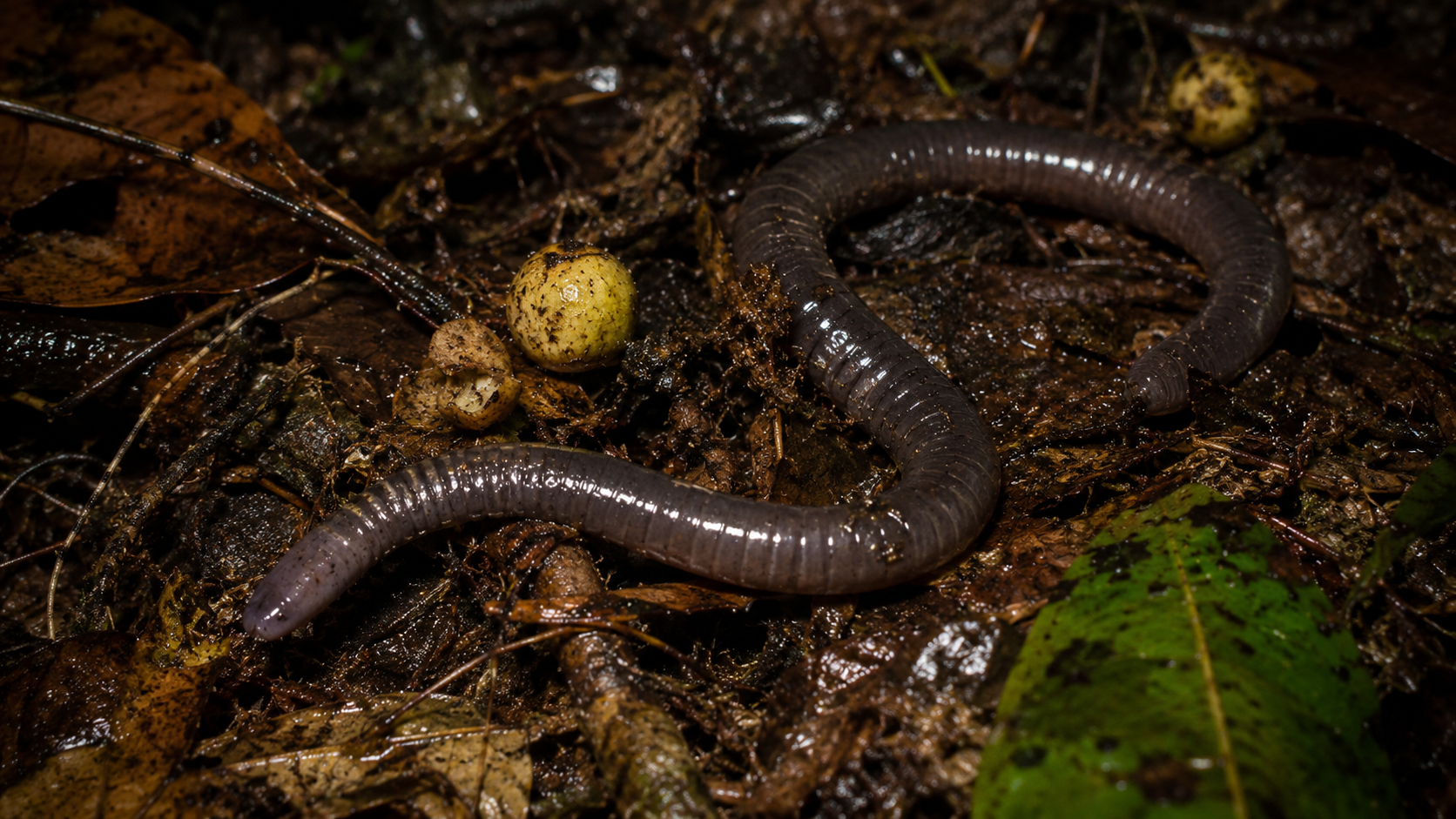
The Mexican caecilian is a predator of small animals that live in or near the soil. Its diet is generally understood to include invertebrates such as earthworms, termites, insects, slugs, snails, and other soft-bodied prey. Larger individuals may be capable of eating small vertebrates when the opportunity arises, but the heart of its feeding strategy is underground hunting. It does not chase prey across open ground like a lizard or wait in a pond like a frog. Instead, it searches through damp soil and litter, using its senses to locate animals that share its hidden habitat. Its mouth contains teeth that help it grip prey rather than chew in the mammalian sense. Once it finds food, the caecilian can seize it with surprising determination for an animal that looks so simple from the outside. This feeding role makes it part of the soil ecosystem’s natural balance, helping regulate small invertebrate populations while also serving as prey for larger animals when it comes near the surface. The species is most likely to be observed after rain, when moisture softens the ground and surface activity increases. For people lucky enough to see one, that brief appearance is often just a glimpse of a much larger underground life.
Reproduction and Live Birth
One of the most remarkable things about the Mexican caecilian is that it gives birth to live young. This reproductive style, called viviparity, is especially fascinating because it differs from the familiar image of amphibians laying jellylike eggs in water. In Dermophis mexicanus, development takes place inside the mother, and the young emerge as fully formed miniature caecilians. Digimorph summarizes this species as viviparous and notes an 11-month gestation period, with litters averaging between four and eleven young.
The developing young have specialized fetal teeth that are used inside the mother’s reproductive tract. These teeth help them feed on nutrient-rich secretions produced by the mother, a striking form of maternal investment. After birth, the young no longer need those temporary teeth and transition toward the adult feeding pattern. This kind of reproductive biology shows that caecilians are not primitive curiosities, but highly specialized amphibians with complex life histories. For a secretive animal rarely seen above ground, the Mexican caecilian has one of the most dramatic family stories in the amphibian world.
Not a Snake and Not a Worm
The Mexican caecilian is often mistaken for a snake or worm because it has no legs and spends much of its life in soil. However, it is neither. Unlike a worm, it has a backbone, skull, jaws, teeth, and a complex amphibian body plan. Unlike a snake, it has moist amphibian skin rather than scales, lacks the same reptilian skull and body structure, and belongs to a completely different evolutionary lineage. Its resemblance to snakes and worms is an example of how different animals can evolve similar body shapes when they live in similar environments. This mistaken identity can create problems for caecilians. In some areas, people may fear them because they appear snakelike, even though they are not venomous snakes and are not dangerous to humans in the way many people imagine. Like many wild animals, a caecilian may bite defensively if handled, but it is not an aggressive creature seeking contact with people. Its usual response is to burrow, hide, and avoid disturbance. Helping people recognize Mexican caecilians as amphibians can reduce unnecessary harm and make this strange animal easier to appreciate.
Its Role in the Ecosystem
The Mexican caecilian is part of the living machinery of tropical and subtropical soils. By feeding on soil invertebrates, moving through tunnels, and interacting with damp organic layers, it participates in the hidden food web beneath forests, gardens, and plantations. Its burrowing may also help mix soil on a small scale, though it should not be thought of as an earthworm replacement. It is a predator, a burrower, and a secretive resident of the decomposing world beneath leaves. That underground zone is where nutrients cycle, roots spread, fungi grow, and countless tiny animals live.
Because the species is difficult to observe, its ecological role is less familiar than that of frogs or salamanders. This lack of visibility can make it easy to underestimate. Yet animals like the Mexican caecilian help remind us that biodiversity is not only found in bright feathers, large mammals, or colorful reef fish. It also exists under logs, beneath gardens, and in the dark soil after rain. A healthy landscape includes not just the animals we see often, but also the ones quietly shaping the world below our feet.
Conservation in a Low-Drama Context
The Mexican caecilian is not usually presented as one of the world’s most endangered amphibians, and some major summaries list it as a species of Least Concern. AmphibiaWeb search results and several secondary summaries reflect that current Least Concern status, while older or less current sources may still repeat earlier concern levels. The important point is that this animal’s underground lifestyle makes population trends difficult to measure with confidence. A species can be widespread and still be poorly observed, especially when it spends most of its life hidden below the surface. The most sensible conservation message for the Mexican caecilian is practical and moderate. Forest loss, soil disturbance, road mortality, pesticide use, and unnecessary killing due to mistaken identity can all affect local animals. At the same time, the species appears capable of using some secondary habitats when enough moisture, cover, and soil structure remain. Protecting leaf litter, shaded ground, riparian vegetation, and low-impact agricultural landscapes can benefit this species along with many other small animals. Conservation for the Mexican caecilian is less about dramatic rescue and more about respecting the living soil.
Why Scientists Still Study It
The Mexican caecilian remains scientifically interesting because caecilians as a group are still less studied than frogs and salamanders. Their underground lives make fieldwork difficult, and many details of behavior, population structure, movement, and local abundance remain hard to document. The 2024 report of a genetically confirmed Costa Rican record shows that even a known species can still surprise scientists with distribution updates. That record was based on a specimen found after heavy rain and confirmed through genetic analysis, demonstrating how modern tools can refine knowledge of secretive amphibians.
Scientists also study caecilians because they reveal important patterns in amphibian evolution. Their skulls, sensory tentacles, reproductive systems, and burrowing adaptations show how far amphibian bodies can diverge from the frog-like form most people know. Dermophis mexicanus is especially valuable because it is comparatively well known among Central American caecilians, yet still mysterious in many everyday details. Each new observation can add useful information about habitat tolerance, breeding timing, diet, or range. In that sense, the Mexican caecilian is both a known species and an ongoing scientific puzzle.
How to Imagine the Mexican Caecilian in the Wild
To picture the Mexican caecilian, imagine a warm forest edge after rain. The soil is dark and soft, leaves stick together in wet layers, roots thread through the earth, and small invertebrates move through the litter. Somewhere below the surface, a smooth gray-brown amphibian pushes forward through a narrow passage. It does not call like a frog, bask like a lizard, or perch like a bird. It belongs to the hidden architecture of the ground itself. Seeing one in the wild would likely be brief. It might appear during rain, under a log, in loosened soil, or near a disturbed patch of moist ground. Its body would gleam slightly in the low light, and its ringed form might seem almost unreal until it begins to move. For most people, the moment would raise a question before it provided an answer: is it a worm, a snake, or something else entirely? The answer is more interesting than either guess, because the Mexican caecilian is a secretive amphibian lineage with a story millions of years deep.
Why This Animal Deserves More Attention
The Mexican caecilian deserves attention because it expands the public idea of what amphibians can be. It is not colorful in the usual sense, not loud, not cute in a familiar way, and not easy to display in a simple nature documentary shot. Its appeal comes from mystery, specialization, and the thrill of discovering that the ground beneath a forest can hold animals as strange as anything in a fantasy story. For readers who enjoy hidden wildlife, it is one of the most rewarding amphibians to learn about. It turns damp soil into a stage for evolution.
It also offers a useful lesson in humility. Humans often notice wildlife that moves through our visual world, but the Mexican caecilian lives mostly outside that frame. It asks us to care about animals we may never see and habitats we may walk over without a second thought. In a world full of bright, fast, camera-ready creatures, this underground amphibian succeeds by being quiet, smooth, patient, and nearly invisible. That is exactly why it is unforgettable once you learn it exists.
Animal Product Reviews
Dive into Animal Streets’ Animal Product Reviews — your guide to the best gear, gifts, books, and gadgets inspired by the animal kingdom. From land-roaming lions to ocean-gliding whales, from household pets to prehistoric giants, we explore top-rated products for enthusiasts, educators, and animal lovers alike. Whether you’re shopping for toys, decor, field gear, or fun collectibles, we’ve sniffed out the best so you can discover it all in one wild place!