
A Living Mystery With an Eel-Like Name
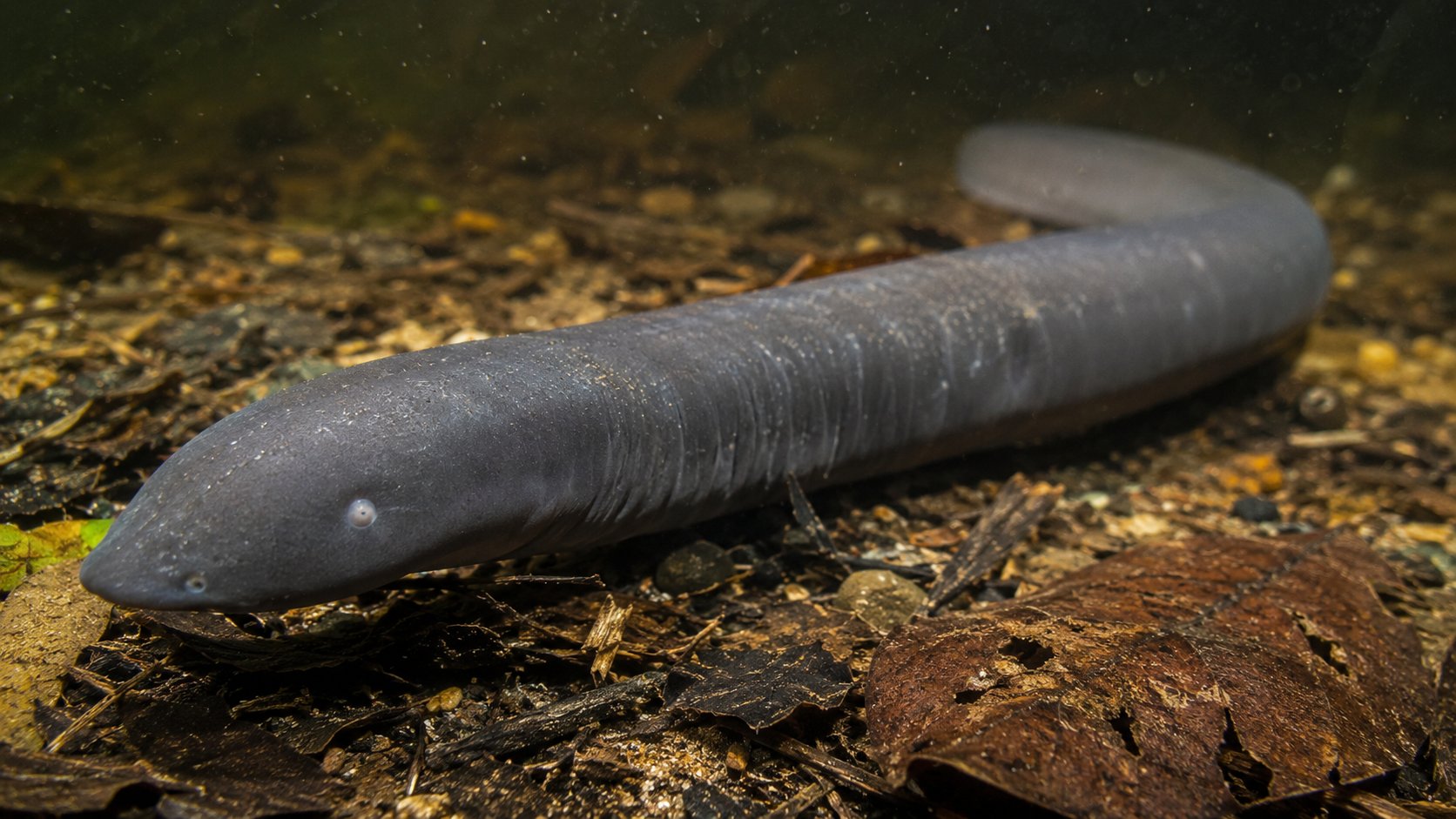
The rubber eel, Typhlonectes natans, is one of those animals that seems designed to surprise almost everyone who meets it. At first glance, it looks like a strange eel, a giant worm, or a smooth aquatic snake, but it is none of those things. It is a caecilian, a member of a little-known order of limbless amphibians that shares the amphibian class with frogs, toads, newts, and salamanders. Its common name is catchy, but it can also be misleading, because the rubber eel is not a fish and does not belong with true eels. It is a freshwater amphibian with a long body, smooth skin, tiny eyes, and a secretive life spent mostly in warm South American waters. Smithsonian’s National Zoo identifies the species as an aquatic caecilian found in Colombian and Venezuelan lowland rivers and streams, with adults reaching about 18 to 22 inches in length. Part of the rubber eel’s appeal is that it makes familiar categories feel suddenly too small. General readers know frogs hop, salamanders crawl, and eels swim, yet this animal blurs those expectations into one sleek, dark, mysterious form. Its body is marked by subtle ring-like folds that give it a segmented look, while its glossy skin and underwater movements help explain the “rubber eel” nickname. Although it may look simple, it is packed with specialized amphibian traits, including skin-based respiration, sensory adaptations for murky habitats, and live birth. For anyone interested in unusual animals, freshwater wildlife, amphibian diversity, or the hidden life of tropical rivers, the rubber eel is a perfect creature to discover.
A: No. It is a caecilian, which is a limbless amphibian.
A: Its scientific name is Typhlonectes natans.
A: It is native to freshwater habitats in Colombia and Venezuela.
A: Adults usually grow about 18 to 22 inches long.
A: No. Like all living caecilians, it has a limbless body.
A: It breathes mostly through its skin, but it can also surface for air.
A: It eats animal prey such as worms, insect larvae, small fish, and other meaty foods.
A: No. This species gives birth to live young.
A: It is not considered dangerous to people, though it should be handled gently and only when necessary.
A: Its eyes are very small and limited, so it depends more on other senses.
Not an Eel, Not a Snake, but a Caecilian
The most important thing to understand about the rubber eel is that it belongs to the caecilians, a group many people never encounter in schoolbooks or wildlife documentaries. Caecilians are limbless amphibians, and many species spend their lives underground, pushing through soil like living drills. The rubber eel is unusual within that already unusual group because it is fully aquatic, which means it is built for life in water rather than for burrowing only through land. Its body form may remind people of eels or snakes, but its anatomy places it firmly among amphibians. Smithsonian notes that caecilians’ bones, teeth, fat bodies, and other structures show their relationship to frogs and salamanders, even though their appearance is very different.
This identity matters because names shape how people imagine animals. Calling Typhlonectes natans a rubber eel makes the species memorable, but it also hides the evolutionary story that makes it so fascinating. True eels are fish with gills, fins, and a very different ancestry, while rubber eels are vertebrate amphibians with lungs, skin that plays a major role in breathing, and reproductive traits unlike those of most familiar fish. They do not have limbs, but the absence of legs does not make them snakes either. Instead, the rubber eel stands as a reminder that evolution has produced many ways to move through water, mud, and darkness. Its shape is not a mistake of classification; it is a solution to life in soft-bottomed freshwater worlds.
The Shape of a Secret Swimmer
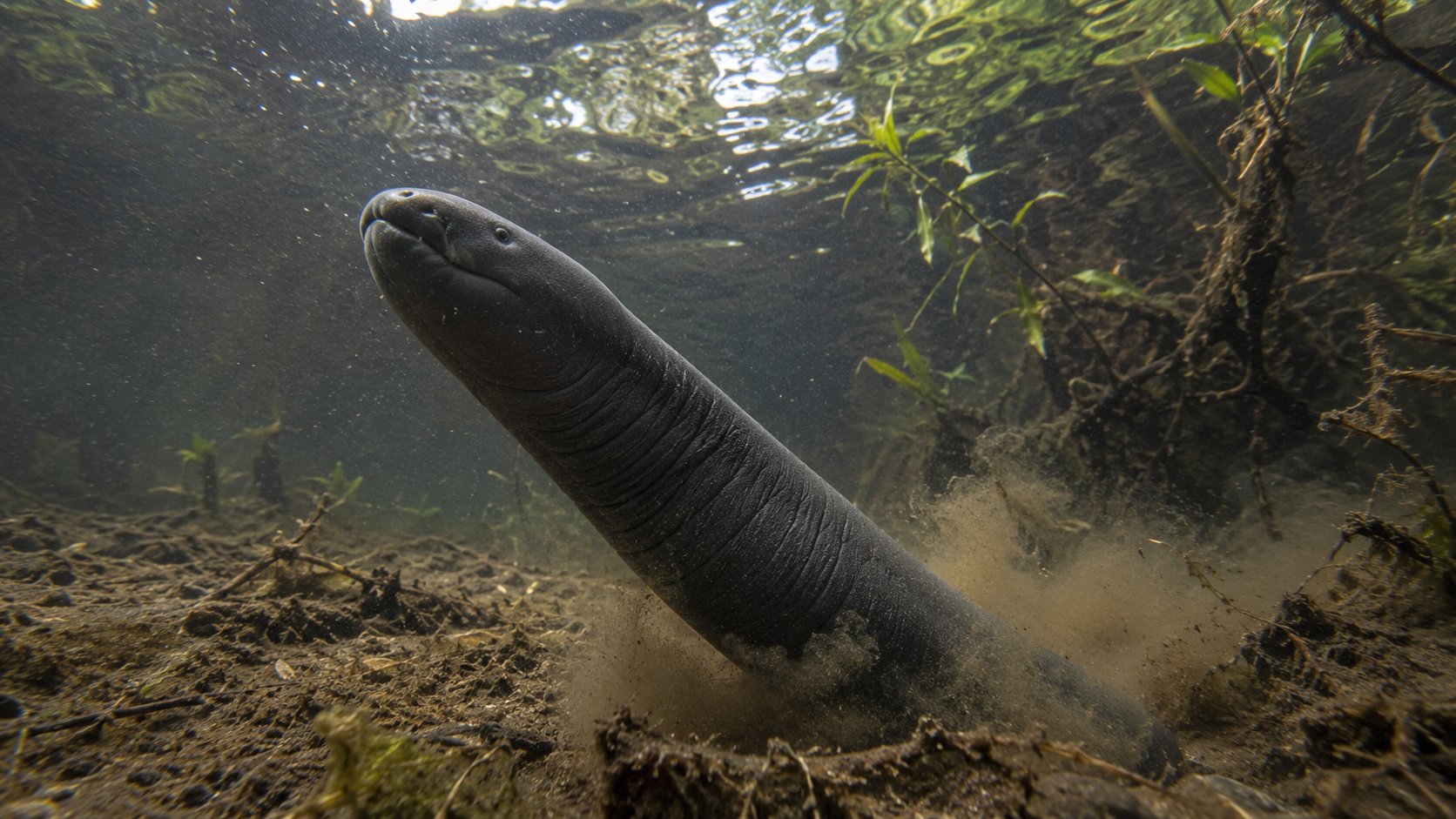
The rubber eel has a long, cylindrical body that narrows only subtly, giving it a smooth, muscular look in the water. Adults are commonly described as dark gray, purplish, or black, and their skin can appear slick because it is moist and mucus-covered, as expected in an amphibian. USGS describes the Rio Cauca caecilian as having fleshy segmented folds along the body and a maximum length of about 45 to 55 centimeters, or 18 to 22 inches. This size makes it large enough to be impressive in an aquarium or field setting, yet small enough to disappear easily among roots, sediment, aquatic plants, and leaf litter. Its head is not sharply distinct from its body, which helps create the continuous eel-like profile that inspired its common name. The animal’s eyes are small and not especially useful in the way human eyes are useful, but that does not mean the rubber eel is poorly equipped. Caecilians have sensory tentacles near the head that help them gather chemical information from the environment, a valuable skill in dark, muddy, or debris-filled water. Smithsonian describes this sensory organ as a tentacle on the upper jaw behind the nostril that carries chemical messages. This is a wonderful example of an animal being adapted to its own world rather than to ours. In clear daylight, a rubber eel may seem nearly blind and plain, but in its natural environment, it is a finely tuned swimmer that can explore by scent, touch, vibration, and subtle chemical trails.
Home Waters of South America
The native range of the rubber eel lies in northern South America, especially freshwater systems in Colombia and Venezuela. USGS lists the Cauca and Magdalena River drainage basins in Colombia and the Maracaibo Basin in Venezuela and surrounding areas as part of the species’ native range, with a possible but unconfirmed presence in Trinidad and Tobago. These are warm, productive freshwater landscapes where rivers, streams, marshes, ponds, and seasonally flooded lowlands can create a patchwork of habitats. In these places, a long-bodied amphibian can use soft sediment, submerged vegetation, and underwater cover to remain hidden from predators and close to food. The species is not a flashy open-water swimmer like a silver fish in bright current; it is more like a shadow moving through the lower layers of the habitat.
Its home waters also help explain why the rubber eel is not as widely known as many more visible animals. A bird may announce itself from a branch, and a frog may call loudly during rainy nights, but a rubber eel lives in a quieter zone of mud, roots, and dim water. Smithsonian notes that rubber eels burrow in sand and leaf litter, which is exactly the kind of behavior that keeps an animal out of sight even when it is nearby. This hidden lifestyle can make the species seem rare or mysterious to casual observers, even where it may be locally present. For naturalists, that secrecy is part of the fascination, because it suggests that tropical freshwater habitats still hold many stories beneath the surface.
Breathing Through Skin and Surfacing for Air
Like other amphibians, the rubber eel has a relationship with water that is deeper than simple swimming. Its skin is not just a covering; it is part of how the animal exchanges gases with the world around it. Smithsonian states that caecilians breathe primarily through their skin but occasionally come to the surface to breathe air through their lungs. USGS similarly notes that Rio Cauca caecilians can breathe air, while most respiration happens through the skin. This combination allows the rubber eel to live as an aquatic amphibian while still retaining a connection to atmospheric oxygen. That breathing strategy is one reason clean, suitable water matters for animals like this, even when conservation is not the main focus of the story. Skin-based respiration depends on a moist, functioning skin surface, so environmental conditions can matter in ways that are different from the needs of scaled reptiles or gill-breathing fish. The rubber eel’s skin must remain healthy, moist, and able to perform its delicate work. In a warm tropical stream or marsh, the animal’s body is constantly interacting with the chemistry of the water around it. This makes the rubber eel feel almost inseparable from its habitat, as if the animal and its river are part of the same breathing system.
A Hunter in Murky Places
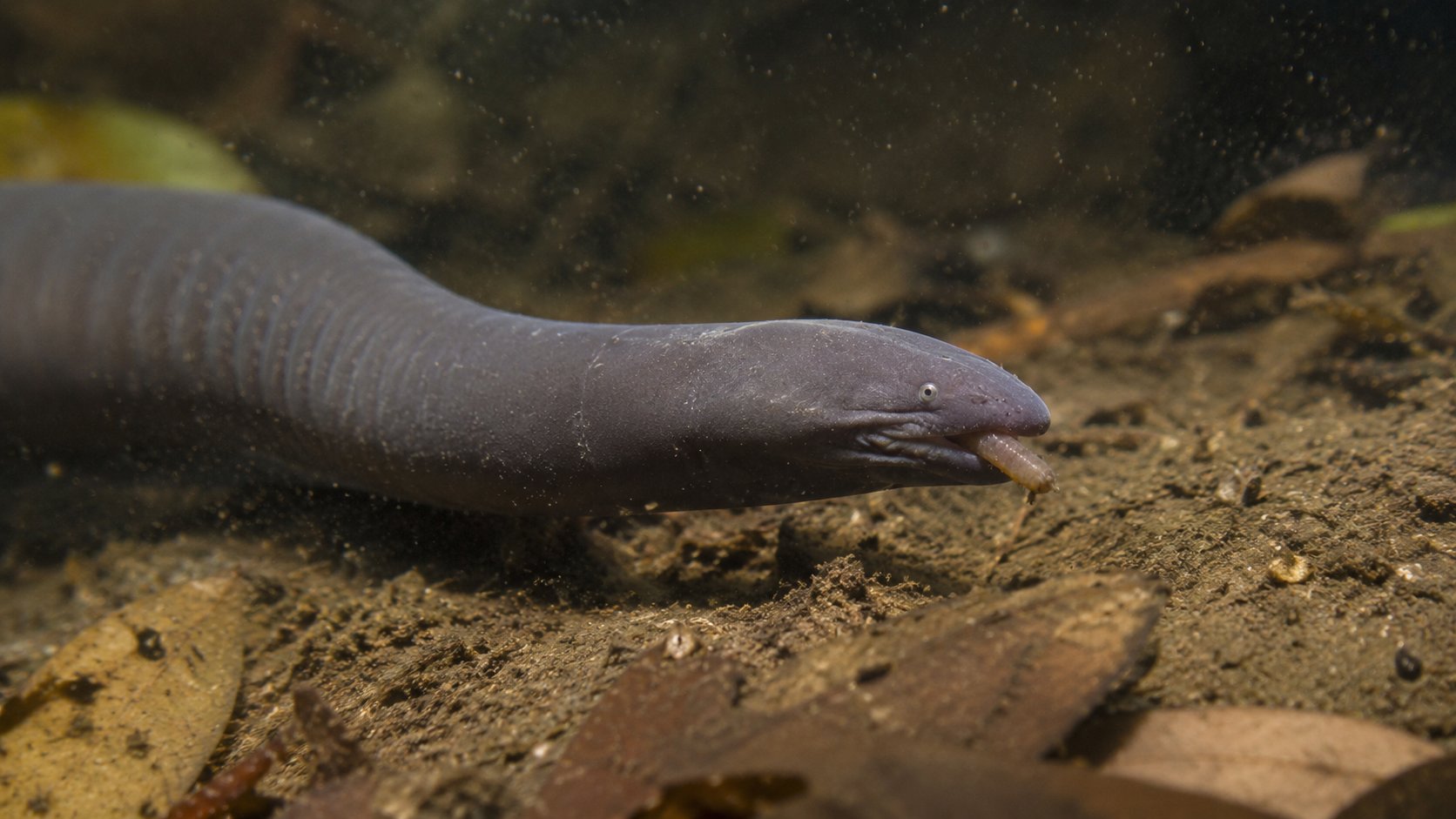
The rubber eel is carnivorous, but its exact wild diet is still not as fully documented as that of many better-known animals. Smithsonian says aquatic caecilians feed on insect larvae, worms, and small fish, using a slow approach before quickly seizing prey. USGS adds that little is known about the wild diet of Rio Cauca caecilians, though observations of them eating fish entrails suggest they may act as both scavengers and predators. This flexible feeding style makes sense for a secretive aquatic animal living among sediment and organic debris. In a river or marsh, opportunities can include live prey, disturbed invertebrates, small aquatic animals, or bits of animal matter left by other events in the ecosystem.
The rubber eel’s teeth are not for chewing in the mammal sense; they are for gripping, holding, and tearing. A prey animal in muddy water may have only a moment before the caecilian’s head darts forward. Once food is seized, the rubber eel can use its body strength and jaws to manage meals in a habitat where visibility is limited and escape routes are everywhere. This is not a dramatic chase predator built for speed across open water. It is a close-range hunter and opportunist, shaped by patience, sensory awareness, and the ability to move through tight spaces where other animals may not notice it until too late.
Live Birth in an Amphibian Body
One of the rubber eel’s most fascinating traits is that it gives birth to live young. Many people associate amphibians with eggs laid in water, tadpoles, and metamorphosis, but caecilians often break that simple pattern. USGS states that Rio Cauca caecilians are viviparous, meaning they give birth to live young, and that females usually have two to 10 offspring per litter. Smithsonian’s animal page also notes that the caecilians on exhibit give birth to one or more live young. This reproductive strategy gives the rubber eel a life history that feels surprisingly advanced to readers who expect amphibians to follow a frog-like script. Live birth is especially interesting in an animal that already seems to challenge expectations. A female rubber eel carries developing young internally, and the young emerge ready for life in water rather than as helpless eggs scattered into the environment. This does not mean their lives are easy, because small aquatic animals face predators, changing water conditions, and competition from the beginning. Still, live birth gives the species a distinctive place in the amphibian world and makes it a powerful example of reproductive diversity. The more one learns about Typhlonectes natans, the harder it becomes to treat amphibians as a single simple category.
Senses Built for a Dim World
The rubber eel does not need bright colors, large eyes, or showy displays to succeed. Its world is often dim, cluttered, and chemically rich, so its senses are tuned to information that people may barely notice. The small eyes are part of this story, because vision is not the star sense in a muddy streambed or under leaf litter. Smithsonian describes adult caecilian eyes as often small and useless, while emphasizing the sensory tentacle that helps carry chemical messages. To a human observer, that may sound like a limitation, but to the animal, it is an efficient way to read the environment.
Imagine moving through a submerged maze of roots, leaves, sand, and soft mud, where light fades quickly and every surface holds scent. A rubber eel can follow chemical cues, detect nearby movement, and use touch to navigate spaces where a more visually dependent animal might struggle. Its smooth body can slide through narrow gaps, and its ringed folds may help with flexibility and movement. This is why the rubber eel should not be viewed as primitive or unfinished. It is specialized, and its strangeness is really a sign that it belongs to a world most people rarely see.
Rubber Eels and Human Curiosity
Because rubber eels look so unusual, they have attracted attention in aquariums, zoos, and the pet trade. USGS notes that Rio Cauca caecilians are widely available in the pet and aquarium trade and are commonly bred in captivity by hobbyists. This visibility has helped more people learn that caecilians exist, but it also creates confusion when the animals are marketed or casually described as fish. A rubber eel in an aquarium may swim like an eel and rest like a strange underwater worm, yet it remains an amphibian with very particular needs. Its skin, water conditions, diet, and stress levels must be taken seriously. For general readers, the best takeaway is respect rather than impulse. The rubber eel is an animal to admire for its biology, not a novelty object. Its unusual body can inspire curiosity in children and adults alike, especially because it connects to bigger themes such as evolution, freshwater ecology, amphibian diversity, and the hidden lives of tropical animals. In professional care settings, rubber eels can serve as ambassadors for overlooked amphibians. They remind visitors that not every remarkable animal has fur, feathers, bright scales, or a familiar face.
A Surprising Florida Footnote
The rubber eel also has a modern story outside its native range. USGS reports that a Rio Cauca caecilian was collected in Miami-Dade County, Florida, in 2019 and was considered the first caecilian collected in the United States. The same source states that the introduction was likely the result of an aquarium release or escape, and it lists nonindigenous occurrences in Florida. This does not mean the species is suddenly a familiar Florida animal, but it does show how the aquarium trade can move unusual species far beyond their natural homes. It also shows why responsible animal ownership matters even with creatures that seem obscure.
The ecological impact of introduced rubber eels in Florida is not yet fully understood. USGS is careful to say that the impacts are currently unknown because studies have not determined how the species has affected ecosystems in the invaded range. That measured statement is important because it avoids exaggeration while still taking the issue seriously. Non-native species deserve careful study, not instant panic or careless dismissal. For the rubber eel, the Florida record adds another layer to its story: a hidden South American amphibian has become part of a broader conversation about trade, release, monitoring, and freshwater ecosystem responsibility.
Conservation Without the Drama
The rubber eel is not usually presented as a headline conservation crisis, and that is worth saying clearly. Smithsonian lists the aquatic caecilian’s conservation status as Least Concern on its fact sheet. That does not mean every local habitat is safe, and it does not mean people should ignore pollution, habitat alteration, or irresponsible collecting. It simply means the species is not currently treated in the same urgent category as many highly threatened amphibians. A balanced view is best: the rubber eel appears relatively secure overall, but its freshwater habitats still deserve thoughtful care. Freshwater animals often depend on conditions that people can easily change without noticing. Runoff, trash, altered streambanks, aquarium releases, and changes to wetlands can all affect aquatic life. For a skin-breathing amphibian that hides in sediment and leaf litter, water quality and habitat structure are part of daily survival. The conservation message here does not need to be heavy-handed. The rubber eel invites a quieter kind of appreciation, one based on understanding that even strange, hidden animals have a place in the living fabric of rivers and wetlands.
Why the Rubber Eel Matters
The rubber eel matters because it expands the imagination. It proves that amphibians are not limited to the familiar forms of frogs on lily pads or salamanders beneath logs. It shows that a creature can look like an eel, breathe like an amphibian, give birth to live young, and navigate with senses that feel almost alien to us. It also highlights the importance of caecilians, an entire order of amphibians that remains underappreciated by the public. When people discover Typhlonectes natans, they often realize that the animal kingdom is stranger, richer, and more inventive than they assumed.
As a reference animal, the rubber eel is perfect for teaching classification, adaptation, freshwater ecology, and the difference between common names and scientific identity. Its story is accessible because anyone can see why it was nicknamed an eel, yet it becomes more exciting once that first impression turns out to be wrong. Beneath the smooth dark skin is not a fish, not a snake, and not a worm, but a specialized amphibian with a long evolutionary history. That surprise is the heart of its appeal. The rubber eel is a living reminder that some of nature’s best stories begin in the mud, under the leaves, and just below the surface of quiet water.
Animal Product Reviews
Dive into Animal Streets’ Animal Product Reviews — your guide to the best gear, gifts, books, and gadgets inspired by the animal kingdom. From land-roaming lions to ocean-gliding whales, from household pets to prehistoric giants, we explore top-rated products for enthusiasts, educators, and animal lovers alike. Whether you’re shopping for toys, decor, field gear, or fun collectibles, we’ve sniffed out the best so you can discover it all in one wild place!