
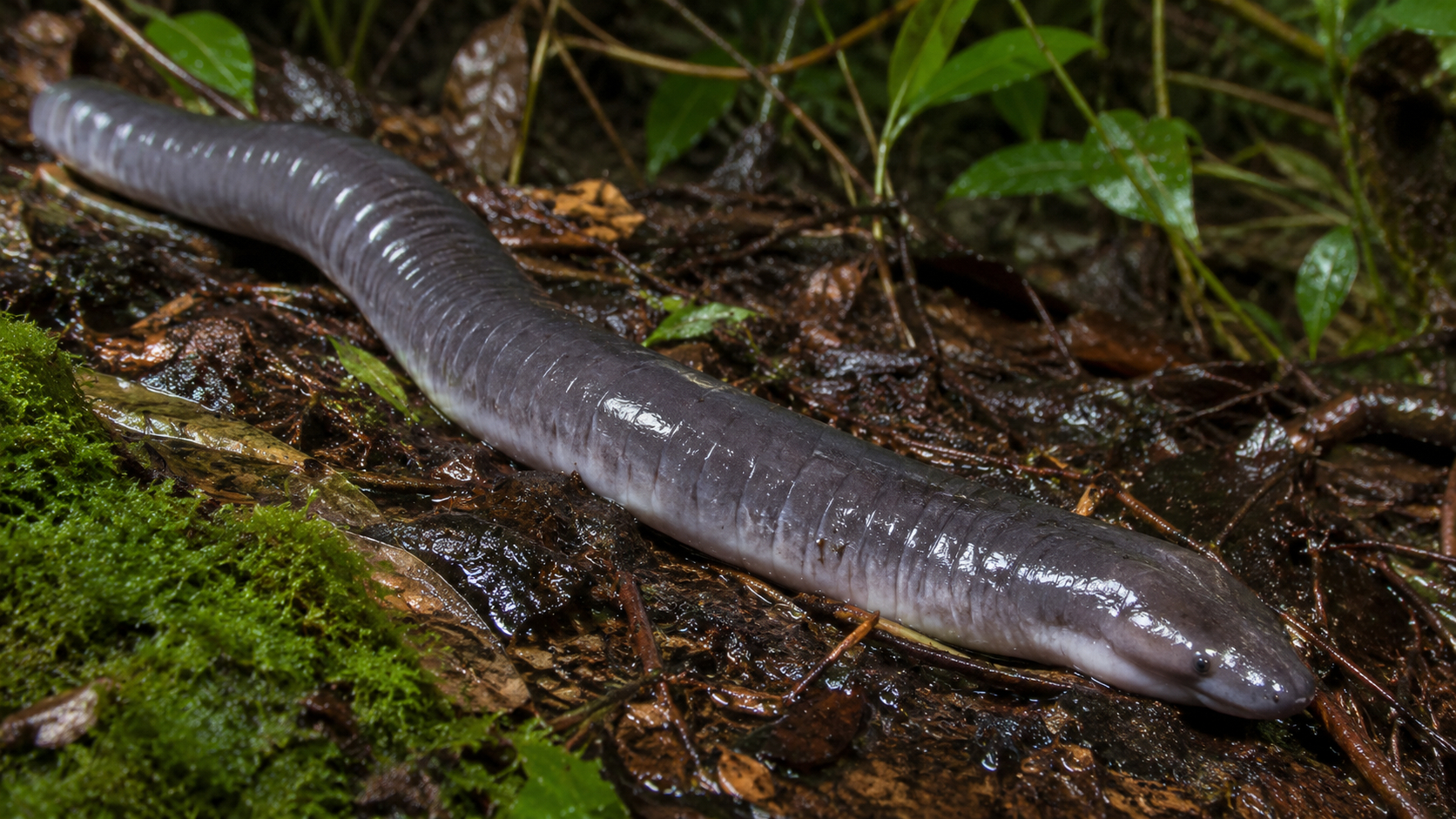
Thompson’s Caecilian, scientifically known as Caecilia thompsoni, is one of the most astonishing amphibians most people have never heard of. At first glance, it may look like an enormous earthworm or a smooth-bodied snake, but it belongs to a completely different branch of amphibian life called caecilians. These secretive animals live mostly underground, where their long, limbless bodies move through soil, mud, roots, and leaf litter with quiet efficiency. Thompson’s Caecilian is especially remarkable because it is widely recognized as one of the largest known caecilians, with commonly cited lengths near 1.5 meters and records suggesting even larger individuals. It is endemic to Colombia, meaning its natural range is tied to one country and especially to humid regions associated with the Magdalena Valley and nearby departments. Unlike frogs and salamanders, caecilians rarely step into the public spotlight, partly because they spend so much of their lives hidden beneath the surface. Yet that hidden lifestyle is exactly what makes Thompson’s Caecilian so fascinating. It is a creature built for a world of darkness, pressure, moisture, and scent rather than sunlight and open air. Its body reveals the story of an amphibian lineage that solved survival in a completely different way from the jumping frog or the pond-dwelling newt. For general readers, Thompson’s Caecilian offers a thrilling reminder that some of Earth’s most impressive animals are not always the most visible ones.
A: No, it is a limbless amphibian, not a reptile.
A: No, it only looks worm-like; it is a vertebrate with a skull, backbone, and jaws.
A: It lives in Colombia, especially in humid tropical and subtropical habitats.
A: It spends most of its time underground in damp soil and leaf litter.
A: It is often reported near 5 feet long, making it one of the largest known caecilians.
A: It likely eats earthworms and other soil-dwelling invertebrates.
A: Yes, but they are small and reduced because it relies more on touch and chemical cues.
A: They help the caecilian detect chemical signals while moving through soil.
A: It is currently listed as Least Concern, though healthy moist habitats remain important.
A: It is best to leave it alone and let it return safely to damp soil or cover.
A Creature That Redefines What an Amphibian Can Be
When many people hear the word amphibian, they picture frogs sitting on lily pads or salamanders slipping beneath damp logs. Thompson’s Caecilian challenges that familiar image immediately. It has no limbs, no obvious neck, and only a short tail, giving it a streamlined body that is perfectly suited for pushing through moist soil. Its skin is smooth and ringed with folds called annuli, which give the animal a segmented appearance without making it an actual worm. This body plan is not primitive or unfinished; it is highly specialized for a subterranean life that demands strength, flexibility, and sensitivity.
Caecilians belong to the order Gymnophiona, a group of amphibians that evolved into expert burrowers. Their eyes are often reduced and partly hidden, because vision is less useful in underground tunnels than touch, smell, and chemical sensing. Thompson’s Caecilian also has sensory tentacles located between the eyes and nostrils, a classic caecilian feature that helps it investigate the world around its head. These tentacles are not decorative quirks; they are part of how the animal reads its environment in darkness. In a habitat where every movement happens through soil and leaf litter, the head becomes a living exploration tool.
Colombia’s Underground Giant
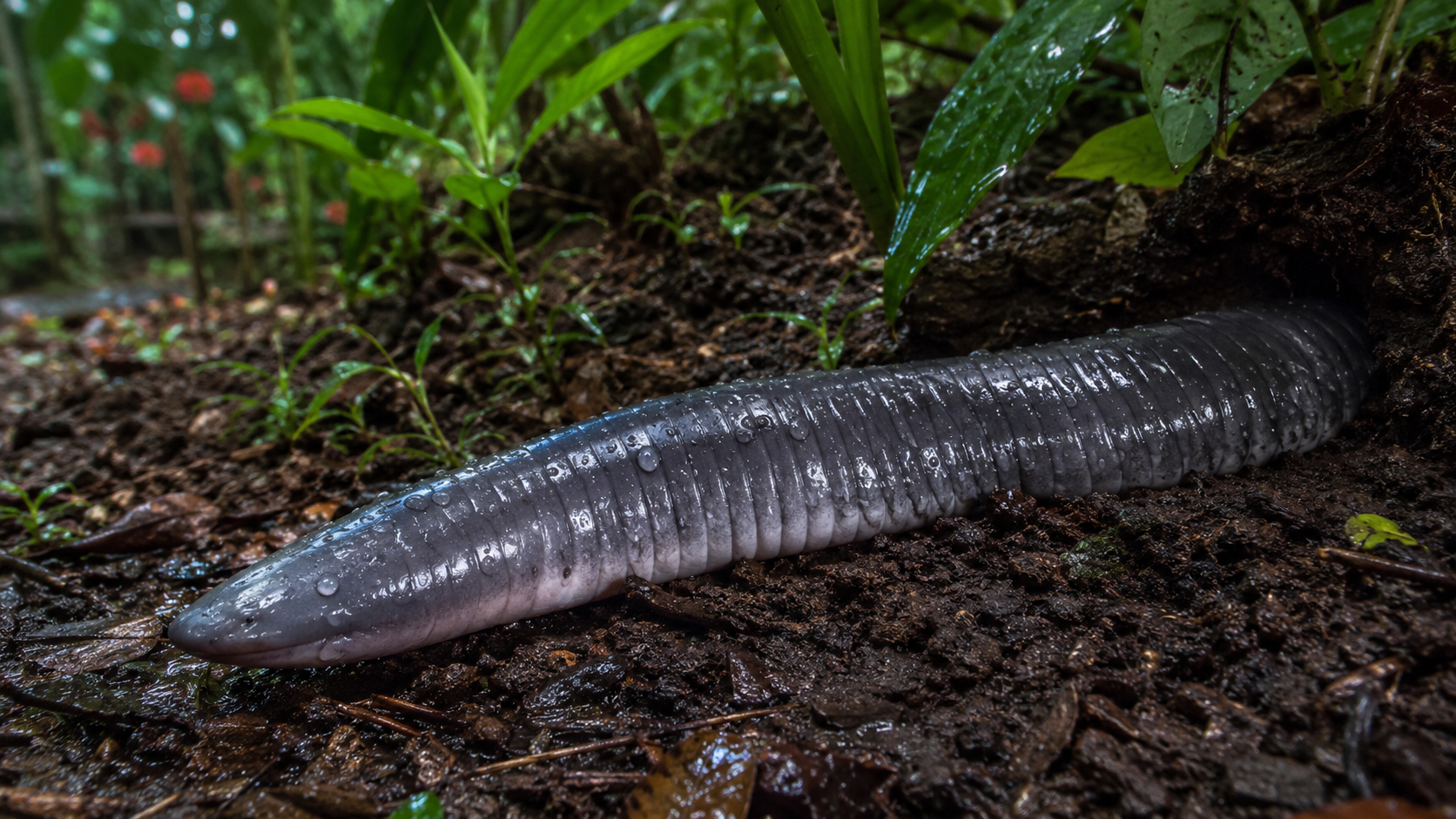
Thompson’s Caecilian is native to Colombia, where it has been recorded from the Magdalena Valley and several departments, including Antioquia, Tolima, Caldas, Cesar, Cundinamarca, Huila, and Boyacá. Its known elevation range has been reported from roughly lowland areas up to about 1,600 meters, placing it across humid lowland and foothill environments rather than in one narrow microhabitat. This range helps explain why the species may appear in forests, plantations, rural gardens, and degraded former forest habitats when moisture and soil conditions remain suitable. Even so, seeing one is uncommon because its lifestyle keeps it below the surface for much of the time. The Colombian landscape gives this species a rich ecological stage. Tropical moisture, deep soils, stream edges, decaying vegetation, and shaded ground all help create the kind of environment a large caecilian can use. The animal’s presence in altered habitats such as plantations and rural gardens suggests a degree of tolerance, but that does not mean it is immune to environmental change. Soil-dwelling amphibians depend on moisture, cover, and healthy underground communities of invertebrates. When those conditions are disturbed too severely, the hidden world they rely on can become fragmented or unsuitable.
Built Like a Living Tunnel
The body of Thompson’s Caecilian is long, cylindrical, muscular, and designed for moving through resistance. While a snake often glides across surfaces or through open spaces, a caecilian must push into a dense medium that presses back from every direction. Its skull is strong, its body is compact, and its smooth skin helps reduce friction as it moves through saturated earth. The annuli along the body may help with flexibility and traction, allowing the animal to bend and brace as it travels underground. In a sense, Thompson’s Caecilian is not merely crawling through tunnels; it is physically negotiating with the soil itself.
Its coloration is practical rather than flashy. The upper body is typically described as dark gray to slate-toned, while the underside may be paler. This subdued palette makes sense for an animal that lives in mud, leaf litter, and shadow. Its skin must remain moist, like other amphibians, and that moisture connects the animal directly to the condition of its surroundings. Dry soil can be stressful or dangerous, while humid soil supports movement, breathing through the skin, and access to prey. Every feature of Thompson’s Caecilian points toward a life shaped by dampness and darkness.
The Largest Known Caecilian Mystery
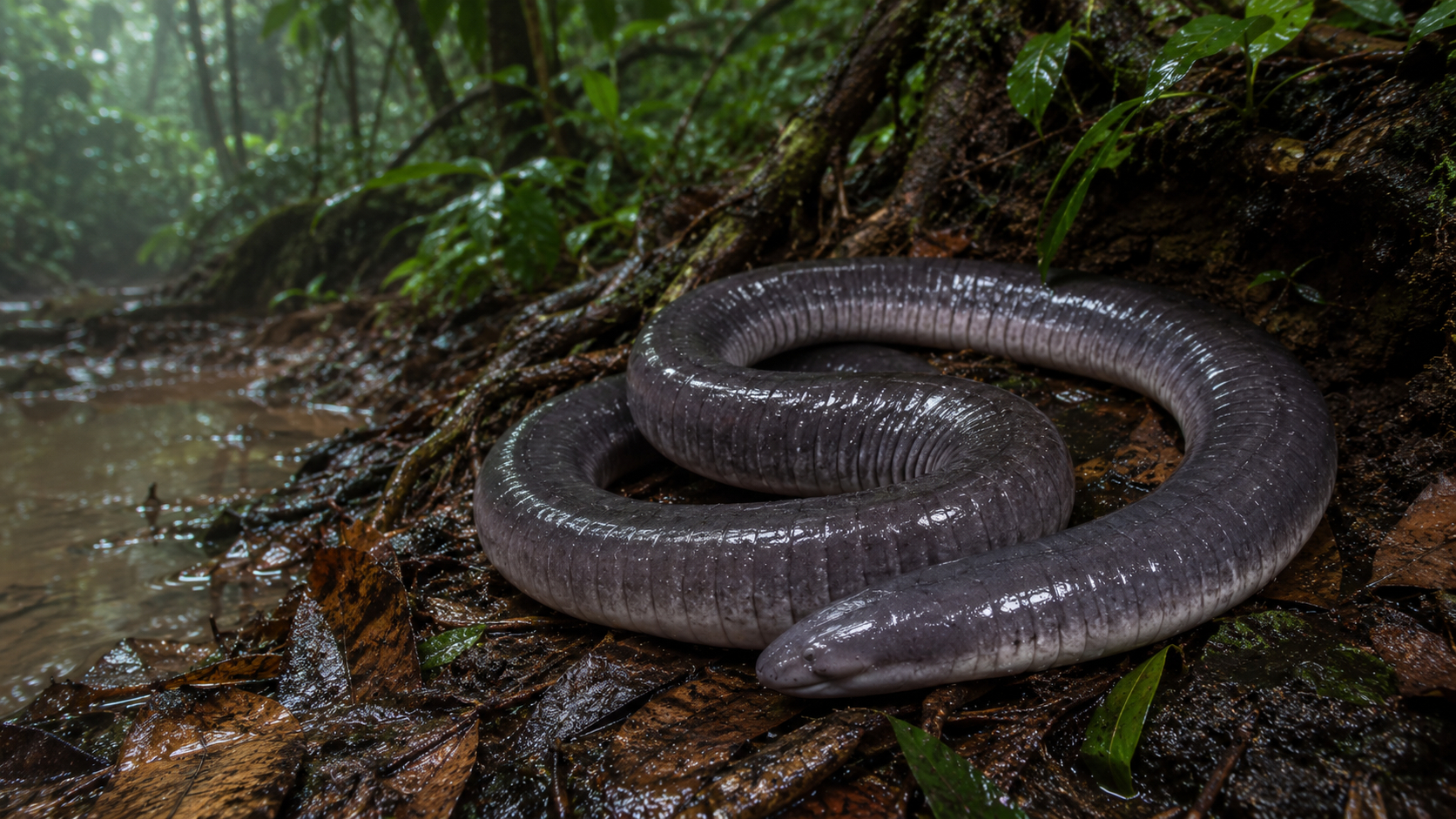
Thompson’s Caecilian has a special claim to fame: it is often described as the largest known caecilian. Many references give its length at around 1.5 meters, or about five feet, with a body mass approaching one kilogram. Some reports have documented even longer specimens, including one exceeding previous maximum size records, which adds to the species’ almost legendary status among amphibian enthusiasts. That makes it larger than many people expect any burrowing amphibian to be. Its size raises exciting questions about how such a large underground predator lives. A bigger body may allow it to overpower larger prey, travel through broader soil spaces, and store more energy during periods when food is harder to find. At the same time, large size likely increases its need for stable moisture and suitable shelter. It is not a tiny animal disappearing into a crack; it is a powerful, elongated amphibian that needs a functioning underground habitat. This combination of size and secrecy gives Thompson’s Caecilian an unforgettable place in the amphibian world.
Life in the Damp Dark
The underground world of Thompson’s Caecilian is not empty. It is filled with roots, fungal threads, insect larvae, earthworms, soft-bodied invertebrates, decaying leaves, mineral particles, water films, and small air pockets. For a surface-dwelling animal, this may sound cramped and uncomfortable. For a caecilian, it is home. The animal moves through this habitat using pressure, touch, chemical cues, and body strength rather than the visual landmarks we depend on above ground.
Moisture is the key that keeps this underground habitat alive. Rain softens the soil, increases invertebrate activity, and may encourage caecilians to move closer to the surface. During wetter periods, individuals may be more likely to appear beneath logs, in gardens, near streambanks, or along muddy slopes. During drier conditions, they may retreat deeper into the ground where humidity remains higher. This pattern helps explain why people can live near caecilians for years and rarely notice them, even when the animals are present nearby.
What Thompson’s Caecilian Eats
Thompson’s Caecilian is generally understood to feed on soil-dwelling animals, especially invertebrates such as earthworms and other soft-bodied prey. Like many caecilians, it likely hunts by using chemical and tactile information in the soil rather than by chasing prey visually. Its head moves through the ground like a probe, detecting edible life hidden among roots and organic matter. Once it locates prey, its jaws and body strength help it secure the meal. This makes it part of the underground food web that many people never see but depend on indirectly through soil health. Its role as a predator matters because soil ecosystems are full of interactions. Invertebrates break down organic matter, mix soil, recycle nutrients, and support larger animals. A large caecilian participates in that system by feeding within it and moving through it. Although it is not usually discussed in the same way as charismatic forest mammals or colorful birds, it helps demonstrate how biodiversity extends below our feet. Thompson’s Caecilian is part of the living machinery of tropical soil.
Senses Designed for a Hidden World
A surface animal often survives by watching, listening, and reacting to distant movement. Thompson’s Caecilian lives in a world where distance is short, light is scarce, and information arrives through contact. Its small, reduced eyes are not useless, but they are not the main tool for understanding its environment. Instead, the animal relies heavily on touch, smell, and specialized chemical sensing. The tentacles near its snout are among the most fascinating adaptations in the caecilian body.
These tentacles can help sample chemical cues and guide the animal through the soil. They give the caecilian a way to investigate its surroundings while keeping its head streamlined for burrowing. This is a brilliant compromise: the body remains built for tunneling, while the senses remain active and refined. To a human observer, Thompson’s Caecilian may seem simple because it lacks visible limbs and expressive eyes. In reality, it is a highly adapted sensory specialist living in a world we are poorly equipped to understand.
Reproduction and the Next Generation
Caecilian reproduction is one of the most interesting areas of amphibian biology, and many species have reproductive strategies that surprise even experienced nature lovers. Some caecilians lay eggs, while others give birth to live young. Thompson’s Caecilian is commonly described as likely giving birth to live young, although many details of its reproductive behavior remain less familiar to the public than those of frogs or salamanders. This lack of widespread knowledge is not unusual for caecilians because their secretive habits make field observation difficult. In caecilians that produce live young, the developing offspring may receive nourishment within the mother before birth, which is very different from the image of frog eggs floating in a pond. This reproductive style fits the underground life well, because open water is not always central to the caecilian life cycle in the same way it is for many frogs. For Thompson’s Caecilian, the next generation likely begins in protected, humid environments where young animals can avoid drying out. The more scientists learn about caecilian reproduction, the clearer it becomes that amphibians are far more diverse than their popular image suggests.
Why It Is Not a Snake or a Worm
Thompson’s Caecilian is often mistaken for a snake or a giant worm, and that confusion is understandable. It has no legs, it is long and cylindrical, and it lives close to or under the ground. However, it is an amphibian, not a reptile or an annelid worm. Unlike snakes, caecilians have amphibian skin that must remain moist, and they belong to a lineage closer to frogs and salamanders than to lizards or serpents. Unlike earthworms, they have a backbone, a skull, jaws, and a much more complex vertebrate body plan.
This distinction matters because it changes how we understand the animal. Thompson’s Caecilian is not a “missing link” between worms and snakes, and it is not a strange version of either. It is part of its own ancient and successful amphibian group. Its worm-like shape is an example of convergent evolution, where unrelated animals develop similar forms because they face similar environmental challenges. In this case, a long, smooth, limbless body is simply an excellent design for life underground.
A Quiet Neighbor in Human Landscapes
One of the most interesting things about Thompson’s Caecilian is its ability to occur in rural gardens, plantations, and degraded former forest, provided suitable moist conditions remain. This does not mean the animal thrives everywhere people modify the land. It means that some human-influenced environments can still provide pockets of usable habitat if soil structure, shade, moisture, and prey remain available. A shaded garden with leaf litter and damp soil may offer more refuge than a dry, compacted, heavily cleared landscape. For local communities, this species is more likely to be encountered after rain, during soil work, or near moist ground. Because it looks unusual, people may react with fear or confusion. Education can make a big difference by helping people recognize caecilians as harmless, fascinating amphibians rather than dangerous snakes. While any wild animal should be left undisturbed, understanding what it is can reduce unnecessary harm. Thompson’s Caecilian is not a monster in the mud; it is a specialized native amphibian doing its job underground.
Conservation Without the Drama
Thompson’s Caecilian is currently listed as Least Concern by the IUCN, which means it is not considered at immediate high risk of extinction across its known range. That status is encouraging, especially for such an unusual endemic amphibian. However, Least Concern does not mean “no concern at all.” Soil-dwelling amphibians can still be affected by habitat loss, pollution, drainage, soil compaction, road expansion, and the reduction of shaded, moist ground.
A balanced conservation view is best. This species appears to have some flexibility in habitat use, but it still depends on moisture-rich environments and healthy underground ecosystems. Protecting forest patches, riparian vegetation, shaded soils, and natural leaf litter benefits not only Thompson’s Caecilian but also many other small organisms that support the broader ecosystem. Because the species is secretive, long-term knowledge may remain incomplete, making continued observation valuable. Conservation for this animal is less about alarm and more about respecting the hidden habitats that keep tropical biodiversity functioning.
Why Thompson’s Caecilian Matters
Thompson’s Caecilian matters because it expands our sense of what nature can be. It reminds us that amphibians are not limited to ponds, choruses, and springtime eggs. Some are silent giants moving beneath tropical soil, shaped by pressure, moisture, darkness, and time. Its size alone makes it extraordinary, but its lifestyle makes it even more compelling. It is a creature that turns the ground itself into a habitat, a hunting field, and a shelter. For readers, this animal is a doorway into a less familiar side of biodiversity. It shows that the most interesting creatures are not always colorful, visible, or easy to photograph. Some are hidden because hiding is their greatest strength. Thompson’s Caecilian invites curiosity about soil, tropical forests, amphibian evolution, and the many lives unfolding below the surface. Once you know it exists, the forest floor feels less like a carpet of leaves and more like the roof of a secret world.
The Hidden Giant Worth Remembering
Thompson’s Caecilian is not famous in the way jaguars, poison dart frogs, or toucans are famous. It does not advertise itself with bright colors, songs, or dramatic displays. Instead, it survives through quiet specialization, moving through Colombia’s damp earth with a body built for an environment most people never think to explore. Its scientific name, Caecilia thompsoni, belongs to an amphibian that is both ancient in lineage and surprisingly modern in its evolutionary efficiency. It is a reminder that nature’s creativity is not always loud.
The story of Thompson’s Caecilian is ultimately a story of hidden excellence. It is large but elusive, simple-looking but highly adapted, obscure but scientifically fascinating. It belongs to Colombia’s living heritage and to the broader wonder of amphibian diversity. For general readers, it offers something rare: the excitement of discovering an animal that feels almost imaginary but is entirely real. Beneath wet leaves and tropical soil, Thompson’s Caecilian carries on as one of the most remarkable underground amphibians on Earth.
Animal Product Reviews
Dive into Animal Streets’ Animal Product Reviews — your guide to the best gear, gifts, books, and gadgets inspired by the animal kingdom. From land-roaming lions to ocean-gliding whales, from household pets to prehistoric giants, we explore top-rated products for enthusiasts, educators, and animal lovers alike. Whether you’re shopping for toys, decor, field gear, or fun collectibles, we’ve sniffed out the best so you can discover it all in one wild place!