
Recognizing an Amazon milk frog
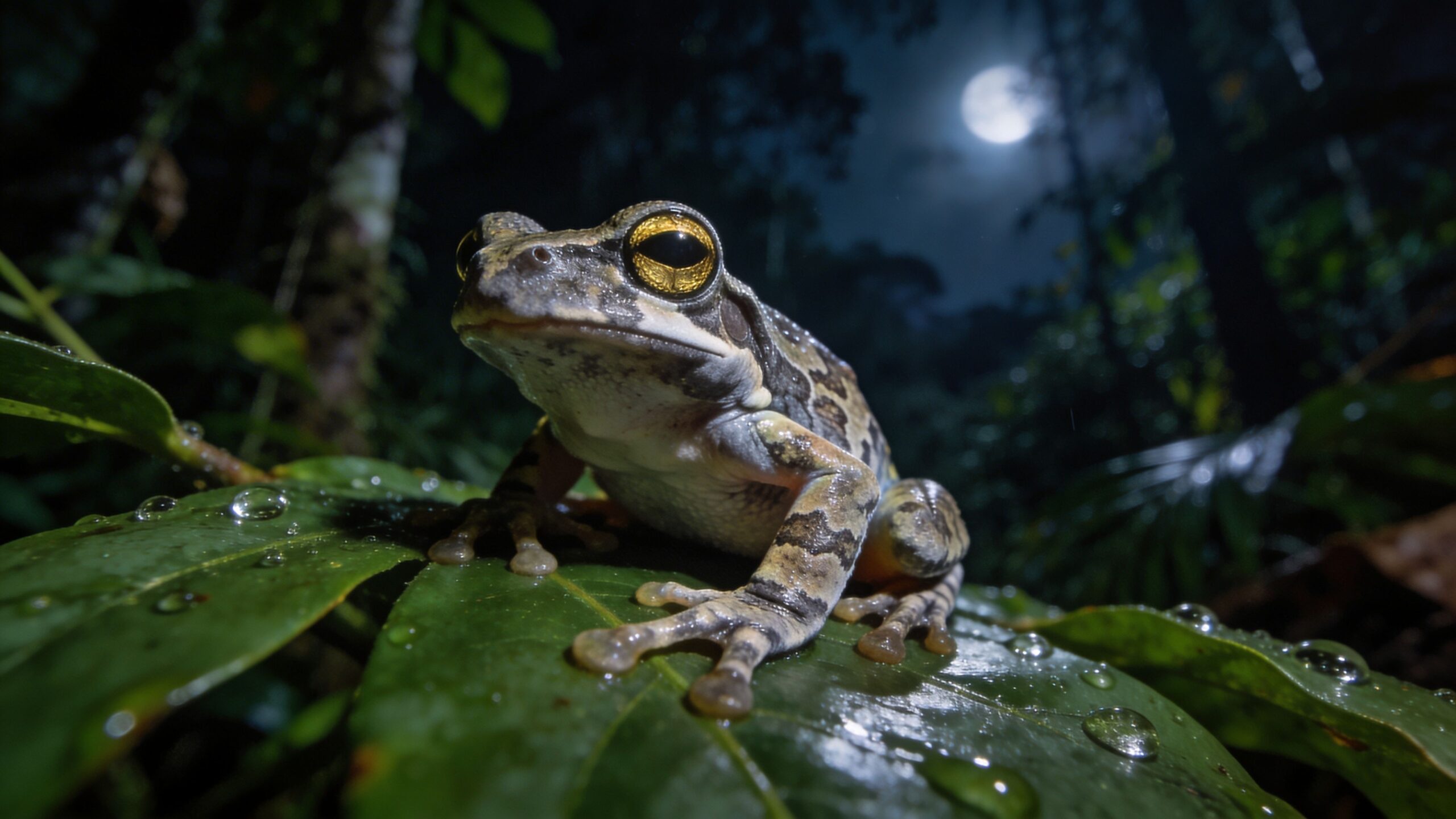
The Amazon milk frog has a boldly patterned body, broad climbing discs and eyes crossed by dark lines. Its scientific name is Trachycephalus resinifictrix, and it is also called the Mission golden-eyed tree frog. Adults have dark brown areas interrupted by a pale patch between the eyes, a pale band across the middle of the back and another pale area above the hindquarters. Living colors vary: bluish tones and beige or brown markings occur in captive-bred individuals.
In the forests around Papaïchton, French Guiana, adults have a beige-to-orange iris bearing a black cross. Scattered rounded bumps, often white-tipped, cover the body, while the top of the head is comparatively smooth. The belly and throat are white and unmarked, and the finger discs are greenish. These details distinguish a milk frog more reliably than the general impression of a large, banded tree frog.
Females are larger than males. Published adult lengths are 65–77 mm for males and 86–100 mm for females, measured from the snout to the vent. Breeding males also have thumb pads associated with clasping and conspicuous vocal sacs at the sides of the head.
Eastern Amazonian forests and their water-filled trees
The species’ established native range lies in eastern Amazonian Brazil and extends north into Guyana, Suriname and French Guiana. Records include the Guiana Shield and parts of the Amazon east of the Negro River, with Juruti in Pará among the documented Brazilian localities. In French Guiana, occurrences span interior places such as Saül, Papaïchton and Maripasoula as well as Camopi, Régina and Roura.
The original locality associated with the species name is the mission of San Antonio do Prata, on the Maracanã River in Pará. Farther northwest, records from Venezuela and southeastern Colombia remain uncertain between this species and T. cunauaru; neither country can be added unconditionally to its established range.
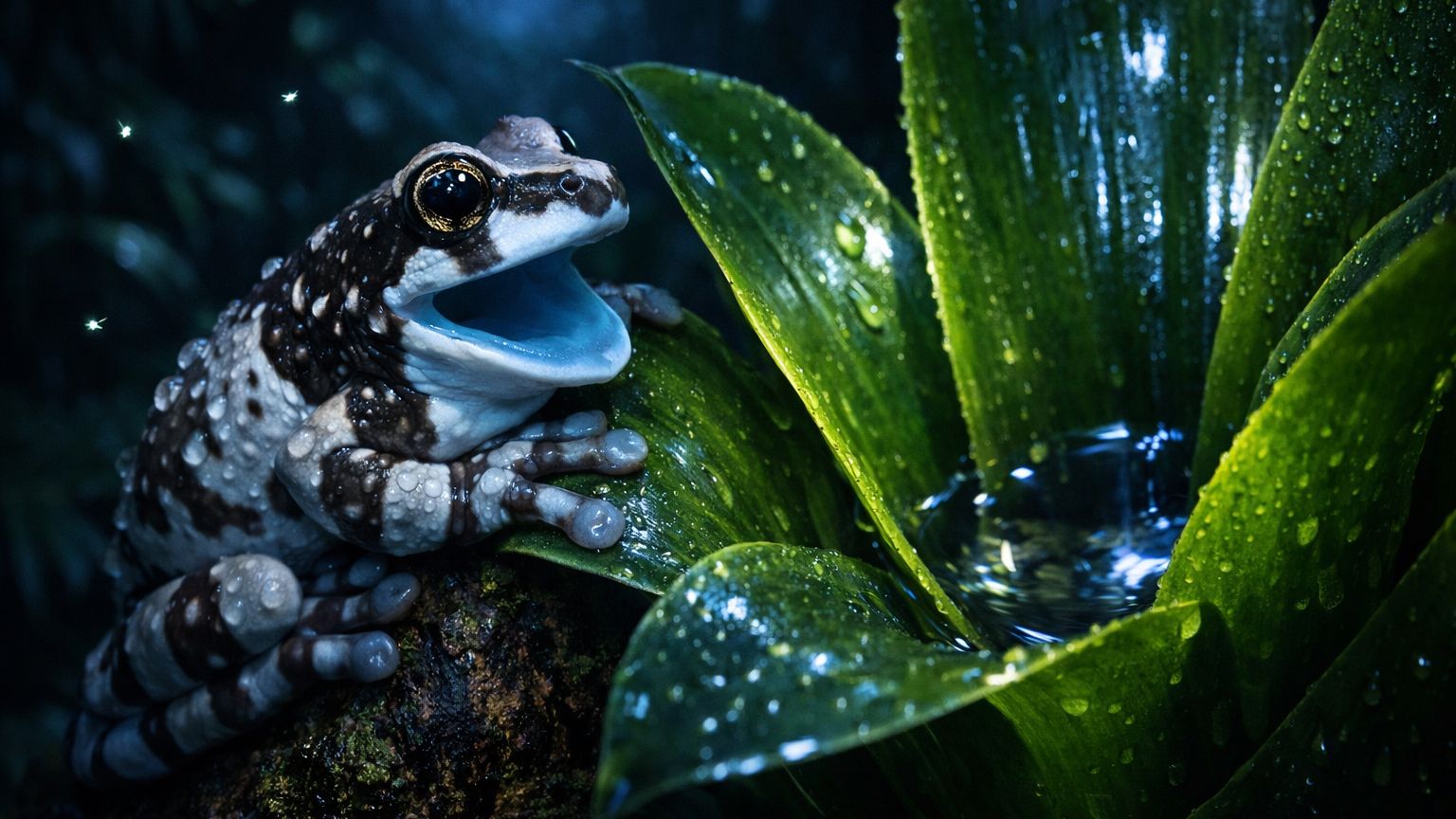
The forest provides aquatic breeding habitat well above rivers and ponds. When a large branch breaks and the remaining wood decays, a hollow can develop in the trunk. An upward-facing opening catches rainfall, while fallen leaves and other organic material accumulate inside. At the Manaus study site, milk frogs used cavities formed in this way.
Tree cavities used by this species can be substantial pools. Descriptions include water volumes of 5.8–90 liters, and canopy sites reach 32 meters above the ground. These are reported examples rather than fixed habitat limits. The surrounding terra-firme rainforest is generally unflooded forest; water in an elevated cavity therefore gives the frogs a breeding site separate from ground-level floodwater.
Height is flexible. At Nouragues in French Guiana, a natural cavity only 47 cm above the ground contained milk-frog tadpoles alongside those of Osteocephalus oophagus in April 2025. Free-living adults also bred regularly in a concrete pool placed on the ground for a field experiment in 2010.
Night calls and the value of a cavity
Male milk frogs call at night from their breeding water. At Manaus, calling males sometimes left their cavities near dawn but remained in the canopy. Calling makes these elevated frogs detectable from the forest floor: during a February–March 2015 survey of the Mitaraka massif in French Guiana, observers heard the species throughout the study area without collecting a specimen.
A male’s occupation of a hollow can persist beyond a single breeding night. One marked Manaus male was recaptured at its calling cavity four months later, and occupied trees were reused across field seasons. Other males attempted to enter or remain in already occupied hollows. Residents and rivals interacted vocally and physically, making the cavity both a calling station and a contested reproductive resource.
Repeated occupation and reuse are consistent with limited availability of appropriate cavities, or with substantial costs of locating another one. They do not establish which explanation is more important.
The advertisement call also helps distinguish similar species. In recordings compared during the description of Trachycephalus cunauaru, milk-frog notes contained about 150–250 pulses per second, compared with approximately 127–146 in T. cunauaru. A pulse is a rapid component within a note, not a separate call. These measurements concern the recordings compared; they are most useful alongside appearance and locality.
Spawning and parental roles
At Nouragues, a male calling from breeding water attracts a female, and the pair enters amplexus before egg laying. At Touroparc, the captive breeding pair used axillary amplexus: the male clasped the female just behind her forelimbs. The female deposits the eggs directly into the water. At Touroparc, however, clasping did not invariably lead to egg laying, so an observed pair in amplexus was not necessarily about to produce a clutch.
The darkly pigmented eggs lie within a gelatinous mass that floats at or close to the surface. Part of a mass may adhere to the inner wall of the hollow. Reported field clutches contain 106–1,540 eggs. Successive clutches can enter the same cavity, so a newly laid mass may share its pool with older, actively feeding tadpoles. Tadpoles are reported in these hollows during the rainy season.
In one Manaus hollow, as many as six clutches were deposited over four months. This repeated spawning puts broods of different ages together, rather than producing a single synchronized group of larvae. For the newest brood, the conditions include not only the available water and accumulated leaf material but also the feeding abilities of tadpoles that hatched earlier.
A male defends access to a breeding cavity against rivals. Larvae already in the water may consume fertilized eggs laid later. These observations do not demonstrate a parent deliberately supplying food to its young. At Nouragues, related T. hadroceps and the co-occurring O. oophagus are reported to feed eggs to their tadpoles, giving superficially similar egg consumption a different parental context.
Two diets across one life cycle
Adult Amazon milk frogs eat insects and other small invertebrates in the wild. A tadpole confined to a tree hollow encounters accumulated detritus and material entering the water, including eggs from later spawnings.
At Manaus, gut examinations found both detritus and developing eggs of the same frog species. One tadpole contained as many as 62 intact eggs. Embryonic development confirmed that the consumed eggs were fertilized and developing, rather than unfertilized food eggs. Eating them is cannibalism across successive broods: younger embryos become food for larvae already occupying the pool.
The diet examinations included repeated collections from one Manaus hollow over five months, as well as comparisons among other cavities. Less frequent material in the tadpoles included algae, leaf fragments, pollen and arthropod remains. The latter included insect mouthparts, wing fragments and mosquito-larva bristles. Such fragments show the variety of material ingested; they do not establish that the tadpoles caught living insects.
Feeding ability changes as the larvae grow. Larger Manaus tadpoles swallowed whole eggs together with their capsules, whereas smaller larvae ate egg fragments. When eggs were unavailable, tadpoles consumed detritus. The observed use of both foods supports opportunistic egg eating. Whether eggs are essential for successful development under particular natural conditions was not experimentally resolved by those field observations.
The larval mouth lies toward the front and underside of the body. Five larvae described at Gosner developmental stages 34–37 had serrated jaw sheaths and rows of small labial teeth around an oral disc.
Water chemistry adds another constraint to life inside a hollow. Four Manaus tree-hole samples had dissolved oxygen concentrations ranging from 0.2 to 3.9 mg per liter, and measurements of algal chlorophyll indicated low phytoplankton abundance. Detritus and newly deposited eggs supplied food in a small aquatic habitat with limited production of suspended algae.
From olive tadpole to patterned froglet
Living milk-frog tadpoles are light to dark olive, sometimes with black dots, silver bellies and transparent fins. The five later-stage larvae in the larval description averaged about 34.7 mm in total length, including the tail. Their bodies were elongated ovals when viewed from above, with eyes positioned and directed toward the sides. Tail musculature tapered toward a pointed tip, bordered by moderately high fins. A single spiracle opened on the side of the body.
Captive breeding makes the developmental sequence easier to follow. At Touroparc, eggs generally hatched within 24–48 hours, releasing larvae about 5 mm long including the tail. The hatchlings had external gills that soon disappeared and spent their first several days floating at the surface. Hindlimbs developed before the forelimbs emerged; the tail subsequently shrank as metamorphosis progressed. Newly metamorphosed frogs were approximately 1–1.5 cm long. During the final phase of metamorphosis, these captive larvae stopped feeding until their tails were completely resorbed. Their much shorter froglet bodies cannot be compared directly with tadpole total lengths that include a long tail.
At water temperatures of 23–25 °C, many Touroparc tadpoles metamorphosed 45–75 days after hatching, but some developed much later. Those durations describe that captive breeding experience, not a fixed timetable in forest cavities.
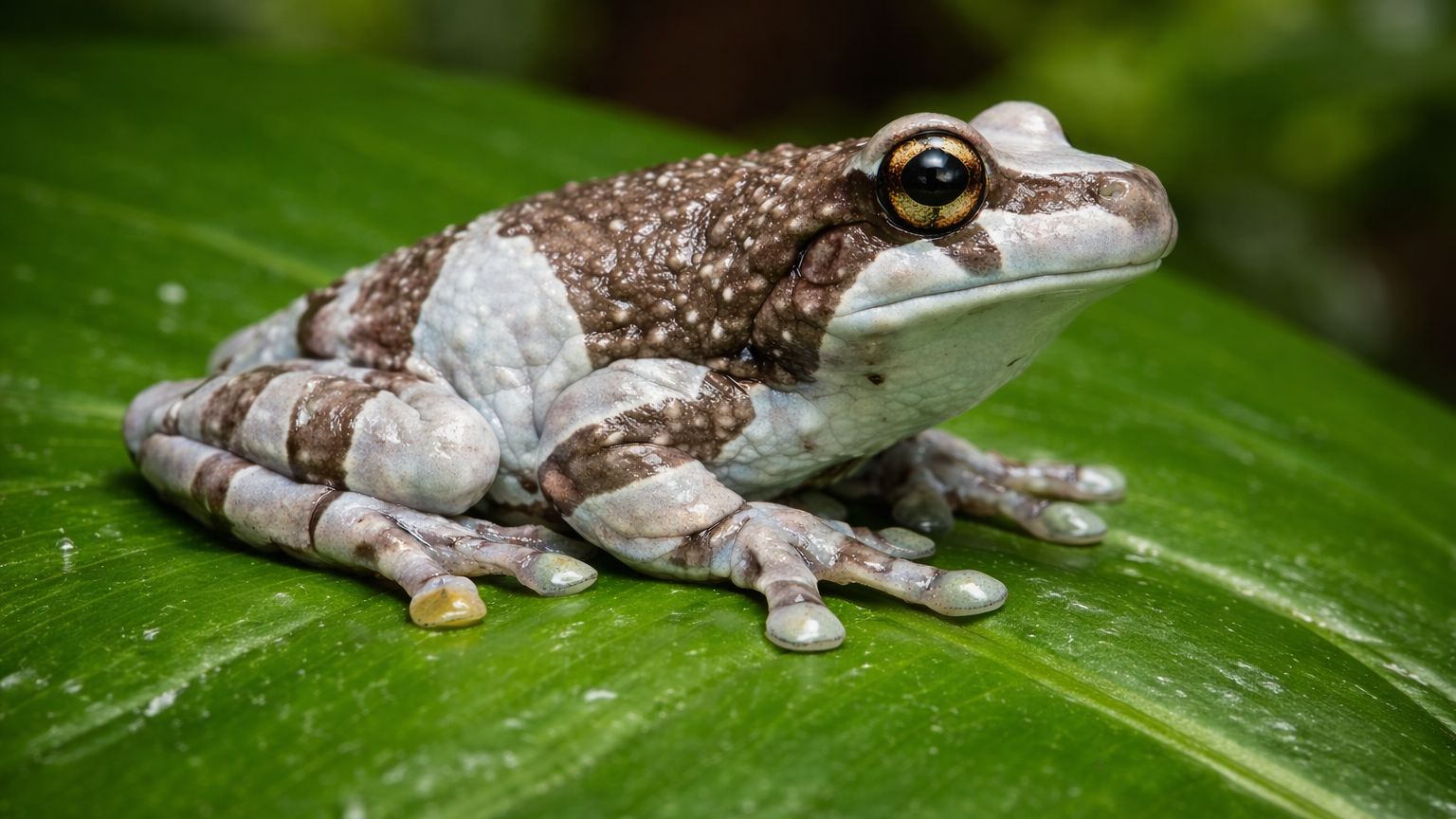
Metamorphs already have striking markings: dark brown backs with large silvery white patches, barred limbs and a golden iris crossed in black. Skin texture changes with growth. Touroparc froglets began with smooth skin, while one-year-old offspring had small bumps on the back and blue-green fingertips. At that age they measured about 5–5.5 cm; this growth observation did not establish when either sex first became capable of breeding.
Landing on a narrow branch
A milk frog’s enlarged toe discs matter during the abrupt end of a jump as well as during climbing. In a laboratory experiment, four captive-bred frogs jumped onto a wooden cylinder 1 cm in diameter. Across forty jumps, half the landings began with abdominal contact and half with toe-pad attachment. These were repeated trials of four frogs, rather than observations of forty different animals in the wild.
After a toe-first landing, a frog could rotate around the branch, swing beneath it and then bring another limb into contact before climbing onto the upper surface. The attached pads stayed in place during the recorded movements. This sequence allowed the animal to recover from an approach that did not place its belly directly on top of the narrow support.
For twelve analyzed deceleration trials involving three of the frogs, calculated dynamic loads reached approximately 14.4 times body weight. That estimate concerns forces during braking, rather than an ability to lift an object of that weight. All four frogs could also support themselves with two forelimb digits, and one hanging observation involved a single pad.
Skin defenses and neighboring animals
The name milk frog comes from the sticky white secretion released through the skin when the animal is threatened. This secretion is poisonous to potential predators and serves a defensive role.
A tree cavity is not necessarily occupied by only one frog species. The mixed larvae at Nouragues demonstrate that milk frogs can share breeding water with O. oophagus. Another local cavity breeder, T. hadroceps, tends to use smaller water collections than milk frogs. These differences in pool use coexist with occasional overlap, creating a community distributed among hollows of different sizes and positions.
Snakes can reach these aquatic nurseries. At Nouragues, juvenile Chlorosoma viridissimum hunted underwater in pools containing milk-frog larvae. Camera recordings documented attempts in the artificial breeding pool, while observers recorded hunting in the low natural cavity. Successful milk-frog captures were not confirmed. The same investigation confirmed captures of T. hadroceps in another hollow, establishing predation on that neighboring species without identifying milk frogs as confirmed prey.
Similar frogs and changing species boundaries
Trachycephalus resinifictrix belongs to Hylidae, within the frog and toad order Anura. Older names include Hyla resinifictrix and Phrynohyas resinifictrix. A more consequential distinction is the separate recognition of T. cunauaru, described in 2013. Some western Amazonian frogs formerly called milk frogs belong to that species, including animals from Panguana in Peru. Their observations cannot all be transferred to eastern Amazonian milk frogs.
T. cunauaru has a densely bumpy head, a dark T-shaped dorsal marking and a pinkish-beige iris with a horizontal bar and a thin lower vertical line. Its established range includes Bolivia, Brazil, Ecuador and Peru. T. hadroceps overlaps milk frogs in Brazil and the Guianas but has closely packed large bumps and a mottled belly and throat. Eye pattern, head texture and underside markings provide useful distinctions where general body shape is similar.
The cavity-sharing O. oophagus belongs to a different genus within Hylidae. Around Papaïchton, it has a yellow iris with radiating markings, rather than the milk frog’s black cross. Males have a granular back and one relatively inconspicuous throat vocal sac.
Forest change and conservation
The Amazon milk frog is classified as Least Concern globally and regionally in French Guiana. Its dependence on forest breeding resources still makes local habitat conditions important. During a 2012 survey near Tailândia in Pará, records were concentrated in rainforest, with far fewer detections in nearby oil-palm plantations. The frogs occurred in both habitats, but the comparison associated them strongly with forest.
That local pattern is consistent with the importance of water-holding trees. Replacing rainforest changes the supply of the cavities in which males call and larvae develop. This local habitat comparison does not measure reproductive success in plantations or a species-wide population decline. Maintaining forest with suitable cavity-bearing trees protects a concrete reproductive resource as well as the adults’ surroundings.
Captive care and observations
Amazon milk frogs breed in zoological collections, where their climbing and retreat needs shape enclosure design. Durrell’s species-specific care account describes spacious, ventilated housing with abundant branches, concealed resting places and regularly refreshed water. Touroparc combined automated misting with active air circulation. These managed arrangements provide humid conditions alongside ventilation; water held inside a wild tree is a different environment from an entire captive enclosure.
Captive adults receive supplemented live invertebrates. Durrell used tong feeding to monitor individual intake because some group members could monopolize food. Larvae there developed on a mixed powdered diet that included prepared fish foods, so egg eating in nature is not a reason to assume that captive tadpoles require a continuous supply of frog eggs. Newly metamorphosed frogs had climbing cover and water dishes with easy exits.
The transition out of water requires particular attention. Touroparc described newly metamorphosed milk frogs as poor swimmers and provided very shallow water so their heads could remain above the surface. Small live crickets and occasional fruit flies supplied food for froglets. Touroparc fed these young frogs daily for the first five to six weeks, then progressively increased the interval between meals as they grew. Growing juveniles were sorted by size into additional enclosures, allowing staff to reduce competition as differences in growth became apparent.
Amphibian skin is permeable, which helps explain the importance of contact residues during handling. Veterinary guidance for amphibians favors minimal handling, moistened powder-free gloves and clean equipment. Historical Durrell records include captive lives of six to eight years, without establishing either a maximum captive lifespan or longevity in the forest.
Juvenile growth has also been examined under different UV-B lighting treatments. An Antwerp experiment followed 23 newly metamorphosed milk frogs for 84 days: six received daily UV-B, six received a brief exposure every two weeks, and eleven served as controls. By the end, the daily-exposure group had greater body mass, head width and femur length than the other groups. Radiographic grayscale, used as an indicator of calcification, was similar among groups at that point.
Growth and bone calcification therefore did not show the same treatment pattern in that experiment. Each treatment occupied a single enclosure, limiting independent replication. The result supports attention to lighting during managed juvenile development, but does not define a universal exposure schedule or establish a measured vitamin D mechanism for this species.