

Appearance and anatomy
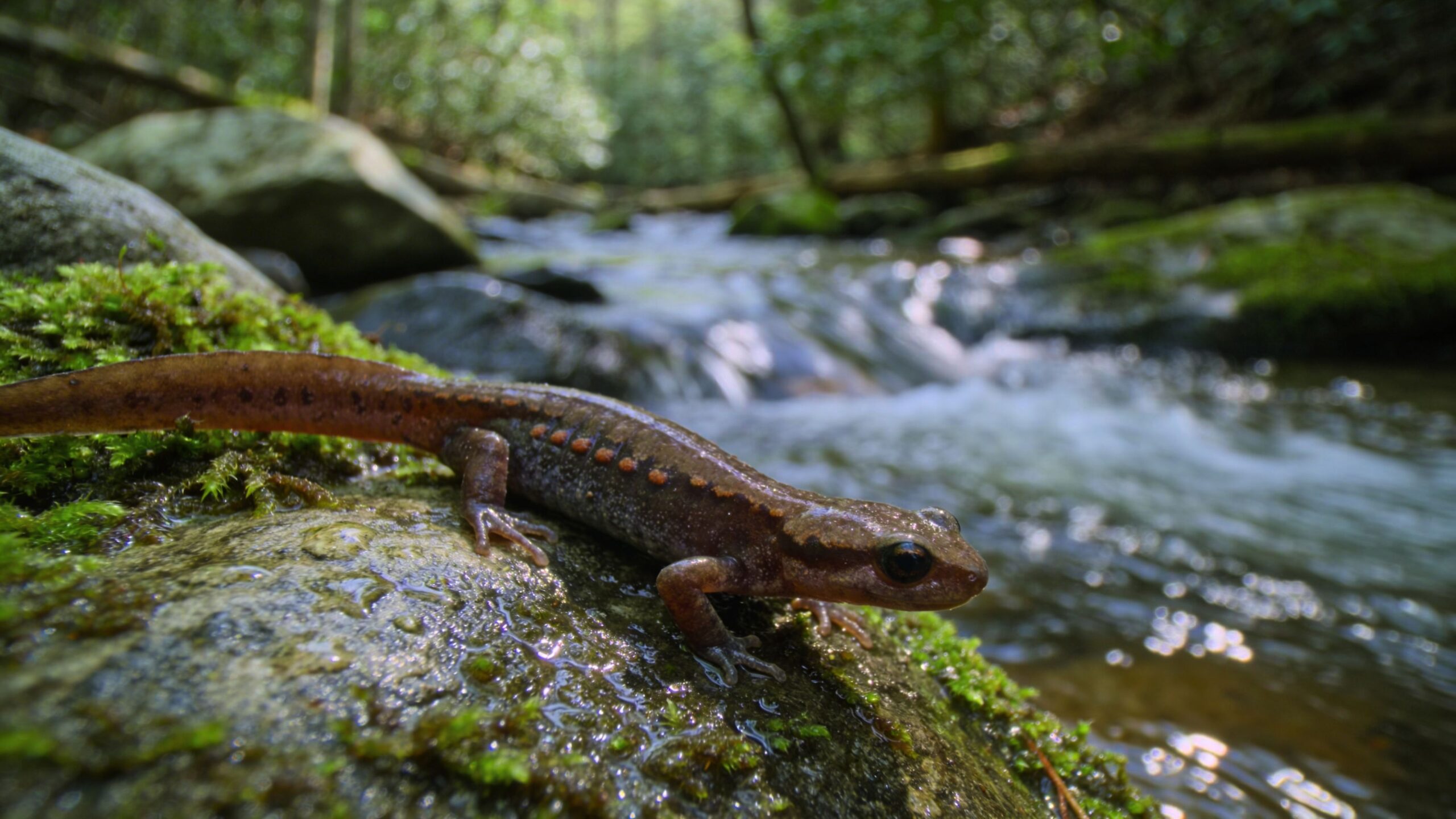
A Northern Dusky Salamander has a compact, sturdy outline, with hind legs that look disproportionately powerful beside its smaller forelimbs. Maine’s wildlife account gives a total length of approximately 2.5–4.5 inches, or 6.4–11.4 centimeters. That measurement includes the tail. Brown to nearly black animals occur there, commonly with gray undersides and sometimes with pale flecks low on the flanks.
More useful than a particular shade of brown is the pale diagonal mark running from the eye toward the back corner of the jaw. Maryland’s identification account pairs that mark with a keeled tail, triangular in cross-section; the tail base can appear lighter than the back. The raised ridge also has a function: Maine’s account describes it as helping the salamander swim.
Appearance changes with growth. Young animals in Maryland can have paired yellowish spots on the back, bordered by a dark, wavy band. As they age, the spots may disappear and the band may blend into the surrounding color. A boldly patterned youngster and a relatively plain adult can consequently belong to the same species.
A distinctive jaw connection occurs within the desmognathine group. Strong ligaments join the first neck vertebra to the lower jaw, allowing head and neck movement to contribute to biting. Deban and Richardson’s 2017 study demonstrated how head flexion transmits and amplifies force in animals then called Desmognathus quadramaculatus. Those animals produced substantially stronger biting performance than the comparison salamander Pseudotriton ruber.
A northern species with a revised identity
The scientific name is Desmognathus fuscus, a member of the lungless salamander family, Plethodontidae. Its present range extends from southern New Brunswick and southern Québec, south of the Great Lakes, west to southeastern Indiana and western Kentucky, and south to northeastern Tennessee and northwestern North Carolina. Ontario also has a documented population in the Niagara Gorge. That small Canadian outpost occupies groundwater-fed habitat near the edge of the species’ distribution.
The familiar name once covered a broader assortment of salamanders. In their revision published in July 2023, Pyron and Beamer named six species from populations formerly associated with D. fuscus and the Spotted Dusky Salamander, D. conanti. Genetic, geographic and anatomical evidence together revealed distinct lineages among similar-looking animals. Some geographic genetic diversity remains within the retained Northern Dusky Salamander.
Two southern relatives illustrate the geographic differences. The Piedmont Dusky Salamander, Desmognathus bairdi, occupies the North Carolina Piedmont and adjoining upper Coastal Plain, with small extensions into South Carolina and southeastern Virginia, at elevations around 300 meters and below. Tilley’s Dusky Salamander, D. tilleyi, has a much smaller range in the Bald Mountains and nearby Great Smoky foothills of Tennessee and North Carolina, roughly 400–1,300 meters above sea level.
Breathing at the water’s edge
Adult Northern Dusky Salamanders have no lungs. Respiratory gases pass across the skin and the internal lining of the mouth and pharynx. This makes the moist environment surrounding the animal part of its breathing biology. A shaded bank, wet crevice or seep provides conditions in which a lungless salamander can remain active or sheltered without leaving the damp surroundings on which its respiratory surfaces depend.
Lunglessness does not mean an absence of breathing-related movements. Sheafor and colleagues’ 2000 study used salamanders identified as D. fuscus from West Branch Reservoir in Portage County, Ohio. Under some low-oxygen conditions, the animals spent longer in bouts of mouth-floor activity, called buccal pumping, and their heart rates changed. Under the most severe condition, pumping frequency was inhibited. Whether those mouth movements actually increased oxygen uptake remained unresolved; duration and frequency described different parts of the response.
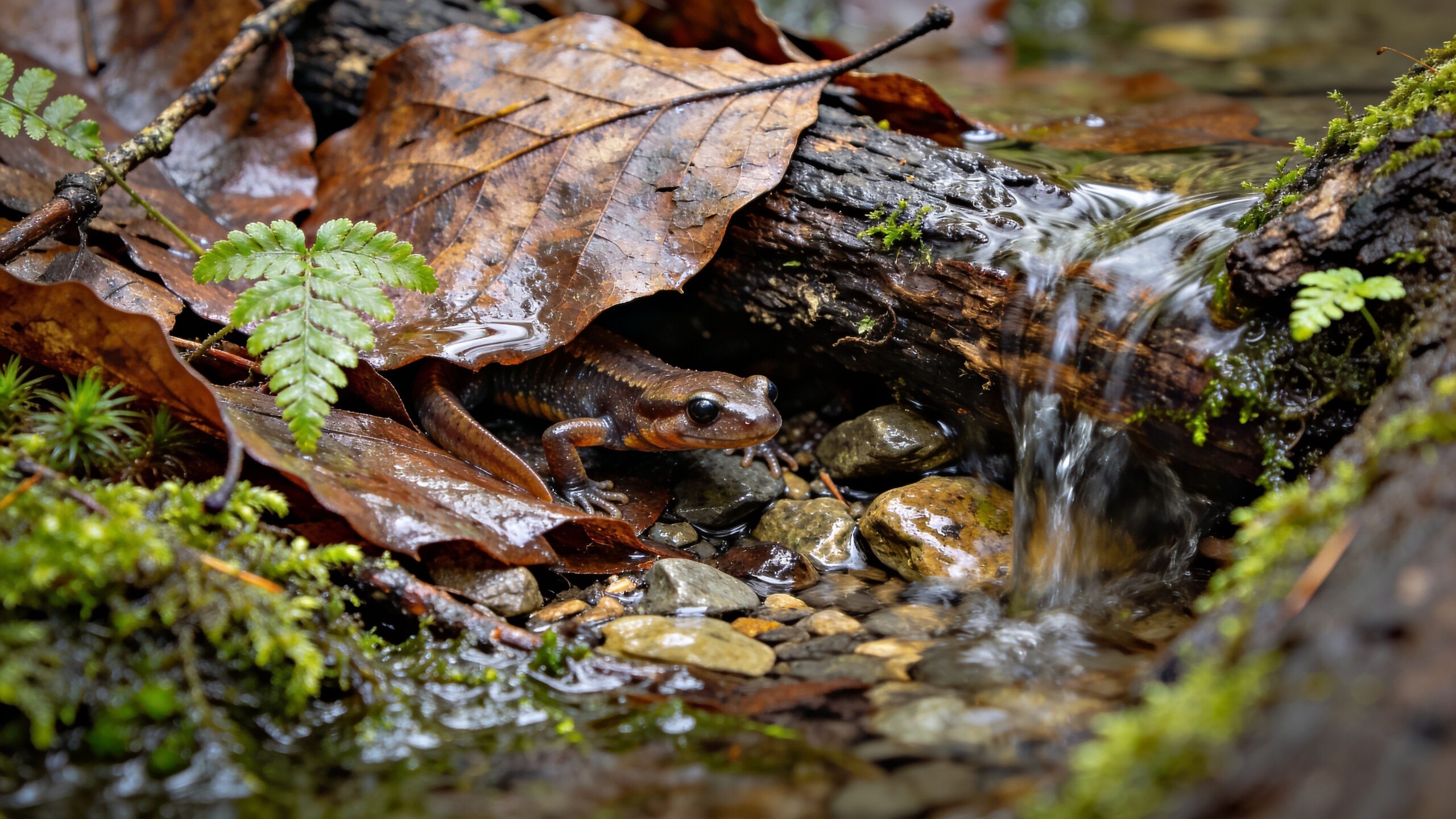
In Maryland woodlands, Northern Dusky Salamanders are usually in water or immediately beside it, beneath flat stones and coarse woody debris along stream margins. Springs and seepages offer additional habitat. The Ontario recovery account describes the surrounding canopy, leaf litter, rocks, woody debris and natural vegetation as parts of the same living space. Shade maintains cooler, moister ground, while the spaces beneath cover offer shelter from adverse weather and predators.
Daily and seasonal retreats make use of that sheltered ground. Ontario’s regional account describes daytime concealment and nighttime feeding along seeps, stream banks and the adjoining forest floor. Maine animals overwinter below frost level near streams, springs and seeps. Moist subsurface cavities and seepages combine protection from freezing with continued access to moisture, allowing winter shelter to meet two needs at once.
Neighbors along a moisture gradient
A stream bank contains many different degrees of wetness over a short distance. At Covey Hill, Québec, surveys from May through September 2004 placed animals identified as D. fuscus in wetter positions than Allegheny Mountain Dusky Salamanders, D. ochrophaeus, although their habitat use overlapped. Slow flow was associated with D. fuscus in May and September, while denser shrub cover was associated with it in August.
The two dusky species can also resemble one another. Both have enlarged hind limbs and a pale eye-to-jaw line. The Ontario comparison describes Allegheny Mountain Duskies as having a rounded tail cross-section, often a brighter yellow-to-red dorsal band and a darker underside. Northern Duskies have a compressed, keeled tail and commonly a paler underside. At Covey Hill, typical D. fuscus had wavier side bands and irregular dorsal spots, whereas typical D. ochrophaeus had straighter bands with a central row of spots or chevrons.
The boundary between those species is locally complicated by hybridization. Anaïs Boutin’s 2006 Covey Hill thesis found genetic evidence of crosses, but intermediate appearance was an unreliable guide to ancestry. The habitat analysis grouped putative hybrids by their dorsal appearance; that group occupied habitat more like D. ochrophaeus and was not a set of individually confirmed genetic hybrids. Among hybrids whose mitochondrial ancestry was resolved, that ancestry came from D. ochrophaeus. A single nuclear marker could also miss later backcross ancestry.
Food from water and land
Northern Dusky Salamanders eat small invertebrates from both aquatic and terrestrial surroundings. Maine’s account includes insects, worms, spiders and mollusks. Their streamside position puts wet surfaces and the neighboring forest floor within the same feeding landscape. Nighttime foraging in the Ontario account extends along the edge and into adjacent forest-floor habitat.
Food overlap with other salamanders can be substantial. Thomas Burton’s Hubbard Brook study in New Hampshire, published in 1976, compared animals then identified as D. fuscus with Eastern Red-backed, Northern Two-lined, Spring Salamanders and Eastern Newts. All five were broad-feeding predators of suitably sized prey. Their foods overlapped even though adult body sizes and habitat use differed. Sharing prey categories can therefore accompany differences in where salamanders live and the sizes of food available to them.
A historical southern comparison gives a closer view of seep feeding. Mynatt and Miller studied postmetamorphic salamanders called D. fuscus at three Short Mountain seeps in Cannon County, Tennessee, from October 1990 to June 1991. Aquatic organisms accounted for 29% of the 958 identifiable prey items pooled across stomachs; aerial and terrestrial foods were also represented. These proportions describe numbers of prey, rather than their weight or energy value, and the pooled categories do not mean every animal ate from all three.
In those Tennessee samples, aquatic prey contributed more of the counted diet in autumn and winter than in the later spring sample. The authors cautioned that the late-spring result involved only six salamanders.
Courtship and choosing a nest
Courtship, fertilization and egg laying occur as separate steps. The 2012 Canadian synthesis, written under the earlier D. fuscus concept, describes courtship on land followed by the female’s uptake of a male-deposited spermatophore, the packet that transfers sperm for internal fertilization. Egg deposition follows later. That synthesis reports clutches of 8–45 eggs across the populations then included under the name. In Maine, eggs are described beneath rocks or logs at stream edges, close to the future aquatic larval habitat.
A study published by Rudolph Danstedt in 1975 followed six Maryland populations identified as D. fuscus. Adult females laid eggs annually, from June into early August. Reproductive output varied among the populations: larger females tended to produce more eggs, and reproductive rates were higher where estimated adult survival was lower.
Nest placement has structure at more than one scale. In their 2007 study of the Baismans Run watershed in Baltimore County, Maryland, Snodgrass and colleagues found nests of salamanders identified as D. fuscus concentrated in shallow, relatively steep headwater reaches draining small catchments. Nest density was greatest near the upstream ends of headwaters.
Within those reaches, nests were closer to water than nearby comparison positions and beside deeper parts of the channel. A small headwater stream could therefore contain a locally deeper patch beside a nest without being a deep stream overall. The researchers proposed that proximity to these patches might reduce larvae’s exposure to drying. That was a possible benefit of nest placement, rather than a demonstrated outcome over the whole larval period.
The female beside her eggs
A detailed historical account comes from Carole Hom’s 1983–1985 work at Reed Creek on Chilhowee Mountain, Tennessee, with salamanders then called D. fuscus. Most nests were beneath moss on moist stream banks, in shallow, smooth cavities containing a female and her eggs; small logs, stones and liverworts also supplied cover. Females commonly remained with clutches, with eggs resting over the head, neck and shoulders. Unattended clutches usually disappeared or developed fungal growth, an association consistent with a protective role for attendance.
Hom’s laboratory observations also revealed different responses to different animals approaching a clutch. Attending females confronted other salamanders with postures, nudges, snaps and bites, often driving them away. When a ring-necked snake approached or contacted them, however, females ultimately abandoned the eggs.
Two directly observed intervals from egg laying to hatching at Reed Creek lasted 46 and 54 days. Other clutches found early in development supported an approximate 40–60-day incubation pattern for that population. These intervals end at hatching, when the young leave the egg. The subsequent aquatic larval period lasts much longer.
From gilled hatchling to streamside adult
The young begin life in a different form from the adults beside the bank. The 2012 Canadian synthesis describes hatchlings, under the historical species concept, as 12–20 millimeters in total length, with remaining yolk reserves and whitish external gills. Paired blotches can merge as larvae and juveniles grow. External gills mark the aquatic larval phase, before metamorphosis into the streamside form.
Local studies give the larval period a seasonal scale. The Canadian synthesis reports 8–10 months for New York animals. In Danstedt’s 1975 Maryland study, larvae metamorphosed in late spring or early summer at about 9–12 months old. These are historical population records of the transition out of the larval stage. Together they describe young spending many months in water, with a later transition to the streamside way of life, while retaining different local developmental intervals.
Sexual maturity is a later milestone. Danstedt’s Maryland males reached it at about two years and females at about three years; those estimates describe maturity rather than the age of first successful reproduction. Across the six populations, adult size and estimated adult survival were negatively associated, while the corresponding juvenile-survival relationship was not significant. Nearby populations could share broad reproductive timing yet differ in their demographic relationships, making body size alone a poor substitute for a local life history. The Canadian synthesis reports a wild maximum of about ten years under the historical species concept, a longevity record distinct from the much earlier attainment of sexual maturity.
The watery edge is also occupied by predators. The Canadian synthesis names crayfish and snakes, including Northern Watersnakes, garter snakes and ring-necked snakes, among predators of salamanders or their eggs in the historical D. fuscus literature. It also describes a tail defense: a detached tail can continue moving and distract a predator while the salamander escapes, with the tail later regenerating.
Other salamanders in the same landscape
The Northern Two-lined Salamander, Eurycea bislineata, shares northern stream margins and small-invertebrate foods with the Northern Dusky. In Maine it is slimmer, yellowish above and yellow below, with a dark line along each side extending toward the tail. Its habitat includes rocky streams and river and lake edges. Its eggs attach beneath rocks within streams, placing reproduction farther into the water than the stream-edge nests described for Northern Duskies in the same state.
The Eastern Red-backed Salamander, Plethodon cinereus, occupies a more terrestrial part of Maine’s forest landscape, using leaf litter, decaying logs, rocks and burrows for shelter and laying eggs in decaying wood. Its wild forms include striped red-backed animals, gray or black lead-backed animals and rare bright-red individuals. An unstriped red-backed salamander can give a similar dark color impression to a dusky, but its forest-floor setting and terrestrial egg habitat reflect a different relationship with the surrounding woodland.
Persistence depends on the stream
Even among species sharing streams, occurrence can differ sharply. Macklem and colleagues’ Connecticut study, published in 2020, estimated Northern Dusky occupancy at 18% of sampled sites, compared with 100% for Northern Two-lined Salamanders. These estimates concern occupied sites in that study. The Northern Dusky models emphasized soil temperature, water conductivity, dissolved oxygen, discharge and sediment distribution, drawing attention to conditions within and beside the stream as well as the surrounding landscape.
Northern Dusky relative abundance was unusually low even in Connecticut watersheds with low housing density. For Northern Two-lined Salamanders, abundance depended on an interaction between housing density and development age, increasing in older developments when density was low. The contrasting results show why one stream salamander’s presence cannot stand in for another’s habitat response. Development history and local water and sediment conditions can produce a more complicated picture than the amount of housing alone.
A five-year North Carolina study by Price and colleagues, published in 2011, followed larvae and adults of salamanders then identified as D. fuscus, alongside Southern Two-lined Salamanders, Eurycea cirrigera, in urbanizing and comparison catchments. After urbanization, larval occupancy of those D. fuscus populations declined while adult occupancy remained close to complete. Continued adult presence could therefore accompany reduced occurrence of the aquatic young. The life stages gave different views of population condition, an important distinction for a salamander whose development spans water and stream bank.
At the broadest scale, NatureServe ranks the revised Northern Dusky Salamander G5, Secure, with a global-status review dated August 22, 2024. It describes the short-term trend as relatively stable and reports no widespread declines, while its long-term trend and global abundance remain unknown. A species can be broadly secure across its range while particular populations depend on small, vulnerable stretches of suitable stream habitat.
New York’s assessment dated January 8, 2025 describes Northern Duskies as widespread and common, with localized declines particularly in urban settings. It gives them a state heritage rank of S5 and identifies them as a Species of Greatest Conservation Need, while recording them as not state-listed. Conservation attention can thus include a common species where particular habitats or local populations face pressure. The assessment also reports an IUCN category of Least Concern, a separate global classification from the state’s conservation priorities.
The Canadian picture is especially uneven. In May 2012, COSEWIC assessed the Carolinian population as Endangered and the Québec/New Brunswick population as Not at Risk. The Carolinian population was added as Endangered to Canada’s federal Schedule 1 in June 2017. Ontario’s 2026 Protected Species in Ontario List also classifies D. fuscus as Endangered. Those regional designations concern a restricted part of the species’ distribution, rather than describing every Northern Dusky population throughout northeastern North America.
At Niagara Gorge, groundwater discharge sustains the seeps occupied by the Ontario population. Interruption or contamination of that supply can affect the salamanders even when the visible occupied patch remains in place. The proposed 2022 federal recovery strategy sets an objective of maintaining the known Ontario local population and promoting natural expansion within its occupied area. Protecting that habitat consequently involves the water feeding the seep as well as the shade, cover and moist ground at the surface.