
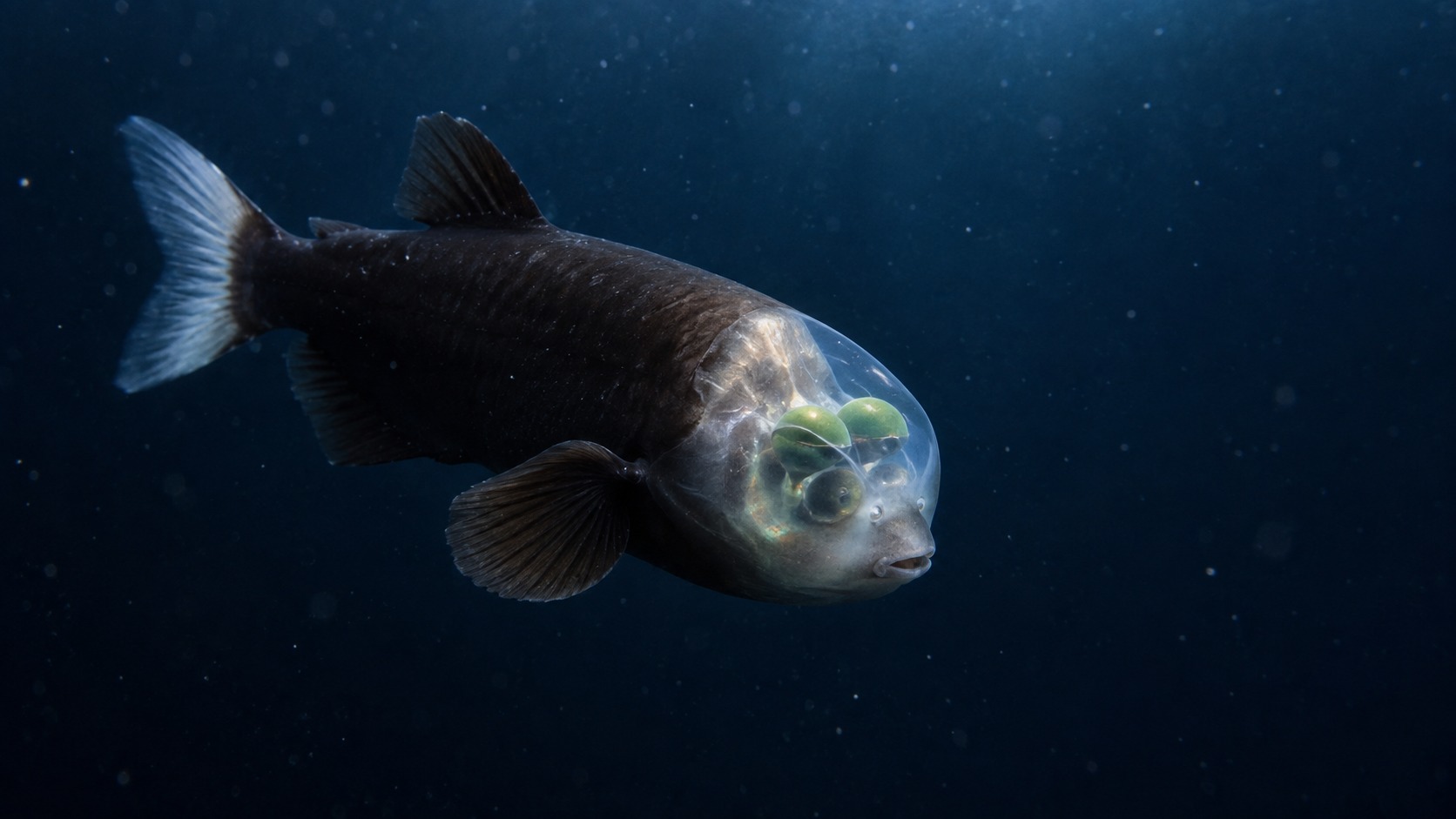
Barreleye Fish becomes much easier to understand when the first impression is tied to the animal’s normal habitat. Deep-sea fishes often look surprising because their bodies are shaped by darkness, pressure, sparse prey, and the need to conserve energy. Those pressures make ordinary shallow-water expectations less useful.
This guide treats barreleye fish as a living fish with a practical body plan, not as a novelty image. The goal is to connect the visible traits with feeding, movement, identification, and the role this animal plays in the deep-sea community.
What Is Barreleye Fish?
Barreleye Fish is a small deep-sea fish associated with the family Opisthoproctidae, a group often called barreleyes or spookfishes. The best-known species is Macropinna microstoma, famous because living observations revealed the transparent head and the greenish tubular eyes inside it. The name is useful for search and memory, but the animal becomes clearer when it is connected to habitat, feeding style, body shape, and the pressure of deep water rather than treated as a strange image floating by itself.
Barreleye fish are bony fishes, not sharks, eels, or jellyfish. They belong in a deep-sea fish context where eye design and feeding position are central identification clues. That placement matters because common names in deep-sea fish pages can be loose. A careful reading starts with what kind of fish it is, then asks how the body solves the problems of darkness, scattered food, and life far below ordinary viewing depth.
How to Recognize Barreleye Fish
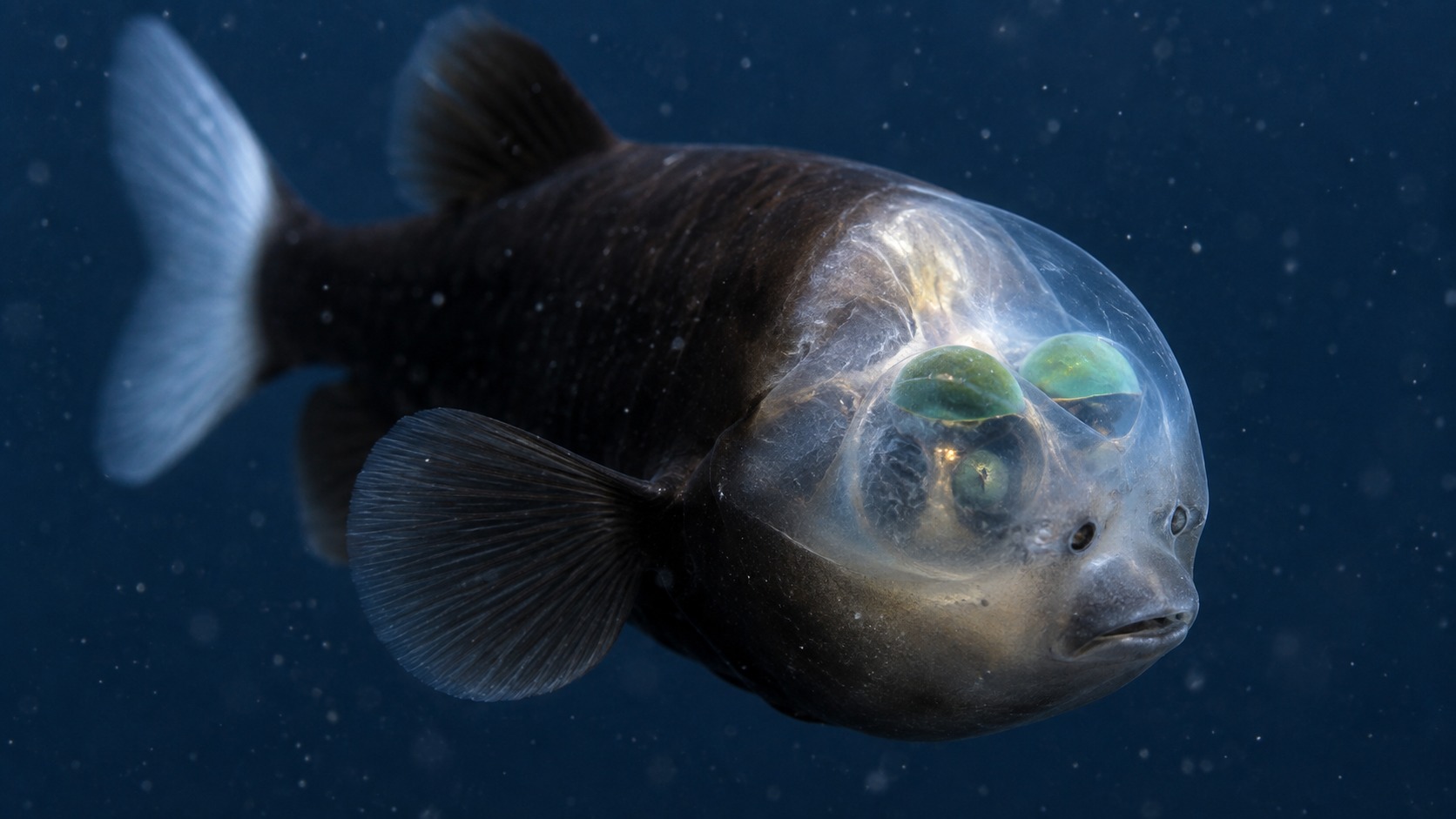
The most memorable clues are the tubular eyes, small mouth, soft body, broad fins, and in Macropinna microstoma, the transparent dome that exposes the eye structures beneath. These visible traits are not random decorations. They help the animal feed, avoid detection, sense prey, or hold position in a habitat where a small advantage can matter.
The image should help readers see why the animal is named for its barrel-like eyes rather than for teeth, a lure, or a glowing body. A strong image of barreleye fish should help readers notice structure first. Color and drama matter less than the clues that separate this animal from nearby deep-sea fishes with similar dark-water reputations.
Habitat and Depth
Barreleye fish are associated with deep midwater habitats, especially dim mesopelagic zones where sunlight is weak but not always completely absent. Deep-sea depth ranges are best understood as broad habitat clues rather than as a single fixed address. Animals can occur across depth bands, and records may vary by life stage, region, or sampling method.
In that setting, eyes that gather faint light are more useful than bright color or fast reef-style movement. The important pattern is the setting: dim or dark water, high pressure, cold temperatures, and food that may be patchy. That setting explains why the animal looks and behaves differently from familiar shallow-water fishes.
Feeding and Diet
Barreleye fish are thought of as careful midwater feeders that use their eyes to detect silhouettes, drifting prey, and possibly food associated with gelatinous animals such as siphonophores. Feeding in the deep sea is usually shaped by opportunity. A predator may wait, hover, drift, or make a short strike rather than chase prey for long distances.
Their food can include small crustaceans and other soft or drifting animals, with the mouth and eye position working together during precise feeding moments. The diet also connects barreleye fish to the surrounding food web. Even when an animal looks unusual, it still participates in ordinary ecological exchanges: finding food, avoiding larger predators, and passing energy through the water column.
Body Design
The transparent head of Macropinna microstoma protects and exposes the eye system in a way that looks almost unreal at first glance. These features make the most sense when the reader imagines the animal in its normal environment, not at the surface or in a distorted photograph.
The tubular eyes can look upward through the head but may also rotate forward, allowing the fish to shift from scanning above to aiming at prey near the mouth. The body is a set of tradeoffs. It balances movement, energy use, prey capture, and predator avoidance under conditions very different from a reef, stream, lake, or home aquarium.
Behavior in the Deep Sea
Barreleye fish are often described as hovering or moving slowly, using broad fins and visual sensitivity rather than constant high-speed pursuit. Much of this behavior is difficult to watch directly because the animal lives far below normal diving depth.
Researchers and educators often work from captured specimens, deep-sea video, stomach contents, related species, and habitat records. That means broad behavior patterns can be explained clearly while still leaving room for species-level variation and future observations.
Life Cycle and Young Fish
Like other bony fishes, barreleyes begin life from eggs and pass through young stages before reaching the adult form. Deep-sea life cycles are often less familiar to general readers than adult appearance, but they are part of the same story.
Young stages may differ in shape, depth, diet, or vulnerability from adults. As the fish grows, the features that make the adult memorable become more important for feeding and survival in deeper or more specialized habitats.
Ecological Role
Barreleye fish occupy a midwater predator role, feeding on smaller animals while also remaining vulnerable to larger deep-sea predators. No deep-sea fish exists as a visual oddity alone. It has prey, predators, competitors, and a place in a larger food web.
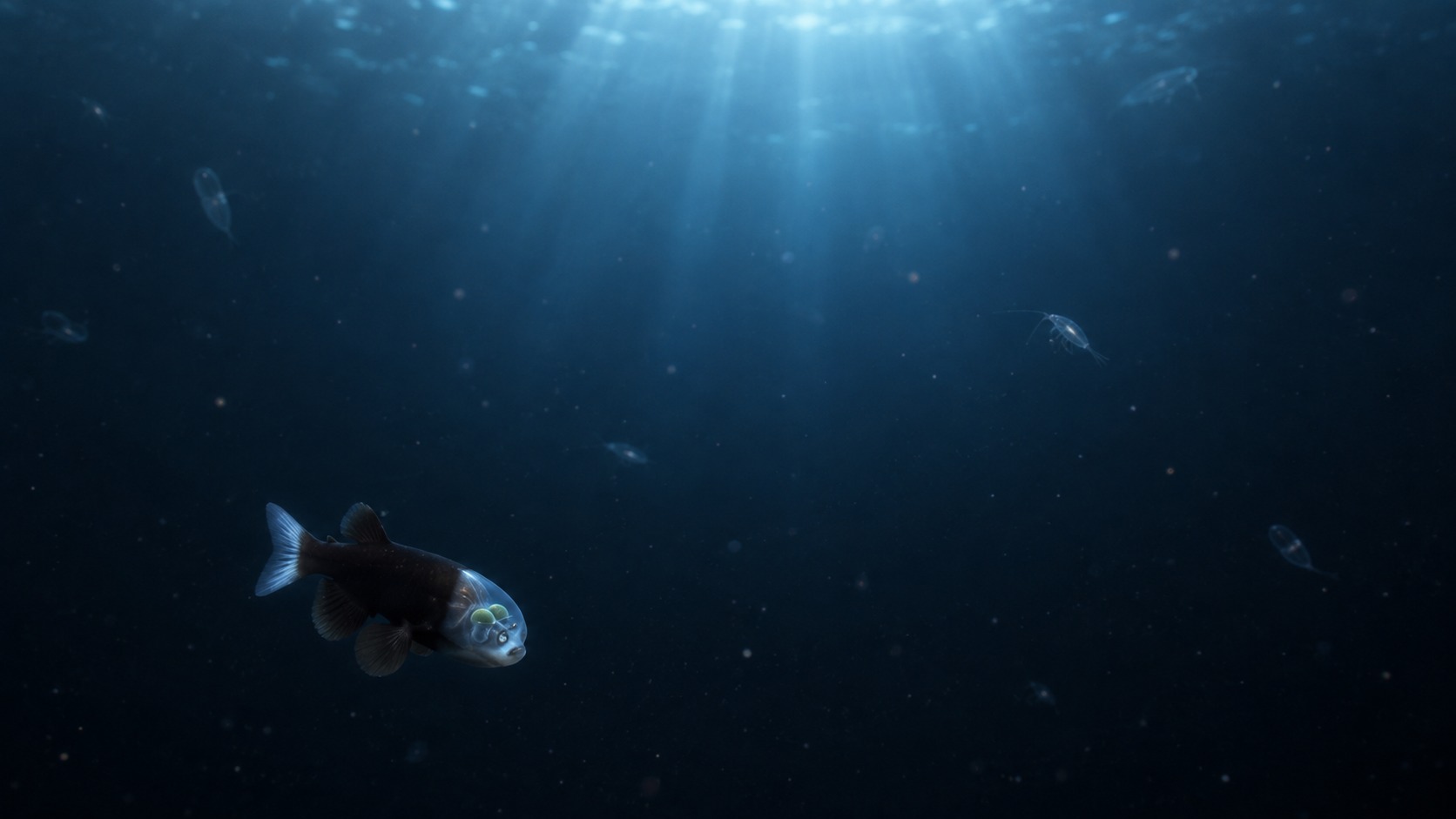
They help show that the twilight zone is not empty darkness; it is a layered habitat where vision, transparency, and precision feeding all matter. This role also helps readers understand why deep-sea pages belong together. Barreleyes, blobfish, hatchetfishes, gulper eels, fangtooths, lanternfish, viperfish, and anglerfish each show a different answer to dark-water survival.
Human Relationship
Barreleye fish became publicly famous because living deep-sea observations showed details that preserved specimens could not explain well. Most people meet this animal through photos, museum material, research footage, or educational writing rather than through direct contact.
That distance is useful to remember. The animal is not a pet, a beach fish, or a creature encountered by ordinary swimmers. Its human story is mostly about science, public curiosity, deep-sea imaging, and the challenge of describing an animal that few people will ever see alive.
Conservation and Caution
Barreleye fish are not common food fishes, and public conservation discussions often focus less on them individually than on protecting deep-sea habitats and food webs. For many deep-sea animals, careful wording is better than easy certainty. Some species are poorly observed, and many live in habitats that are hard to survey.
The safest public takeaway is that deep-sea ecosystems deserve caution. Fishing pressure, bottom disturbance, climate shifts, pollution, and food-web changes can matter even when a single species is not part of a familiar conservation headline.
Common Misunderstandings
The biggest misunderstanding is that the fish has eyes on top of the head that cannot look forward. A dramatic photograph can make the animal seem stranger than it is, especially when pressure, damage, lighting, or angle changes the way the body appears.
Living observations show a more flexible system, with eyes adapted for scanning overhead and orienting toward food. A better approach is to ask what each feature does. Once function comes first, the animal stops being a novelty and becomes a readable example of adaptation.
Similar Deep-Sea Animals
Barreleye fish can be compared with hatchetfishes, lanternfishes, and other small mesopelagic fishes that rely on vision and light. Comparisons are useful because deep-sea animals often get grouped together in public imagination.
They differ from viperfish and fangtooths because the first clue is not extreme teeth; it is eye design and the transparent head structure. The key is to compare specific traits: eyes, teeth, mouth shape, body depth, light organs, habitat, and feeding style. That prevents every deep-sea fish from being described with the same dark-water vocabulary.
How to Read Images of Barreleye Fish
A useful barreleye image should draw attention to the dome, eye tubes, small mouth, and broad fins. Images can be powerful, but they should be read carefully. A specimen at the surface may not look exactly as it does alive at depth.
For Animal Streets readers, the best image reading habit is simple: look for structure before emotion. Ask what the eyes, mouth, fins, body shape, and skin or scales tell you about life in dark water.
Why Barreleye Fish Matters
Barreleye fish matter because they show how strange-looking anatomy can be a practical answer to faint light and overhead prey. It gives readers a concrete way to understand a habitat that is usually invisible.
The deeper value is perspective. Earth has entire communities that live beyond sunlight, and each deep-sea fish page helps turn that hidden world from a vague mystery into a set of understandable lives.
Pressure, Shape, and First Impressions
Barreleye fish are less about pressure distortion than blobfish, but surface context still matters because delicate head structures and soft tissues can be damaged or misunderstood outside the normal deep-water setting. Deep-sea animals are often judged by surface images, preserved specimens, or dramatic close-ups. That can be useful for attention, but it can also distort the biology if the habitat is forgotten.
For barreleye fish, the better habit is to connect appearance with pressure, light, and food. A feature that looks exaggerated near the surface may be ordinary and useful at depth, where the body is supported differently and the animal is solving a different set of survival problems.
Movement and Energy Use
Barreleye fish are often interpreted as careful hoverers, using broad fins and visual scanning rather than constant pursuit. In deep water, energy often matters as much as speed. Food can be scattered, temperatures can be cold, and a constant chase may cost more than it gains.
That is why many deep-sea fishes look like specialists rather than all-purpose swimmers. Some hover, some drift, some wait, and some make short controlled strikes. Barreleye Fish fits that broader pattern by using body design to make limited opportunities count.
How It Fits This Animal Streets Group
Barreleye fish sit especially well beside lanternfish, hatchetfish, and viperfish because all of them make the reader think about light from different angles. The parent group is useful because it lets readers compare several dark-water solutions side by side.
A barreleye emphasizes vision, a blobfish emphasizes pressure and soft-body support, a hatchetfish emphasizes light control, a gulper eel emphasizes mouth expansion, and a fangtooth emphasizes teeth. Those differences keep the deep-sea category from becoming one repeated story about darkness.
What Readers Should Not Assume
Readers should not assume the transparent dome is a gimmick or that the eyes are fixed in one useless upward position. Common-name pages can tempt readers into quick assumptions, especially when the animal has a memorable nickname or a famous image.
The safer method is slower: identify the animal, place it in habitat, read the body parts as tools, and then compare it with nearby species. That keeps the page useful for students, animal fans, and casual readers who want more than a surprising photograph.
Why Deep-Sea Knowledge Changes
Barreleye fish are a classic example of how living observation can improve deep-sea interpretation, because preserved specimens did not tell the whole story of the transparent head. Deep-sea knowledge often improves when better cameras, submersibles, remotely operated vehicles, and careful specimen work reveal details that older descriptions missed.
That does not make the animal unknowable. It means the best public explanation should be confident about the major pattern while staying careful with fine details. Barreleye Fish is most understandable when the stable traits are explained clearly and uncertain details are not overstated.
Identification Summary
To identify a barreleye-style fish, start with the tubular eyes, small mouth, soft body, and in the famous species, the clear head dome.
The quick check is habitat plus structure. If the animal is being described as a deep-sea fish, the next questions are simple: what does the eye, mouth, body shape, light organ, or fin shape do, and which similar animal could it be confused with?
The Pattern Worth Remembering
The pattern worth remembering is vision first: a small deep-sea fish using tubular eyes and a clear head dome to read faint light above it. This pattern gives readers a compact way to remember the animal without reducing it to one dramatic body part.
The strongest deep-sea pages work this way: first name the animal, then name the habitat, then explain the structure that solves the habitat problem. For barreleye fish, that structure-centered reading turns a strange-looking fish into an understandable part of the ocean.
How This Differs From a Shallow-Water Fish
A shallow-water fish can often rely on reefs, plants, currents, bright visual cues, or familiar hiding places. Barreleye Fish belongs to a different kind of setting, where darkness, distance, pressure, and scattered prey change the value of every body part.
That difference is why deep-sea profiles need slower explanations. A mouth, eye, light organ, fin, or soft body may look strange only because the reader is imagining the wrong environment. Once the deep-water setting comes first, the animal’s shape becomes less mysterious and more logical.
Simple Takeaway
Barreleye fish are deep-sea bony fishes built around extraordinary vision, careful hovering, and precise feeding in dim midwater.
The transparent head and tubular eyes are not gimmicks; they are tools for reading a dark water column where prey may appear as a shadow above.