
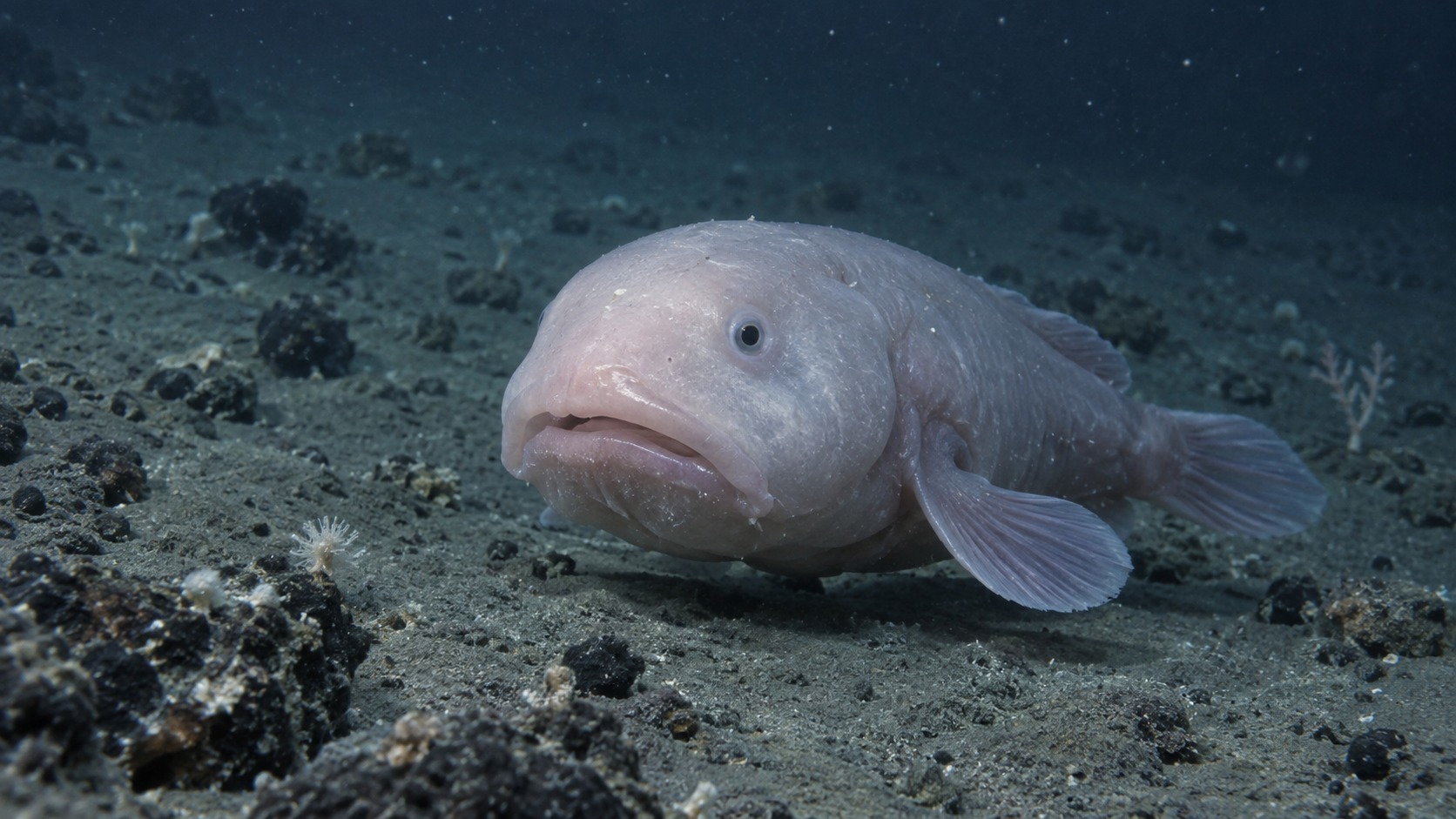
The blobfish is a deep-water bony fish with loose skin and an outsized head. Australia’s smooth-head blobfish, Psychrolutes marcidus, lives along the continental slope. The famous “Mr Blobby” belongs to a separate New Zealand-region species, Psychrolutes microporos, whose soft body is supported very differently underwater than in air.
Australia's smooth-head blobfish occupies deep slope habitat from Queensland around the southern coast, including Tasmania, to Western Australia. The separately recognized New Zealand blobfish, P. microporos, reaches a reported 63 cm total length and has been filmed swimming at depth.
Psychrolutes marcidus and P. microporos are separate species in the genus Psychrolutes, family Psychrolutidae. Both are ray-finned teleost fishes. The genus belongs to Cottoidei, placed within Perciformes in the current World Register of Marine Species classification. “Blobfish” is a shared common name.
Small teeth form gripping bands inside the broad jaws. New Zealand blobfish observations include movement by sculling the pectoral fins, while near-water-density gel contributes buoyancy. One well-known collected P. microporos also carried a parasitic copepod beside its mouth.
Why does a blobfish look sad?
Out of water, unsupported soft tissue sags. Drooping lips and a forward-falling skin fold produce the apparent expression.
Was Mr Blobby an Australian smooth-head blobfish?
No. The museum identifies him as Psychrolutes microporos; the Australian smooth-head species is P. marcidus.
Do these two species guard eggs?
Parental attendance has been filmed in the related P. phrictus. That observation does not establish egg guarding in either P. marcidus or P. microporos.
Are blobfish endangered?
FishBase gives P. marcidus and P. microporos the IUCN designation Not Evaluated. Neither has an assessed extinction-risk category in those entries.
Several fishes share the name blobfish
The Australian smooth-head blobfish, Psychrolutes marcidus, belongs to the family Psychrolutidae, a group of large-headed fishes with notably loose skin. It is also known as the Australian sculpin. Its range follows the deep continental slope around eastern and southern Australia, including Tasmania. The animal behind the famous photograph of a drooping, pink-faced blobfish is a different species: Psychrolutes microporos, associated with the New Zealand region.
Both species are ray-finned bony fishes and members of the genus Psychrolutes. Within the current World Register of Marine Species classification, the genus belongs to the order Perciformes and the cottoid group Cottoidei. Australian references sometimes retain the older order Scorpaeniformes. These different arrangements concern the larger branches of the fish family tree; the two blobfishes remain distinct species within Psychrolutidae.
The Australian species was first described in 1926 under the name Neophrynichthys marcidus. Its name-bearing specimen came from deep water off southern Australia or Tasmania. P. microporos was described in 1995 from New Zealand material, including a specimen collected southwest of Hokitika on the Southern Challenger Plateau in December 1983. That specimen came from a collection at 975–986 metres, documenting deep habitat long before the species acquired its scientific name.
Recognizing the Australian smooth-head blobfish
A broad, rounded head dominates the front of P. marcidus, while the body narrows toward a tail region flattened from side to side. The head accounts for about 40 percent of standard length, the fish measurement that excludes the tail fin. Smooth, scaleless skin lies loosely over the body. Its usual coloration is uniformly pale brown to grey, without the dark marbling found in some relatives.
The eyes sit high on the head, above a mouth that extends backward to beneath the rear of the eye. Neither jaw projects beyond the other. Small, threadlike skin projections called cirri occur on parts of the head, although the top of the head lacks them. The front nostrils form little tubes with raised rear rims, a detail documented in Joseph Nelson’s anatomical examination of the Australian species.
Its fins can be less obvious than those of a more rigid-bodied fish. Fleshy skin encloses the two dorsal fins so that they appear connected, and the seven spines within the first dorsal fin are weak. Behind that spiny portion, the second dorsal fin contains soft rays. This arrangement combines two different kinds of fin support along the back, although the covering of skin makes them look like one continuous structure. Large pectoral fins spread from the sides behind the head. The pelvic fins beneath the front of the body are much smaller.
Specialists also distinguish these fishes using features that require close examination. A regional identification key gives P. marcidus usually 24–25 rays in each pectoral fin and a black lining inside the body cavity. Together with its pale body and minute head cirri, these characters help separate it from the western blobfish. The large head alone is shared too widely among its relatives to identify the species reliably.
The second dorsal fin runs along a longer base than the first, with a shallow notch marking the separation between their rounded outer edges. The anal fin lies opposite the second dorsal fin and has a slightly shorter base. A moderately large, rounded tail fin completes the rear outline. These median fins occupy the narrowing rear half of the fish, behind the broad head and the large paired pectoral fins.
Another feature of P. marcidus is its lateral-line system, which is obvious externally only on the head. In fishes, this sensory system detects movements of the surrounding water through receptors sensitive to fluid displacement. It supplies information through mechanical stimulation rather than through light entering the eyes. A visible lateral line is therefore part of the animal’s sensory anatomy, distinct from the cirri projecting from the skin. Its presence does not depend on the fish having a covering of scales.
The New Zealand species
P. microporos has a similarly broad front end that narrows into a tadpole-shaped body. Its head is large and smooth, and the New Zealand fisheries guide describes the head, body and fins as uniformly pale pinkish-olive, becoming paler underneath. Loose, scaleless skin partly conceals the dorsal and anal fins.
A skeleton inside the softness
The yielding body of a blobfish still contains a vertebral column, jaws and supporting bones. Nelson recorded 32 vertebrae in two examined P. marcidus and described fragile skull bones and weak bony rims around the eyes. He also characterized the preserved bodies as exceptionally limp. This combination explains why the fish can feel unusually soft while remaining, anatomically, a bony fish.
Te Papa’s curators describe thin, soft skeletal bones in the New Zealand blobfishes they discuss. One named structure is the suborbital stay, a bone beneath the eye. Such small internal features connect blobfishes to their cottoid relatives, even though the loose tissues overlying the skeleton give them a very different appearance from many familiar sculpins.
Teeth are another easily overlooked part of the Australian fish. Its upper and lower jaws carry broad bands of fine teeth; Nelson described five or six irregular rows on the upper-jaw premaxillary bones and four to six on the lower-jaw dentaries. It lacks vomerine teeth, which would sit on a bone in the roof of the mouth. In Te Papa’s account of blobfishes, the small jaw teeth hold prey rather than chew it, giving the broad mouth a gripping surface.
The name marcidus comes from a Latin word meaning withered, wasted or weak. It may refer to the loose skin covering the head, body and fins, which conceals much of the anatomy underneath. The everyday name smooth-head blobfish likewise emphasizes an outward feature, while its classification rests on more detailed structures within and beneath that skin.
How large do blobfish grow?
Size depends on both the species and the measurement used. The New Zealand fisheries guide reports P. microporos reaching about 63 centimetres in total length, measured to the end of the tail fin. The famous individual called Mr Blobby measured 28.5 centimetres in standard length. His measurement excludes the tail fin and describes one particular fish, so it cannot serve as the species’ maximum size.
Published measurements for P. marcidus disagree. FishBase gives a maximum of 30 centimetres total length, while Fishes of Australia reports 38 centimetres without specifying the length convention. Nelson’s examined material included a male measuring 30.70 centimetres in standard length, already longer before the tail fin is included than the FishBase total-length figure. These records cannot sensibly be combined into a precise adult size range.
Measuring such a soft animal poses an additional problem. Nelson noted that the position of the limp body and its loose skin changes the measured length. Standard length and total length also use different endpoints, so a direct comparison requires the same convention.
Deep slopes around Australia and New Zealand
The Australian species occurs offshore from east-northeast of Coolangatta in Queensland, around the southern coast and Tasmania, to south-southwest of Eucla in Western Australia. Although those place names are coastal, the fish lives far below shallow coastal habitats. It is demersal, meaning associated with the seabed, and occupies the continental slope where the continental margin descends beyond the shelf.
Fishes of Australia gives P. marcidus a depth range of 600–1,200 metres. CSIRO lists an expected band of 600–900 metres, a narrower interval within that broader range. An anatomical study also examined Australian specimens trawled off Sydney at 732 metres, providing a specific collection locality within the slope habitat.
P. microporos occurs widely around New Zealand, where the fisheries guide gives a depth range of 600–1,500 metres. It shares part of the Australian species’ depth band, but inhabits a different geographic region. Reports also place P. microporos near Japan, although that occurrence remains provisional in the specialist Catalog of Fishes.
Offshore ridges also feature in blobfish collection records. Mr Blobby, for example, came from the West Norfolk Ridge during the NORFANZ expedition. The collection tow covered depths of 1,013–1,340 metres. That interval describes the trawl’s course through deep habitat; it does not pinpoint the depth at which that individual entered the net.
Those depth bands straddle a major change in illumination. In the ocean, the weakly lit twilight zone extends from about 200 to 1,000 metres, with sunlight dwindling rapidly downward. Below about 1,000 metres, sunlight no longer penetrates. Both species therefore inhabit depths well below the surface zone where light supports photosynthesis, and their deeper records fall in sunless water. Their habitat has no sunlit vegetation growing beside them, even where a small amount of light still arrives from above.
Pressure also rises sharply across their habitat. Each additional ten metres of seawater adds approximately one atmosphere of pressure. At 600 metres, the pressure is roughly sixty times the pressure at the surface; at 1,200 metres it is roughly 120 times surface pressure. The New Zealand species’ reported range extends still deeper, while its filmed appearance at 900 metres shows a fish swimming under pressure many times greater than at sea level.
Buoyancy without a gas bladder
A large volume of gel contributes to buoyancy in the New Zealand blobfishes described by Te Papa. Because this material has a density close to that of the surrounding water, it adds bulk without making the fish proportionately heavy underwater. A thick-looking body can consequently be supported with much less downward force than its appearance in air might suggest.
The cottoid group containing Psychrolutes lacks a gas-filled swim bladder. Many other fishes use such an organ in buoyancy control, whereas these blobfishes carry their soft tissues without that internal gas reservoir. Cold and pressure have also been suggested as influences on gel firmness, but that proposed effect is less certain than the role of buoyant support.
Removing a blobfish from water changes the forces acting on its body. The surrounding water no longer supports the gelatinous layer, and gravity makes the tissue sag. Lips droop, and a fold of skin can fall forward into the shape that resembles a hanging nose. Those changes create the familiar frowning face.
Preservation can alter that face again. Formaldehyde fixation tightened Mr Blobby’s skin and reduced the nose-like fold. The Australian Museum now keeps the specimen in 70 percent ethyl alcohol. A living fish underwater, a freshly collected fish in air and a preserved museum specimen therefore show different outlines, even when all three appearances belong to the same individual.
Swimming above the seabed
Direct underwater observations reveal more movement than the sagging surface appearance suggests. Te Papa identifies a freely swimming blobfish filmed at 900 metres as P. microporos. The recording came from a baited remote underwater video system. It establishes that this species can swim in its deep habitat, with the surrounding water supporting the body while the fish moves.
Other New Zealand observations described by Te Papa include a blobfish sculling its large pectoral fins above the bottom. Sculling involves movements of the broad fins through the water, rather than simply drifting wherever a current carries the fish.
The New Zealand fisheries guide suggests that P. microporos probably burrows in mud and ambushes prey. That remains a proposed feeding strategy. The recorded swimming demonstrates movement away from a fixed resting position, but supplies no daily timetable or swimming speed.
A separate baited-lander survey in the Kermadec region recorded P. microporos at 1,473–1,527 metres, including a published underwater view at 1,527 metres. These are observations near the deep end of the New Zealand fisheries guide’s approximate depth band. Together with the 900-metre swimming record, they place identified living fish at substantially different depths. The lander records establish attendance around baited equipment, without by themselves identifying a natural meal or demonstrating how the fish catches prey.
Food, teeth and a small parasite
The available feeding records have broader scope than either the Australian or New Zealand species alone. A specialist account of Psychrolutidae reports gastropods, the molluscs that include snails, in the stomachs of some family members. Te Papa’s curators also describe blobfishes eating deep-water warty sea anemones. Neither account identifies those meals specifically with P. marcidus or P. microporos, so the records describe feeding within the wider group.
The Australian fish’s large mouth and bands of small teeth provide a more direct view of its feeding equipment. A broad gape admits prey, while numerous small teeth provide multiple points of contact for holding it. That anatomy agrees with the gripping function described for New Zealand blobfishes. Its actual prey preferences require species-identified feeding records.
Mr Blobby also carried another animal: the yellowish object beside his mouth was a parasitic copepod. Copepods are crustaceans, and this individual was attached as a parasite rather than being identified as food.
Eggs and parental care in named relatives
The Australian Museum notes that blobfish eggs and larvae have not been described. Courtship, egg development and early growth remain poorly documented for P. marcidus and P. microporos. The most striking filmed examples of parental attendance belong to a different congener, the North Pacific blob sculpin, Psychrolutes phrictus.
At the Gorda Escarpment off northern California, MBARI filmed P. phrictus close to or positioned over pinkish-purple egg masses on boulders. The attending fish were commonly around 60 centimetres long. Repeated summer surveys found these fish and Graneledone octopuses using the same localized brooding area.
Another relative shows how different the life cycle can be within the genus. The soft sculpin, Psychrolutes sigalutes, occurs from the Bering Sea to Washington at depths of 0–225 metres. It lays eggs on solid surfaces in rocky subtidal habitat, and males guard the nests. Spawning in August is reported from British Columbia. Its larvae live in the water column, and juveniles can return there to feed.
Reproductive timing also differs among psychrolutids farther away. On the southwest Atlantic shelf edge and slope, Psychrolutes marmoratus showed synchronous egg maturation, with a spawning peak in autumn and winter. A different member of the family in the same study, Cottunculus granulosus, showed group-synchronous maturation and reproduction throughout the year. The first pattern involves eggs maturing together, while the second involves groups of developing eggs. Such differences in reproductive scheduling are biologically significant even within a family of similarly built fishes; neither schedule describes an established breeding season for P. marcidus or P. microporos.
Distinguishing the western blobfish
The western blobfish, Psychrolutes occidentalis, adds another Australian species to the comparison. Its range runs from off Shark Bay to the Arafura Sea near the Northern Territory, with records off Papua New Guinea. Its reddish-brown body has darker marbling, contrasting with the uniform pale coloration of P. marcidus. It also lacks head cirri and usually has fewer pectoral-fin rays, 21–23.
Fishes of Australia gives the western species a maximum of 11 centimetres standard length and a reported depth band of 305–704 metres. Original collections included mud-bottom trawls around Rowley Shoals. A remotely operated vehicle also filmed a fish off Barrow Island at about 1,220 metres that specialists considered most likely P. occidentalis. That deeper record retains a qualified identification; it is separate from the confirmed New Zealand swimming record.
Mr Blobby and encounters with people
Mr Blobby was collected aboard the research vessel Tangaroa on 3 June 2003, during the NORFANZ expedition. Kerryn Parkinson photographed the freshly collected fish. The Australian Museum identifies the specimen as P. microporos, preserving both the animal and the collection record behind its familiar appearance. The recognizable face belongs to that individual after collection, while the species also has a documented life moving through deep water.
Commercial fishing brings the Australian smooth-head blobfish into contact with people too. P. marcidus is occasionally caught incidentally in trawl fisheries. Such bycatch is a documented route by which a seabed-associated fish reaches the surface. The effect of those captures on the population across its Australian range has not been quantified in the reported bycatch records.
FishBase lists both P. marcidus and P. microporos as Not Evaluated for IUCN purposes. This means the species have not been evaluated against the Red List criteria; it supplies no assessed level of extinction risk. The distinction matters when considering incidental capture: evidence that a fish is caught and an assessment of its overall conservation status answer different biological questions.
Animal Product Reviews
Dive into Animal Streets’ Animal Product Reviews – your guide to the best gear, gifts, books, and gadgets inspired by the animal kingdom. From land-roaming lions to ocean-gliding whales, from household pets to prehistoric giants, we explore top-rated products for enthusiasts, educators, and animal lovers alike. Whether you’re shopping for toys, decor, field gear, or fun collectibles, we’ve sniffed out the best so you can discover it all in one wild place!