
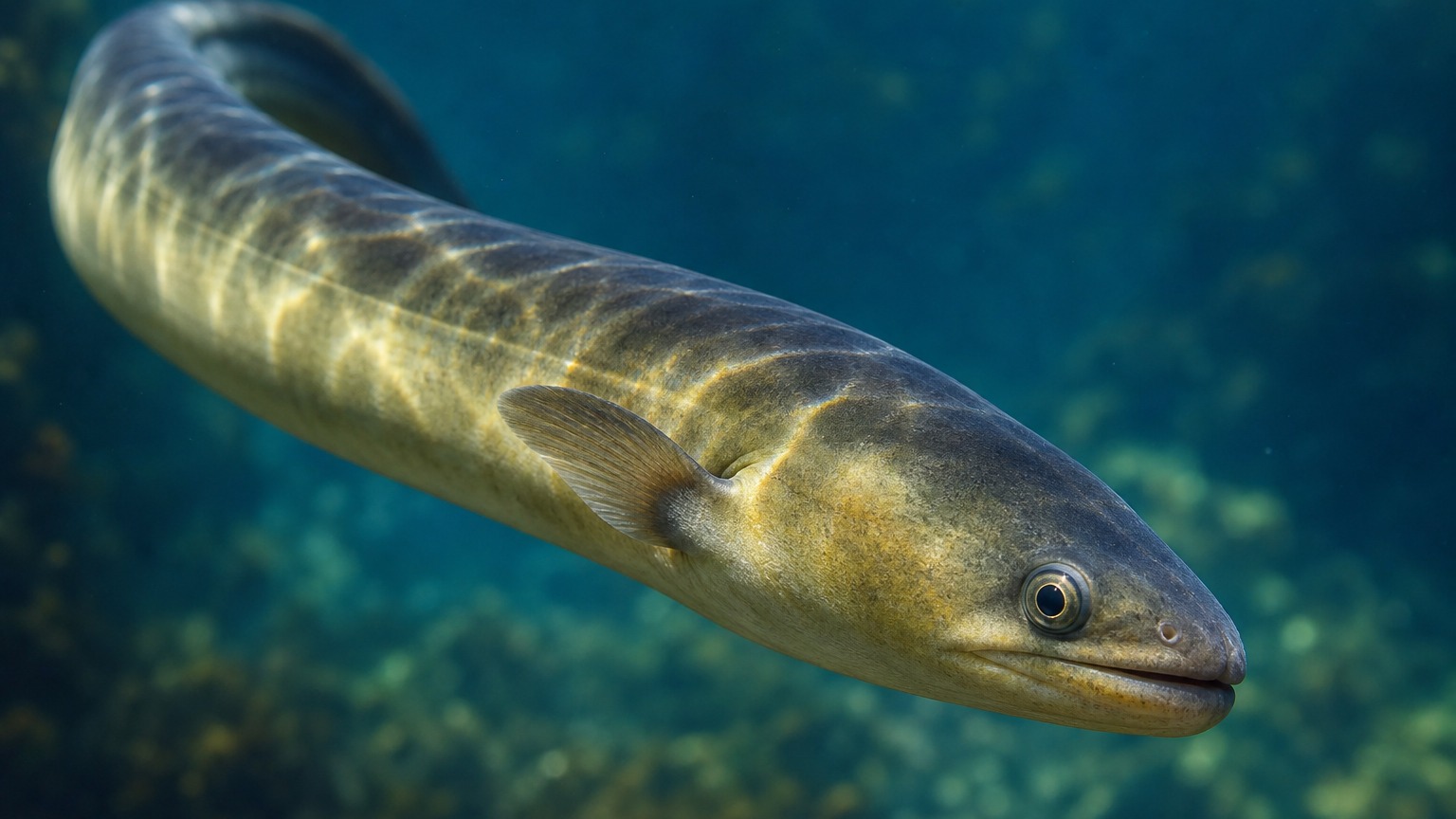
The head at the mouth of a reef crevice may belong to a moray; the long fish slipping over a rocky bottom may be a conger. Both are marine eels, but the resemblance hides important differences. Their flexible bodies, reduced fins and secretive habits suit life around shelter, while specialized feeding structures and transparent drifting larvae make their biology unlike that of most familiar reef fishes.
- Adult morays lack pectoral fins; congers retain a pair immediately behind the head.
- A moray opening and closing its mouth may be pumping water across its gills rather than threatening another animal.
- In studied morays, mobile pharyngeal jaws grasp food inside the mouth and pull it toward the throat.
- True eels begin life as flattened, transparent leptocephalus larvae, not miniature replicas of the adult.
- Marine morays and congers are ray-finned bony fishes in the order Anguilliformes.
- Morays belong to Muraenidae, while congers belong to Congridae.
- The green moray, Gymnothorax funebris, is a western Atlantic species; the California moray, Gymnothorax mordax, occupies eastern Pacific waters.
- Conger conger is the European conger; Conger oceanicus is the American conger. Each is a species within a broader family.
- Yellowish mucus over dark skin gives the green moray its characteristic green appearance.
- A long body is not sufficient evidence of eel identity: electric eels and many spiny eels belong to other fish groups.
- Small tubular nostrils help morays sample chemical information around their shelter and potential prey.
- A refuge used by day can become the starting point for a feeding excursion after dark.
Q: How can a moray and a conger be distinguished?
A: Look for pectoral fins behind the head: congers have them, adult morays do not. Morays also have small, rounded gill openings rather than the more conspicuous openings of congers.
Q: Why do morays keep opening their mouths?
A: The movement helps ventilate their gills. An open mouth by itself is not proof that the fish is preparing to bite.
Q: Do all eels have a second set of moving jaws?
A: Many fishes have teeth or jaws in the throat, but the highly mobile prey-transport system demonstrated in morays should not be attributed to every eel.
Q: Do marine eels migrate to the Sargasso Sea?
A: Not as a group. That familiar spawning story concerns particular Atlantic freshwater eels, not all morays and congers.
Q: Are morays and congers snakes?
A: No. They are fishes with gills and fish fin structures. Their elongated bodies evolved within the fish lineage.

Conger Eel
Read about Conger Eel through its defining traits, natural setting, feeding behavior, movement, and the comparison clues that separate it from other animals in the eel group.

An Eel Is a Fish, Not a Body Shape
Eels are easily recognized by their length, but length alone is an unreliable definition. A marine moray and a conger are true eels belonging to Anguilliformes, an order of bony fishes. Their bodies contain the skeleton, muscles, gills and organs of fishes, reorganized into an elongated form. A swimming eel may suggest a snake because its body bends in waves, yet that resemblance does not establish a close relationship. The movement solves a mechanical problem rather than revealing a reptilian ancestry.
The common name eel also appears on unrelated animals. Electric eels are knifefishes, and aquarium spiny eels belong to another fish lineage. Long-bodied salamanders can produce similar confusion when seen briefly in water. For marine morays and congers, fin structure, gill openings and scientific identity resolve the ambiguity. Moray eel and conger eel each encompass multiple species, so neither name supplies a single worldwide adult size, diet or native range. Their shared outline is the beginning of a comparison, not its conclusion.
Two Families with Different Fins
Morays belong to Muraenidae. An adult lacks paired pectoral fins behind the head, leaving a relatively uninterrupted outline along the front of the body. The long dorsal and anal fins in familiar reef morays continue toward the tail. Congers, in Congridae, retain pectoral fins, which are visible as a small pair near the head. Both families lack pelvic fins. These differences are useful even when a fish’s markings are obscured by shade, distance or turbid water around its hiding place.
Gill openings provide another clue. Morays have small openings set behind the head, while congers have more conspicuous openings associated with the front of the body. A fish partly concealed in a hole may reveal only its face, so identification is not always immediate. Waiting for a fuller view is more reliable than assigning every emerging head to a moray. Color can supplement the structural evidence, but the presence or absence of pectoral fins is a particularly practical distinction between these two familiar marine families.
Movement Along a Flexible Body
Swimming involves a traveling wave of bending along the eel’s body. Muscles on alternating sides produce the curves, and the interaction of the body with water generates movement. This differs from the more concentrated tail strokes of many compact reef fishes. A long flexible body can turn through irregular spaces and bring the head around a corner while the rear remains sheltered. That capability is valuable in a rocky environment where food and refuge are separated by narrow passages rather than broad, unobstructed water.
Flexibility does not eliminate physical limits. An eel still needs an opening large enough for its head and body, and a tight refuge can make rapid turning difficult. The direction of a swimming wave, the position of the head and the shape of the surrounding rocks affect an escape or feeding encounter. When an eel moves across exposed bottom, the same body mechanics propel it without enclosing walls. Shelter and open-water swimming therefore use one flexible design in different circumstances, not two unrelated ways of moving.
Skin, Mucus and Close Contact with Shelter
Adult morays have scaleless skin covered by mucus. That surface is well suited to frequent contact with the edges of rocky crevices. The mucus forms part of the fish’s protective boundary with its environment; it is not merely an oily-looking decoration. Skin color and the appearance of the mucus together influence what an observer sees. On a green moray, yellowish mucus over a darker underlying body creates the characteristic green tint. A preserved specimen can look different after that living surface has changed.
Congers have their own smooth external appearance, and the absence of obvious overlapping scales can add to the impression of a snake. Nevertheless, skin is only one component of eel identity. The continuous fin margins, pectoral fins in a conger and gill openings place the animal unmistakably among fishes. Contact with shelter also explains why handling can be harmful: an intact surface belongs to the fish’s normal defenses. Pulling an animal from a hole alters both its position and the protective interface around its body.
Breathing Behind an Open Mouth
A moray often rests with its head exposed and its mouth repeatedly opening. The movement helps pass water across the gills, where dissolved oxygen is taken up. It can look dramatic because the teeth remain visible throughout the cycle. Interpreting every opening as aggression mistakes a necessary physiological activity for a threat display. The animal may be ventilating quietly while remaining in a suitable refuge, without pursuing another fish or responding directly to a nearby observer.
Context still matters. A fish approached closely, touched or blocked from retreat can react defensively, and a predator may also open its mouth during feeding. The same visible structure serves more than one activity. Respiration, prey capture and defense cannot be distinguished by teeth alone. The position of the body, movement toward another animal and surrounding circumstances provide additional information. Leaving the eel space allows those natural activities to remain separate from a reaction caused by human contact at the entrance to its shelter.
Finding Food in a Crevice-Rich Environment
Many morays hunt where sightlines are short. A rock wall or reef branch can hide an animal a few centimeters away, even in otherwise clear water. Chemical cues become useful in this setting. Prominent nostrils help the fish sample water, and scent can indicate food that is not yet visible. The head can enter gaps while the body follows, giving access to sheltered prey. Feeding is therefore not limited to waiting for a clearly illuminated fish to swim across an open stretch of reef.
Congers also encounter prey close to the bottom, often becoming active after dark. A moving fish, crab or cephalopod can be found around the same shelter network used for daytime refuge. Darkness does not imply that the eel searches randomly or that its eyes have no function. Several kinds of information can contribute to an encounter. Sensory abilities work with body shape: locating food is useful only if the fish can reach it, position the head and complete a successful capture in the available space.
The Moray’s Internal Prey-Transport System
Research on morays has demonstrated an unusually mobile set of pharyngeal jaws. After the oral jaws seize prey, these inner structures move forward to grip it and then withdraw, carrying food toward the throat. The process helps solve the problem of moving a captured animal backward inside a long, narrow head. Other fishes possess pharyngeal structures too, but the particular transport mechanism studied in morays is not a generic feature that can be assumed for all fishes with teeth in the throat.
The inner jaws do not shoot across open water to grab distant prey. Their role follows capture within the mouth. This distinction separates the actual mechanics from the exaggerated image of a second mouth attacking independently. A moray needs to secure the animal first, and the prey’s size and shape still constrain what can be handled. Studies of particular species establish how the mechanism works; they do not make every feeding event identical or assign the same specialized action to congers simply because those fishes are also eels.
Teeth Reflect Different Meals
Not every moray has the same teeth or eats the same prey. Sharp, recurved teeth are effective for retaining slippery animals, while crushing forms in some relatives suit hard-shelled foods. The green moray is a predator of fishes, crustaceans and cephalopods. California morays also take animals such as small fishes and octopuses. A family-wide description of morays as exclusively fish eaters would overlook important differences, just as describing every eel as a crab specialist would flatten the diversity in the opposite direction.
The American conger is primarily a fish eater, with shrimp and small shelled animals also recorded as food. European congers consume fishes, crustaceans and cephalopods. For these bottom-associated hunters, the neighborhood of a refuge contains potential meals as well as competing predators. A conger leaving a sheltered opening after dark is entering that feeding community, not merely relocating its hiding place. The presence of piers, jetties or rocks can make the animal easier for people to encounter while leaving much of its ordinary activity out of view.
Morays Across Different Oceans
The green moray, Gymnothorax funebris, is familiar in the western Atlantic, especially warm coastal and Caribbean environments. Its relatively uniform green appearance differs from the spots, bands and mosaics of many other morays. The California moray, Gymnothorax mordax, lives in the eastern Pacific. These examples demonstrate why moray habitat should not be reduced to tropical coral alone. Rocky shores and reefs also offer appropriate shelter, with temperature and regional conditions determining which species can use them.
An aquarium display may bring several morays together under one roof, but that arrangement does not map their native distribution. Closely related-looking animals can originate in different oceans. Even a broad species range does not mean every location within it has the same abundance or breeding activity. Occasional northern records and established warm-water populations are different kinds of evidence. Geographic information becomes more useful when it identifies the species and the setting instead of describing all morays as inhabitants of any warm reef worldwide.
Congers on Rocky Shores and Continental Shelves
The European conger, Conger conger, occupies eastern Atlantic and Mediterranean waters, with records extending into other connected regional seas. The American conger, Conger oceanicus, is a western Atlantic relative. They should not be combined into a single fish circling every Atlantic coastline. Their separate identities matter for interpreting range records, adult size and biological observations. Both illustrate a conger association with marine bottom habitats, where rocks, holes and other structures can supply refuge between feeding excursions.
Congers may also occur over sand or other substrates, particularly when searching for food or moving between shelter sites. A name associated with a rocky hole does not make every part of the life cycle permanently confined to rock. Juveniles and adults can differ in depth and habitat use, and a fish can leave its resting place without abandoning its general habitat association. The surrounding shelf landscape contains feeding areas as well as refuges. An occupied cavity is one useful location within that larger environment.
Daytime Shelter and Nighttime Excursions
Many familiar morays and congers remain concealed for substantial periods and forage more actively after dark. This pattern reduces the value of judging abundance from one daytime view of a reef. Several hidden fishes may occupy structures that appear empty when inspected casually from above. Conversely, seeing one exposed head repeatedly does not prove that the same animal never leaves. A refuge can be used at one part of the daily cycle and vacated when food becomes more accessible elsewhere.
The timing and extent of activity vary among species and circumstances. A daylight feeding observation does not contradict the tendency toward nocturnal activity, nor does a nighttime swim imply a long migration. Food, disturbance and the distribution of suitable openings influence local movements. Repeated observations are needed to understand how an individual uses its surroundings. The most informative distinction is between the sheltered position itself and the activities that connect it to the rest of the bottom habitat over time.
Cleaning Partners and Shared Reef Space
Morays can interact with cleaner shrimps and other cleaning animals. These smaller organisms gain food from material removed from the fish, while the eel receives a cleaning service. The encounter is especially striking when a tiny shrimp approaches the exposed mouth of a much larger predator. It shows that the eel’s response is not determined by the simple rule that every smaller nearby animal is prey. The immediate behavioral setting changes the meaning of the approach.
Cooperative hunting provides a different kind of association. A Red Sea study documented a giant moray hunting alongside a grouper, with the two predators gaining access to different escape routes used by prey. That evidence concerns a particular system rather than every reef eel. Cleaning and hunting partnerships also serve different functions and should not be merged into a vague account of friendly reef behavior. Both demonstrate that ecological relationships depend on the participants and the situation, not solely on their relative size or sharp teeth.
Transparent Larvae Before the Familiar Adult
True eels produce leptocephalus larvae. These are flattened, transparent forms that drift in the plankton and look unlike the narrow, muscular adults. Their appearance can make the connection difficult to recognize without developmental evidence. A young eel does not begin as a tiny moray head peering from a rock. It passes through a pelagic stage whose movement is influenced by water circulation before metamorphosis produces the juvenile form associated with more familiar eel habitats.
This transformation changes more than length. Body proportions and external structures are reorganized as the larva develops. The distinct larval phase helps connect separated coastal habitats because early life is not restricted to the adult refuge. However, drifting larvae are not all carried along one identical route, and their destinations cannot be predicted simply by tracing the nearest current on a map. Species identity, spawning geography, development and suitable settlement conditions all contribute to where a juvenile can eventually establish itself.
Spawning Knowledge Has Important Gaps
Marine eel reproduction is less easily observed than an adult resting in an accessible hole. Eggs, mature fish and larvae provide different pieces of evidence, and many details remain uncertain for individual moray species. It is possible to describe the existence of egg laying and the leptocephalus stage without pretending that every spawning site, season or migration route is known. A complete-looking account with precise but unsupported coordinates would be less accurate than one that retains those genuine biological gaps.
The well-known Sargasso Sea story belongs to particular Atlantic freshwater eels in Anguilla. It must not be assigned to every moray or conger. Marine families have their own reproductive histories, and a species that spends adulthood around a reef is not simply following the freshwater-eel itinerary in reverse. Even within congers, proposed spawning locations and depths require species-specific evidence. The crucial point is that shared larval form does not establish a single shared spawning destination for the entire order.
Growth, Predation and Food-Web Connections
Eels pass through very different ecological circumstances as they grow. A larva drifting in the water column is exposed to a different predator community from an adult occupying a deep rock opening. A small juvenile must find suitable refuge and prey before it can develop the bulk of a large conger or moray. The striking size of an adult consequently represents survival through earlier stages, not evidence that the species is safe from predation throughout its life.
Adult eels help transfer energy from smaller fishes and invertebrates into larger marine predators when they themselves are eaten. Their feeding reaches into spaces that some compact fishes cannot enter as easily. This gives crevice-dwelling prey a predator with a distinctive approach, rather than adding merely another open-water hunter. The food-web role remains species-dependent: different teeth, habitats and body sizes produce different interactions. Eel diversity is therefore relevant to the structure of the marine community, not just to the variety of shapes a diver sees.
Human Encounters and Habitat Change
An eel with its head outside shelter may remain still as people approach. That tolerance should not be confused with domestication or an invitation to handle it. Feeding, touching or probing an occupied opening changes the encounter and can provoke defensive or food-directed responses. Observing from outside the refuge is enough to appreciate the breathing cycle, fin structure and markings. The animal’s ability to remain in place is part of the scene worth observing, rather than an obstacle to obtaining a more dramatic reaction.
Fishing, bycatch, coastal alteration and damage to structural habitat affect marine eels in different ways across species and regions. Secretive adults and incompletely known early stages can make population assessment difficult. The absence of an eel from one visible hole is not a conservation trend, and its presence there is not proof of a secure worldwide population. Morays and congers retain their distinctive place in marine life through a combination of shelter, prey, larval development and suitable water conditions. Understanding those connections replaces the misleading impression of a snake-like fish living alone in permanent darkness.
Animal Product Reviews
Dive into Animal Streets’ Animal Product Reviews — your guide to the best gear, gifts, books, and gadgets inspired by the animal kingdom. From land-roaming lions to ocean-gliding whales, from household pets to prehistoric giants, we explore top-rated products for enthusiasts, educators, families, and curious animal lovers.