
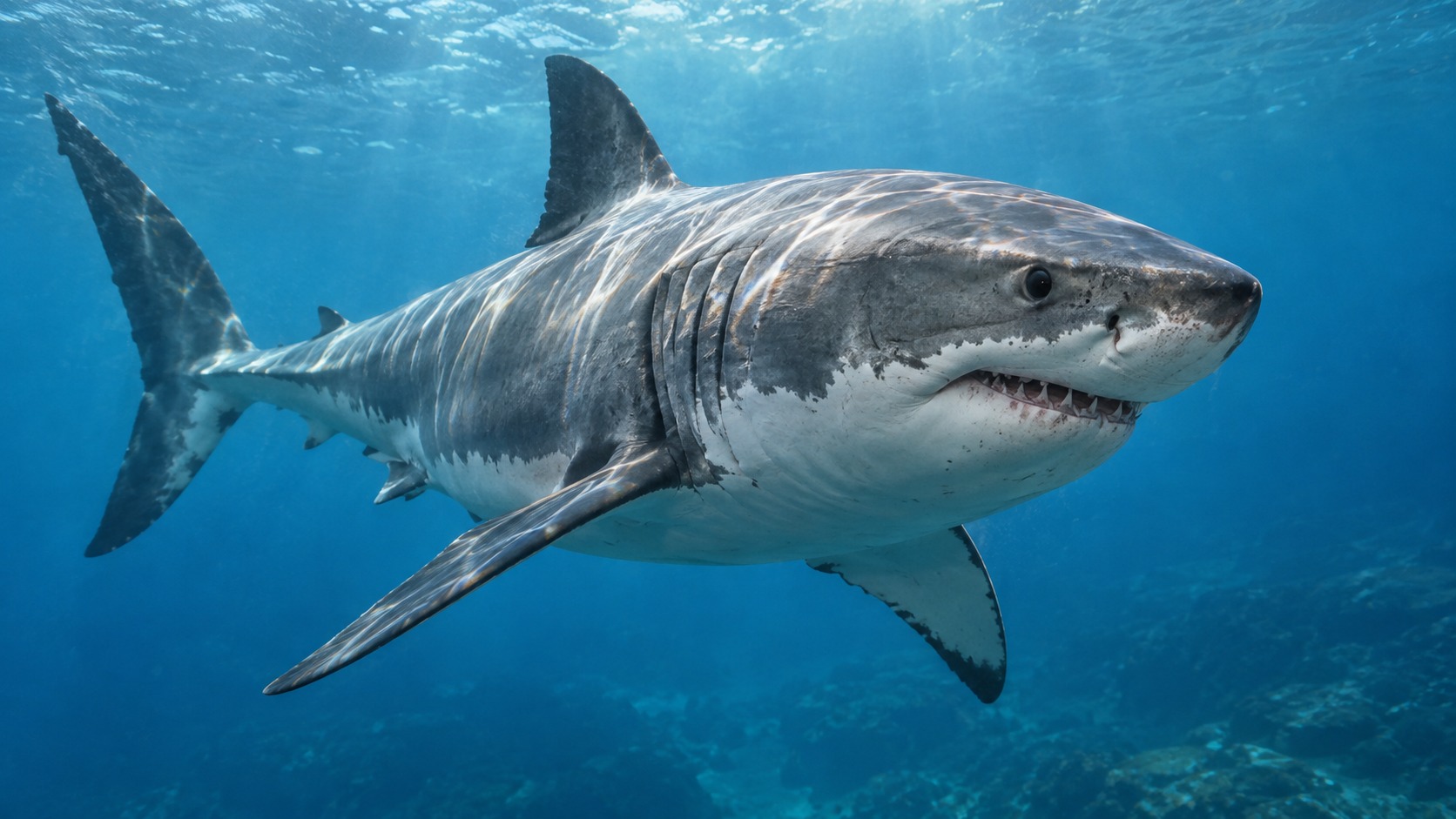
The great white shark (Carcharodon carcharias), also called the white shark or white pointer, is a large ocean predator with a pointed snout, triangular teeth and a crescent-shaped tail. Its life extends beyond the familiar image of a shark near a seal colony: young animals use coastal nursery areas, while larger sharks can cross ocean basins and return to places they have visited before.
A: Carcharodon carcharias, a large member of the mackerel shark family, Lamnidae.
A: No. Its back is dark, while its underside is pale to white with a sharp boundary.
A: Large individuals can reach about six metres. Young sharks are much smaller, and females generally grow larger than males.
A: No. White sharks use coastal habitats but can also travel across ocean basins.
A: Common prey includes squid, stingrays and other fishes; the familiar marine-mammal diet is more associated with larger sharks.
A: No. Their prey also includes fishes and other marine mammals, and they scavenge dead whales.
A: No. Pups develop inside the female and are born alive.
A: A white shark has broad triangular serrated teeth, while mako teeth are longer, narrower and smooth-edged.
A: Yes. White sharks can maintain body temperatures above the surrounding water.
A: No. A sighting, an approach and physical contact are different observations; white sharks can nevertheless cause serious injury.
What Is a Great White Shark?
The great white belongs to Lamnidae, the mackerel shark family, alongside makos, porbeagles and salmon sharks. Its skeleton is made of cartilage rather than bone. A streamlined body and strong tail support efficient swimming through both coastal and offshore waters.
Large individuals can reach about six metres long. Females generally grow larger than males, but a single dramatic photograph is a poor size guide: distance and camera angle can hide the scale of the animal. A young white shark can be much smaller than the large adults most often shown in documentaries.
How to Recognize One
The snout is conical and the first dorsal fin large and triangular. Behind it, the second dorsal fin is very small. Broad pectoral fins extend from the sides, and a strong keel runs along each side of the narrow tail base. The crescent-shaped tail has upper and lower lobes much closer in size than those of many other sharks.
The upper body is grey, bronze or nearly black, with a sharply contrasting white underside. The name does not describe an entirely white animal. Colour is most useful alongside shape, fin placement and the teeth, rather than as an isolated field mark.
Adult teeth are broad, triangular and serrated, with narrower teeth in the lower jaw. A mako instead has a sharper snout and long, slender, smooth-edged teeth. Porbeagle teeth have small side cusps, and a pale patch marks the free rear tip of the first dorsal fin. These comparisons separate related sharks more clearly than body size alone.
A Marine Range, Not Just a Coastline
White sharks occur widely in temperate and subtropical seas. Coastal shelves, islands and productive inshore waters are important parts of their range, but they also travel through the open ocean. A coast where sharks gather seasonally is one part of that wider marine landscape.
They can maintain body temperatures above the surrounding water. That capacity distinguishes them from most fishes, but it does not make them independent of water conditions. The water column offers different temperatures and feeding opportunities, and white sharks use more than the surface layer.
Electronic tags and photographic identification have shown both coastal return journeys and transoceanic movement. A 2005 study linked white sharks in South Africa and Australia through a return migration. It demonstrates what an individual can do, rather than a route followed by every white shark.
New South Wales tracking also records white sharks travelling far beyond the state, including across the Great Australian Bight and to New Zealand. An acoustic receiver records a tagged shark when it passes within detection range. A gap in detections is not evidence that an animal has remained at one beach.
Diet Changes with Growth
White sharks eat a variety of fishes and marine mammals. Young sharks commonly take smaller prey, including squid, stingrays and other fishes. Large sharks can take seals, sea lions and dolphins, and they also scavenge dead whales. Fish remain part of the diet of some adults; growing larger does not create a strict switch to mammals alone.
This distinction matters when interpreting a shallow-water sighting. A small white shark feeding in a coastal area need not be searching for the same prey as a large animal near a seal colony. Diet, body size and location belong together, rather than treating every white shark as an identical seal hunter.
Young Sharks and Reproduction
White sharks give birth to live pups. The young develop inside the female instead of being deposited outside her body in egg cases. They produce relatively few young, and their slow growth and delayed maturity limit how quickly losses can be replaced.
Southern California provides a useful example of juvenile habitat. The California State University Long Beach Shark Lab describes young white sharks near the coast and contrasts their nursery use with the wider offshore and coastal movements of larger animals. That local pattern should not become a claim that every birth occurs at a particular beach or in a known worldwide set of nurseries.
Finding young sharks in an area and observing a female giving birth are different kinds of evidence. Coastal concentrations help researchers identify habitat used early in life, while many details of reproduction remain harder to observe directly. A nursery is a place used during growth, not proof of a precisely located birth site.
Predators, People and Fishing
White sharks are large predators within marine food webs, but their ecological role changes with body size and the prey available. The fishes eaten by juveniles and the mammals eaten by large adults connect them to different parts of those food webs. The species cannot be understood solely through spectacular surface feeding.
White sharks can seriously injure people. California’s wildlife agency documents incidents involving swimmers and other water users, while distinguishing physical contact from a mere sighting. An individual seen near people is therefore not itself a record of a bite. Nor can a species profile determine the risk at a particular beach on a particular day.
Fishing is an important conservation concern, including capture in gear set for other species. Wide-ranging sharks encounter conditions beyond any single aggregation site, and a locally conspicuous group does not establish the condition of the species everywhere. Protecting them requires attention to survival as well as to the places where they feed and grow.
Reading the Whole Animal
For identification, combine the pointed snout, strong tail keel, crescent tail and dark-over-white colour boundary. For natural history, distinguish a juvenile in coastal habitat from a large travelling adult. The same species can use both settings without fitting one fixed image of a shark patrolling a seal colony.
Animal Product Reviews
Dive into Animal Streets’ Animal Product Reviews – your guide to the best gear, gifts, books, and gadgets inspired by the animal kingdom. From land-roaming lions to ocean-gliding whales, from household pets to prehistoric giants, we explore top-rated products for enthusiasts, educators, and animal lovers alike. Whether you’re shopping for toys, decor, field gear, or fun collectibles, we’ve sniffed out the best so you can discover it all in one wild place!