
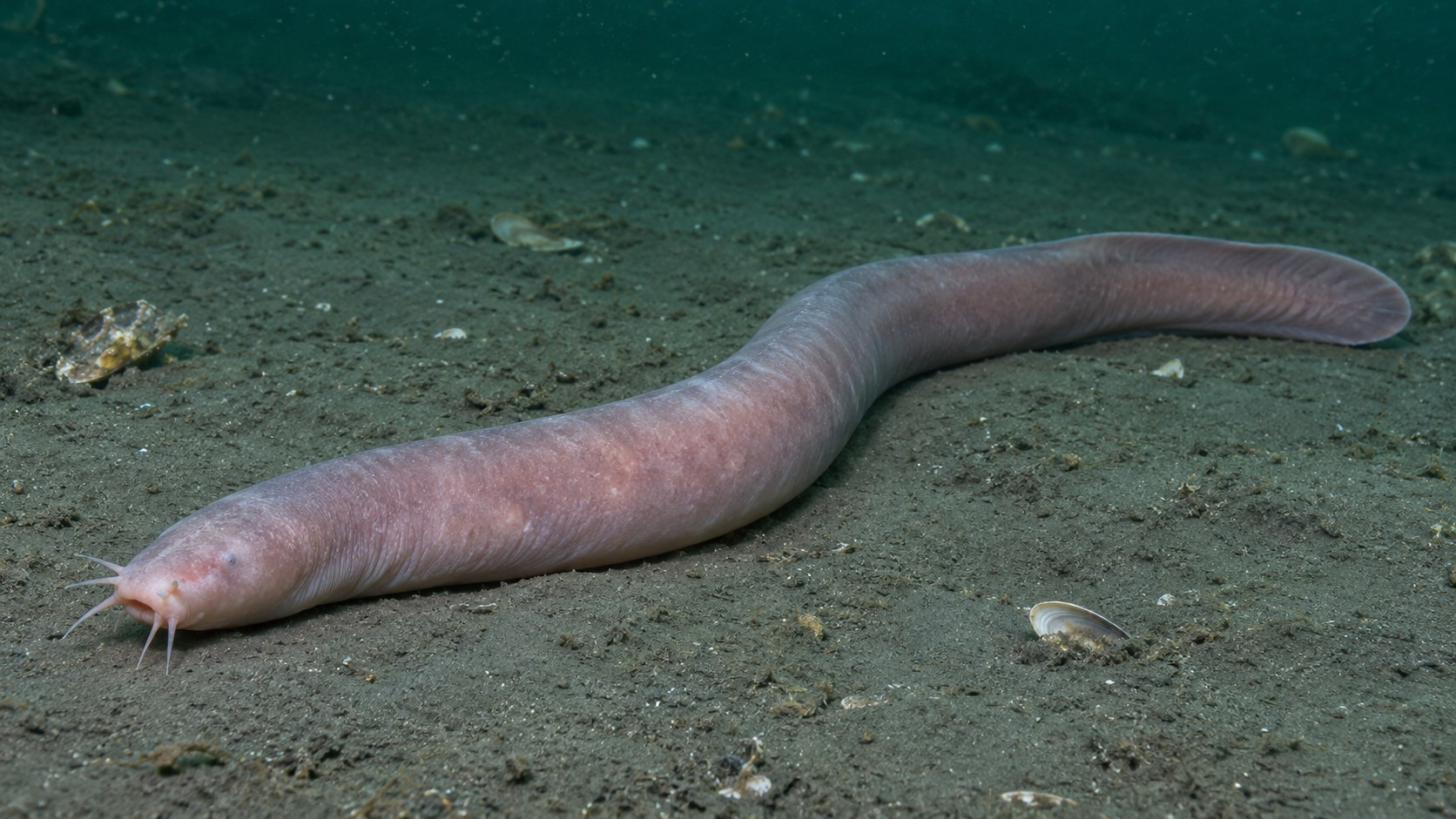
An eastern Atlantic hagfish
Myxine glutinosa belongs to the jawless vertebrate group Cyclostomata. Its classification places it in the class Myxini, order Myxiniformes and family Myxinidae. Within that family, Myxine is the genus and glutinosa identifies the species. Common hagfish is another English name used for it. The scientific name is especially useful here because Atlantic hagfish is also applied to a different species on the opposite side of the ocean.
Fernholm and colleagues confirmed the distinction between eastern Atlantic Myxine glutinosa and western Atlantic Myxine limosa in 2013. Their investigation combined taxonomy with comparisons of mitochondrial 16S and COI sequences.
Much laboratory work was published under M. glutinosa without stated collection origins. These animals retain their published identification; they cannot be assigned confidently to a modern eastern or western population.
Along Europe, an Icelandic Marine and Freshwater Research Institute account describes M. glutinosa from Murmansk and northern Norway south through Kattegat and western European coasts to Iberia and the western Mediterranean. The account draws on the 2013 book Íslenskir fiskar. It also illustrates the difficulty of older identifications: two Icelandic specimens caught in 1973 and 1977 were assigned successively to M. glutinosa and M. ios, and are now considered probably M. jespersenae.
Recognizing the body
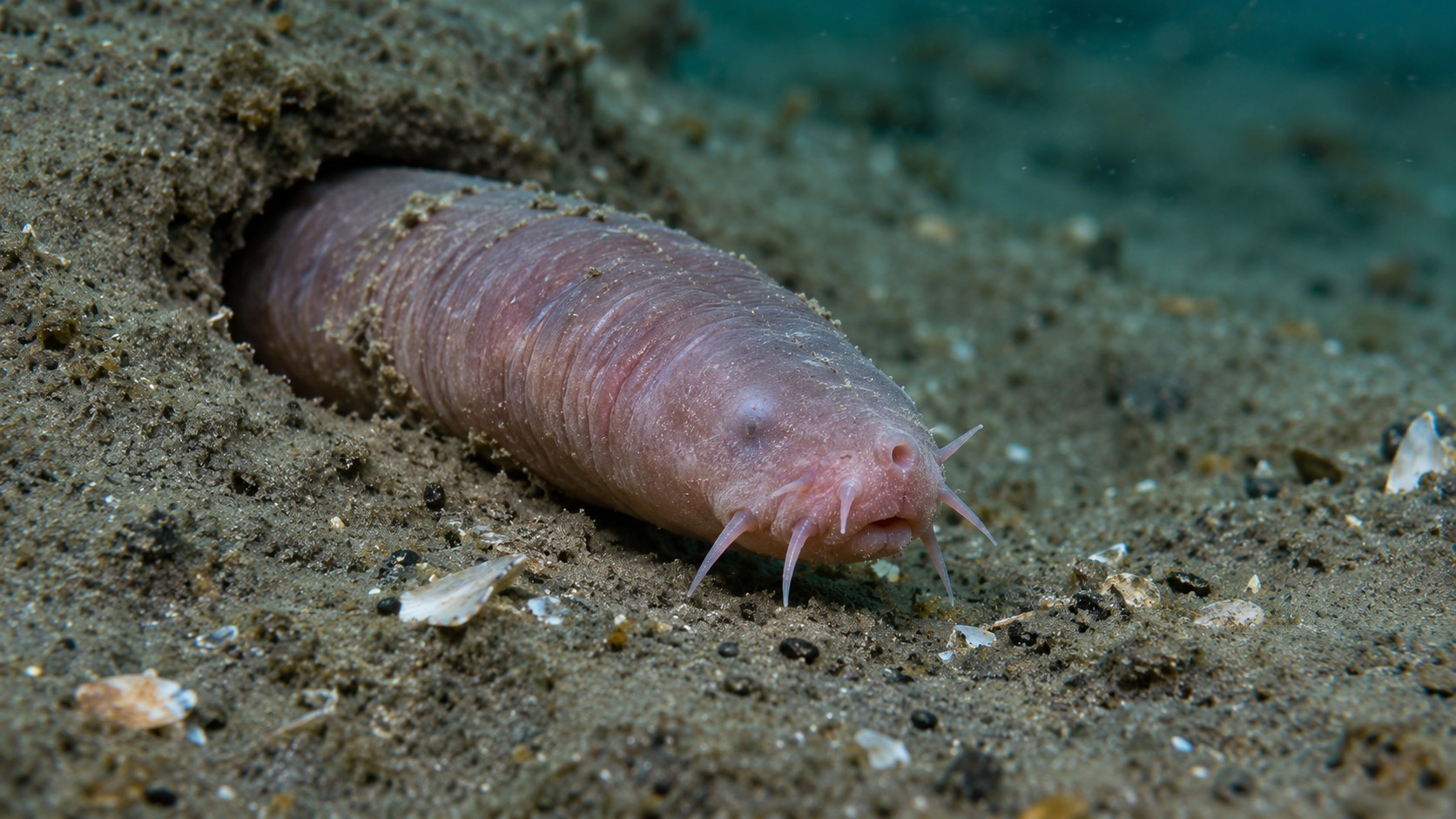
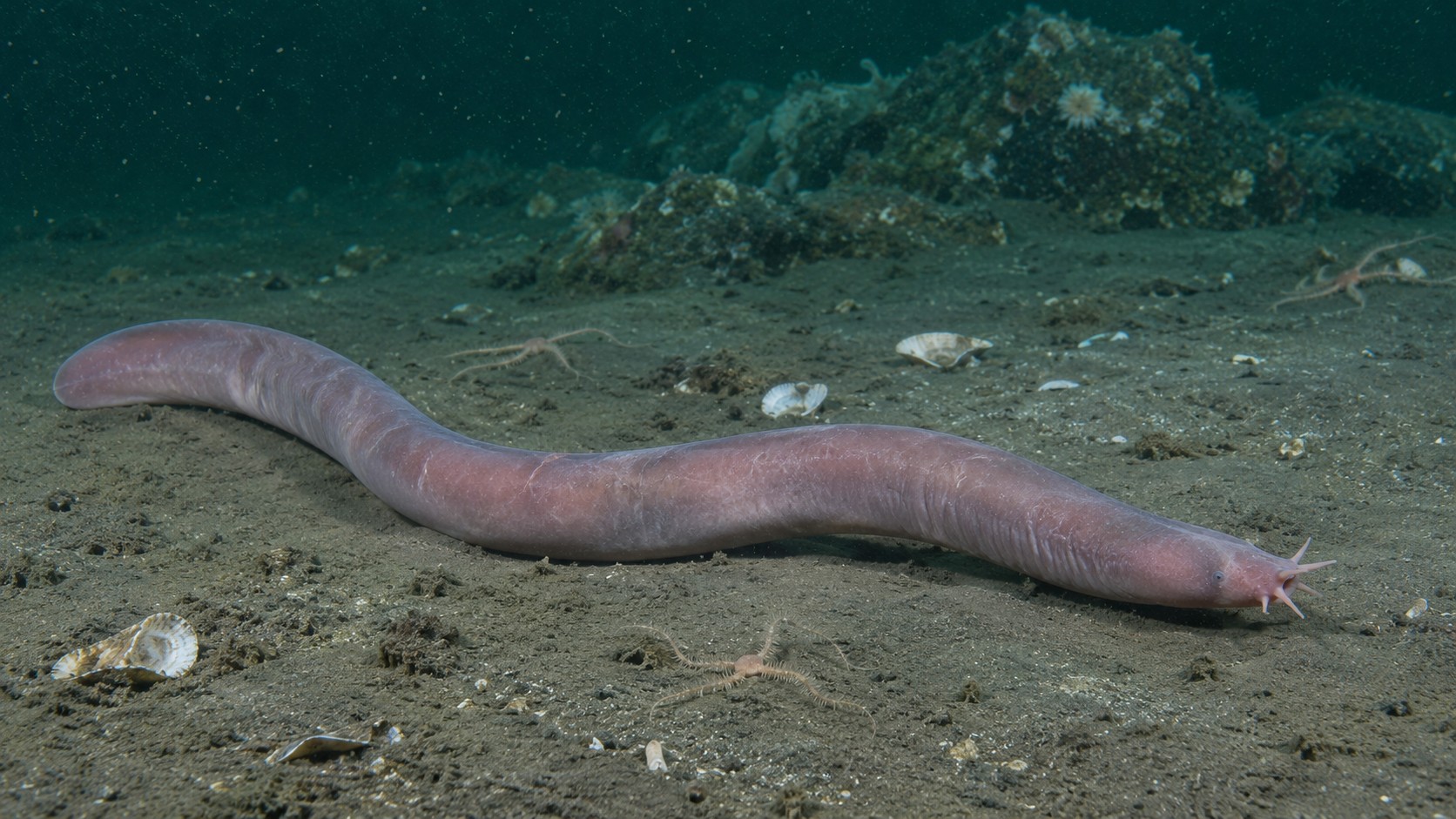
The body is long, smooth and usually grayish brown or reddish gray. A continuous skin finfold curves around the tail and extends forward underneath the body. At the head, barbels surround the mouth and nasal region, with one nasal opening at the snout tip. The closed mouth looks star-shaped and has neither jaws nor lips. On each side, a single external gill pore lies just ahead of the ventral finfold. MarLIN records it around Britain, sheltering in mud. It reports an upper length of about 80 centimetres, rather than a typical adult size.
Inside, the historical Fishes of the Northeastern Atlantic and Mediterranean diagnosis usually records six pairs of gill pouches. Gill pouches are internal respiratory chambers. The same diagnosis gives 32–36 feeding-tooth cusps, the pointed projections on the feeding apparatus.
Mud, mounds and seabed communities
Mud is both a resting place and a material through which the hagfish moves. The UK Marine SACs habitat synthesis describes conspicuous volcano-like mounds at burrow entrances, citing Foss’s observations. Below the surface, the burrows are described provisionally as U-shaped or J-shaped and apparently mucus-lined.
A secondary abstracting summary of Foss’s 1968 field study places a hagfish mud-hillock habitat at about 30 metres in Ulvikpollen, Hardanger, western Norway. It describes a bottom-working suction apparatus and reports quicker, more varied responses in natural mud than in aquaria.
During the March 2024 MAREANO cruise, station R3392 VL3477 recorded M. glutinosa on mud with Flabellum cup corals, sponges and sea pens.
The Norwegian Institute of Marine Research’s 2026 shrimp-survey catch table includes M. glutinosa from the Skagerrak and Norwegian Trench survey. It complements the older eastern distribution treatment, which lists Portugal, the North Sea, Skagerrak, Kattegat and Varanger Fjord, and reports the fish on muddy Norwegian fjord bottoms as deep as 1,100 metres.
Food and the jawless feeding apparatus
A secondary abstracting summary of Shelton’s 1978 study reports that pandalid shrimps dominated gut contents from the Farn Deeps and Fladen Ground, alongside small fishes and other bottom invertebrates. The summary describes a sample of 129 hagfish. Most remains were torn or fragmented. The summary transmits Shelton’s interpretation of active benthic predation and a feeding niche comparable to a large, mobile burrowing polychaete, a segmented marine worm. Gut contents reveal consumed animals, while that interpretation goes further than a direct record of an observed attack.
A jawless mouth can still grip food with a moving dental plate. In Clark and Summers’ 2007 laboratory comparison, the plate unfolded as it protruded, exposing keratinous teeth. The teeth engaged food before the plate withdrew. Both studied taxa, published as M. glutinosa and Eptatretus stoutii, showed broadly similar movement patterns and gape cycles lasting approximately one second. A gape cycle is one opening-and-closing movement of the mouth. Clark and Summers proposed a fixed-pulley model, in which a stationary support redirects the muscular pull moving the plate. The Pacific species had larger feeding plates and a stronger main retractor muscle.
Motor recordings from six animals identified as M. glutinosa in a 2010 study showed the deep protractor activating during outward plate movement. The clavatus, perpendicularis and tubulatus activated during withdrawal. The authors interpreted the latter muscles as stiffening the origin of the clavatus retractor, giving it a firm base for pulling. Ingestion normally involved four gape cycles, followed by four for moving food within the mouth. Retraction activity declined across those later cycles, suggesting increasing reliance on passive musculoskeletal properties as transport continued.
Three-dimensional reconstructions published in 2019 reveal how those muscles fit together in animals identified as M. glutinosa and E. stoutii. The perpendicularis sits inside a needle-shaped clavatus, itself enclosed by a sleeve-like tubulatus. The researchers proposed that perpendicular fibres of the clavatus and perpendicularis could contract together to make a terminal swelling that resists passage through the surrounding sleeve. Extending the tubulatus could then shift the bulb and clavatus backward, tensioning the dental-plate tendon, the connective attachment transmitting the muscles’ pull to the feeding plate. Physiological cross-sectional area measures the combined muscle-fibre area perpendicular to the fibres, relevant to force production. The reconstructions also showed a relatively larger tubulatus physiological cross-sectional area in E. stoutii, which the authors suggested could support more forceful retraction in that Pacific species.
Skin and body loops
Kennedy and colleagues examined five North American supplied animals published as M. glutinosa. Their skin had similar stiffness along the body and around its circumference, whereas the tested Eptatretus skins were stiffer lengthwise. Microscopy showed an outer epidermis, a thick collagen-rich dermis and an underlying fatty hypodermis. In the published Myxine specimens, dermal staining was predominantly collagen-like, whereas Eptatretus dermis also contained fibres staining like muscle. Staining alone does not establish those fibres’ identity or explain the mechanical differences. Stiffness describes resistance to deformation; strength describes the stress a material withstands before failure. The separate American eel comparison, Anguilla rostrata, had stronger, stiffer skin, particularly around the circumference.
Haney and colleagues’ laboratory study included four animals published as M. glutinosa, supplied through Gloucester, Massachusetts, with ten analyzed escape events from those animals. With the head restrained, the recorded three-species movements included bending, twisting, surface contact and insertion of the tail through a loop. Knot formation began toward the tail and progressed toward the head; release could draw the head through the loop and undo it. The study also described loops bracing against the restraint membrane without becoming complete knots, although that particular action was not assigned to every species separately.
Two kinds of secretion
Using animals identified as M. glutinosa, Herr and colleagues’ 2010 account describes protein filaments packed into bundles and mucin enclosed in membrane-bound vesicles. These small sacs package the mucin before release. Contact with seawater accompanies the bundles’ unravelling and the vesicles’ swelling and rupture. Mucin is a glycoprotein: a protein bearing carbohydrate groups that contributes the mucus-forming component of the slime.
Protein glue helps hold thread bundles, or skeins, together before deployment. Bernards and colleagues’ 2018 comparison found lower seawater solubility in the glue associated with published Atlantic M. glutinosa than in Pacific E. stoutii glue. Under unravelling conditions, proteins and glycoproteins were released. The researchers matched peptides, short protein fragments, to sequences in a Pacific hagfish transcriptome, a catalogue of expressed RNA sequences. Most had Atlantic homologs, corresponding sequences related through shared ancestry. Two acidic sequences were proposed as structural glue glycoproteins. The comparison identifies differences in the material binding the skeins; the proposed molecular roles remain hypotheses rather than demonstrated advantages in either species’ wild habitat.
A 2008 biochemical study of animals identified as M. glutinosa distinguished continuously produced epidermal mucus from extruded slime associated particularly with feeding, provocation or stress. Extruded slime had about twice the lysozyme-specific activity of epidermal mucus, together with higher activities of other measured enzymes. Lysozyme breaks down components of bacterial cell walls. Proteases break down proteins; serine proteases and metalloproteases differ in the chemical machinery they use. The slime’s protease profile contained relatively more serine trypsin-like activity; the surface mucus had more balanced serine and metalloprotease contributions. Those assays measured secretions, rather than resistance to disease in wild populations.
Sensing light, chemicals and body position
Braun’s 1998 comparison described multicellular Schreiner organs throughout the epidermis of specimens published as M. glutinosa and E. stoutii. They were especially dense in the prenasal sinus, nasopharyngeal duct and pharynx, placing many of these organs along nasal and throat passages. Their nerve supply included trigeminal, glossopharyngeal or vagal, and spinal inputs, linking organs in different regions to different sensory pathways. From their structure and central projections, Braun concluded that they were not homologous to ordinary vertebrate taste buds: they were not interpreted as the same inherited type of organ. Their distribution shows a widespread sensory system, while anatomical connections alone do not measure what the whole animal can taste.
In a 1984 study of animals identified as M. glutinosa, the eye lacked a cornea, lens and vitreous body. Antibody-based microscopy nevertheless detected opsin-reactive material on photoreceptor outer-segment membranes. Photoreceptors are light-sensitive cells; opsins are proteins involved in detecting light. Such segments occurred in retinal follicles and in the optic-nerve lumen. The authors interpreted the combination of anatomy and immunoreactivity as supporting light perception. Detecting light and forming a detailed image are different capacities; these findings support the former without supplying a measure of visual sharpness.
Von Düring and Andres described four configurations of sensory nerve endings in muscles and connective tissues of specimens published as M. glutinosa. Two configurations lay inside layered corpuscles along or above the myosepta, the partitions between muscles. Free endings also occurred at dense collagen junctions and within straight collagen bundles. These positions prompted discussion of a proprioceptive role, meaning sensory information about the body’s own position or movement.
Body fluids, blood and breathing
Historical tissue-chemistry studies published under M. glutinosa describe tissues as essentially iso-osmotic with seawater: their overall dissolved-particle concentration is similar to the surrounding sea. A later review synthesizes contributions from Bellamy and Chester Jones and from Robertson, with inorganic ions accounting for much of the plasma’s osmotic concentration. Plasma is the liquid surrounding circulating blood cells. Within muscle and liver cells, the review discusses organic osmolytes including free amino acids and trimethylamine oxide, drawing also on Cholette and Gagnon. Osmolytes are dissolved substances contributing to the balance of water across cell membranes. The distinction between plasma and cell interiors matters because similar overall concentrations can be achieved through different chemical mixtures in different compartments.
The tissue-chemistry review attributes to Malte and Lomholt’s 1998 account observations of animals identified as M. glutinosa withdrawing into sediment and stopping ventilation for hours. It supplies neither a measured oxygen concentration nor an experimental survival threshold for the species.
Red blood cells show an unusual combination of properties in a 2000 study published under M. glutinosa. Bicarbonate permeability of intact cells was indistinguishable from zero in the assay, yet the cells contained substantial carbonic-anhydrase activity. Bicarbonate is a dissolved ion involved in carrying carbon dioxide. Carbonic anhydrase speeds the reversible conversion between carbon dioxide and bicarbonate. Enzyme activity inside a cell and bicarbonate passage through its membrane are separate properties; their combination here differs from the conventional vertebrate pattern of blood carbon-dioxide transport. Peters and colleagues proposed that this combination could enhance oxygen delivery to tissues.
Temperature affected ventilation in a separate 1984 experiment on animals identified as M. glutinosa. An electromagnetic flowmeter measured breathing-water movement directly. Between experimental conditions of 7°C and 15°C, both ventilatory flow and breathing frequency increased. The measurements distinguish the amount of moving water from the rate of breathing movements, with both responding in the same direction. These experimental temperatures describe that physiological comparison rather than a preferred wild temperature range.
Large eggs and direct development
The historical northeastern Atlantic species treatment describes large eggs, about 20–25 millimetres, enclosed in a horny shell. At both ends are clusters of filaments tipped with anchors, giving the egg a distinctive hooked-ended form. Its reported complement of 19–30 eggs describes an egg count in that account, rather than annual fecundity. Drawing on Schnakenbeck and Walvig, the early-development entry describes direct development: the young develop toward the hagfish body form within the egg, without an intervening larval stage.
Patzner and Adam’s 1981 account compares liver-to-body indices among eight gonadal-condition groups of animals identified as M. glutinosa. Females carrying eggs longer than ten millimetres differed significantly from the other groups. The authors inferred that the liver was producing a protein associated with yolk. Yolk provides stored material for the developing embryo within the egg. The liver-to-body index compares the organ’s weight with the animal’s overall weight, allowing relative organ size to be compared among reproductive conditions.
Close relatives with different traits
The western species M. limosa provides a clearly named burrowing comparison. A 2024 study examined it in transparent gelatin and described two phases in making U-shaped burrows. A swimming-like thrash was followed by movements of body regions already beneath the surface. The transparent medium exposed a sequence that would be hidden inside opaque mud. Those observed phases belong to the western species and that laboratory material; they offer a comparison with eastern burrow descriptions without supplying a measured digging sequence for wild M. glutinosa.
Myxine jespersenae is another useful comparison from the northern Atlantic. Its 2005 description places it on continental slopes off western Greenland and southern Iceland at 752–1,556 metres, deeper than M. glutinosa occurring in the same region. It is dark grayish brown with a white head and a variable pale stripe along the underside. Nasal-sinus papillae and tooth-cusp arrangement also contribute to its diagnosis. The same paper reported M. glutinosa in East Greenland waters.
Norwegian conservation and fishing encounters
Norway’s fish expert committee assessed M. glutinosa as Least Concern in the Norwegian Red List for Species 2021, published on 24 November that year. The assessment recognizes that it occurs and reproduces in Norwegian waters. Knowledge of its distribution and population development was limited, but the assessors reported no time series or other information indicating a threatened or near-threatened category. It describes the Norwegian assessment area rather than establishing a global population trend or a worldwide Red List category.
Norway’s Vestlandet survey counted three M. glutinosa in brown-crab pots during its 2023 work. Separately, Shelton’s historical North Sea introduction explains why trawl catches could underrepresent hagfish: swimming, burrowing and escape through unobstructed cod-end meshes can affect what reaches the catch.
Hagfish in environmental research
Ahvo and colleagues sampled M. glutinosa at three Skagerrak sites in 2017–2018. The researchers compared enzyme activities as biochemical indicators of tissue condition. Activities of glutathione reductase, superoxide dismutase and glutathione S-transferase differed between wreck and reference sites, while catalase and acetylcholinesterase did not. As an observational comparison, it identifies differences among samples without isolating one causal contaminant or demonstrating a population decline.
Straumer and colleagues examined 113 M. glutinosa: 82 from a wreck site, 14 from a Skagerrak reference and 17 from a northern North Sea reference. Lesion prevalence did not differ significantly between the wreck and nearby reference samples. The northern North Sea sample showed low prevalence of nonspecific lesions and no observed pre-neoplastic or neoplastic lesions. Lesions are areas of tissue damage or abnormality; neoplastic lesions involve tumour growth, while pre-neoplastic changes can precede it.
Sundt and colleagues found strong fluorescence in bile from M. glutinosa collected in the Barents Sea and southwestern Norway. Such measurements use particular wavelengths to screen for metabolites of polycyclic aromatic hydrocarbons, or PAHs. Further chemical analysis excluded PAHs as the origin of this strong fluorescence: components of hagfish bile produced unusually intense background signals.