
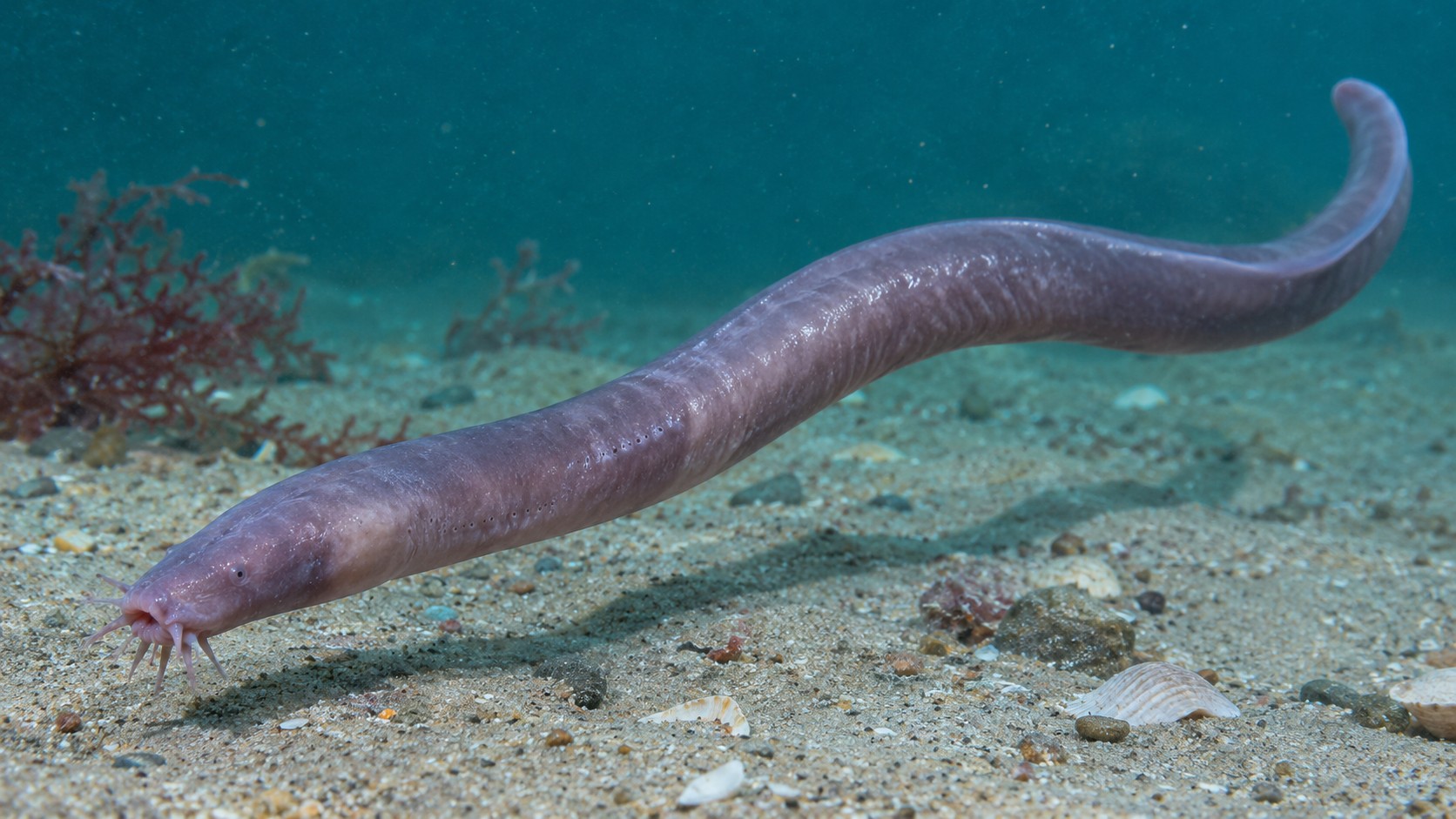
Recognizing a hagfish
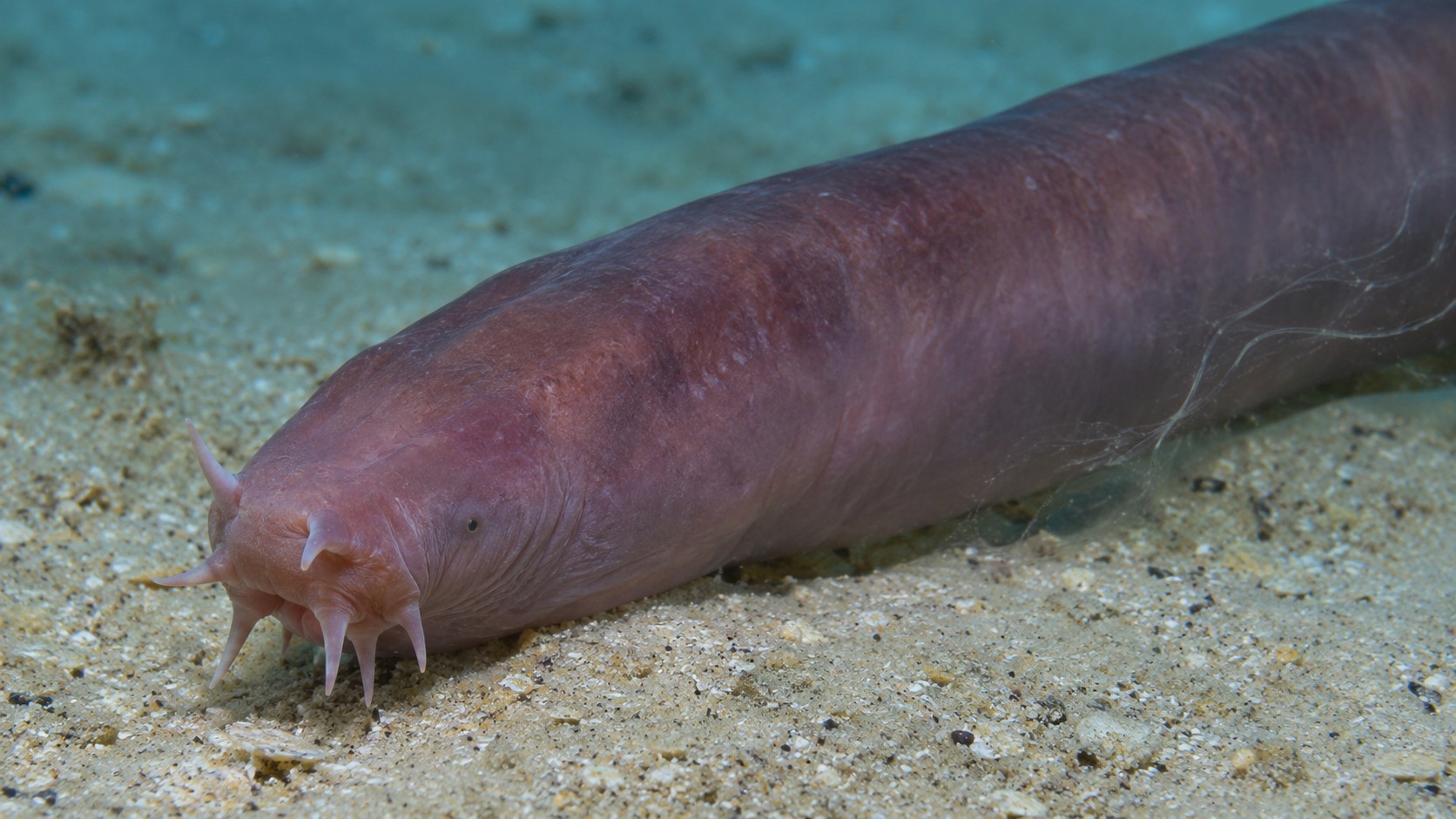
A Pacific hagfish, Eptatretus stoutii, has a flexible, elongated body supported by cartilage. Look toward the head for tiny paired eyes, a single nostril and barbels around the jawless mouth. Its coloring can be grey or dark brown, sometimes with a bluish or purplish cast, while the underside is paler. Fisheries and Oceans Canada gives a maximum length of 60–70 cm for this species. That is an upper size in the profile, rather than the length to expect of every animal.
In the 2024 fisheries field guide, Eptatretus cirrhatus has inconspicuous eyespots, mouth barbels and six to eight pairs of external gill openings, but no dorsal fin. Its brown to purple-brown body can have narrow pale rims around some slime pores. The guide lists a maximum total length of 97 cm and places it on New Zealand shelf and upper-slope grounds. Mottled Eptatretus poicilus, recorded from the northernmost North Island, instead has pale patches over a brown head and body. Other local genera, Neomyxine and Nemamyxine, have just one external gill opening on each side.
The American eel, Anguilla rostrata, has upper and lower jaws, small scales and pectoral fins. Its long dorsal fin joins the tail and anal fins, while pelvic fins are absent.
Pacific hagfish lack scales and paired fins, and their mouth works without true jaws. Pointed keratinous teeth are secured to rasping dental plates.
A sea lamprey, Petromyzon marinus, offers a different comparison: it too is jawless. Its oral sucking disc carries horny teeth and a rasping tongue, and the parasitic feeding stage attaches to fish to take body fluids. Pacific and Atlantic hagfish use retracting dental plates instead.
From coastal mud to deep shelters
Pacific hagfish occur along the eastern North Pacific from Baja California to Alaska. Soft mud and sand provide burrowing ground, and the Canadian profile describes roughly 100–500 m as typical habitat depths. It also describes generally sedentary habits, with short movements in some populations. Those depths characterize common habitat in that account; they are not the outer limits of every occurrence.
American eels, Anguilla rostrata, use large streams and rivers but reproduce in the western North Atlantic, according to the Indiana profile. That combination of inland habitat and marine spawning differs from the marine seabed habitat of Pacific hagfish.
Alaska biologists describe overlapping ranges for Pacific hagfish and black hagfish, Eptatretus deani, with Pacific hagfish generally shallower. Black hagfish predominate in the inside waters of southern Southeast Alaska in that regional account.
At the shallow end, longfin hagfish, Eptatretus longipinnis, inhabit soft bottom off South Australia between Robe and Port MacDonnell at 14–40 m. Their diagnosis includes a ventral finfold beginning ahead of the first gill openings and six pairs of gill pouches.
During a 2018 Nautilus encounter at 815 m near southern California’s Channel Islands, a hagfish lay inside a yellow sponge. A squat lobster and shrimp were also present. The expedition’s description, published in 2019, identifies the fish as Pacific hagfish. That single encounter shows an animal occupying a sponge cavity; it does not establish a regular partnership with the sponge or a social group among its occupants.
Finding and sharing a meal
The Monterey Bay Aquarium account lists worms, small mud-dwelling invertebrates, and dead or dying fish among Pacific hagfish foods. Entry into a carcass lets the animal feed on tissue from the inside.
In a 1999 laboratory comparison, most tested Pacific hagfish began searching within seconds of exposure to carrion scent, without a similar response to the tested live-prey odor. The hagfish had been collected at about 300 m in Monterey Bay; the paper printed their name as Eptatretus stouti. The amphipod Orchomene obtusus also responded quickly, whereas the snail Neptunea amianta showed no apparent odor response. The same study reported slime release during feeding and interference with some carrion competitors.
In night-time T-maze tests, actively swimming Pacific hagfish spent more time near food odor, but avoided the anaesthetic MS-222 and reversed backward more often in its presence. With no stimulus they showed no zone preference. These observations concern choices inside a laboratory maze, rather than a measured scent-tracking distance across the seabed.
Burrowing and tying knots
Burrowing changes which part of a hagfish does the propelling. In a 2024 study of Myxine limosa, transparent gelatin made the otherwise hidden movements visible. The fish first thrashed its head and body sideways to enter. Once the front was submerged, the exposed portion stopped swimming, while the buried anterior body continued to drive entry. Later movements combined head motion with alternating bends and straightening, resembling a concertina working inside the substrate. Stress patterns visible in the gelatin supported this interpretation of how the animal pushed through the substrate. Animals produced U-shaped burrows, generally finishing with only the head exposed. The timing dataset contained 25 trials, including 12 with pauses; those are trial counts, not a count of separate fish or a universal burrowing speed.
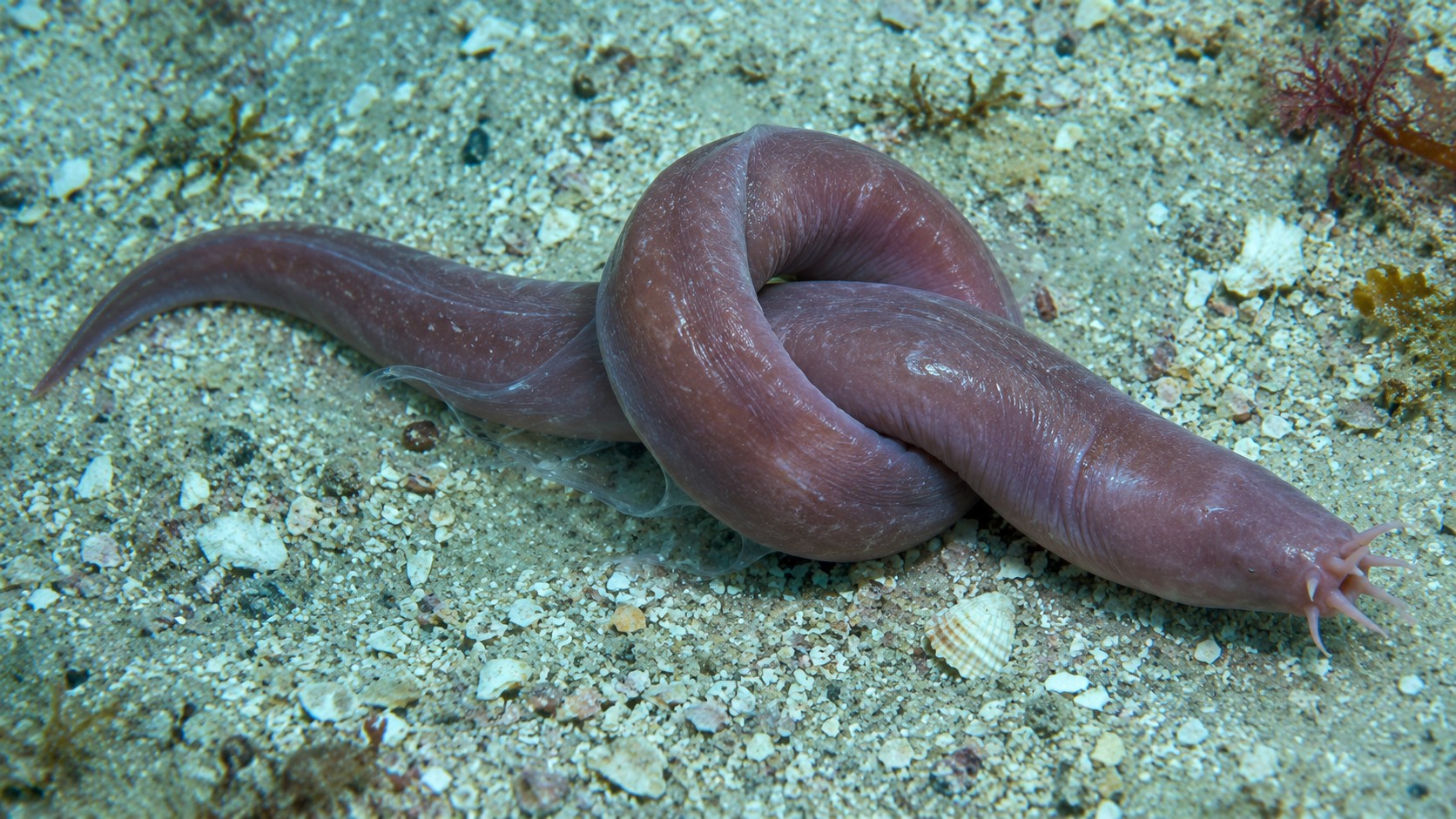
The same long body can form a knot. In a captive restraint experiment, all three tested hagfish species favored simple overhand knots but could make more complicated ones. The sample contained 20 Pacific hagfish, three Eptatretus springeri and four Atlantic hagfish, named Myxine glutinosa in the study. Pacific hagfish made complex knots more often and also coiled at rest. High-speed recordings showed bends, twists, contacts with surfaces and insertions of the tail combining into different configurations. The authors proposed that these component movements act as motor primitives. The neural control was not measured directly, and the unequal samples concern this captive restraint task.
A mouth that pulls food inward
Dental plates can retract without a hinged jaw because muscles are arranged around one another deep in the feeding apparatus. Reconstructions of Pacific and Atlantic hagfish, Eptatretus stoutii and Myxine glutinosa as named in that study, revealed a perpendicularis muscle inside a needle-shaped clavatus, itself enclosed by a sleeve-like tubulatus. This nested arrangement supports proposed mechanisms for pulling the plates back and shearing food. The anatomical model also proposed rearward displacement and a swelling, stopper-like action of the muscle complex during retraction. Muscle activation itself was not measured. The Pacific species had relatively more tubulatus physiological cross-sectional area, suggesting greater potential force. That comparison comes from anatomy, without directly measuring living bite force.
A Pacific hagfish series spanning about a sixfold difference in body length showed that tooth area and supporting structures do not simply enlarge as identical copies. Estimates of retractor force and tooth stress scaled differently, suggesting that adults can grasp proportionally larger portions. Low tooth stress was interpreted as a constraint on puncturing and tearing at both small and large sizes. Softer tissues, or using a body knot for leverage, offer ways around those mechanical limits. These are functional interpretations of the anatomy, rather than a measured menu for every age.
Swallowing also brings food close to the breathing pump. Imaging and physiology place the Pacific hagfish’s inhalation-driving velum chamber downstream of the junction between food and water passages. Large food pieces passing through may briefly interfere with breathing. In captive feeding work, swallowing involved peristaltic movements along the underside of the body. After an anchovy meal equal to 20% of body mass, animals remained motionless, and oxygen consumption roughly doubled within an hour and stayed elevated for 12–24 hours. This shows a substantial response to an experimentally supplied meal, rather than a usual daily ration in the wild.
The outer body can acquire nutrients too. Laboratory assays showed Pacific hagfish taking up dissolved alanine and glycine through skin and gills. The tissues differed in how uptake depended on concentration, sodium and inhibitors, pointing to transport processes rather than food merely sticking to the surface. Juvenile and adult skin also differed in the distribution of absorbed amino acids. Taking advantage of dissolved nutrients around a carcass was proposed as an adaptive benefit. The established finding is transport across these tissues; its contribution to a free-living animal’s energy supply remains unmeasured.
How a compact secretion becomes slime
Slime begins as separately packaged materials inside glands. Mucous cells provide vesicles containing mucins, while thread cells contain tightly coiled bundles of protein thread, called skeins. Released into seawater, the components can form the deployed slime. Unwinding and hydration let those compact gland contents spread into the surrounding water.
In a 2014 isolated-vesicle study of Pacific hagfish, most mucin vesicles needed calcium to rupture. An aquaporin inhibitor reduced rupture and slowed swelling, while molecular evidence identified two aquaporin homologues expressed in the gland. Together those results supported a model in which calcium-activated transport and facilitated water entry help release and hydrate the contents. Aquaporins are water-channel proteins, so the proposed mechanism connects a membrane process with the rapid physical expansion outside the cell.
Thread opening can follow another route. Isolated Pacific hagfish skeins in the 2014 unraveling experiments opened without added mucins or mixing. Protease treatment also induced unraveling, and surface and inter-thread features were lost. The results supported an adhesive that dissolves in seawater, releasing stored strain energy from the coil. In this interpretation, the skein is a mechanically loaded package held together by protein glue.
Atlantic hagfish experiments show a complementary mechanism. Winegard and Fudge’s 2010 laboratory work, attributed to Myxine glutinosa in the later comparative account, found that mixing and mucin vesicles helped deploy thread bundles. Swollen mucin strands attached to the skeins and transmitted forces from moving fluid as tension. The mucus could therefore help pull the coils open while water became entrained. Solution chemistry matters, and it does not establish that Atlantic skeins can never unravel spontaneously in another solution.
A 2018 comparison found Atlantic hagfish glue less soluble in seawater than Pacific hagfish glue under the conditions tested. Researchers compared released proteins and glycoproteins with gland transcriptome sequences and proposed two unusual acidic-protein sequences as structural glue components. The comparison supplies a biochemical difference between the species, rather than a fully established recipe for the adhesive. The suggestion that different predation pressures shaped glue solubility remains an ecological hypothesis.
Slime can interfere with water flow across breathing structures. In Lim and colleagues’ 2006 experiments, Pacific hagfish slime increased flow resistance through artificial gill models and real fish gills. That provides a physical basis for a possible impediment to gill breathing. The work also described localized jets of glandular secretion. In vitro, convective mixing helped form coherent slime, while excessive mixing made it collapse. These tests measured flow resistance and formation, rather than the outcome of an attack by a living predator.
Loose skin and real predators
A hagfish’s loose skin supplies a different kind of mechanical protection. In a single mako-shark-tooth guillotine test on freshly dead fish, skin was pierced in all eight Pacific hagfish trials and all 18 Atlantic hagfish trials, yet the underlying muscle was not punctured. Each species contributed six individuals, so repeated strikes did not represent extra animals. Tightening the skin or attaching it more firmly increased muscle damage. The protective feature was the slack, weakly attached covering allowing underlying tissue to move, rather than exceptionally puncture-proof material. A separate comparison across 22 fish species found Pacific hagfish skin unexceptional in puncture resistance once thickness was considered.
Hagfishes also enter other animals’ diets. Villanueva’s 1993 study recorded Cape hagfish, Myxine capensis, as prey of the octopus historically named Octopus magnificus in the southeastern Atlantic. The collection comprised 102 octopuses from 80–550 m, taken between March 1989 and November 1990. It does not show the attack sequence or how the fish’s defenses functioned during capture.
Different reproductive rhythms
A 1983 account of Eptatretus burgeri from Kamo Bay, Oki Islands, Japan Sea, reported collections inside the bay from late October through July. Fish were absent there in August and September, with catches outside the bay near 50 m in August and early October. Declining ovarian mass and egg size between August and early October, together with October postovulatory follicles, suggested September breeding outside the bay. Fully mature males were not caught. Spawning was inferred, not witnessed; this remains the uncorrected abstract’s interpretation, with field years and sample size unspecified.
New Zealand Eptatretus cirrhatus showed a different sampled pattern. Among 393 fishery-derived animals collected dockside in 2009–2011, reproductive stages did not shift in a synchronized seasonal way. This contrasts with the inferred Japanese pattern, but uneven sampling, inadequate autumn numbers and unknown capture sites limit the comparison. The dockside series cannot establish the absence of seasonality throughout the species’ range.
Within the New Zealand sample, recognizable females occurred at smaller sizes than recognizable males, and mature animals had an approximately equal sex ratio. The authors interpreted the size pattern as a difference in differentiation timing. Females with large eggs, mature males and postovulatory females were present, but gravid females were absent. Large eggs and low fecundity contributed to concern about harvesting, although this cross-sectional sample did not follow individual sex histories or measure the rate at which the population replaced itself.
Fleury and colleagues’ 2021 study of Pacific hagfish, Eptatretus stoutii, and black hagfish, Eptatretus deani, combined contemporary and historical data. It reported about 20 eggs per female and earlier onset of maturation in females than males. Their reproductive profiles were interpreted as consistent with slow growth and late maturity. The study called for further assessments to inform management; it did not establish a sustainable quota, give absolute maturity ages in its abstract or measure a present population trend.
Growth, digestion and early development
In a 2025 study, Eptatretus burgeri received meals every four to five weeks for more than 1.4 years. Individuals gained mass, lost mass or showed no growth. Digestion generally took eight to ten days and ended with a large consolidated evacuation. A model based on relative growth predicted gonadal development no earlier than about four years and potential longevity near 50 years. That last number is a model estimate, not the age of an animal watched for half a century. The imposed feeding schedule likewise differs from the authors’ inferred wild interval of less than two weeks.
Histological work on multiple Eptatretus burgeri pharyngula-stage embryos identified putative neural-crest cells appearing to detach and migrate along vertebrate-like routes. Patterns of regulatory-gene expression supported similar mechanisms for specifying those cells. These findings provide comparative developmental evidence, without making a living hagfish an unchanged picture of an ancestral animal.
Fisheries and uneven conservation risk
A California survey in Monterey Bay on March 25–28, 2013 used 96 bucket traps, divided into four escape-hole treatments with 24 traps each. The catch totaled 7,595 hagfish over three full survey days, with another 1,441 on a separate prospecting day. Full-day traps soaked for about 24 hours, compared with two to four hours during prospecting. Hole size affected average catch size. Because soak times differed, the catches cannot simply be read as standardized abundance estimates.
Alaska biologists also explored a potential regional hagfish fishery through a commercial-vessel pilot trip in fall 2017, reported in April 2018. This was a regional investigation, rather than a measure of a global population trend.
Conservation risk belongs to individual species. A 2011 analysis using IUCN methods placed nine of the 76 hagfish species assessed at that time in threatened categories. Restricted distributions, overexploitation and destructive fishing were important concerns for several members. Those numbers describe a historical assessment set, rather than today’s species census or a current threatened fraction.
The longfin hagfish account reports discarded bycatch in gillnet, hook and trap fisheries, including occasional captures in rock-lobster pots. It displays Vulnerable with a Mincarone 2013 status citation, version 2014.3, downloaded in January 2015. That dated listing accompanies the South Australian species account; it is not a fresh assessment of all hagfishes.
Human uses can also obscure identity: the Monterey Bay Aquarium notes that some wallets sold as eel skin are actually made from hagfish.