
A Common Name With Regional Meanings
In Britain and much of Europe, brook lamprey generally refers to Lampetra planeri. Across North America, names such as American brook lamprey, northern brook lamprey, western brook lamprey, and least brook lamprey identify other species. These names should not be collapsed into a single worldwide animal with one range map. They describe related jawless fishes whose details depend on the region and lineage.
European brook lampreys exemplify the non-parasitic, stream-resident lifestyle shared with several distinct North American species. Exact size, distribution, reproductive timing, and conservation status require a species-specific reference. A reader who knows the watershed already has an important clue, but location alone may not settle an identification. Closely related larvae can be particularly difficult to distinguish, even when an adult from the same stream would be easier to recognize.
Recognizing the Stream’s Slender Resident
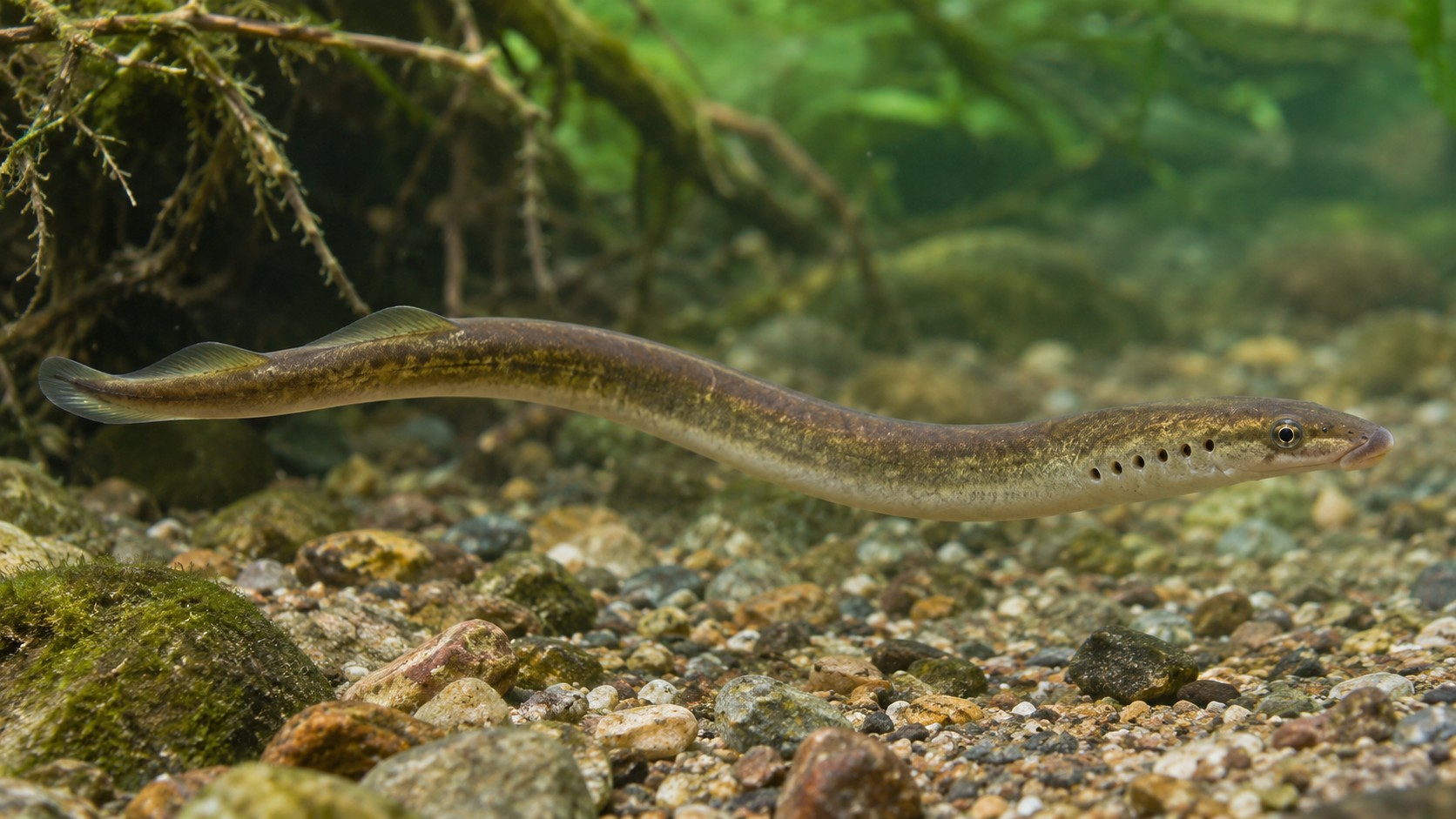
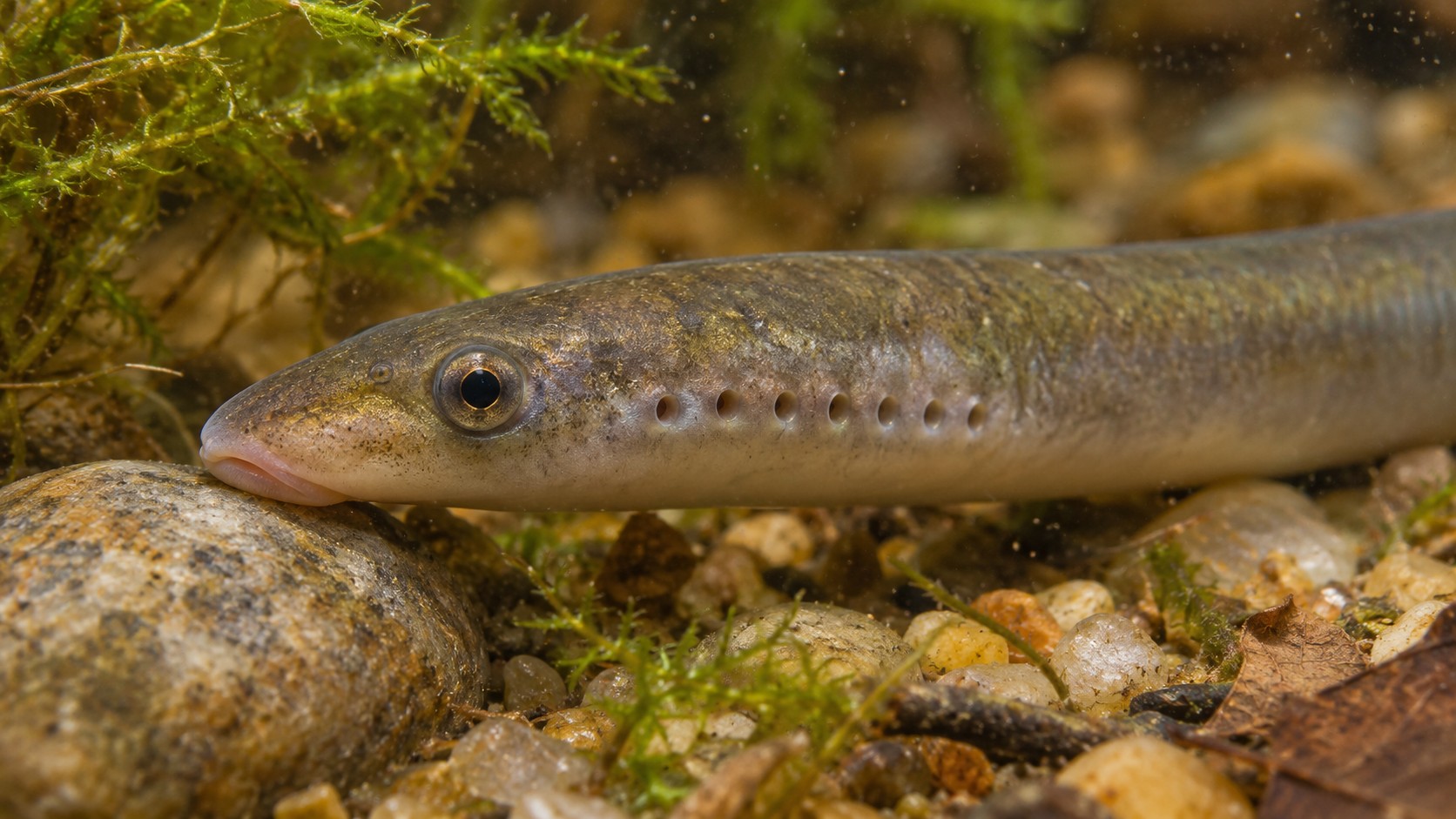
A brook lamprey has the long cylindrical silhouette that makes lampreys resemble small eels, yet its anatomy tells a separate story. There are no paired pectoral or pelvic fins, and the mouth lacks hinged jaws. A small eye, seven gill openings along each side, smooth skin, and dorsal fins toward the rear provide more useful clues than color alone. Viewed in water, the muted brown, olive, or gray body often blends with gravel and shadows.
Most of Life Happens in a Burrow
The brook lamprey’s early life is easy to miss because the animal lives within the bed of the stream. Its larvae, called ammocoetes, settle into suitable soft sediment, where they maintain a position that allows water and suspended food to pass through their feeding apparatus. The larval mouth has a hoodlike form, rather than the familiar adult disc. The conspicuous eyes associated with adult fish are not yet developed for the same kind of open-water life.
Feeding during these years supplies the growth and reserves that support later transformation and reproduction. Tiny organic particles and microorganisms connect the buried animal to the water flowing above it. This is a very different role from a parasitic lamprey attached to a fish. The animal’s name and shape can create an expectation of blood feeding, but the larval brook lamprey is using a quiet, small-particle food supply.
A long larval period also changes how a population should be understood. Many individuals may be present even when no adults are visible during an afternoon visit. Their survival depends on conditions maintained across years, not just on a brief spring spawning event. Repeated disturbance of sediment, poor water quality, or changes in flow can therefore affect a life stage that casual observation rarely records.
Transformation Without a New Feeding Career
Metamorphosis produces an adult with developed eyes, an oral disc, and a body ready for reproduction. In a parasitic lamprey, a comparable transition prepares a new period of feeding on fish. A non-parasitic brook lamprey instead moves toward a reproductive phase supported by stored energy. The digestive system changes, and the adult does not begin the extended host-feeding lifestyle associated with sea lampreys.
That makes the larval years more than a preliminary chapter. They finance the adult’s remaining activity, from movement within the stream to spawning. Growth is no longer the central task once adulthood arrives. The fish can become more visible at precisely the time when its opportunity to replenish energy has ended, so disturbance during reproduction should not be dismissed as an inconsequential interruption.
One Brook, Several Necessary Habitats
The word brook suggests a small flowing channel, but a suitable channel contains different physical neighborhoods. Clean gravel can provide spawning habitat, while softer sand or silt margins support buried larvae. These areas may be close together without functioning identically. Water speed, deposition, roots, stones, and the shape of the bank determine where each kind of patch occurs.
A uniformly scoured bed is not automatically better than a mixed one. Removing every quiet depositional margin can erase the places where larvae live. Conversely, allowing fine sediment to blanket the whole bed can degrade the gravel used for reproduction. The ecological value lies in the right distribution and condition of substrates, rather than a simple rule that all sediment is good or all sediment is bad.
This habitat mosaic also helps explain why small engineering changes can matter. Straightening a channel, hardening its banks, changing drainage, or removing stable cover can alter currents and sediment placement. A brook may still carry water afterward while offering a different combination of habitats. For lampreys, the persistence of each life stage depends on those details, including the quieter portions of the channel that rarely attract photographs.
Spring Work Among the Stones
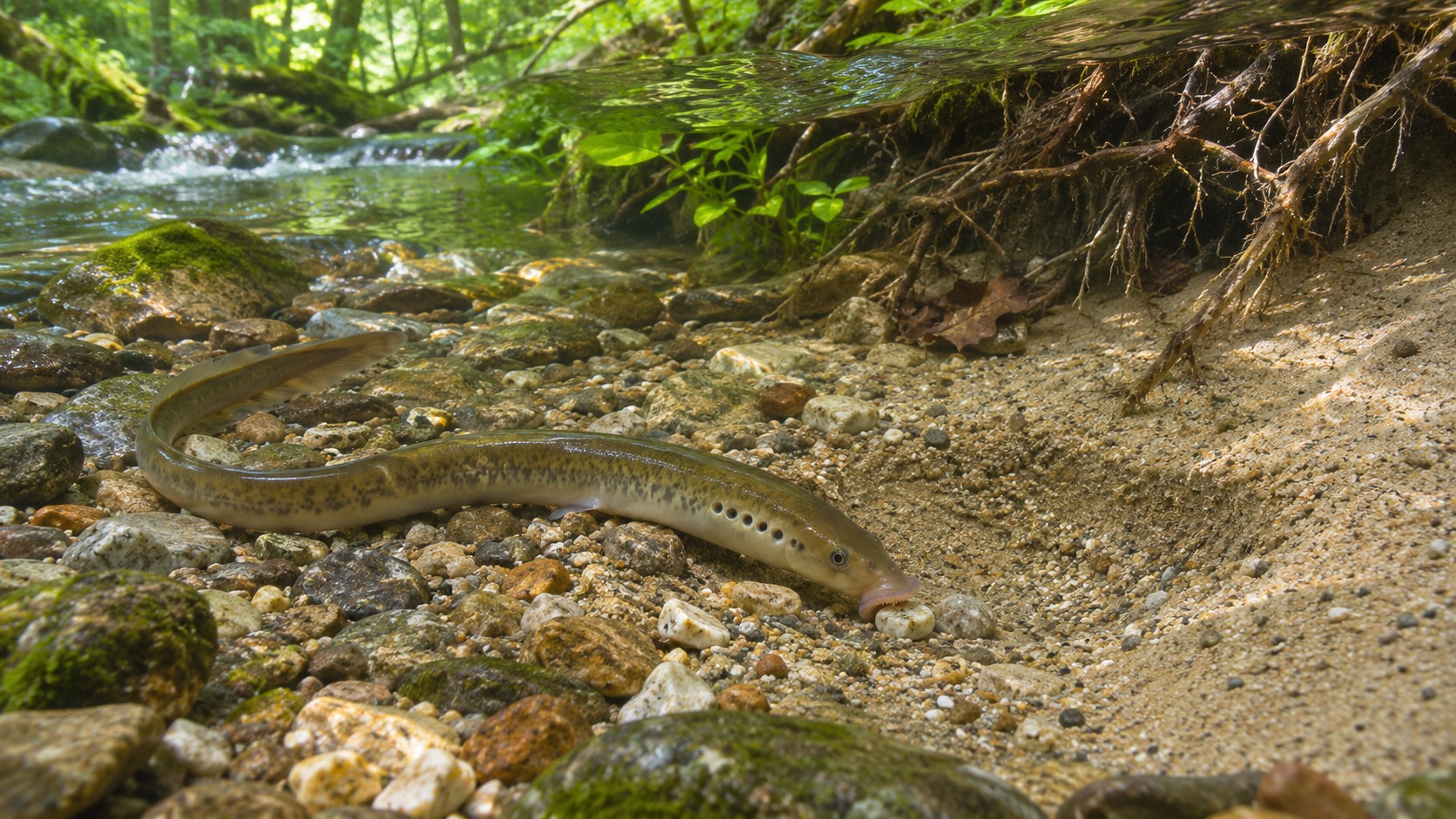
When spawning conditions arrive, adult brook lampreys gather around suitable gravel and participate in nest preparation and reproduction. Their mouths can grip material, while body movements help work the substrate. Seeing an animal attached to a small stone therefore does not mean it is eating the stone or searching for a host. The mouth is helping with a reproductive task. After spawning, the adults die, and the next generation begins a new cycle whose most substantial feeding phase will again take place out of sight.
Why a Resident Fish Still Needs Connections
Brook lampreys do not need the ocean-feeding migration associated with some of their relatives, but stream residency does not make movement irrelevant. Adults still need access to appropriate spawning patches, and the channel must connect reproductive habitat with places where larvae can settle and survive. A short local movement can be essential even when it would look small beside a sea lamprey’s journey.
Barriers and altered flows therefore deserve attention at the scale of the local population. A culvert, channel break, or poorly timed water diversion can affect a small fish without creating an obvious dry river. Recolonization after a local loss may also be difficult where neighboring habitat is disconnected. The practical issue is access to the sequence of conditions required by the life cycle, not the distance a species travels on a map.
Finding Evidence Without Digging Up the Answer
An adult spawning gathering may offer the clearest ordinary chance to see brook lampreys, but a lack of sightings is weak evidence of absence. Buried larvae are cryptic, and adult visibility is limited by season, water conditions, and behavior. Professional surveys use methods and identification expertise suited to those limitations. An observer standing on a bridge is seeing only a small part of the population’s possible activity.
For a useful observation, record the place, date, habitat, approximate size, and visible features without handling the animal. Photographs of the whole body and side of the head can complement a view of the mouth when that view occurs naturally. Moving gravel or digging sediment to improve the picture risks disrupting both reproductive sites and larval habitat. A record can remain valuable even when it stops at lamprey rather than claiming an uncertain species.
Local guidance matters because some populations receive special conservation protection and collection rules vary. An apparently common-looking fish in one district may be poorly known or vulnerable in another. Consult the appropriate wildlife authority before activities involving capture or habitat disturbance. Observation from the bank is usually far more compatible with understanding a spawning event than trying to make the animal perform for a photograph.
Reading Water Quality Over Several Years
Brook lampreys depend on the stream through a lengthy larval residence, so their habitat story extends beyond today’s clear water. A single clean-looking afternoon cannot reveal previous pollution events, low flows, or repeated changes to the bed. Persistent populations reflect a sequence of conditions that allowed multiple stages to survive. They can help focus attention on the long-term functioning of a stream, although no single sighting proves that every aspect of water quality is good.
Catchment conditions belong in that assessment. Runoff, erosion, wastewater, water abstraction, and loss of streamside vegetation can influence a small channel from beyond its banks. Local restoration is strongest when it addresses those causes alongside the visible habitat. Improving one gravel patch while leaving chronic upstream problems unresolved may deliver a much narrower benefit than its appearance suggests.
Different From the Lamprey in the Headlines
The public image of lampreys is strongly influenced by sea lamprey control in the Great Lakes. Brook lampreys illustrate why that image cannot stand in for the whole group. Their adults do not rely on a parasitic feeding phase, and native stream populations have their own ecological relationships and conservation needs. The existence of a harmful introduced lamprey population elsewhere is not evidence that a local brook lamprey should be removed.
The distinction is also visible in what an informative photograph emphasizes. A brook lamprey’s small body, modest oral disc, and relationship with gravel and soft margins tell more than an enlarged tooth display. The most revealing image may be an animal shifting a pebble or resting near submerged roots. Its ordinary setting provides the scale and context needed to understand a fish whose most important years were spent beneath that same setting.
Comparing relatives still helps when the comparison is precise. Sea lamprey highlights a separate host-feeding phase, while brook lamprey highlights the transition from larval feeding directly toward reproduction. Both share jawless ancestry and burrowing larvae, but their allocation of time and energy differs. Those differences are more useful than calling one animal a miniature version of the other.
The European Brook Lamprey at a Practical Scale
The European brook lamprey is a small fish, generally remaining under 20 centimeters as an adult. Its size helps separate a typical spawning individual from the much larger sea lamprey, but it does not settle every identification. A young sea lamprey and an adult brook lamprey can overlap in length. The mouth, body proportions, stage, and regional species list are therefore more informative together than a measurement alone. The European species belongs to the genus Lampetra and the lamprey family Petromyzontidae.
Lampetra planeri is especially closely associated in identification discussions with the European river lamprey, Lampetra fluviatilis. Their larvae can be extremely difficult to distinguish. The adults differ in feeding history, with river lampreys developing a parasitic phase while brook lampreys proceed to reproduction without that extended adult feeding period. It is the whole developmental strategy, rather than a single dramatic feature, that explains their contrasting lives.
Names That Keep North American Species Distinct
American brook lamprey commonly identifies Lethenteron appendix, while northern brook lamprey identifies Ichthyomyzon fossor. The least brook lamprey is Lampetra aepyptera. These names refer to separate fishes, not regional color forms of Europe’s Lampetra planeri. Their distributions and identifying characters belong to their own natural histories. The shared nonparasitic lifestyle is a useful comparison, but a North American conservation assessment cannot be transferred automatically to a European population.
Scientific names also help distinguish two uses of the word resident. A brook lamprey completes its life in freshwater, while a landlocked population of a normally migratory relative may also remain in freshwater. Staying out of the sea does not establish whether an adult feeds on hosts. Residency describes geography and movement; nonparasitism describes feeding. A species can share one of those properties with a neighbor without sharing both.
A Burrow That Depends on Moving Water
Ammocoetes occupy fine sediment, but their feeding does not take place in a sealed pocket of mud. Water must move through the feeding system to carry particles and support respiration. The animal’s position within the bed brings shelter and water exchange together. A stable margin with an organic food supply can therefore be more useful than an apparently similar patch repeatedly scoured or left stagnant. The quietest-looking section is not necessarily the least active habitat.
Fine material reaches a stream through normal erosion as well as human disturbance. A functioning brook distributes it into deposits while maintaining other areas of coarser substrate. Excessive runoff can upset that distribution, covering spawning gravel and changing conditions within larval deposits. The distinction is not between a completely sediment-free stream and a muddy one. It is between a channel maintaining complementary habitats and one in which those habitats have become unsuitable or disconnected.
Several larval age groups can occupy a stream simultaneously. The adults appearing during one spawning season are only the portion reaching the final stage at that time. Younger animals may remain concealed through later years. This overlapping residence gives a local population some continuity, but it also means that a single excavation or pollution episode can affect more than one future reproductive season. Damage can persist after the visible water has cleared.
Reproduction Without Time to Replace Lost Energy
As metamorphosis ends, the adult has the sensory and attachment equipment needed for reproductive activity but no new long feeding career ahead. Stored reserves support its local movements and the production of eggs or sperm. Seasonal warming helps organize the spawning period, although the date varies across the European range. The spring gathering is therefore a synchronized use of suitable conditions, not evidence that all brook lampreys spend the year living together in a visible group.
Adults work the gravel with the mouth and body before releasing reproductive cells at the nest. Their subsequent deaths leave no parental guarding phase for later larvae. Survival depends on the substrate, water, and settling opportunities already available. This makes the relationship between nesting gravel and downstream sediment a reproductive requirement even though the two habitats look different and may support very different-looking stages.
Why Small Native Fish Need Local Conservation
European conservation recognizes brook lamprey as part of the freshwater fauna whose habitats require protection. That concern does not imply that every population has the same abundance or threat level. A small isolated stream can lose access or nursery sediment even while the species remains widespread elsewhere. Local assessments consider barriers, water quality, channel work, and the persistence of suitable habitat through the whole life cycle.
The ability to remain within one stream reduces dependence on a long coastal route, but it can increase dependence on that stream’s continued condition. Where a local population disappears, another population must have a usable connection before recolonization is possible. Protecting a resident lamprey therefore includes the surrounding catchment and the nearby channel network, not just the few stones around a spawning gathering.
A Small Life Cycle With a Large Habitat Lesson
Brook lampreys reveal how much a fish can depend on places people barely notice: a soft patch beside the current, gravel with spaces between its stones, and a channel that still connects them. Their adulthood is brief, but the conditions behind it have been accumulating for years. Understanding the regional name, the hidden feeding stage, and the reproductive ending makes the animal easier to recognize and the stream easier to read. It is a reminder that a healthy freshwater community includes lives below the bed as well as fish swimming above it.
The same lesson can guide a return visit to a familiar local waterway. Notice where the current slows, where the bank retains roots, and where gravel remains open rather than buried. These observations do not replace a biological survey, but they make habitat differences easier to recognize. A small fish may need all of those features at different times. Remembering that sequence helps explain why conserving a stream involves more than keeping its water visibly clear. It means allowing the channel to support the feeding, transformation, movement, and reproduction that turn one generation into the next.