
Following the Pacific Branch of the Family
Pacific lamprey belongs to the jawless fishes, but its name identifies a particular species rather than every lamprey along the Pacific coast. Its broad North Pacific distribution includes watersheds of western North America. Within a region, other lampreys may share freshwater habitat, so an eel-like body and a river location are not enough to establish the identity. Life stage and anatomical details still matter.
The native setting is especially important because public impressions often come from introduced sea lampreys in the Great Lakes. Pacific lamprey has its own evolutionary history with Pacific fish communities. Its parasitic feeding phase belongs within that history, rather than making it an invading species by default. A conservation discussion should begin with the species and watershed involved, not with a reputation borrowed from another place.
An Unusual Toolkit for Moving Upstream
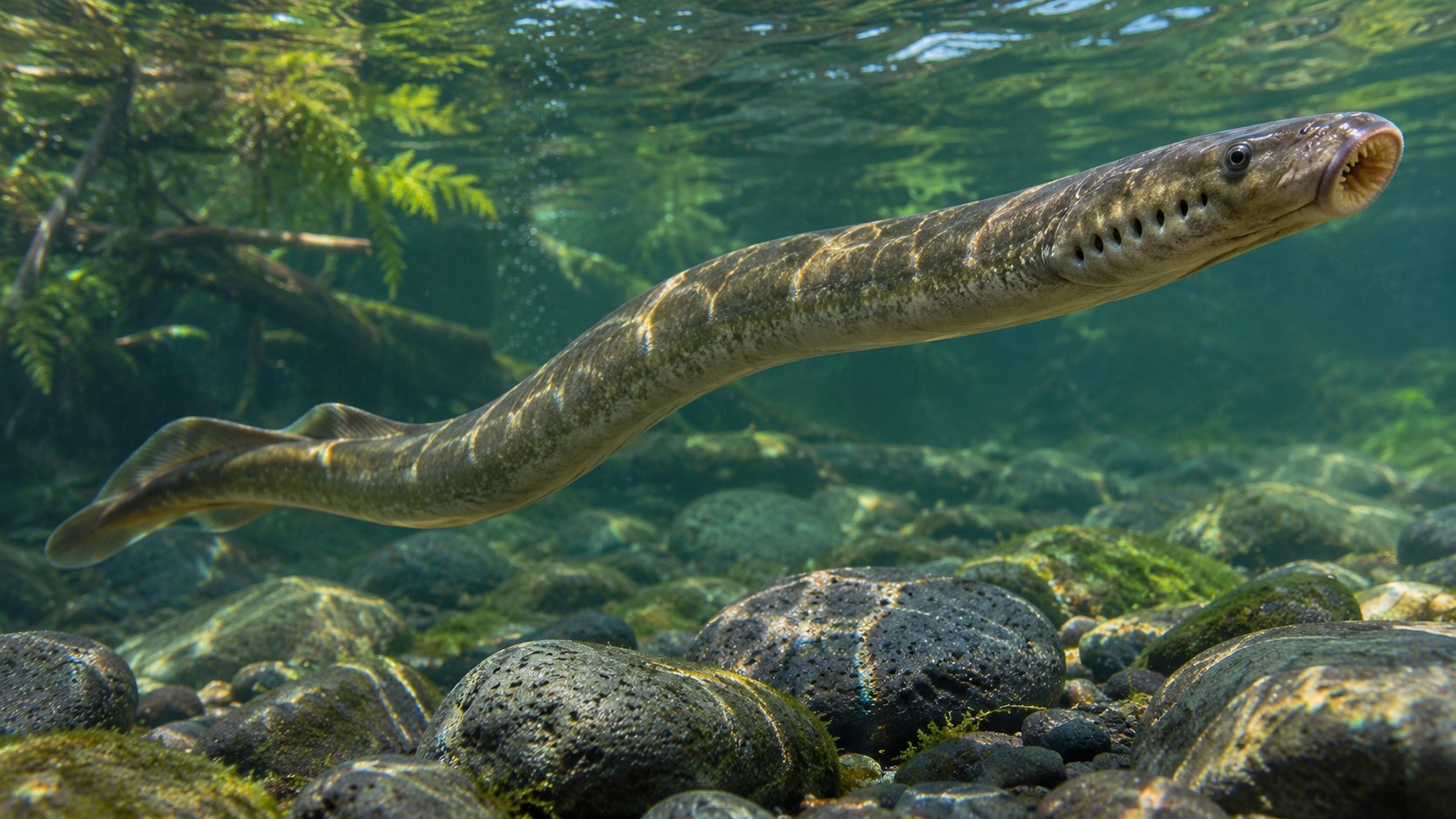
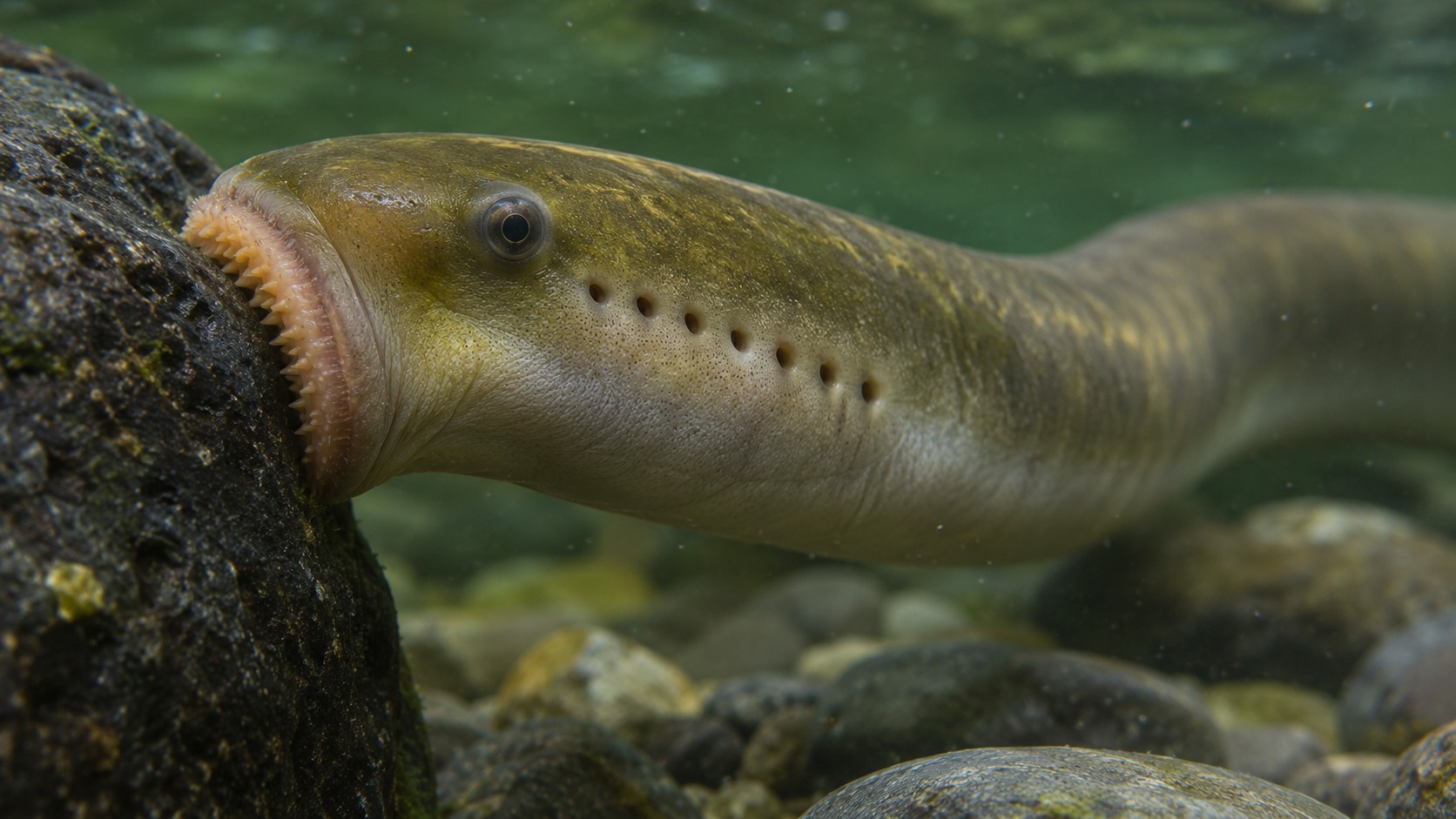
The long body has no paired pectoral or pelvic fins, and its smooth skin lacks the obvious scales of many familiar river fishes. Seven external gill openings occur behind the head on each side, while dorsal fins lie toward the rear. The circular oral disc can maintain attachment to a surface, giving the animal a way to hold position as its body works against water. In close views, the disc’s tooth arrangement helps specialists distinguish species, but ordinary observation should not require handling a migrating fish to inspect its mouth.
A Childhood Buried Within the Channel
Pacific lamprey begins life as a small freshwater larva rather than an ocean traveler. After the earliest stages, larvae settle into suitable sediment and filter food from passing water. These ammocoetes have a hoodlike mouth and a body suited to a sheltered, burrowing existence. Their role in the river is therefore very different from the later lamprey that attaches to a host fish.
The larval period lasts years, with its duration influenced by growth and local conditions. Soft sediment, access to moving water, and a supply of suspended organic material support this hidden life. The largest visible fish in a river may capture attention, while a substantial lamprey stage remains beneath the bed. A population can depend on places that would look like ordinary silt or sand to someone scanning the channel from a bridge.
That hidden residence changes the consequences of channel work. Dewatering a sediment deposit, excavating a margin, or altering flow can affect animals that are difficult to see and rescue. Habitat assessment has to consider the buried stages before disturbance occurs. Waiting until adult migrants appear would overlook much of the species’ freshwater life and the years of growth already invested in those larvae.
Transformation and the Downstream Route
Metamorphosis prepares the young lamprey for a new way of living. Eyes develop, the mouth becomes an oral disc, and the animal changes internally as well as externally. The transformation leads toward a feeding phase that differs sharply from larval filter feeding. Its timing and progression are biological events, not simply the moment when a small fish becomes large enough to leave the stream.
The downstream route connects juvenile habitat with estuaries and the sea. Flow conditions and passage hazards matter in this direction as well as during the adults’ later return. A dam discussion focused only on upstream fish can miss that second journey. Successful conservation follows both movements, asking whether a young lamprey can leave its rearing environment and whether a returning adult can reach reproductive habitat.
Ocean Feeding Within a Native Food Web
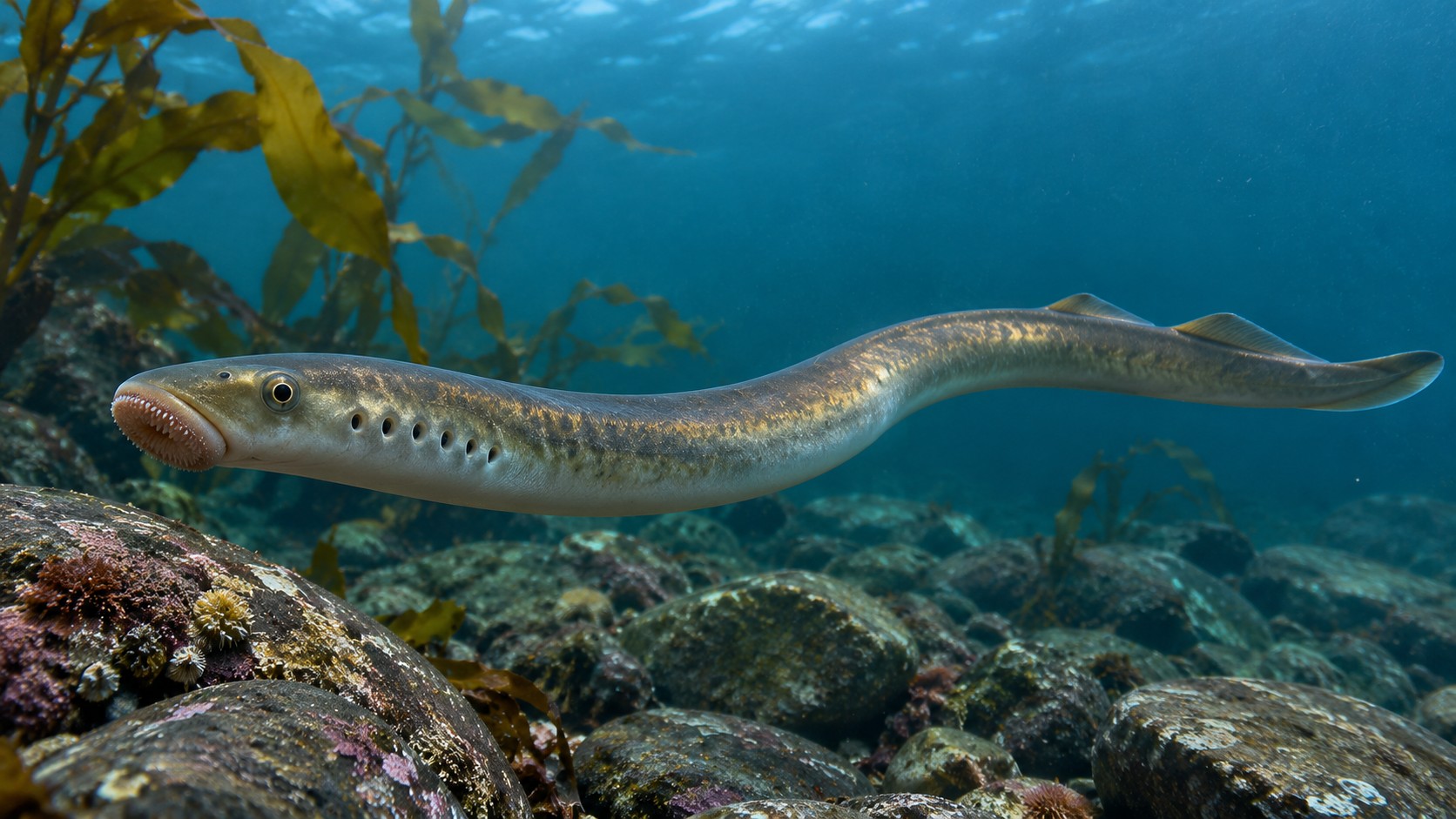
At sea, the lamprey attaches to host fish and feeds using its suction disc and specialized mouth structures. This parasitic phase supports growth and the accumulation of energy reserves. A host can be injured by feeding, but that individual interaction needs to be distinguished from the overall ecological status of the species. Native Pacific lampreys developed alongside the fish communities in which they feed.
The ocean phase also places lampreys within a network of predators and prey. They consume resources, become food for other animals, and later carry accumulated material back into freshwater. Describing them solely as parasites leaves out those other relationships. The feeding behavior is real and important, but it is one part of a mobile fish’s contribution to connected ecosystems.
Much of this marine life is less visible to river observers than a spawning migration. A person watching an adult near a waterfall sees the result of earlier growth at sea, not the whole process that produced it. Images of a lamprey in coastal water can help restore that missing context. The river journey makes sense only when it is joined to the time spent beyond the river mouth.
Returning on a Finite Energy Budget
As Pacific lampreys return to freshwater for reproduction, they stop feeding and rely on stored reserves. Some adults remain in freshwater for an extended period before spawning, so entry into a river and reproduction should not be treated as the same instant. The body is supporting movement, holding, and reproductive development from a finite store. Repeated delays and difficult passage can therefore matter even when the fish eventually moves beyond a particular obstacle. The relevant question is not just whether an animal passes, but what completing the route demands of it.
Why a Salmon Ladder May Not Be Enough
Fish passage structures often reflect the swimming abilities of the species they were originally designed to serve. Pacific lamprey uses a different combination of body movement and oral attachment from salmon. Smooth surfaces, abrupt transitions, strong local velocities, and features that interfere with attachment can create difficulties. A route usable by one migratory fish is not automatically suitable for every other fish sharing the river.
Lamprey-focused passage work examines those details and may provide routes shaped around the animal’s abilities. Managers and engineers can assess surfaces, entrances, flow, and opportunities to rest or attach. The aim is a continuous usable route rather than a structure that merely carries the name fish ladder. Field monitoring remains essential because the actual behavior of fish tests whether an apparent design solution works in the river.
Spawning and the Return of Nutrients
Suitable spawning habitat includes flowing freshwater and gravel where adults can prepare nests and reproduce. The oral disc can help grip stones while body movements work the site. This use of the mouth is particularly revealing: a structure associated with parasitic feeding also assists reproduction and movement. A lamprey attached to a rock should not automatically be interpreted as feeding.
Adults die after spawning, returning their bodies to the freshwater food web. Their accumulated nutrients then become available through decomposition and consumption by other organisms. The reproductive journey therefore connects ocean growth with river processes even after the adult’s movement has ended. The next generation will begin a markedly different existence within the streambed.
Protecting a spawning reach also requires thinking downstream and into the future. Eggs, newly emerged larvae, and older burrowed animals do not all use identical patches of habitat. A river must support their sequence, including areas where young larvae can settle. Attractive gravel alone is only one component of a functioning lamprey watershed.
A First Food and an Ongoing Relationship
For many Indigenous peoples of the Pacific Northwest, Pacific lamprey is a valued food and part of cultural practice, knowledge, and responsibilities to the river. Lamprey traditions, harvest practices, and restoration priorities differ among Indigenous communities across the Pacific Northwest. Tribal sources provide the appropriate starting point for learning about specific relationships.
The Columbia River Inter-Tribal Fish Commission and its member tribes have been prominent in lamprey restoration, research, and public understanding. Their work connects ecological recovery with access to healthy traditional foods and the transmission of knowledge between generations. A returning lamprey can therefore represent more than a fish counted at a structure. Its availability and condition can affect relationships among people, places, and practices that conventional fishery summaries do not fully capture.
Restoration Across the Whole Watershed
Passage improvements are important, but they operate within a larger set of pressures. Water quality, flow changes, sediment conditions, channel disturbance, and access to suitable rearing and spawning areas can all influence survival. The species moves through several environments and remains in some of them for years. A single successful passage project cannot be assumed to resolve every limiting condition across that life cycle.
Tribal and agency programs use multiple approaches, including research, monitoring, habitat work, and carefully planned interventions such as adult translocation in some settings. These are context-dependent tools rather than a general invitation to move lampreys between streams. Decisions require knowledge of the population, destination habitat, and intended recovery outcome. Success means more than placing an adult upstream; it also concerns reproduction and the survival of subsequent stages.
Climate-related changes add another reason to follow the connected system. Shifts in water temperature and seasonal flow can change migration conditions and the habitat available to larvae. Local responses should be evaluated with evidence rather than treated as identical across the range. Maintaining options within a connected watershed gives managers more to work with than relying on one reach or one seasonal window.
Watching a Migration With Better Questions
A lamprey sighting becomes more informative when it records the location, season, visible behavior, and surrounding habitat. Is the animal moving, holding to a surface, or working gravel? Is the observation near a barrier, in a tributary, or in coastal water? These details help place the encounter within its life cycle without pretending a single view reveals everything. Observers should keep their distance, leave the substrate intact, and follow local rules for access and reporting.
A photograph can document the flexible body and gill region while also showing the water the fish must negotiate. That wider frame is especially useful for Pacific lamprey, whose conservation depends on routes as much as resting places. A close portrait may establish useful anatomical clues, but a habitat view can reveal a difficult transition or a missing connection. Both views have value when their limits are understood.
Adult Size and the Three-Toothed Name
A mature Pacific lamprey is much larger than many people expect from a fish whose larva disappears into sediment. Washington wildlife accounts give an adult length range of about 33–84 centimeters. These figures describe a variable living animal, not a minimum size for identification. A returning fish can shrink during its nonfeeding freshwater residence, so its length at spawning need not match its length when it left the ocean.
The species name tridentatus refers to a three-toothed feature of the mouth. Three prominent teeth on the anterior oral plate are among the characters used in adult identification. This detail is more diagnostic than simply having many teeth around a disc. Other lampreys can share the same river, and larval identification can require specialist examination. The adult’s relatively large size and oral characters narrow the comparison, while the long flexible outline alone does not.
A Range Around the North Pacific
Pacific lamprey occurs around the North Pacific, with records extending from Japan through northern waters and along western North America toward Baja California. On the North American side, river systems such as the Columbia, Fraser, Klamath, Eel, and Sacramento–San Joaquin connect different parts of its life. These rivers differ substantially in flow, engineering, temperature, and available habitat. A northern watershed and a southern coastal river should not be assigned one identical seasonal schedule.
Freshwater distribution can also change when access is lost or restored. Historical occurrence above an obstacle does not guarantee that migrants still reach it, while the absence of adults upstream can conceal a passage problem farther down. Habitat maps therefore describe more than a set of isolated places. They describe potential routes between buried larvae, seaward migrants, marine feeding areas, and adults returning with the resources needed for reproduction.
Years in Sediment and Months of Transformation
Larval Pacific lampreys can remain in freshwater for several years. Government summaries commonly describe approximately two to seven years, while newer research and passage guidance recognize that longer larval residence occurs. The important point is not to choose one upper value as a universal deadline. Food, growth, and local conditions influence when an individual is ready to transform. Several future year classes can occupy the same watershed at once.
Metamorphosis unfolds over months. Eyes become conspicuous, teeth develop, the oral hood changes, and internal physiology prepares for a different feeding strategy and, in migratory populations, salt water. The transformed downstream migrant is sometimes called a macrophthalmia. That name refers to a developmental form, not another lamprey species. Its need to move through a channel is different from the need of the small larva sheltered beneath the bed.
Migration toward the sea brings a young animal through changing currents, estuarine conditions, and structures that may be difficult to negotiate. Reservoirs and passage routes designed around familiar salmon stages can create a different set of challenges for lampreys. The species’ ability to attach is useful, but it cannot make every water intake or abrupt surface transition harmless. Upstream and downstream passage involve separate journeys and deserve separate attention.
The Ocean Supplies More Than One Kind of Host
Pacific lampreys feed on a range of marine and anadromous fishes. Salmon, flatfish, rockfish, and other hosts occur in agency descriptions, and marine mammals have also been documented as hosts. The disc holds the lamprey while its feeding structures obtain fluids. This broad access to hosts helps explain how a jawless fish can accumulate the reserves needed for a large adult body without using the prey-capture methods of a shark or a salmon.
Reported marine residence varies among studies and individuals. It can last several years, and the ocean portion remains harder to follow than fish moving through a monitored river structure. A lamprey’s later spawning effort depends on what happened during that less visible interval. River counts consequently measure returning animals, not every juvenile that entered the sea or every feeding encounter that preceded the return.
Holding Habitat Is Part of Reproductive Habitat
Some returning adults enter freshwater well before they spawn. They can hold through a substantial interval while remaining on stored energy. A sheltered reach suitable for that residence supplies a different function from the gravel eventually used for a nest. Access to spawning habitat is therefore not just a race to one destination. It includes the places and conditions allowing the fish to survive until reproductive timing is right.
When adults finally reproduce, the sequence ends with their deaths and the beginning of another buried generation. Restoration that improves adult counts but leaves larval deposits vulnerable has addressed only part of the cycle. Conversely, nursery sediment cannot replace the ocean growth phase or provide access through a blocked migration route. The species’ distinctive biology makes connected recovery especially important: every successful return depends on several different habitats having worked in succession.
The Connection Worth Remembering
Pacific lamprey links a sheltered larval burrow to the open ocean, then returns through rivers with the energy needed for one final reproductive effort. Along that route, its unusual mouth becomes feeding equipment, an attachment tool, and part of nest construction. Its native ecological role and importance to Indigenous communities give restoration a depth that a simple species count cannot convey. To understand this fish, follow the connections: sediment to current, river to sea, passage to spawning habitat, and ecological recovery to the people whose lives remain connected with its return.