
Recognizing a Sea Lamprey in Moving Water
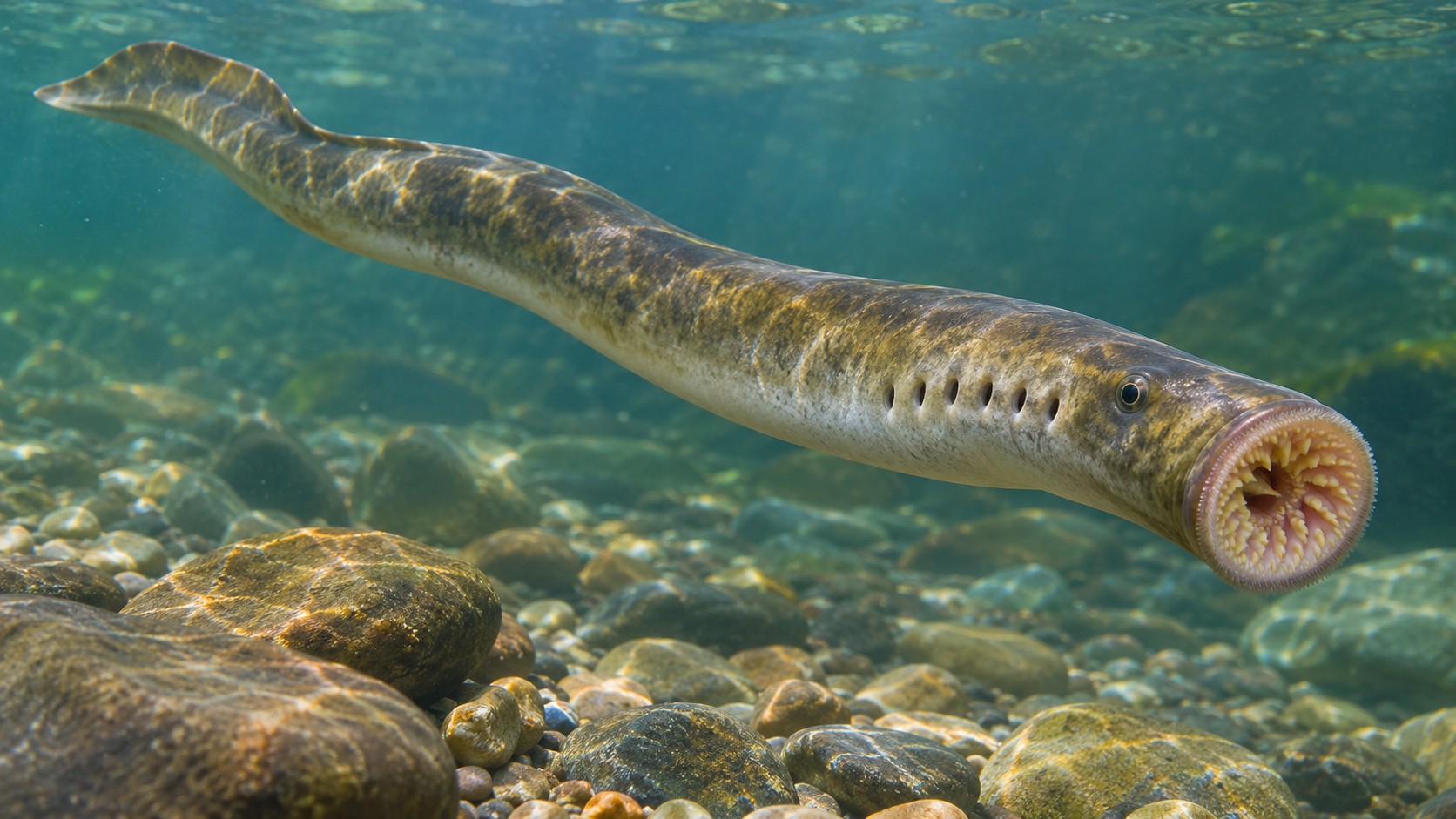
The first impression is often an eel, but the resemblance is superficial. A true eel has jaws, and many eels also have paired pectoral fins. A sea lamprey has neither jaws nor paired fins. Its body moves through water in traveling waves, with low dorsal fins and a tail fin contributing to control. Mottled brown, olive, gray, or dark coloration breaks up its outline against a riverbed, and the pale underside can be difficult to see from above.
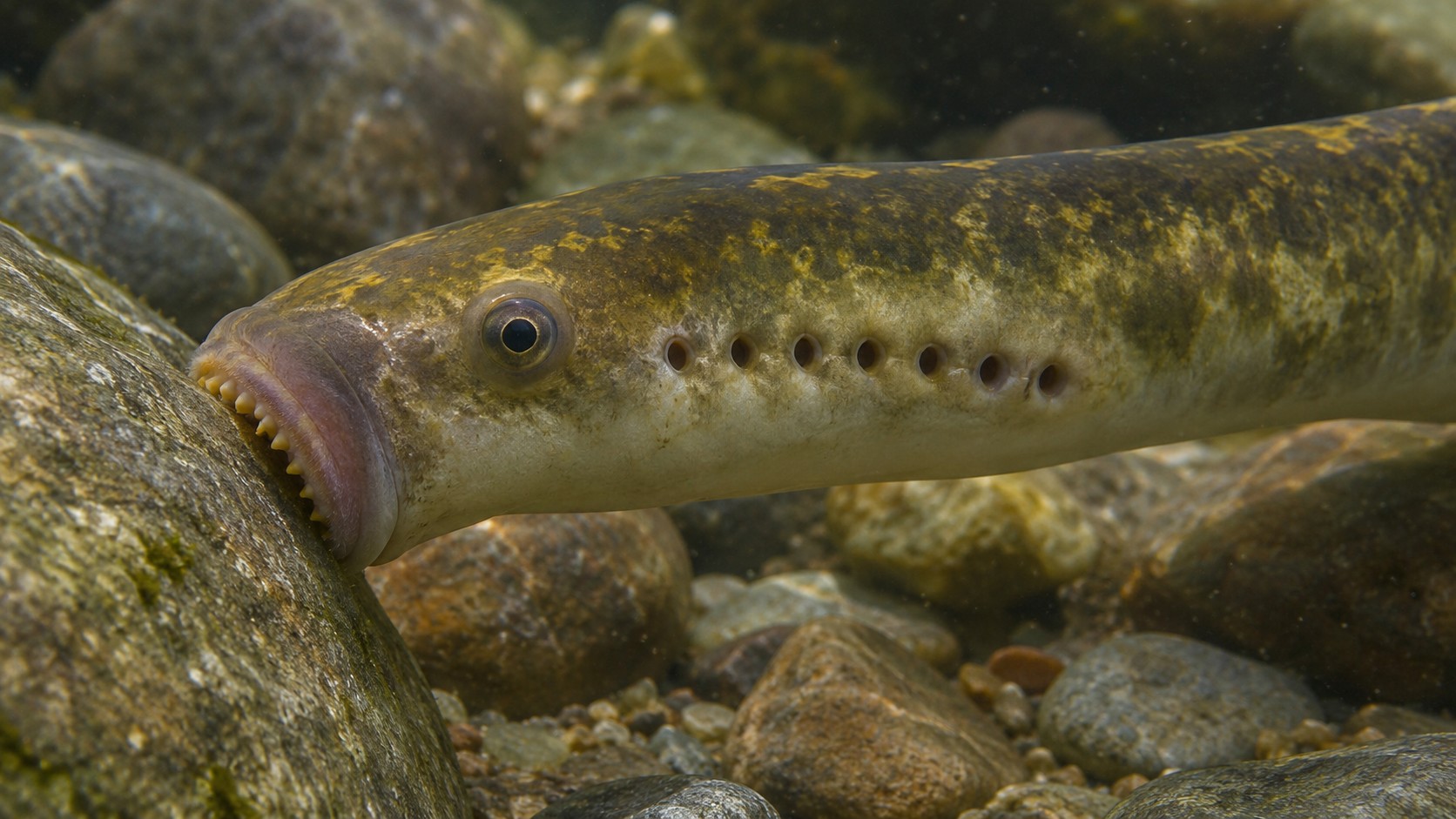
Behind the eye, seven small external gill openings form a useful identification feature on each side. At the front, a circular disc surrounds the mouth, with horny tooth structures and a rasping tongue inside. The disc can attach to a fish during the feeding stage, but it also helps the animal hold against current and manipulate stones. A photograph showing attachment to a rock therefore captures a different activity from a photograph of feeding.
Native Atlantic Fish, Introduced Great Lakes Problem
Geography is essential to interpreting this species. Sea lampreys are native to Atlantic waters and associated coastal rivers in North America and Europe. Their migrations belong within the ecological history of those systems, where they interact with hosts, predators, and river habitats. Calling every sea lamprey an invader removes the very information needed to understand whether a population is native or introduced.
In the upper Great Lakes, sea lampreys spread into waters where their parasitic feeding contributed to severe fishery losses. Large fish, including lake trout, were vulnerable hosts. This history explains the extensive control programs associated with the species today. It does not establish that all lampreys, or even all sea lamprey populations, should receive the same management response.
Lake Ontario’s history deserves particular care because sources have treated its origin differently, and scientific discussion is more complicated than a simple statement about every Great Lake. For a reader starting with identification, the dependable distinction is that upper Great Lakes invasions and native Atlantic populations are different ecological situations. Native and introduced populations have different ecological histories and management needs.
The Years Spent Beneath the Surface
A newly hatched sea lamprey does not begin hunting large fish. Its larval stage, known as an ammocoete, settles into suitable soft sediment and filters small particles from water. Larvae have a hoodlike mouth rather than the developed oral disc familiar from adult photographs. Their eyes are not yet the conspicuous working eyes of the later stage, and their daily existence centers on a burrow rather than open swimming. These quiet years can occupy much of the life cycle. Growth and development depend on local conditions, so a single fixed age is a poor description of every larva. Sediment patches with water movement provide access to food while sheltering the animal. A river that looks empty from the bank may contain a substantial hidden lamprey population beneath its softer margins.
Larval habitat also explains why a spawning riffle alone cannot support the whole species. Eggs and spawning adults use one set of river conditions, while larvae need another. Protecting a continuous life cycle means recognizing the connection between gravel, fine sediment, water quality, and downstream movement. The stages are linked even when they occur in different parts of a watershed.
Metamorphosis Rebuilds the Feeding Equipment
Before entering its parasitic phase, the lamprey undergoes a substantial transformation. The mouth develops into a suction disc, the eyes become functional for the new lifestyle, and the internal body changes with the shift in feeding and habitat. This is a biological transition rather than merely the same fish becoming longer. Its relationship with surrounding water and potential food changes along with its appearance. The transformed animal can leave its larval stream habitat for larger waters where host fish are available. In Atlantic populations, that journey can lead toward coastal marine feeding areas. In Great Lakes populations, the lakes supply the larger-water environment. The common name therefore does not mean every individual must enter salt water to complete its life cycle.
How Attachment and Feeding Work
During the parasitic stage, a sea lamprey uses its oral disc to maintain contact with a host fish. Horny teeth and the tongue help open a feeding site, and the lamprey takes blood and other fluids. The host can be injured or killed, with effects depending on factors such as its size, condition, and the feeding encounter. An attached lamprey is not simply riding along like a harmless passenger.
That specialized feeding apparatus is an important part of the species, but it is also easy to exaggerate. A close photograph magnifies the mouth and makes it appear to define the animal at every age. Larvae do not feed in this way, and the final spawning adults cease feeding. Describing the stage along with the behavior produces a more accurate picture than assigning the same appetite to every lamprey in a stream.
The presence of parasitic lampreys also has to be understood at the population level. A feeding relationship in a native ecosystem is different from an introduced predator or parasite encountering a vulnerable fish community. That distinction explains how conservation of native migratory fish and suppression of invasive populations can both be reasonable goals. The relevant evidence is the watershed and its history.
The Final Journey Into Fresh Water
As reproduction approaches, sea lampreys enter the last major phase of their lives. Feeding gives way to a spawning migration into freshwater streams, and stored energy supports the journey. Conditions in the river determine whether suitable gravel can be reached. A blocked route can interrupt reproduction even if the destination upstream still looks like excellent habitat.
Migration should not be pictured as a random trip up any wet channel. Flow, access, substrate, and environmental cues shape where lampreys can move and reproduce. Their flexible bodies and attachment ability help them deal with current, but those abilities do not make dams, difficult culverts, or altered channels irrelevant. Passage conditions must be considered for this kind of fish, whose movement differs from that of a strong-jumping salmon.
Building a Nest From River Stones
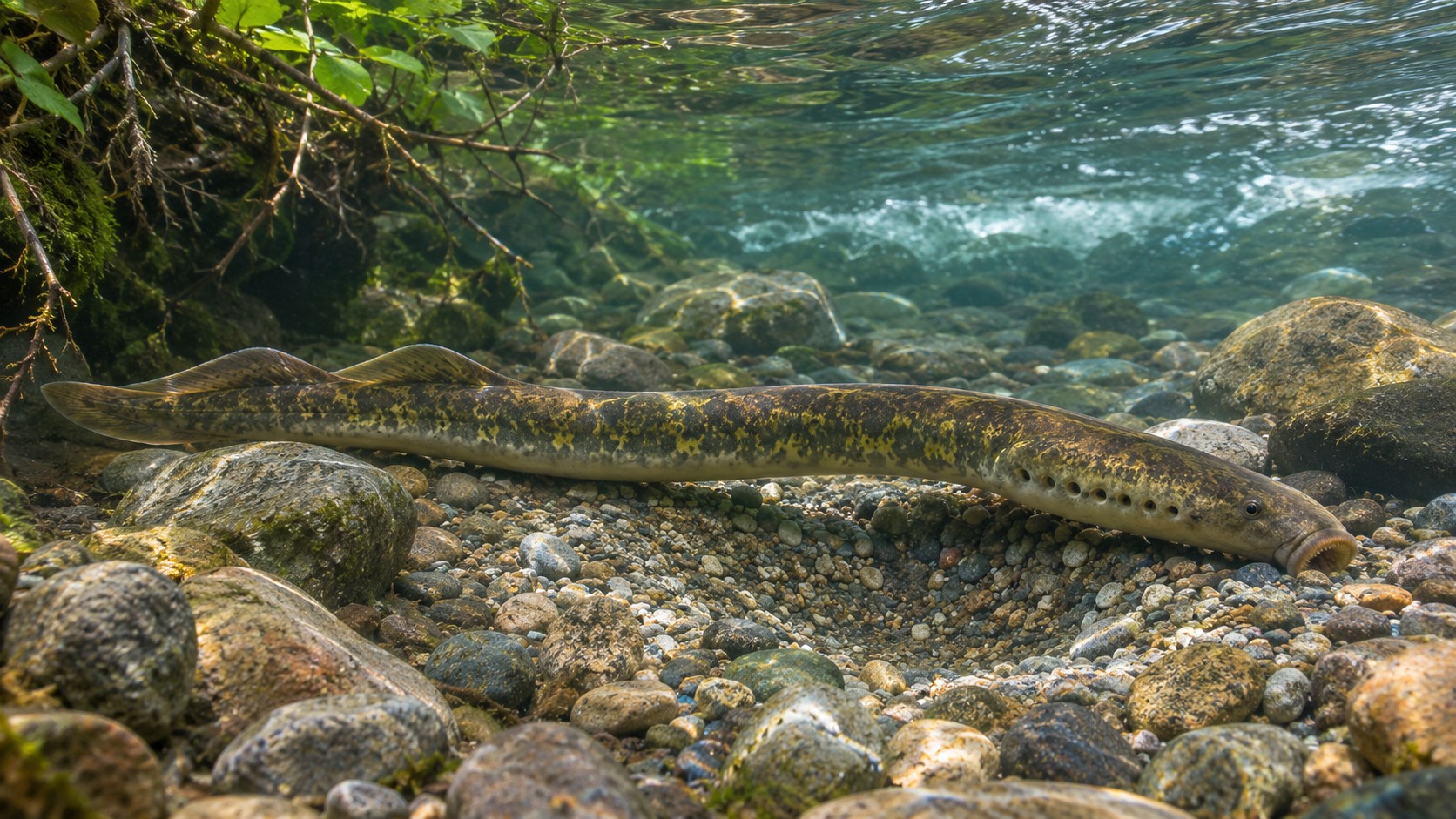
In a suitable spawning area, adults work around gravel and stones to create a nest depression. The oral disc provides a way to grip and shift material, while body movements help prepare the site. From the bank, these actions may look like a fish struggling among rocks. Underwater, they reveal the mouth functioning as a tool for positioning and construction.
Moving water helps supply oxygen around the developing eggs. Gravel with open spaces functions differently from a bed smothered in fine sediment, so the condition of the substrate matters as well as its presence. After reproduction, the adults die. Their bodies then enter the food web, while the next generation begins a very different existence as small larvae.
A spawning scene is worth watching from a respectful distance because disturbance can interrupt behavior at a brief, important stage. Moving stones, handling animals, or attempting to relocate them changes the very process being observed. Identification photographs and observations can be useful without rearranging the habitat. Local reporting guidance is especially important where native and invasive fish management overlap.
Why Great Lakes Control Targets Several Stages
The Great Lakes control effort is built around the lamprey’s life cycle. Agencies survey streams to locate larvae and assess where treatments or barriers can reduce future recruitment. Specialized lampricides, trapping, and barriers are among the tools used in coordinated programs. Each method has a particular purpose and operating conditions, so this is professional watershed management rather than an activity for individual residents to improvise.
Targeting larvae can prevent a future generation from entering the parasitic feeding stage. Intercepting migrating spawners can reduce reproduction, while barriers can limit access to suitable tributaries. These approaches work at different points in the same cycle. Their value depends on monitoring and coordination, because a treatment in one location does not automatically resolve production across an entire lake basin.
A Different Priority in Native Rivers
In native Atlantic watersheds, the questions can shift toward access, habitat quality, and maintaining natural migratory connections. Spawning lampreys can influence gravel and contribute nutrients after death, and their different stages become food for other animals. Those relationships are part of the river’s ecology. They should be evaluated locally instead of borrowing conclusions from an invaded Great Lakes tributary.
Restoration also requires attention to the less visible larvae. Channel work that protects only a fast gravel reach may overlook soft sediment used during the long filter-feeding stage. Conversely, excessive sedimentation can degrade spawning habitat. A connected river with a range of suitable conditions supports the sequence of stages better than a single carefully photographed patch of water.
This perspective does not require overlooking the lamprey’s effect on host fish. It places that effect within a broader ecological history. Native ecosystems contain feeding relationships that can be damaging to individuals while remaining part of the system’s normal functioning. Management decisions require population evidence and place-specific goals, not a judgment based on how friendly an animal appears.
Separating Sea Lampreys From Their Relatives
Sea lampreys belong within a wider lamprey group whose members have different ranges and adult feeding strategies. Some brook lampreys are non-parasitic, completing reproduction without an extended adult feeding phase. Pacific lampreys belong to a different regional and cultural story along western North America and the Pacific. Shared jawless anatomy does not make these animals interchangeable.
For field identification, a broad lamprey resemblance is only the beginning. Location, size, life stage, oral-disc details, and other diagnostic characters may be needed to establish the species. An image that cannot show those features should support a cautious identification. Recording the place and date can be more useful than trying to force certainty from a distant view.
Size, Teeth, and Breeding Appearance
Adult sea lampreys are substantial fish. The U.S. Fish and Wildlife Service describes adults of roughly 30–61 centimeters, although larger individuals occur and size differs among populations. A length estimate is most informative when it identifies the stage: a recently transformed juvenile has not completed the feeding growth that produces a spawning migrant. The two dorsal fins lie on the rear portion of the body, separate from the continuous impression created by the long trunk. Like other lampreys, the animal has no pectoral fins immediately behind its gill region.
The teeth are hard, keratinous structures rather than miniature versions of a shark’s mineralized teeth. Their arrangement supplies more diagnostic information than the general appearance of a round mouth. Identification specialists examine the oral disc and tooth plates when separating lamprey species. During breeding, a male can develop a pronounced ridge along the back. These changes belong to reproductive condition; the mottled fish attaching to a host and the darkening fish working a river nest need not look identical.
One Life Divided Between Different Food Webs
The larva and feeding juvenile draw energy from very different sources. Suspended organic material and microorganisms support the buried filter feeder. After metamorphosis, attachment to a fish opens access to a concentrated source of blood and tissue fluids. That switch changes the lamprey’s position in the food web. A stream producing young lampreys can influence fish far beyond the patch of sediment where the larvae developed, while a returning adult brings material back into flowing freshwater.
In Great Lakes descriptions, the larval residence commonly lasts several years, followed by a much shorter host-feeding interval. Those intervals are not a universal timetable for Atlantic populations. Temperature and the availability of food affect larval growth, and the transition depends on developmental condition as well as elapsed time. A fish that spends longer in sediment has not simply added extra years to an otherwise unchanged adult life. It has prolonged one particular feeding stage before its body takes on another task.
The return migration ends this opportunity for growth. A mature spawner can no longer compensate for a difficult ascent by finding a meal. Muscle, reproductive tissues, and movement must draw on the resources already accumulated. A stone that supplies an attachment point can therefore have practical value during an upstream journey, not just during nest construction. Access through a river is a chain of usable surfaces and flows rather than a single measure of swimming speed.
How Eggs Become Burrowing Larvae
Spawning takes place in nests worked into gravel. Eggs settle among the substrate rather than receiving prolonged care from a surviving parent. Development depends on water conditions, and the newly hatched stages initially remain associated with the nest before moving into suitable depositional habitat. Their small size and limited abilities make the connection between a spawning site and downstream nursery areas important. A nest isolated from usable larval sediment does not provide the same opportunity as gravel within a functioning reach.
Once established, a larva positions its feeding apparatus near the sediment surface and draws water through its branchial system. The burrow offers concealment while maintaining contact with the moving water carrying food. This arrangement connects the fish to fine-scale conditions within the bed. Sediment can be present but unsuitable if water exchange deteriorates, and sudden drying can expose larvae before their hidden presence is recognized.
Seven gill openings remain a useful feature in the later lamprey, but the route of breathing has to work during attachment too. The animal can ventilate its gill region while its oral disc is occupied. Holding a surface does not mean that breathing must stop until the mouth lets go. This is a particularly important functional distinction in a fish whose mouth participates in feeding, resting against current, and reproduction.
Control and Restoration Can Create Different Passage Goals
A barrier can protect an invaded tributary by preventing sea lampreys from reaching spawning habitat, while a barrier in a native Atlantic river can obstruct a population that conservation work aims to retain. The physical structure may look similar; its ecological purpose differs. Managers also have to account for other species using the same route. Removing an obstacle without considering introduced lampreys, or retaining one without considering native migrants, can exchange one problem for another.
In an invaded basin, coordinated monitoring links larval production with the number of future parasites. In native rivers, recovery can involve restoring access and protecting both spawning and nursery areas. These approaches share a dependence on knowing where each stage lives. The most useful distinction is the local population’s history and ecological setting, followed by the conditions that allow its next generation to survive.
In the northeastern Atlantic, OSPAR identifies sea lamprey as threatened or declining across its listed Arctic, North Sea, Celtic Seas, and Bay of Biscay–Iberian regions. This is a regional conservation concern, distinct from Great Lakes invasive control. OSPAR’s coastal account describes larvae remaining in sediment for approximately five to seven years before a marine growth phase of around two years. Those intervals describe that migratory setting rather than every landlocked lamprey population.
Reading the Whole Life Cycle
The sea lamprey is easiest to understand by holding its successive lives together: a buried filter feeder, a transformed swimmer that feeds on fish, and a migrant returning to gravel to reproduce. Each phase changes what the animal needs and what it contributes to surrounding waters. The watershed adds the final essential context, distinguishing a native Atlantic migration from an invasive Great Lakes population. Once those connections are visible, the remarkable mouth becomes part of an understandable fish rather than the entire story.
An observation becomes more useful when it includes the fish's setting. A lamprey over gravel, one attached to a stone, and a larva recovered during a professional survey represent different pieces of the same cycle. Place, season, and behavior allow those pieces to be interpreted. Even a clear photograph benefits from that information, because the animal's appearance cannot reveal whether a watershed population is native or introduced.
For a curious observer, the most productive next step is to compare this species with the other lampreys known from the region. Consult local fish resources, leave spawning habitat undisturbed, and record uncertainty where diagnostic features remain hidden. Recognizing what the evidence can establish makes encounters more informative. It also keeps an unusual fish connected to the real river or lake that supports it.