
Two Wing Cases, Countless Ways to Live
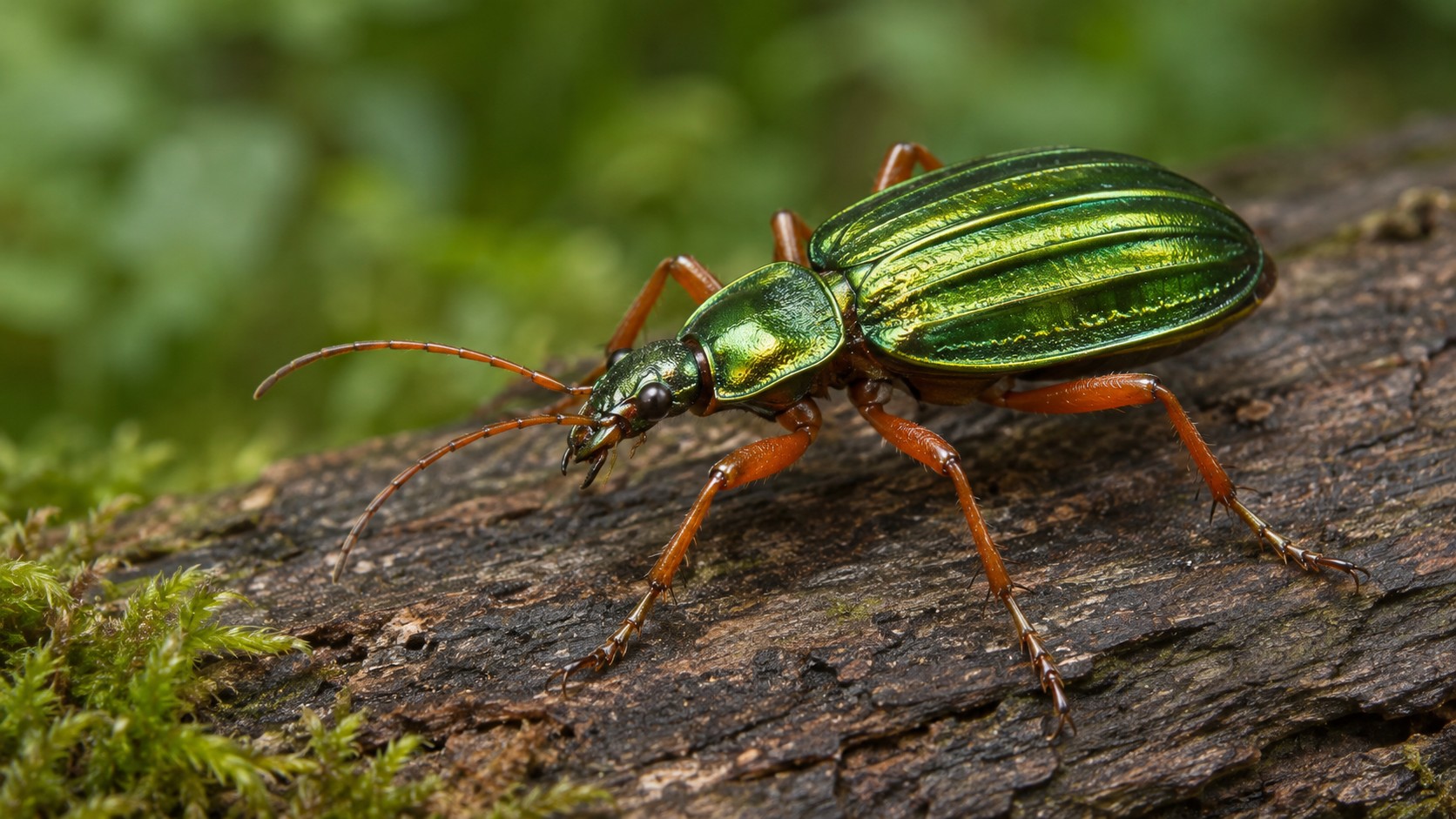
A beetle crossing a leaf often presents a neat line down the middle of its back. That seam separates two modified forewings, the elytra, and introduces one of the most successful variations on the insect body plan. Beetles belong to Coleoptera, an enormous order that includes compact grazers, fast ground hunters, wood-associated larvae, aquatic predators, and the insects we call fireflies. Their diversity does not erase their shared anatomy, but neither does one familiar beetle represent the whole group. Understanding them starts with the wing cases and then asks what changes beneath, behind, and around that recognizable exterior.
A: Usually it is the meeting line between the paired modified forewings called elytra.
A: In many flying species, membranous hindwings deploy from beneath the protective forewings.
A: No. Rove beetles and other modified forms show why several characters are needed for identification.
A: No. Beetle larvae vary widely, and their anatomy differs substantially from the adult stage.
A: No. It could be hunting, resting, or visiting for another reason; direct feeding evidence is stronger.
A: No. Fireflies belong to the beetle family Lampyridae.
A: Yes. Adults of many aquatic species can fly between water bodies.
A: No. Species associated with decay are not automatically attackers of sound structural wood.
A: No. The order also includes decomposers, fungal feeders, flower visitors, and other ecological roles.
A: The visible evidence may support the order while lacking details needed for a narrower identification.
The Back Is Not One Solid Shell
The paired covers visible on most adult beetles are modified forewings rather than a single lid. They protect much of the abdomen and, in many species, a second pair of delicate wings folded underneath. When a flying beetle prepares to leave a surface, those hidden wings must deploy. The distinction between protective forewings and flight wings explains why a resting beetle can look so different from the same animal in flight, with several moving surfaces suddenly visible.
Elytra are a major identification feature, but their significance goes beyond recognition. Protection helps beetles move through abrasive or crowded places such as litter, bark crevices, and soil without constantly exposing delicate wing membranes. The Australian Museum’s overview connects this anatomy with the group’s extraordinary range of habitats. A ground beetle’s polished back is therefore not merely decorative armor. It is part of a body arrangement that permits the insect to use demanding physical spaces.
The Familiar Outline Has Exceptions
Not every beetle wears long wing cases covering the entire abdomen. Rove beetles have conspicuously shortened elytra, while some flightless beetles have reduced flight wings or fused covers. Other forms are softer-looking than the hard, rounded animal many people picture. An exception does not mean the classification has failed; it means that one order contains modified versions of a shared plan. Identification works best when several characters agree, rather than treating a shiny oval body or an exposed abdominal tip as a complete test.
Legs, Mouthparts, and Antennae Change the Job
Adult beetles have the insect arrangement of six legs attached to the thorax, together with a head bearing antennae and mouthparts. Those basic parts can be reshaped for very different tasks. Long running legs suit a surface hunter, broad digging forelegs help move soil, and modified swimming legs assist some aquatic species. Looking at how a beetle moves can consequently reveal more about its lifestyle than an isolated photograph of its color pattern.
Antennae vary too, from relatively threadlike forms to clubs, fans, or very long segmented structures. They are sensory organs, not interchangeable ornaments. The shieldlike region immediately behind the head can also differ markedly in width and outline among groups. For identification, the relationship between head, thorax, and wing cases is often more informative than the apparent size of the whole animal, which perspective can exaggerate in a close photograph.
Most beetles have chewing mouthparts, but the foods they process range from plant tissue to prey and decomposing material. Large jaws should not automatically be interpreted as a danger to people or as proof of one particular diet. Some conspicuous structures also have roles in competition between individuals. The function of enlarged structures differs among beetle lineages and between particular behaviors.
A Larva Is Not a Small Adult
Beetles undergo complete metamorphosis: egg, larva, pupa, and adult are distinct stages. Larvae lack the finished adult wing cases and can have very different body proportions. The word grub is often used for a beetle larva, but not every larva is the familiar pale, curved form found in soil. Predatory larvae can be elongated and active, while others are specialized for concealed life inside plant tissue, wood, or other food-rich spaces.
This separation allows juvenile and adult stages to use their surroundings differently. It also complicates identification: a larva found beside an adult is not necessarily its offspring, and two similar larvae may produce quite different beetles. A reliable association may require rearing records or detailed diagnostic features. The safest field description retains the stage and the substrate rather than turning every pale larva in a log into a miniature version of the nearest adult.
No Single Beetle Diet Exists
Plant feeders, predators, fungal feeders, scavengers, and other specialists all occur within Coleoptera. Some species change foods between life stages; others occupy similar feeding roles as larvae and adults. An order-level statement that beetles eat leaves or beetles eat pests is therefore incomplete. Both can be true of particular groups, while neither describes the order as a whole. Their ecological importance comes partly from this division into many different ways of acquiring food.
A beetle’s presence on a plant also needs interpretation. It might be eating the plant, hunting smaller animals there, taking pollen, or simply resting. Missing leaf tissue does not identify the consumer by itself. Direct observation of feeding, the identity of the plant, and a clear view of the insect provide a stronger record than proximity alone. This matters especially in gardens, where a beneficial predator can be mistaken for the cause of damage it was actually investigating.
Human labels such as pest and beneficial depend on the organism and setting. A species feeding on a crop can create an economic problem, while another contributes to biological control nearby. Native status, population density, and the stage responsible for damage add further context. Before deciding how to respond, establish what the beetle is doing rather than assuming that all hard-backed insects visiting one location share the same effect.
Hunters Along the Soil Surface
Many ground beetles are predators that search at or near ground level. University of Minnesota Extension describes their use of shelter beneath leaves, logs, stones, and loose bark, with many active at night. Their long legs and quick movement make sense in that setting. A daytime glimpse under cover may show a resting hunter rather than its usual feeding behavior. Ground beetles are one beetle family among many, and color and body shape vary widely across the order.
Recycling Is More Than Eating Fallen Leaves
Beetles participate in decomposer communities through several routes. Some consume dung, others feed on fungi or animal remains, and many are associated with decaying wood. Their activities interact with microbes and other invertebrates rather than replacing them. The SARE guide to soil beetles separates groups by their feeding and life histories, showing why recycling should not be reduced to one generic animal eating every kind of waste.
Dead wood is a changing habitat, not simply a lifeless object. Moisture, fungal growth, decay stage, and the condition of the bark influence what can live there. A beetle associated with rotten timber is not automatically a species that attacks sound building wood. That difference is important both for identification and for understanding woodland habitat. Retaining suitable decaying material where safe can support a community whose needs would be missed by looking only at living flowers and foliage.
Fresh Water Has Beetles Too
Several beetle lineages use aquatic habitats, with bodies and behaviors unlike those of a ground runner. Predaceous diving beetles, for example, can swim effectively and store air beneath their wing covers before diving. The Missouri Department of Conservation describes both the adult and the elongated predatory larva. They remain insects even when much of their activity occurs below the surface; an aquatic lifestyle does not turn them into a different major animal group.
Water use can also change across the life cycle. Some aquatic beetle larvae leave the water to pupate in a protected place nearby, linking the pond to its margin. Adults of many species can fly, allowing movement between water bodies. A beetle found far from a pond is not necessarily evidence that someone transported it, and a swimming-pool encounter does not establish that a pool is suitable habitat for completing its development.
Different aquatic beetles solve different problems, so the diving-beetle example should not become a rule for every family. Some crawl over submerged surfaces rather than swimming freely, and breathing arrangements vary. For a pond record, note whether the animal is an adult or larva, its position in the water, and the behavior actually seen. Those details help distinguish a hunting swimmer from a crawling grazer without requiring the observer to force either into a demonstration.
The Beetles That Light the Night
Fireflies are beetles in the family Lampyridae, despite a common name that sounds like a kind of fly. The National Park Service’s firefly account highlights how much of their lives can occur in the larval stage, far less conspicuous than the adult light display. Light production and signaling vary across the family, so the familiar flashing adult is not the only possible form. Their inclusion in Coleoptera is a reminder that classification follows relationships and anatomy, not whether a common name sounds like beetle.
Flowers, Collections, and the Size of the Order
Beetles also visit flowers, and some transfer pollen between them. Their role depends on the beetle, the plant, and the way the visitor contacts reproductive structures. A flower visit is not automatically effective pollination, just as pollen feeding is not necessarily equivalent to harmless service to a plant. Idaho State University’s pollinating-insect resource presents beetles as part of this broader pollinator picture rather than assuming that all insect pollination belongs to bees and butterflies.
The order contains hundreds of thousands of described species, with totals changing as research continues. Described species are not the same as all species that exist, and a large museum collection is not a direct census of the planet. The American Museum of Natural History’s Coleoptera collection represents many beetle families and research histories. Such collections preserve evidence for comparison, helping scientists connect names, specimens, and changing knowledge rather than merely accumulating impressive numbers.
Recognizing Families Beneath the Shared Wing Cases
Some beetle families have especially useful adult features. Many true weevils in Curculionidae carry a snout with mouthparts at its end. Scarab antennae can open into a fan of flattened segments, while longhorn beetles in Cerambycidae often have conspicuously long antennae. These are different modifications of the head, not interchangeable versions of one ornamental projection.
Leaf beetles in Chrysomelidae supply many plant-feeding examples, whereas Carabidae includes numerous ground-running hunters. Staphylinidae contains the rove beetles with shortened wing cases. A beetle’s family can narrow the biological possibilities, but the species and life stage still determine its food and habitat. A long snout or a fan-shaped antenna provides a starting clue rather than a complete life history.
The head and the shield immediately behind it are separate structures. That shield is the pronotum, covering the upper surface of the first thoracic segment. The remaining thorax carries the wings, and all three thoracic segments bear legs. Locating those regions helps make sense of unusual proportions, including a large scarab with digging forelegs or a flattened beetle moving beneath bark.
Bombardier Beetles Have a Specialized Chemical Defense
Bombardier beetles provide an example in which a small body contains a remarkable defensive apparatus. Studied members of the ground-beetle tribe Brachinini discharge a hot chemical spray from abdominal glands. Reactions occur within a reinforced chamber, and the discharge emerges in rapid pulses rather than as a continuous stream.
Research published in 2015 used high-speed X-ray imaging to investigate the internal mechanism. The observations connected chamber pressure, membrane movement, and pulsed release. This is a coordinated system of gland chemistry and physical structures, not evidence that the insect catches fire or explodes its whole abdomen.
The defense belongs to particular beetle lineages. A shiny ground beetle without that apparatus cannot be assumed to produce the same discharge. Nor do chemical defenses imply that every encounter ends in escape. Predators differ in how they attack, and an adult’s abdominal glands do not describe every hazard faced by its eggs and larvae.
A Dung Beetle Can Keep Its Direction Under the Stars
Some dung beetles roll a food ball away from a crowded dung pile, where other animals compete for the same resource. Maintaining a straight departure reduces repeated turns through the contested area. The task is directional orientation, rather than necessarily finding a familiar nest by recognizing landmarks along a memorized route.
A 2013 study tested nocturnal dung beetles beneath different views of the night sky, including conditions in a planetarium. The animals could use the broad light pattern of the Milky Way to maintain their course. Their small eyes did not need to resolve every individual star to obtain useful directional information.
This result concerns the beetles and behavior tested. It does not establish that every dung-feeding species uses the same celestial cues. It does show that finding and transporting an ordinary-looking resource can involve a sensory relationship with a much larger environment than the patch of soil beneath the animal.
Burying Beetles Prepare Food for Their Young
The American burying beetle, Nicrophorus americanus, demonstrates parental behavior beyond placing eggs near food. A breeding pair prepares and buries a small vertebrate carcass, making a resource for the developing brood. The parents work the carcass into a brood ball and prepare a feeding area for the arriving larvae.
Larvae can receive regurgitated food from an adult as well as feeding on the prepared resource. One or both parents remain involved during development. This extended association contrasts with beetles whose larvae begin an independent feeding life immediately after hatching, despite both strategies occurring within the same order.
Burial requires suitable soil as well as an available carcass. The resource is perishable and attractive to competitors, so its preparation, location, and defense matter to reproductive success. Carrion feeding is consequently more than an adult scavenger obtaining a meal: in this species, it also supports the next generation.
Ambrosia Beetles Cultivate Food Inside Wood
Ambrosia beetles tunnel into wood while depending on fungi grown in their galleries. Adults transport their fungal partners to a new site, where the fungi establish along the tunnel surfaces. Larvae obtain food from that cultivated growth instead of simply digesting the wood through which the adults bored.
The association changes how boring damage is interpreted. A tunnel shows excavation, while fungal staining records another organism growing in the same place. Moisture and the condition of the wood affect whether the fungal food can persist. A piece of timber can therefore contain a small, interacting system of beetles and microbes rather than one insect consuming every material it encounters.
Many ambrosia beetles use stressed, dying, or recently dead trees, while certain introduced species and their fungal associates cause serious disease in living hosts. Their effects differ with the beetle-fungus partnership. The mere presence of an ambrosia gallery does not establish the cause of a tree’s decline, but identifying both partners can explain an impact that would be missed by considering the beetle alone.
Identify Before Generalizing
A useful beetle observation includes the whole adult from above and, when possible without disturbance, another view showing the head and body profile. Antennae, leg form, wing-case texture, and the shield behind the head can all matter. Record the locality and the exact substrate: on a leaf, beneath loose bark, walking on soil, or swimming near vegetation. Habitat context helps, but should support identification rather than replace it.
True bugs can resemble beetles, and common names create further confusion. An apparent hard back is not enough on its own. The Australian Museum’s identification guide emphasizes combinations of adult features. Where a photograph does not support a species name, stopping at family or order is a useful result. It is better to preserve an honest identification limit than to attach an exact name that later becomes a misleading ecological record.
Beetles are easiest to appreciate when a shared structure and varied lifestyles remain in view together. The same broad order includes animals using leaf surfaces, dark litter, decaying wood, fresh water, and the night air. One individual can introduce that diversity without standing in for all of it. Start with the paired wing cases, watch what the animal actually does, and let the surrounding habitat add detail. A neat seam down the back opens onto a much larger biological story.
Animal Product Reviews
Explore field guides, close-up photography equipment, and nature-themed books and gifts in Animal Streets’ product reviews. Thoughtful choices can support an interest in insects without taking wild beetles or their shelters out of the landscape.