
The Familiar Beetle and Its Unfamiliar Young
A rounded red beetle on a leaf is easy to welcome, while a dark, spiky-looking insect crawling nearby may receive a very different reaction. Both can be ladybugs at different stages of life. These beetles, also called ladybirds or lady beetles, belong to the family Coccinellidae and include much more variety than the familiar spotted adult suggests. Many hunt small plant-feeding insects, but some relatives eat fungi or plants instead. Understanding the family means recognizing its changing forms, reading patterns without inventing an age code, and seeing a garden as a place where prey, shelter, and seasonal movement shape what the beetles do.
A: No. Spot number is not an age counter; pattern and other features are used in identification.
A: It may be a ladybug larva, whose body differs greatly from the rounded adult form.
A: No. It may be an attached pupa undergoing normal development.
A: No. Different species can specialize on other prey, and some also use pollen or nectar.
A: No. The family includes fungus-feeding and plant-feeding species as well as predators.
A: Not necessarily. Some species release defensive fluid when disturbed, so observation without handling is preferable.
A: No. Seasonal aggregation does not imply a permanent colony with shared labor.
A: No. Adults can disperse, and a release is not a guarantee of permanent residence or complete aphid control.
A: Not by itself. Feeding, hunting, resting, and effective pollen transfer are different observations.
A: Yes. That status describes its geographic history rather than a color or shape visible in a photo.
Red With Black Spots Is Only One Version
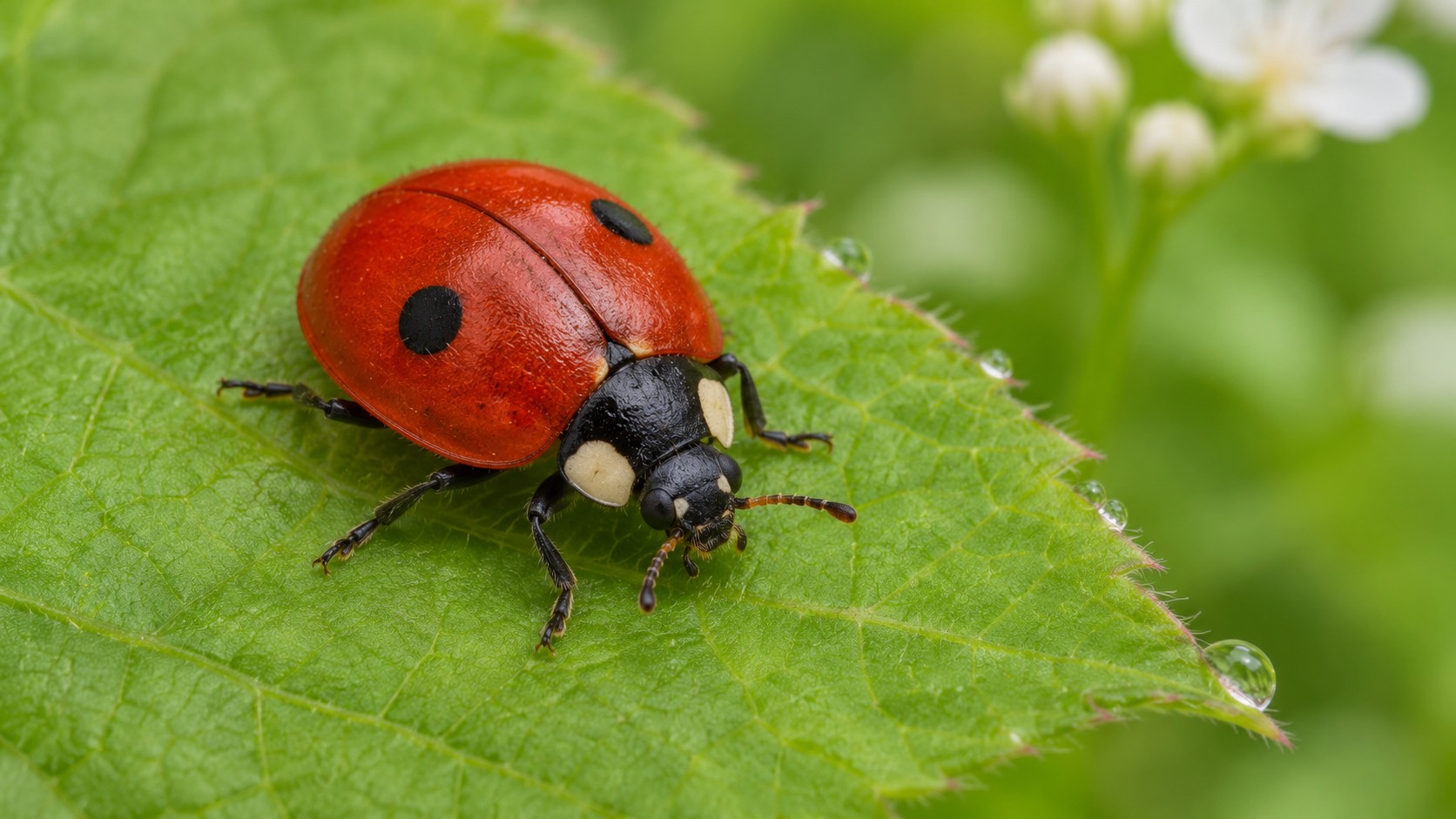
Many adult ladybugs have a strongly domed, rounded or oval body and short antennae with small clubs at their ends. Their hardened forewings form paired covers over the back, meeting at a central seam. Red and black is a familiar combination, but the family also includes yellow, orange, pinkish, black, and less conspicuous forms. Some have bold spots, others contrasting patches or very few obvious markings. A single color scheme is not a definition of the family.
Spot count can contribute to identification, but it is not a birthday tally. A beetle does not add one spot each year. The UK Ladybird Survey’s explanation explicitly separates number of spots from age. Pattern, body shape, markings behind the head, and locality need to be considered together. Some species also have different color forms, so finding a black individual with red patches does not necessarily mean it is unrelated to a more familiar red form.
The Larva Is Already Doing Important Work
Ladybug larvae do not look like tiny domed adults. Many are elongated, with a body that tapers toward the rear, six legs near the front, and dark coloration interrupted by orange or other pale markings. Their textured surfaces can look armored or spiny. The comparison with a miniature alligator is memorable, but it is only a visual analogy: these are juvenile beetles with their own insect anatomy and movement.
In many predatory species, larvae hunt the same broad kinds of prey as adults and can be important consumers of aphids and other small insects. Their unfamiliar appearance can therefore lead gardeners to remove an ally while carefully protecting the rounded beetle beside it. The University of California identification guide emphasizes learning the whole life cycle, not just recognizing the adult. A beneficial role does not begin only when red wing covers appear.
Larvae grow through molts rather than stretching indefinitely inside one outer covering. Each interval between molts is an instar, and the last larval stage eventually prepares to pupate. Timing changes with species, temperature, and food, so a photograph cannot provide a universal countdown to adulthood. A larva moving between leaves may be searching for prey or a suitable place to continue development; its activity should be described from observation rather than assigned a purpose automatically.
Egg Placement Connects the Next Generation With Food
In many aphid-feeding ladybugs, the female lays elongated yellowish or orange eggs on plants near prey. Clusters are common, although arrangements vary among species. That placement gives newly hatched larvae a useful starting point, but it does not turn the leaf into their principal food. An egg cluster on an aphid-infested stem connects the next generation with animals feeding there. Keep that relationship in view when inspecting leaves, rather than treating every small yellow cluster as a plant pest that should be removed.
The Attached Pupa Is Not an Injured Adult
After the feeding larval stages, a ladybug becomes a pupa attached to a plant or another suitable surface. It lacks the active searching behavior of the larva and the finished outline of the adult. Depending on the species, its colors and markings can make it look like a small orange-and-black lump or an incomplete beetle. This is a normal developmental stage, not a failed attempt by an adult to grow its shell back.
An attached pupa should not be peeled off to see whether it is alive. Transformation is occurring within a structure that belongs in place. When an adult emerges, its body and coloration may not immediately match a fully mature portrait, and the empty remains can persist nearby. The sequence matters: a pupa, a newly emerged adult, and an older adult are not interchangeable appearances. Comparing photographs across time can explain those changes without disturbing the insect.
Predators With Different Menus
Many familiar ladybugs eat aphids, but that is not the only predatory specialization in the family. Some focus on scale insects, mealybugs, mites, or other small prey. Cornell’s biological-control resource describes a range of foods and feeding relationships. Calling an insect a ladybug therefore provides a useful starting point, not a complete menu. Identifying the prey actually being taken gives an observation much more ecological value.
Other members of Coccinellidae depart from predation. Some feed on powdery mildew fungi, while plant-feeding relatives include the Mexican bean beetle and squash lady beetle. These exceptions are not evidence that an insect has stopped being a ladybug. They show that a family relationship and a feeding role are different kinds of information. The University of Kentucky account discusses the plant-feeding examples alongside the more familiar predatory species.
Adult pollen and nectar use adds another layer to the story. Supplemental foods can help some predatory ladybugs when prey is scarce, while other species have more specialized diets. A beetle on a flower could be feeding, hunting, or resting. Its position alone cannot distinguish those possibilities. A ladybug on damaged foliage may be hunting other animals, eating plant material, or resting; the family includes species with very different diets.
Aphid Numbers and Predator Numbers Do Not Move in Lockstep
Aphids can increase rapidly, while ladybugs need time to arrive, reproduce, or grow through their juvenile stages. Seeing aphids before seeing predators is not necessarily proof that natural enemies have failed. Conversely, the arrival of several adult beetles does not guarantee that an outbreak is about to disappear. Feeding rate, prey supply, plant condition, weather, and other natural enemies interact. A repeated inspection of the same plant gives a better picture than one alarming or reassuring snapshot.
Bright Color and a Defensive Droplet
Some ladybugs respond to disturbance by releasing an unpleasant defensive fluid, a behavior often called reflex bleeding. A yellowish droplet after handling is therefore not necessarily evidence of a fatal injury. It also explains why repeated handling is not a harmless way to make a photograph more interesting. Bright coloration and chemical defense belong to the animal’s interactions with potential predators, not to a performance it needs to repeat for an observer.
The response varies among species and circumstances, and it should not be exaggerated into a claim that ladybugs are dangerous to approach. Watching them on their original leaf or stem avoids unnecessary contact. If identification requires a better view, first try a different camera position rather than forcing the beetle to move. The useful details are its anatomy and behavior, not the amount of defensive fluid a person can induce.
Winter Groups Are Not New Colonies
Many ladybugs survive unfavorable seasons as adults in protected places. Leaf litter, bark, rocks, and other shelter can hold them, sometimes in aggregations. These groups are not nests organized like a bee colony. They bring individuals together around seasonal conditions and shelter rather than creating a permanent workforce with shared tasks. The National Park Service’s ladybug overview connects aggregation and seasonal movement with the broader life history.
Some species also enter buildings while seeking overwintering sites, with the multicolored Asian lady beetle especially familiar in this context. That behavior does not apply equally to every ladybug family member. A congregation near a window needs a species-aware explanation rather than a claim that all garden ladybugs are trying to breed indoors. Likewise, an insect active inside a warm room in winter has experienced different conditions from one remaining sheltered outdoors.
Seasonal timing varies by region, species, and year. Several life stages may overlap during a warm growing season, while sheltered adults dominate a different part of the annual cycle. A calendar from one locality cannot stand in for all populations. Retaining the date and location beside a photograph helps separate a normal local event from an unusual observation and prevents seasonal generalizations from becoming more precise than the evidence allows.
Purchased Adults Are Not a Permanent Garden Workforce
Ladybugs sold for aphid control can disperse after release, so the number poured onto a plant is not the number that will remain working there. UC IPM’s convergent lady beetle account describes this limitation, while research also shows that releases can suppress aphids under suitable conditions. These are compatible findings: a managed release can have an effect without creating a self-sustaining population on demand. Buying insects and conserving an existing local community are different approaches.
Food and Shelter Work Together
A landscape supporting ladybugs offers more than one momentary meal. Flower resources may supplement diets, prey-bearing vegetation supports hunting and reproduction, and protected sites can provide seasonal shelter. Those needs can occur in different parts of the same garden. The most attractive flower patch is not necessarily where larvae are feeding, and an undisturbed corner may contribute something that an immaculate bare surface does not.
Protecting natural enemies also means considering the effects of pest-management actions on them. Broad-spectrum insecticides can kill beneficial insects as well as target pests, so an unidentified larva on a leaf should not automatically trigger treatment. For a persistent plant problem, use current local extension guidance and confirm the cause before choosing a response. Supporting ladybugs does not require ignoring plant health; it requires distinguishing harmful feeding from the predators and developmental stages already present.
A Predator Disguised by Wax
The mealybug destroyer, Cryptolaemus montrouzieri, has a larva that can be mistaken for the animals it eats. Long white waxy projections cover its body, giving it a woolly appearance among mealybug colonies. Beneath that covering is a mobile beetle larva with three pairs of legs and predatory jaws. A large larva can reach about 13 millimeters long, considerably larger than many of the mealybugs around it. Its white coat conceals the familiar dark, elongated outline associated with other ladybug larvae.
Both the adult and the larva consume mealybugs. The adult looks very different from its young: dark wing covers contrast with an orange-brown head and front of the thorax. Thus, two visibly different predators can occupy the same colony while belonging to one species. A wax-covered insect moving through a mealybug cluster may be one of its hunters. Appearance alone does not reveal which animal is feeding on the plant and which is feeding on its neighbors.
The Tiny Ladybug Among Spider Mites
Stethorus punctum is easy to overlook beside a large red ladybug. An adult is only about 1.5 millimeters long, shiny black, and covered with fine pale hairs. Its body retains the convex shape of a lady beetle, but neither bright red coloring nor a conspicuous spot pattern announces its identity. In orchards, this small predator searches for spider mites, animals much smaller than the aphids associated with many better-known ladybugs.
Its egg placement also differs from a familiar cluster of upright yellow eggs. Females lay tiny whitish eggs singly, often on leaf undersides near veins. The larvae move over foliage and pass through four instars before pupation. Because adults and larvae both prey on mites, more than one life stage can contribute to feeding activity on a leaf. A very small black beetle beside mite-damaged foliage may therefore be participating in the response to the mites rather than causing the damage itself.
A Ladybug That Grazes on Mildew
The twenty-spotted lady beetle, Psyllobora vigintimaculata, feeds on powdery mildew. Its larvae and adults consume fungal material, including the threads, spores, and structures that produce spores on affected leaves. This is a sustained diet rather than an occasional drink or supplement to insect prey. The species depends on the fungus for survival and reproduction, so a patch of mildew supplies a feeding site and a place for development.
Adults measure roughly 3–4 millimeters and have pale cream, grayish, or yellowish surfaces with dark markings. Some spots merge, making the pattern less tidy than the common name suggests. Females place eggs on foliage associated with mildew, and the pale, dark-marked larvae feed there as they grow. A mildewed leaf can consequently support a ladybug whose abundance rises with the fungal food supply. Its presence has a different explanation from that of a predatory species searching the same plant for aphids or other small animals.
The Vedalia Beetle and Cottony Cushion Scale
One of the best-known historical ladybug introductions involved the vedalia beetle and cottony cushion scale in California citrus. Beetles were brought from Australia in 1888, and their establishment became an early landmark in biological control. The successful interaction involved a particular predator and a particular scale insect, rather than a general effect of releasing any ladybug into any crop. Recognizing that specificity explains why the episode became so influential in agricultural entomology.
The scale’s conspicuous cottony egg sacs and its association with citrus made the pest highly visible. The beetle’s feeding and reproduction connected its population with that resource. This history places ladybugs within a much wider set of prey relationships than aphid hunting alone. It also reflects deliberate movement between continents. A species can become familiar through successful pest suppression while still having an introduced history in the region where people encounter it. Usefulness in a crop and geographical origin describe different aspects of the same animal.
Convergent Lady Beetles on the Move
The convergent lady beetle, Hippodamia convergens, has two pale markings behind its head that angle toward one another. These marks give the species its common name; they are separate from the variable dark spots on the wing covers. Its life can involve substantial seasonal movement. In parts of western North America, large numbers leave feeding areas and gather in cooler mountain locations, where concentrations of resting adults can be strikingly different from the scattered beetles seen hunting on plants.
Such an aggregation is a seasonal stage in the lives of mobile adults. It does not mean the surrounding rocks or trees have supplied the aphid colonies needed by all their young. Feeding grounds, reproductive sites, and resting sites can lie in different places. The dense gathering and the lone garden visitor are therefore compatible parts of the species’ biology. They reflect changes in activity and location through the year, rather than two different kinds of ladybug society.
A Good Record Looks Beyond the Spots
For an adult, retain a clear view of the wing covers, the area behind the head, the head itself, and enough of the legs to judge shape. A side view can help show how domed or elongated the animal is. For a larva or pupa, record the attachment surface and pattern rather than forcing it into an adult identification key. Each stage supplies different clues, and an exact species name may not be possible from every photograph.
Native and introduced status also depends on place. A species can be familiar and useful in one setting while having a different history elsewhere. Red coloration does not reveal that history, and a general claim that all ladybugs are native or all are invasive erases the family-level diversity. Regional recording schemes and reliable identification resources help connect an observation with its actual geographic context.
The most rewarding change is learning to recognize a whole living sequence on the plant. Eggs near prey become searching larvae, attached pupae produce rounded adults, and those adults disperse or seek shelter as conditions change. Familiar spots are only one part of that story. A better understanding welcomes the less familiar stages too, while leaving room for dietary exceptions and regional differences. Ladybugs become more interesting, not less, when they are treated as real beetles rather than a single universal garden mascot.
Animal Product Reviews
Browse nature books, insect field guides, and close-up photography equipment in Animal Streets’ product reviews. Good observation tools can make a garden encounter more rewarding without removing ladybugs, their eggs, or their shelters from the plants they use.