
How Big Is Big?
The Atlas Moth is among the world’s largest moths, but the phrase largest needs a measurement. Wingspan measures the distance between wing tips; wing area describes how much surface the wings occupy. Body mass is a third comparison altogether. Different species can lead different lists, and individual size varies. An impressive maximum should not be presented as the ordinary measurement of every moth seen in an exhibit.
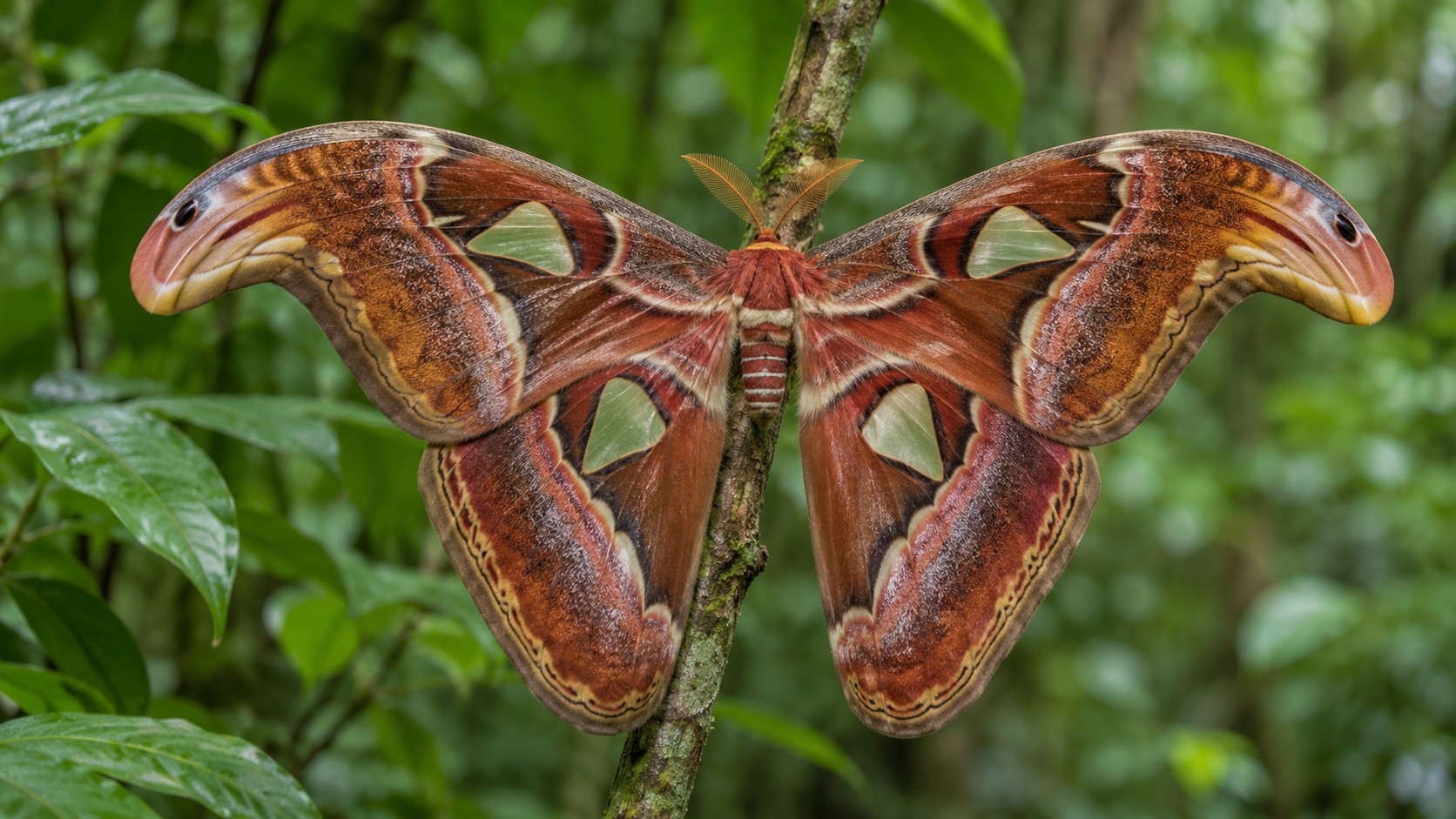
A full view makes the proportions especially clear. The wings are enormous relative to the central body, and their broad surfaces create much of the visual impact. Perspective can exaggerate or conceal that relationship in photographs.
The Windows Are Not Missing Pieces
Each wing carries a prominent translucent patch, often described as a window. These areas belong to the natural pattern; they are not holes cut by predators or a sign that the specimen has been damaged. Light passing through them makes their appearance depend partly on the background. A green leaf behind a window can therefore affect its apparent color without turning the wing tissue itself into a green pigment patch.
The surrounding wing surfaces carry complex bands in brown, rust, cream, and darker tones. Their arrangement can be inspected through several levels of detail: the full outline, broad pattern regions, and the fine scales making up much of the surface. A window stands out partly because it interrupts that densely patterned material. The contrast is more informative when the whole wing remains visible rather than being reduced to an isolated transparent triangle.
Irregular missing tissue at a damaged edge tells a different story from the repeated, bordered windows in an intact adult. Knowing the normal pattern helps an observer recognize genuine wear without interpreting every unusual feature as an injury. It also keeps the moth’s architecture connected to identification rather than treating the windows as a separate curiosity.
A Name Is More Useful Than a Record Claim
Attacus atlas belongs to Saturniidae, the giant silk moth family. Related Attacus species can look similar, which makes a reliable scientific identification valuable when comparing photographs or exhibit labels. A large moth with translucent patches is not automatically this exact species. The name Atlas has been linked both to the mythological figure and to maplike wing markings, but the origin is not certain enough to turn either explanation into an unquestioned fact. Its biology is more securely understood through the animal’s observable features than through a confident naming legend.
The Famous Snake-Like Tips
The forewing tips curve outward and carry markings that people often compare with a snake’s head. The resemblance is strong enough to inspire familiar common-name explanations and defensive stories. It is still a wing tip, not an independent head or a structure capable of biting. Anatomy and resemblance should remain separate even when the illusion is compelling to a human viewer.
Snake mimicry has been proposed as a defensive benefit, but the Florida Museum’s account notes that this particular hypothesis has not been experimentally tested. That qualification matters. A plausible resemblance, a report of movement when disturbed, and a measured predator response represent different kinds of evidence. The interesting question is how potential attackers perceive the moth, not merely whether a person can imagine a snake in the pattern.
Stillness Deserves to Be Observed
Atlas adults commonly spend daytime periods resting and are more associated with reproductive activity after dark. A motionless individual is not necessarily a decorative specimen or an animal failing to behave normally. Resting can conserve resources during a nonfeeding stage. It also provides an opportunity to inspect the wing outline and pattern without provoking movement. Repeatedly disturbing a moth to obtain a dramatic defensive display changes the situation being studied and may consume energy that the adult cannot replace by taking another meal.
Comb-Shaped Antennae Gather Chemical Information
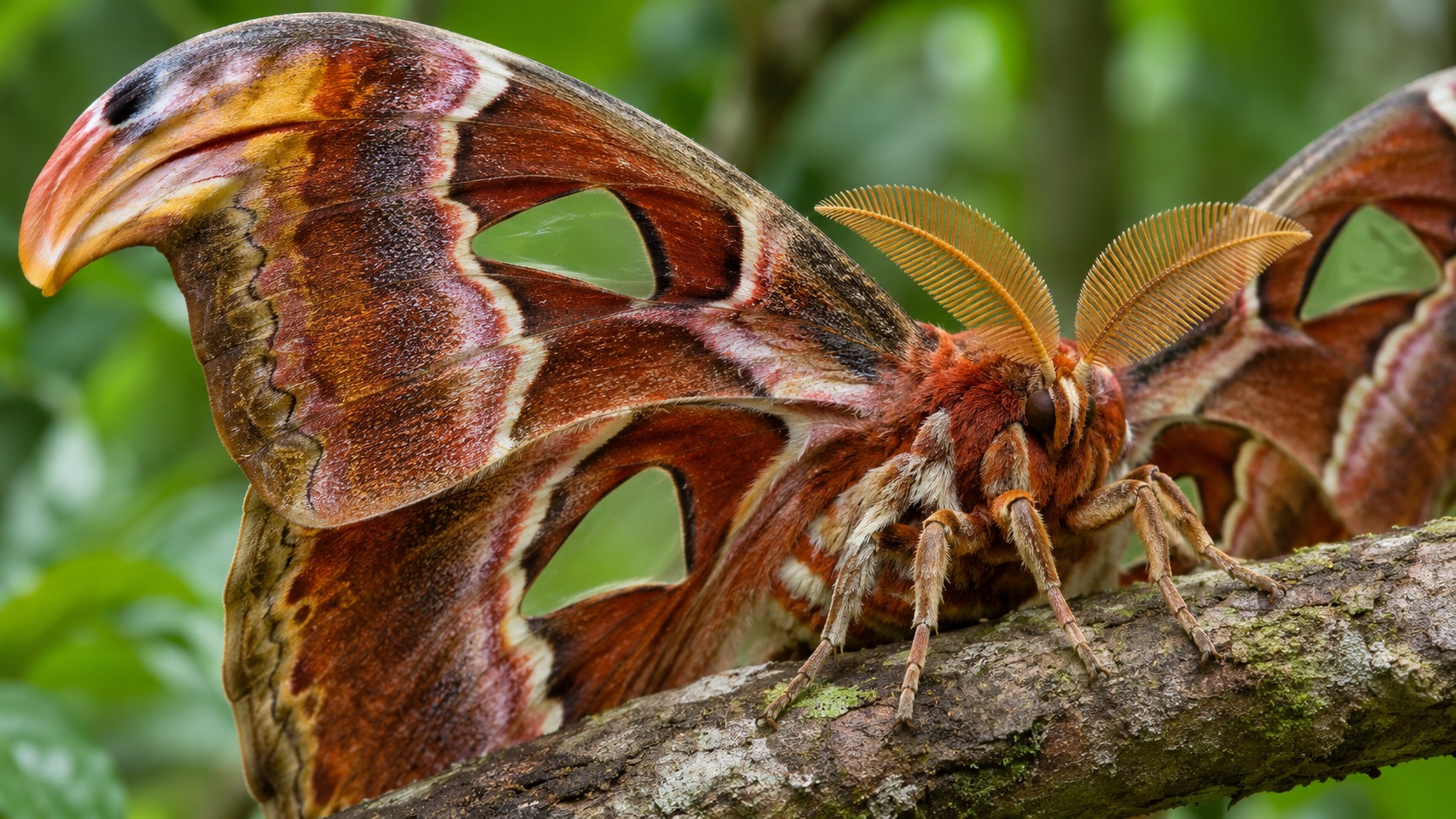
The male’s broad, branched antennae provide a conspicuous contrast with the smaller antennal structures of the female. Their many branches increase the sensory surface used in detecting chemical cues. A female releases sex pheromones, and the male’s sensory equipment helps him locate a potential mate. The structures that look like delicate combs are therefore working parts of a reproductive system rather than ornamental extensions of the head.
Sexual differences extend beyond a single feature. Females are generally larger and heavier, while size and proportions vary among individuals. A photograph of antennae can contribute to identification of sex, but angle, sharpness, and the condition of the specimen affect what can be judged. It is better to combine visible features than to assign a confident label from one blurry outline.
This chemical communication also corrects a misleading idea about the moth’s patterned wings. Their size and visual complexity do not mean that mate finding must depend on one individual seeing another across the forest. Different sensory channels can serve different parts of the life. The antenna close-up and the broad wing portrait reveal complementary functions in the same animal.
A Large Adult Without a Functional Feeding Tube
Atlas Moths do not feed as adults. The proboscis is reduced and nonfunctional, so the animal cannot behave like a nectar-drinking moth simply because a flower is offered. Flight and reproduction depend on reserves accumulated during larval life. Adult life is consequently short, often described on the scale of a week or two, though individual outcomes differ.
The absence of adult feeding is not the absence of feeding from the life cycle. Before pupation, the caterpillar consumes foliage and builds the body and stored resources used later. A resting adult on a branch may therefore owe its condition to a host plant some distance away. The flower-rich setting around an exhibit can be attractive to people while supplying no food that this adult actually uses.
Several Hosts, Not Any Leaf
Atlas caterpillars have documented associations with a range of trees and shrubs. Records include plants such as guava, cinnamon, citrus, and others, while captive rearing accounts describe additional accepted foliage. Wild host records and successful feeding under managed conditions answer related but different questions. Neither establishes that every available leaf is appropriate for every population. Host identification and local context matter, especially when a broad online list combines observations from several countries and rearing practices.
The Feeding Stage Can Be Conspicuous
The caterpillar is large, pale greenish, and equipped with raised projections unlike the adult’s broad patterned wings. Its growth takes place through successive molts before pupation. A photograph of the mature larva can make the developmental investment visible, but a single size or number of days should not be turned into an exact universal timetable. Temperature, food, and population differences influence the course of development.
Feeding can be substantial when many larvae occupy one host. A published Singapore record documented Atlas caterpillars defoliating a sentul tree, a useful reminder that an admired adult still originates in an herbivorous stage. That observation is not a reason to label every Atlas population a crop emergency. It describes a particular plant-insect event, whose significance depends on abundance and setting rather than the emotional response to the adult.
The Cocoon Is an Engineered Biological Shelter
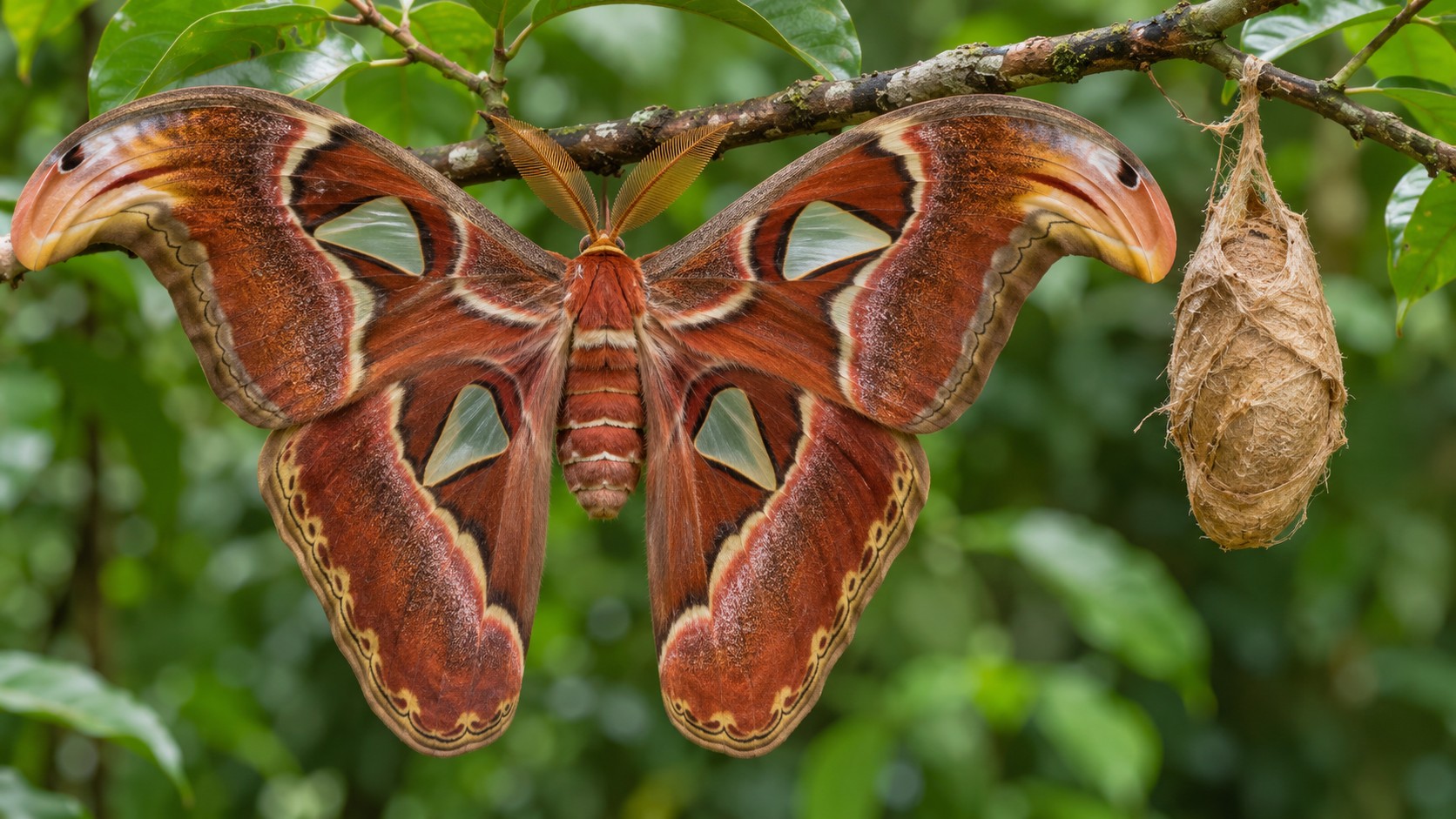
At the end of larval growth, the caterpillar produces silk and constructs a tough brown cocoon. The pupa develops inside that structure. Cocoon and pupa are not interchangeable terms: one is the protective material made by the larva, the other the developmental stage of the insect. Their association is close, but recognizing the difference helps interpret both the material and the living occupant.
The cocoon’s durability has attracted attention beyond entomology. Researchers have examined the organization and physical properties of Atlas silk fibers, treating the structure as a biological material with measurable characteristics. The coarse appearance of the exterior does not mean it is an accidental tangle. It is an organized fiber shelter, produced by an animal using resources gathered during growth.
When the adult emerges, its wings must expand and reach working condition. The broad span visible in a completed portrait was not packed inside the cocoon at that full width. A secure emergence position and time for expansion are important, and a newly emerged individual should not be forced into flight. Transformation includes preparation after the insect leaves the pupal covering, not only the changes that happened out of sight.
Fagara Is Not the Same Silk Story as Mulberry Silkworms
Silk associated with Atlas Moths is known as fagara. It has been used in textiles and crafts, but its history and material properties should not be silently merged with the much larger mulberry-silk industry based on Bombyx mori. Different insects produce different cocoons under different biological and production conditions. The common word silk identifies a connection without making all fibers, harvesting practices, or finished materials equivalent.
A museum textile or cocoon artifact records a human use of the material. It does not automatically establish how a particular wild population is managed or whether a marketed product has a documented origin. These are separate questions from recognizing the insect. A careful explanation can appreciate the material while avoiding unsupported claims about sustainability, commercial scale, or the welfare implications of every product carrying the name.
A Tropical Asian Animal in a Managed Exhibit
The Atlas Moth’s natural distribution lies in Asia, including tropical and subtropical forest regions. A conservatory elsewhere supplies conditions and protection that differ from its original setting, and the animal may arrive through a managed rearing program. Encountering one in such a facility does not demonstrate that it lives wild in the surrounding city. Location should therefore be recorded as an exhibit encounter when that is what occurred, rather than treating the photograph’s coordinates as a natural-range record.
A Measured Giant Rather Than One Fixed Maximum
The Natural History Museum in London describes Atlas Moths reaching a wingspan of approximately 27 centimeters, or 10.6 inches. A smaller individual can still be a perfectly normal Atlas Moth. In a laboratory study from India’s Western Ghats, females measured about 24–25 centimeters across the wings, while males measured about 21–23 centimeters. These observations illustrate both sexual size differences and the danger of treating an upper size record as an average.
The difference between the sexes is especially apparent when span is considered alongside the abdomen and antennae. A female has space for a substantial developing egg complement, while a male has particularly broad sensory branches on the antennae. Neither sex is simply an enlarged copy of the other. Their different proportions relate to reproductive roles as well as the resources accumulated during larval growth.
Small Eggs Begin a Large Investment
Atlas eggs are pale, oval structures only a few millimeters long, with a sticky coating that helps attach them to a surface. They may be laid on host foliage, where the young larvae can begin feeding after emergence. The adult does not guard the developing caterpillars or return with meals. Its reproductive work is concentrated in mating and placing eggs during a short adult interval.
A hatchling is far removed from the enormous moth it can become. Its mouthparts cut plant tissue, its legs keep it on the feeding surface, and its body must grow through repeated molts. Energy gained from the leaves supports both immediate activity and the later transformation. The adult’s limited feeding anatomy makes that earlier accumulation particularly important, because reserves spent in flight cannot be replaced at a flower.
Development Changes With the Population and Conditions
A 2011 study followed Atlas Moths collected from the Western Ghats and reared on a locally used host tree identified as Sapium insigne. The researchers observed two generations and recorded development, reproduction, and differences between the sexes. The results belong to that host and rearing setting, rather than supplying a universal timetable for every tropical population.
Five larval instars are commonly described, but a sixth has been reported in other rearing work. An instar count is therefore more informative when it remains attached to the animals actually studied. Growth can vary without creating a different species. A caterpillar’s last feeding stage, its prepupal transition, and the time spent as a pupa also measure different portions of the cycle.
Late larvae carry conspicuous pale, waxy material and raised projections on a greenish body. The waxy appearance develops during growth, so a young larva need not look like a scaled-down mature one. Size, body structures, and stage together help distinguish an Atlas caterpillar from other large silk moth larvae. Pale surfaces alone are insufficient, particularly where related Attacus species occur.
The Cocoon Has Layers With Different Jobs
Physical examination has shown that an Atlas cocoon contains outer, intermediate, and inner layers. The structure is made from silk arranged around a developing animal, rather than a single sheet of uniform material. Researchers at the University of Nebraska–Lincoln compared the fibers’ structure and tensile properties with those of the domesticated mulberry silkworm. The study treated the layers separately, allowing differences within one cocoon to be measured.
At the fiber level, fibroin supplies the main structural protein, with sericin associated with the fiber surface. Another study examined Atlas silk alongside eri and mulberry silk using microscopy and chemical methods. The comparison found shared features as well as differences among the materials. The familiar word silk describes a biological connection, but it does not make their composition or mechanical behavior identical.
A cocoon’s protection comes from this whole arrangement of fibers around the pupa. The strong case must still permit the emerging adult to leave at the appropriate time. Afterwards, the moth expands wings that were folded within a much smaller enclosure. The protective material and the soft newly emerged adult consequently occupy very different physical states during the same transition.
A Geographic Range Contains Many Local Habitats
Atlas Moths are native to parts of Asia, including China, India, Malaysia, and Indonesia. That broad description includes forests and landscapes with different rainfall patterns and host vegetation. It does not mean every Asian woodland supports the species, or that all populations emerge in the same month. Seasonal conditions affect foliage and development even in places without a northern winter.
The host tree can remain important beyond the feeding stage. A larva uses foliage, the cocoon occupies a protected attachment site, and a female can remain near her emergence place while attracting a male. These stages do not require the same type of movement. An adult male’s search for a mate and a larva’s progress along a branch operate at different scales within the vegetation.
Changes to that vegetation can remove several resources at once. A tree is not just scenery behind a resting adult: it can supply food and physical supports used during development. Conversely, one adult on an ornamental branch does not establish that the tree supported its larvae. Direct records of feeding, cocoon placement, and local reproduction reveal how a particular population uses its surroundings.
Make the Details More Important Than the Superlative
A good Atlas Moth observation can begin with a whole-wing view, then move to the bordered windows, curved tips, antennae, and body proportions. Those details explain why the animal is distinctive without requiring a contest for the largest possible number. They also connect its appearance to deeper questions about communication, development, and defense. Observing a natural resting posture keeps those features in the context of an undisturbed animal.
The result is a story larger than size alone. Host foliage supports an extensive feeding stage; silk surrounds the developing pupa; broad wings unfold into a short reproductive adulthood. The adult’s inability to feed and the cocoon’s strength are different consequences of the same earlier investment. Atlas Moths become more remarkable, rather than less, when the headline gives way to the working details of their lives.