
The Pattern Has More Than One Scale
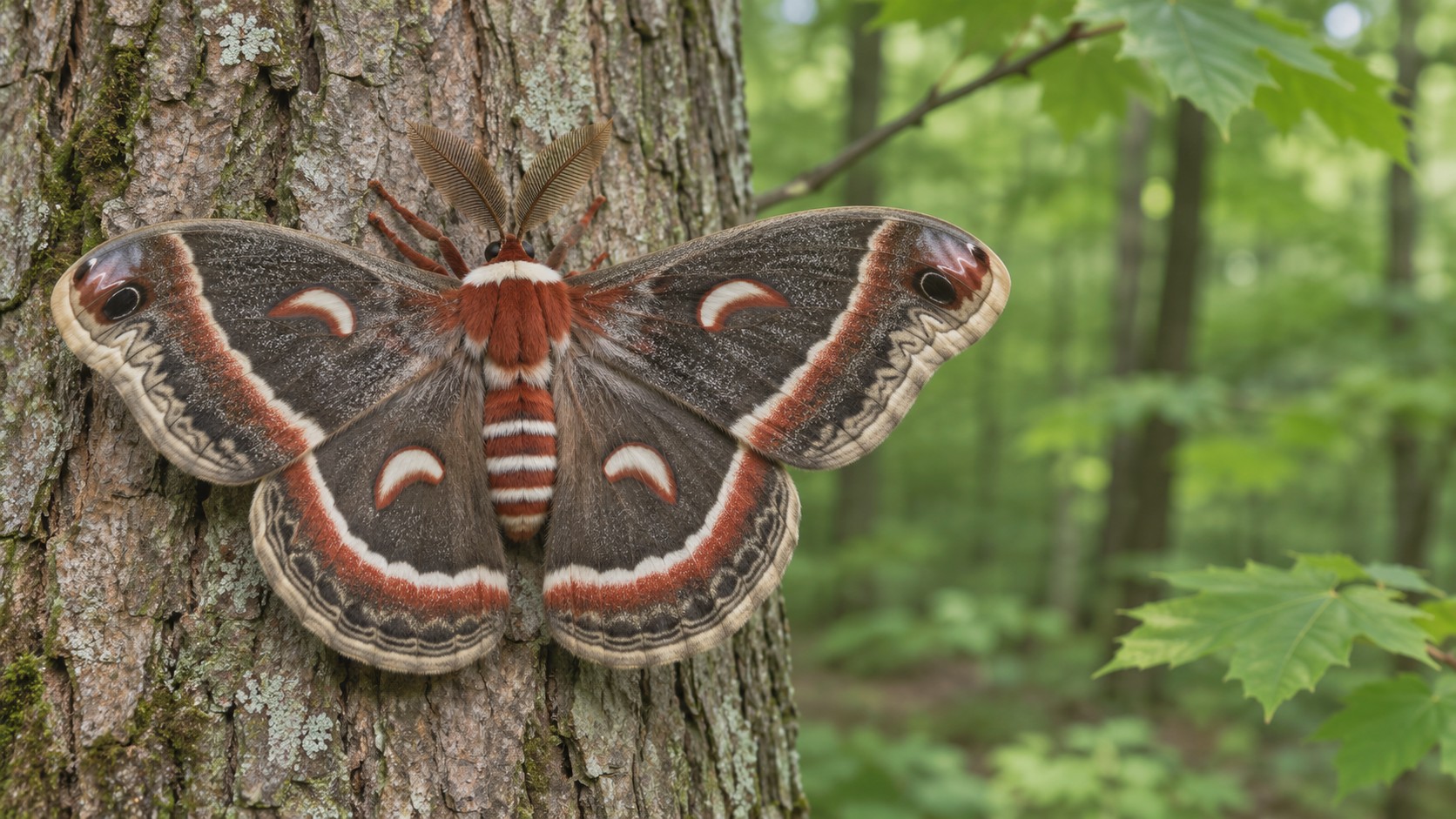
From a distance, the broad wings read as dark surfaces crossed by red and white bands. Closer inspection reveals pale hairlike scales scattered across the brown-gray ground, creating the characteristic frosted effect. Each wing has a pale crescent-shaped mark, while additional dark markings occur near the forewing tips. These features belong together. A red band alone could match several moths, but the complete arrangement, body coloration, and wing outline create a much more distinctive identification.
The central body deserves attention too. A reddish thorax, pale collar, and white abdominal bands continue the contrast carried across the wings. The North Carolina moth atlas distinguishes its crescents from the more elliptical spots of the Polyphemus Moth. This is more useful than treating every large patterned moth as interchangeable. Keep the whole insect visible when comparing photographs, because an isolated wing patch loses the combination of clues that makes this species recognizable.
Plumes That Belong to a Sensing System
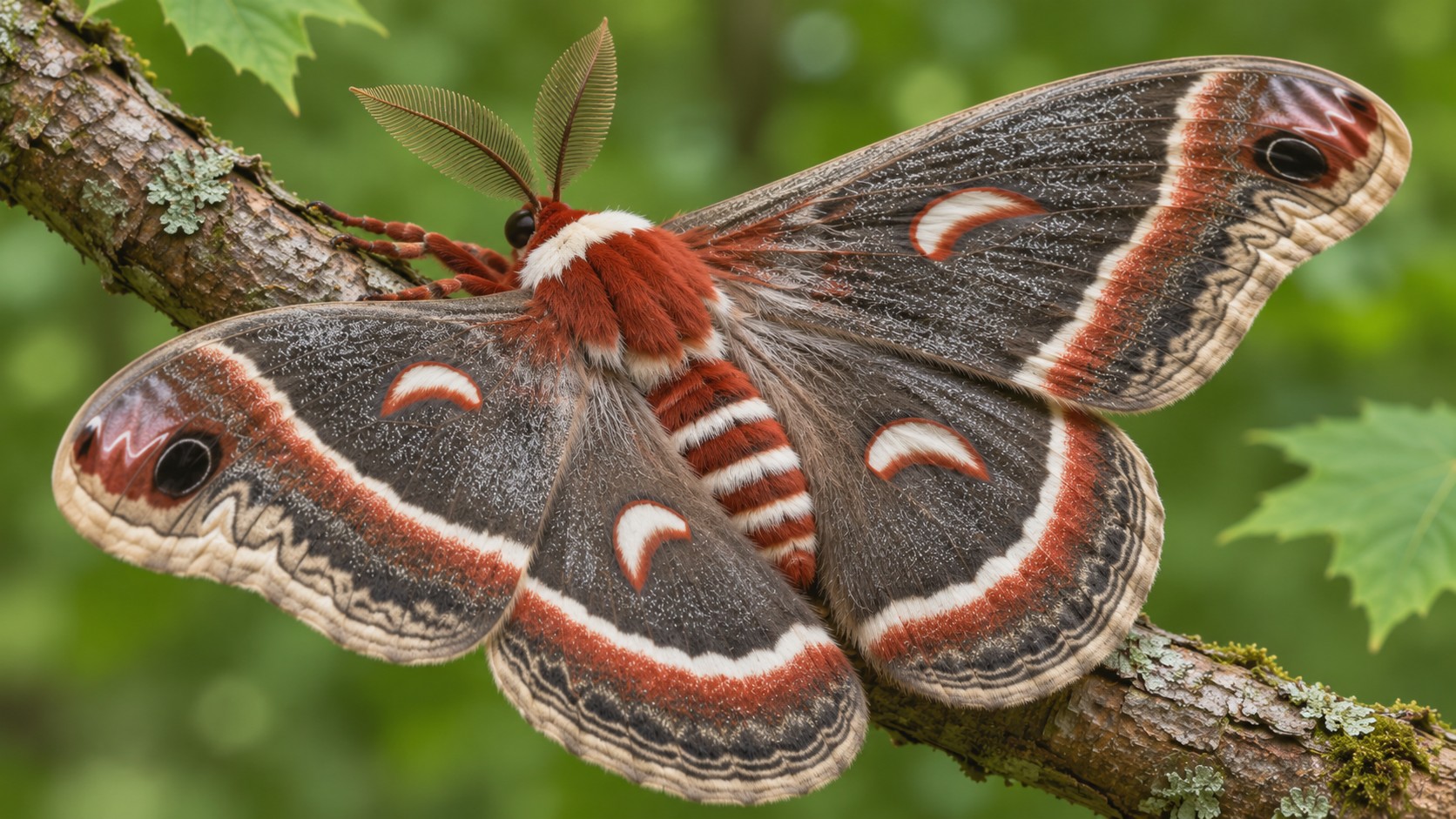
The male’s antennae are broad and plume-like, adding delicate structure above the head. Females also have branched antennae, but the male’s are more conspicuous. Their role includes detecting chemical signals involved in finding mates, so their shape is not merely decorative. A good close photograph preserves both antennae and the head rather than sacrificing them to a tight wing crop. Their fine branches can disappear against textured bark, which makes lighting and the plane of focus important when the aim is to document anatomy rather than just color.
A Caterpillar With Changing Colors and Knobs
The mature larva looks radically different from the moth: a large blue-green or green body carries conspicuous red, yellow, and blue projections. These raised structures are called tubercles. Their arrangement supplies useful detail beyond the general impression of a big green caterpillar. The Illinois wildlife account describes red projections on the thorax and rows of yellow and blue ones elsewhere, providing a more precise picture than a single dominant color.
The youngest caterpillars do not begin as small replicas of that final form. Early stages can be dark, and appearance changes through successive molts as the insect grows. An instar is the interval between molts, not a different species or a separate generation. Eggs are laid on host leaves in small groups, and the developing larvae begin their feeding lives close to that vegetation. A record that includes stage and plant context is easier to interpret than a color comparison alone.
Young larvae may feed together, whereas older ones are often found individually. That shift should not obscure their main task: acquiring the resources that support growth and the eventual adult. A caterpillar can be both an impressive animal and a leaf consumer without becoming a major outbreak pest. Its size explains why an individual may remove noticeable foliage, while its abundance determines whether that feeding becomes a broader problem for a plant or woodland.
Woody Plants Supply the Growth Phase
Cecropia caterpillars use a variety of trees and shrubs rather than depending on one flower or a single named tree. Documented hosts include willows, cherries, apple, dogwoods, and several other woody plants. Different regions emphasize different members of that menu. A plant list should therefore be understood as a collection of feeding records, not an assurance that any leaf offered anywhere will serve equally well. The host plant supports the juvenile stage that does the eating.
The University of Minnesota’s apple diagnosis guide includes Cecropia feeding while describing the resulting defoliation as typically minor. That distinction is valuable: visible feeding does not automatically justify a response intended for a damaging infestation. Identify the caterpillar, observe the extent of damage, and retain the plant’s condition in the picture. A single large larva is not equivalent to a canopy crowded with hundreds of smaller leaf-eaters.
Anchored Lengthwise, Not Hung Like a Pendant
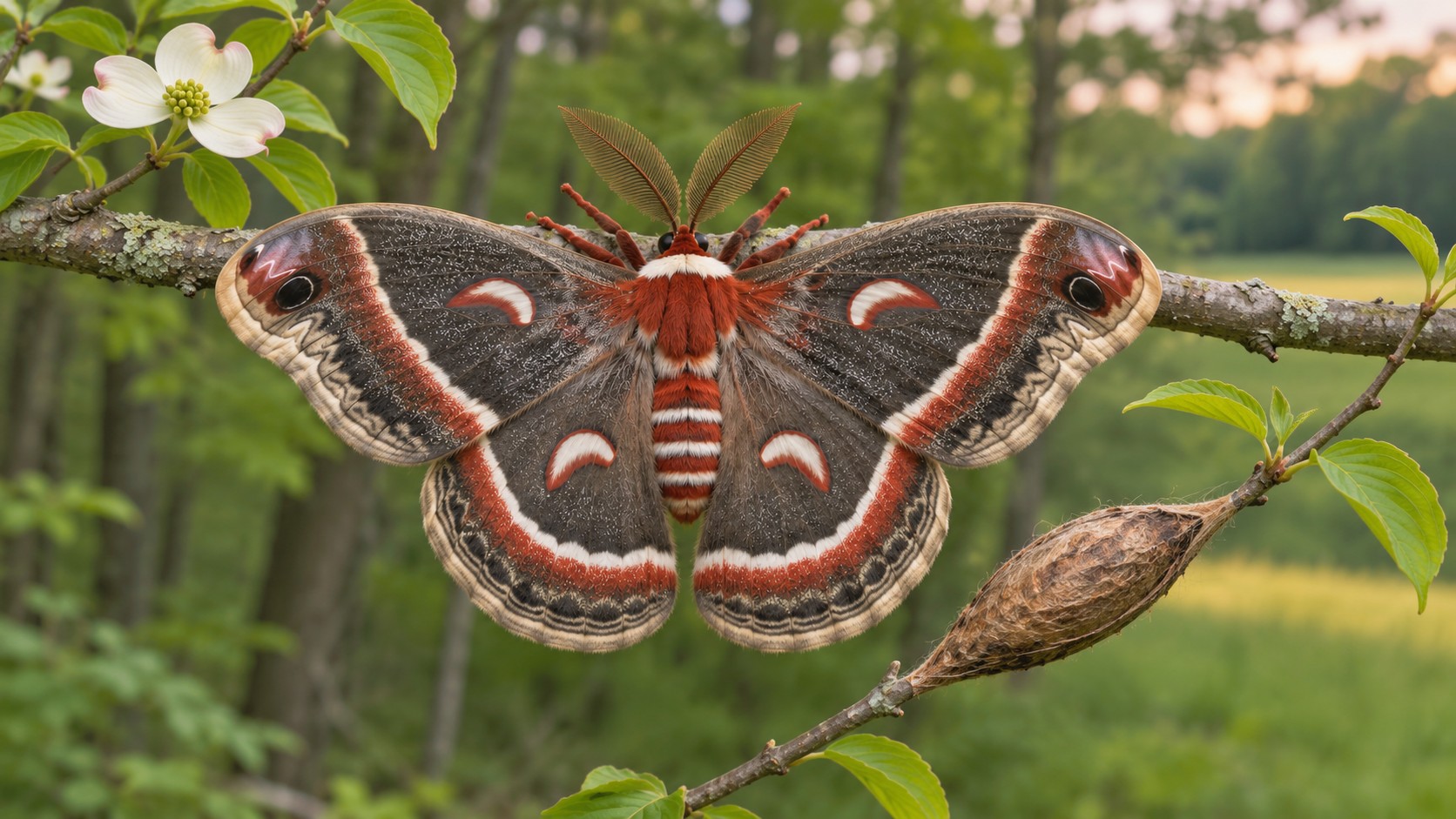
As the caterpillar finishes growing, it seeks a suitable place to spin. The completed cocoon is commonly attached along a twig or branch, with silk securing its length rather than simply suspending it from a narrow stalk. Its placement in protected vegetation makes the attachment part of the structure’s function. The twig is not an accidental prop added after construction. A photograph that includes both the enclosure and its supports can therefore explain more than a detached cocoon presented against an empty background.
Inside the Brown Exterior
A Cecropia cocoon is not a uniform lump of silk. Research describes an outer envelope, an intermediate region containing silk, and an inner envelope surrounding the pupa. These components create an arrangement of surfaces and spaces rather than one solid wall. The developing insect is the pupa; the layered material around it is the cocoon. Keeping those objects conceptually separate makes it easier to understand what researchers measure when they examine the shelter.
The 2017 study of Cecropia cocoon forms examined architecture and physical behavior, including differences in the outer envelope. An intact exterior does not reveal every internal feature, which is why the researchers used methods beyond an ordinary field photograph. For a naturalist, that is an argument for leaving a living cocoon closed, not a reason to cut one open to confirm a diagram. Scientific descriptions can supply the internal view without destroying an observed shelter.
Layering also changes the questions worth asking. Total size, the amount of silk, the distance between envelopes, and the way fibers are arranged are different properties. A larger outline does not necessarily mean a proportionally larger animal inside it. Nor can the strength or thermal behavior of a whole enclosure be read from one loose strand. The cocoon is interesting as an assembled structure whose properties depend on how its material has been placed.
Baggy and Compact Are Two Real Forms
Cecropia caterpillars can make a loose-looking, relatively large baggy cocoon or a smaller, more tightly configured compact one. Both are normal forms of the species, not automatically evidence of damage or incorrect construction. The prominent difference is in the outer architecture; the inner enclosure is much more similar between forms. It is therefore misleading to equate a baggier exterior with a much bigger pupa or a careless caterpillar that failed to finish its work.
Studies found no statistically significant difference in whole-cocoon silk weight between the compared groups, despite their different exterior dimensions. That result highlights allocation and arrangement rather than simply more material versus less. Researchers have proposed that variation may help cope with environmental uncertainty, but a proposed adaptive explanation should remain distinct from a direct measurement. A viewer can confidently recognize two forms without claiming that the exterior alone proves the exact weather conditions a particular caterpillar anticipated.
Spinning Is a Sequence of Behaviors
A silk enclosure takes shape through repeated movements and attachments, not through the sudden appearance of a ready-made bag. Researchers studying Cecropia construction describe distinct movement patterns as the larva lays down material. The sequence produces a scaffold and then more developed envelopes. It is a useful example of animal construction because the insect’s repeated actions create a shelter far more elaborate than a casual glance at the finished brown object suggests.
A 2020 experimental study re-examined how silk use and timing regulate construction. Its conclusions concern controlled observations and manipulations, not a claim that a caterpillar counts silk in human-style units or carries a conscious architectural plan. Everyday words such as measuring and building can communicate the behavior, provided they do not replace the biological mechanism with an imagined miniature engineer.
For an observer outside the laboratory, the meaningful details are simpler. Note where silk is being attached, whether the enclosure is still open, and how the supports relate to its final outline. Do not interrupt construction to improve visibility. A sequence of photographs from the same unobtrusive position can document change without turning the process into a forced demonstration. The finished cocoon preserves the result of that activity, while direct observation adds information about how it was achieved.
Winter Belongs to the Pupa
The species normally overwinters as a pupa within its cocoon, with one generation produced annually. The visible enclosure may remain apparently unchanged while seasonal conditions shift around it. That stillness is not proof of death, and an exterior photograph cannot reliably predict the day of emergence. A cocoon left on its original support retains its natural exposure and attachment context. Moving it into a heated room changes those conditions, so an indoor emergence date should not be treated as a straightforward record of the wild seasonal schedule.
Large Wings Must Be Prepared for Flight
After emergence, the new adult needs space and time for its wings to expand and become ready for use. At first, they do not resemble the full broad surfaces seen in a mature resting portrait. This temporary appearance should not immediately be labeled permanent damage. The branch, hanging position, and clearance around the insect are biologically relevant, not clutter to remove from a picture. A quiet observation can preserve them without testing the moth’s ability to fly.
The adult does not feed, relying instead on resources accumulated by its caterpillar. A nearby flower therefore supplies setting rather than evidence of a nectar meal. Its brief adult period is devoted to reproduction, linking the completed cocoon stage to eggs on host foliage. This creates a sharp contrast between the feeding, growing larva and the large but short-lived winged animal. The largest-looking stage is not the one doing the most eating.
Size Is Only One Part of Recognizing Cecropia
A Cecropia Moth can be remarkably broad, but individuals differ in size. Missouri’s state field guide gives a wingspan of 3.75–6 inches, approximately 9.5–15 centimeters. The spread-wing measurement is different from body length or the length of one forewing. A large individual can occupy much more space than its central body initially suggests.
The white crescents help distinguish Cecropia from other large silk moths. A Polyphemus Moth has conspicuous rounded eyespots and a different overall pattern; a Luna Moth has green wings and long hindwing tails. Cecropia combines its crescents with red and white bands and a red, white-banded body. Its outline remains useful even when wear has reduced the frosted appearance of the wing scales.
Five Feeding Instars Produce the Adult’s Reserves
Cecropia larvae usually pass through five instars. University of Florida descriptions give approximately a week for each under the conditions summarized, with first-stage larvae black and second-stage ones becoming yellowish. The later stages develop the familiar colorful tubercles on a green or blue-green body.
These intervals describe active growth rather than a fixed schedule imposed on every climate. Each molt marks the end of one larval instar, while the final larval molt leads into the pupal stage. The animal can spend weeks consuming foliage before the much shorter adult phase begins. Its eventual wing size and reproductive resources depend on that earlier feeding history.
The red, yellow, and blue tubercles also have locations, not merely colors. Large reddish projections occur on the thorax, yellow ones along the upper abdomen, and blue ones in lateral rows. Their arrangement contributes more to identification than the vague description of a caterpillar covered in bright knobs.
Mate Finding Follows an Airborne Chemical Signal
Female Cecropia Moths release a sex pheromone, commonly during the hours before dawn. Males detect it with their branched antennae and move toward its source. The movement can involve upwind progress and changes in direction as the male encounters the odor-bearing air. The female need not advertise through a visible wing display across an open landscape.
Wind makes the signal different from a stationary trail painted onto a branch. Concentrations change as air moves among vegetation, and a searching male may lose and regain contact with the plume. The antennae supply chemical information while flight brings the insect into another part of that moving signal. These processes connect an apparently quiet female on a perch with a male’s much more conspicuous activity.
Eggs are then distributed in small groups on host foliage. The female does not remain to guard the hatchlings or bring them food. Reproductive investment includes the material already present in the eggs and the places chosen for them, while the caterpillars obtain their own meals after emergence.
This Moth Helped Reveal How Metamorphosis Is Regulated
Cecropia became an important research animal in twentieth-century studies of insect development. Carroll Williams and other researchers used silk moths to investigate juvenile hormone and the endocrine organs producing it. The work helped explain how an animal can undergo several growth molts before making a fundamentally different transition.
Juvenile hormone contributes to maintaining immature developmental characteristics, while molting and metamorphosis involve additional hormonal signals. A molt is therefore more than the mechanical escape from an outer covering that became too small. Internal regulation helps determine the kind of body produced at the next stage.
That distinction connects the familiar sequence of green caterpillar, brown pupa, and patterned moth with events that cannot be seen from outside. The same living individual retains continuity through substantial changes in form. The cocoon protects part of that process, but the silk itself does not direct which developmental stage comes next.
Parasitoid Effects Can Change Between Studies
The introduced tachinid fly Compsilura concinnata has been associated with mortality in native giant silk moths, including Cecropia. A study published in 2019 compared more recent New England field results with earlier work. It found much lower parasitism in the recovered Cecropia larvae during 2017 and 2018 than in the older comparison study.
The later work also recorded substantial mortality associated with pathogens. Lower incidence of one parasitoid did not therefore translate into high survival through every other hazard. The researchers followed larvae exposed in particular places and periods; their percentages are not a census of all Cecropia across North America.
The comparison shows why a single cause cannot explain every local change in abundance. Predators, parasitoids, disease, host resources, and conditions during development can affect different portions of the cycle. Following several possible causes preserves the ecological value of the evidence, rather than treating a quiet year or one successful cocoon as proof that all pressures have disappeared.
A Native Giant Needs More Than a Good Portrait
Cecropia Moths occur across a broad part of eastern North America and into areas near the Rocky Mountains. Wooded edges, shrubs, and human-shaped landscapes with suitable woody plants can all be relevant. A species can be geographically widespread without being equally frequent at every site. Regional accounts differ in how commonly the moth is encountered, and a range map should not be interpreted as a promise that every suitable backyard holds one.
Reports of local declines have prompted attention to several possible pressures, including introduced parasitoids and adult encounters with artificial lights. The University of Florida species account discusses nontarget effects of introduced biological control agents. These concerns should not be reduced to a single cause for every population. A dated local observation contributes a record, whereas demonstrating a trend requires comparable observations over time and a clear account of how the animals were detected.
The practical value of this moth’s life history is that it broadens what counts as habitat. Host foliage feeds the caterpillar, living twigs support construction, a cocoon shelters winter development, and quiet space permits emergence and adult activity. Appreciating the patterned wings is a good beginning, but noticing those less conspicuous connections makes the encounter more complete. The Cecropia’s silk shelter is not packaging to discard from the story; it is one of the most revealing things the animal makes.