
Reading the Four Eyespots
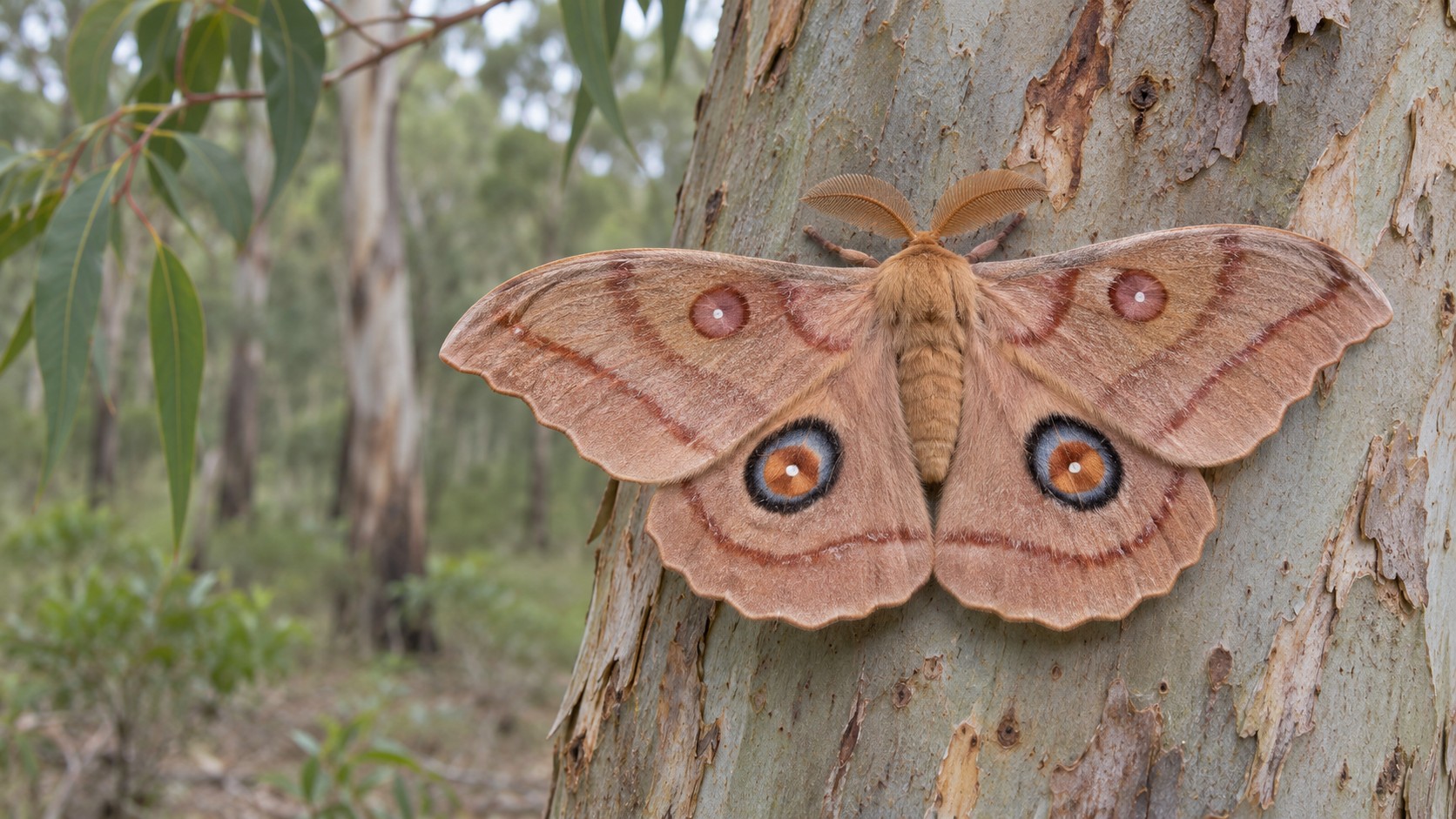
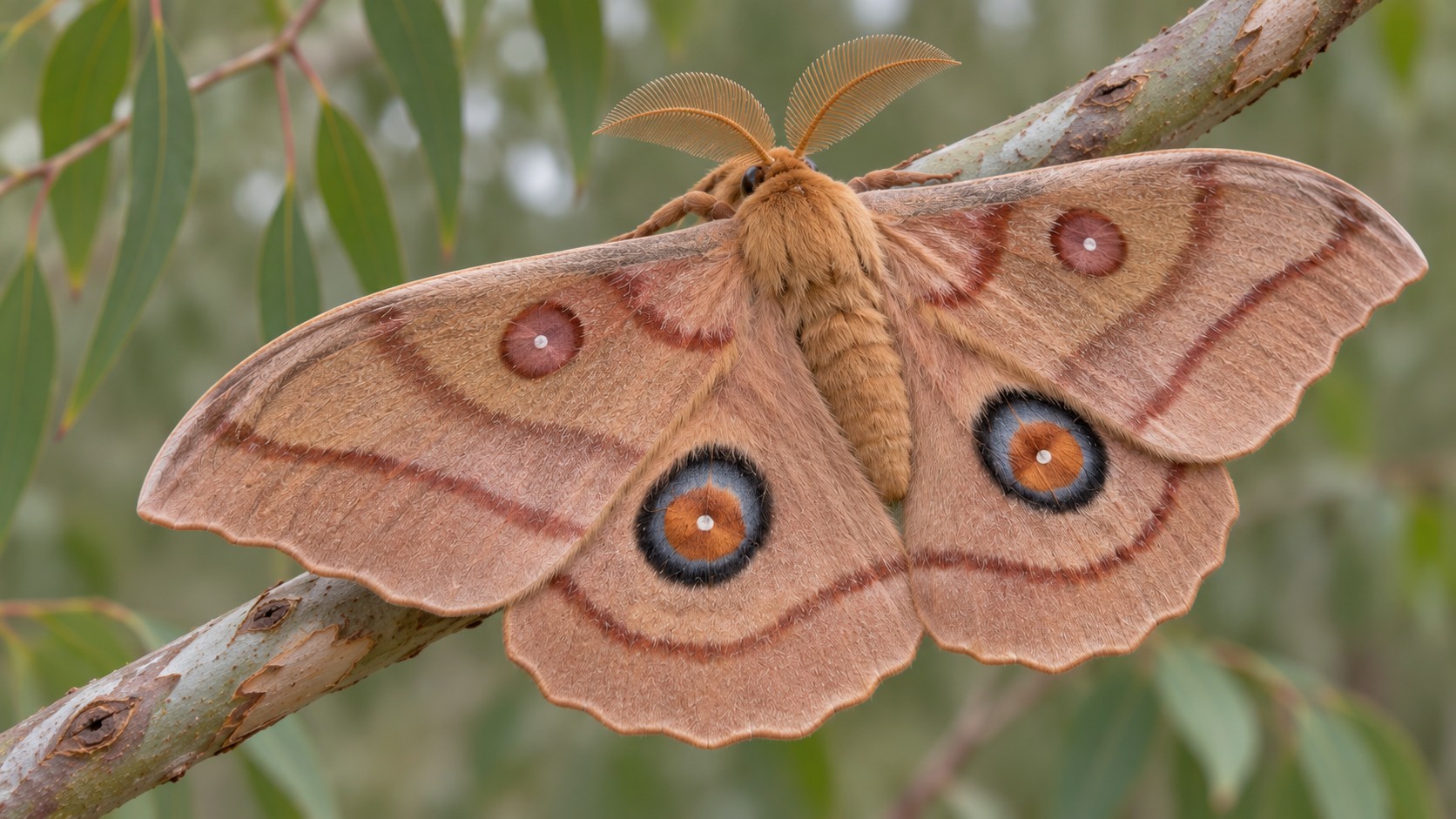
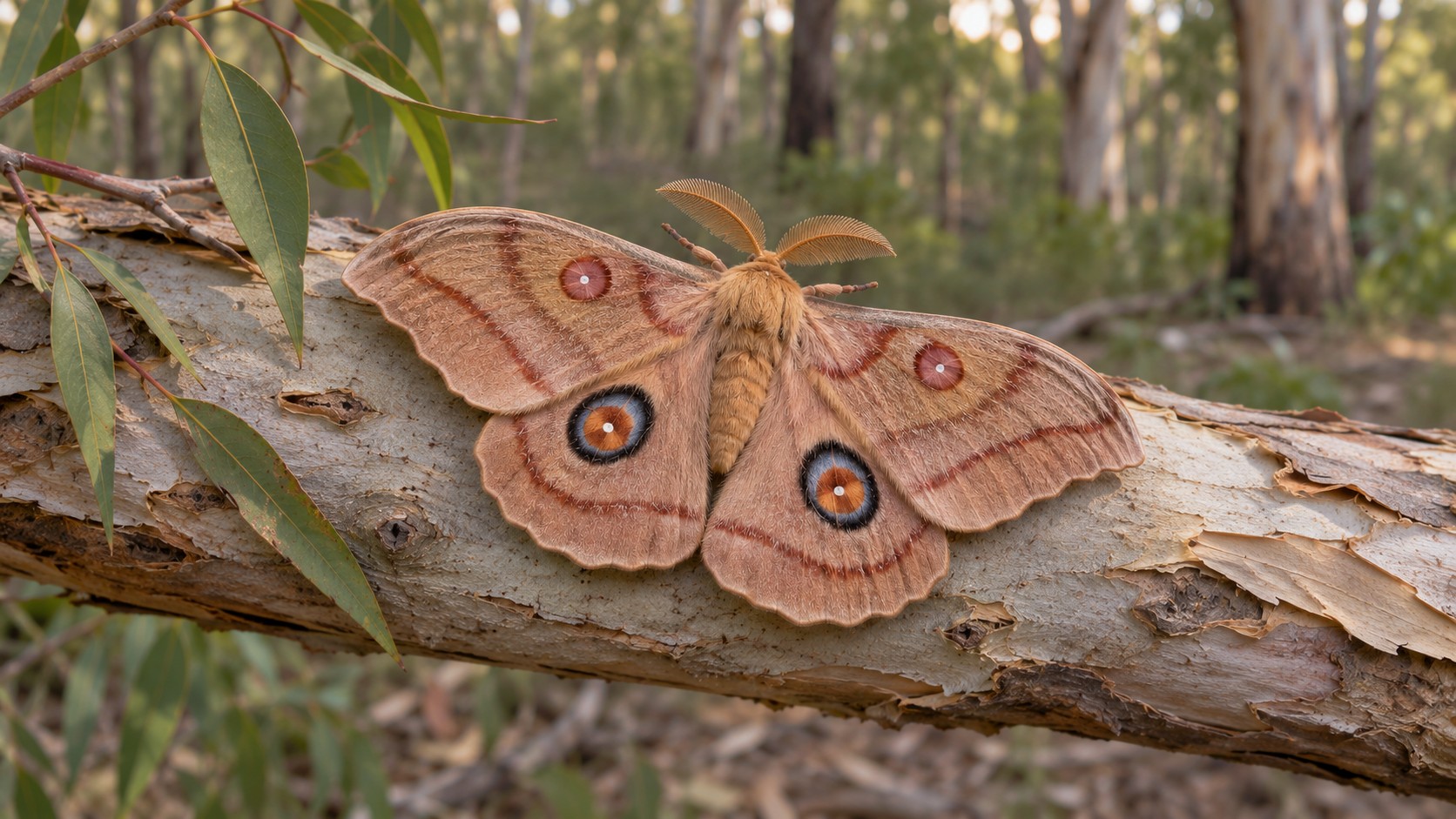
Begin with the whole wing pattern rather than a single dramatic spot. An Emperor Gum Moth has a warm brown ground color that may look pinkish or fawn, darker curved bands, and one eyespot on each wing. The forewing spots are relatively small and reddish; the hindwing spots are larger and more strongly outlined. Pale central points add another layer of contrast. Lighting changes the apparent richness of these colors, so a softly lit photograph is often more useful than a heavily saturated close-up.
The spots are wing markings, not additional eyes or transparent holes. Their resemblance to eyes has prompted a defensive interpretation, but resemblance alone does not explain every encounter with a predator. An observer can describe the pattern confidently without claiming that every bird is frightened away. A useful identification photograph includes the outer wing shape, the relationship between the two pairs of spots, and the central body rather than cropping the animal into four disconnected circles.
A Name That Connects Different Stages
The scientific name links photographs that otherwise look surprisingly unrelated. Opodiphthera eucalypti belongs to Saturniidae, the family that includes many large silk moths. Older references may place it under Antheraea eucalypti, so a search using only the current combination can miss useful historical accounts. Museums Victoria records the species in its collections under the modern name. Checking the complete name, rather than assuming that every animal called an emperor moth is identical, keeps Australian observations separate from similarly named moths elsewhere.
Australia and New Zealand Tell Different Stories
This is an Australian moth, with a native distribution associated especially with the country’s eastern regions. Woodland is an important setting, but the presence of suitable plants can also bring the species into human-shaped landscapes. A moth found near a house is not automatically a garden specialist. It may have developed on a nearby tree and moved only a short distance before the encounter that brought it to someone’s attention.
In New Zealand, the same species has a different biogeographic status: it is introduced, not native. The Moths and Butterflies of New Zealand Trust gives Whanganui in 1915 as its first appearance there. That historical record is not the date the species first evolved, and it should not be used to imply that the moth naturally crossed every part of its present range. Establishment in a new country and occurrence within its original range are different histories.
Location therefore belongs beside the photograph, not in an optional afterthought. A regional record can help interpret likely season, host vegetation, and whether an encounter involves a native or introduced population. It cannot, by itself, establish abundance. Finding one large moth on a fence tells us that an individual was there, while learning whether the population is increasing requires repeated, comparable observations.
The Caterpillar Does Not Keep One Costume
A green caterpillar covered with colorful raised knobs looks nothing like the rosy adult, and even its own appearance changes during development. James Cook University’s account describes early larvae as dark before later stages become greener and acquire conspicuous colored tubercles. Those projections and their hair tufts are features to document rather than reasons to touch the animal. A close photograph can show their arrangement without disturbing a feeding caterpillar.
Developmental stage helps explain why two genuine photographs may seem inconsistent. Compare body color, side stripes, the placement of projections, and the plant on which feeding was actually observed. A small dark larva should not be rejected simply because a field guide’s main picture shows a large green one. Conversely, a green caterpillar on a gum tree is not identified by color and location alone; several insects can share that combination.
Why the Tree Identification Matters
Eucalypts are central to this moth’s life, but a host relationship deserves more precision than the statement that it eats trees. The caterpillar consumes foliage; the adult does not visit those leaves for meals. Records from James Cook University include eucalypts and additional northern Australian hosts. Different regions and developmental stages can produce different feeding records, so a plant list should be read as evidence of documented use rather than a promise that every larva accepts every listed plant.
The distinction becomes especially clear in New Zealand forestry research. The Scion account reproduced by the New Zealand Farm Forestry Association reports feeding on a selection of examined eucalypt species, not indiscriminate use of all of them. It also distinguishes complete development on pepper tree from records on some other plants where older caterpillars may have been involved. A larva resting on a leaf, taking a few bites, and completing its whole development on that plant are three different observations.
For a naturalist, the best record begins with restraint. Photograph the leaf shape and arrangement as well as the animal, and record feeding only when chewing is actually visible. If the tree cannot be identified, leave that uncertainty in the record. An honest unidentified host is more useful than a confident but incorrect eucalyptus name that later gets repeated as a new biological fact.
A Cocoon Is Shelter, Not the Insect Itself
After feeding and growth, the caterpillar makes a tough silk enclosure and pupates inside it. The Australian Museum describes cocoons that may be reinforced with bark, with the protected stage sometimes lasting a year or more according to conditions. The cocoon and the pupa are not interchangeable objects: one is the surrounding construction, while the other is the developing insect. A brown enclosure attached to a branch may therefore hide a living animal even when nothing visible has changed for a long time.
The Wait Has No Universal Countdown
A long pupal interval is easy to misread as failure. In this species, however, the Australian Museum explicitly describes a potentially extended stay inside the cocoon. That does not mean every individual waits several years, nor does it provide a reliable emergence date for a cocoon found in a particular garden. Temperature, locality, and the insect’s developmental state are missing from a photograph of its exterior.
The practical response is to avoid testing the contents by cutting, squeezing, or repeatedly moving the enclosure. Its attachment and surroundings are part of the record. A series of photographs taken without interference can document an eventual opening or other change while leaving the insect undisturbed. Where a branch can safely remain in place, watching it is more informative than turning the cocoon into a household experiment with an assumed deadline.
Emergence Is More Than Getting Through a Wall
Leaving the cocoon is only part of becoming a flying moth. The newly emerged adult must expand its wings before they become ready for normal use. Space around the emergence site consequently matters: a moth should not have to unfold broad wings against a container wall or a person’s fingers. A crumpled appearance immediately after emergence is not equivalent to the permanent wear seen on an older adult.
Timing also changes how an observation should be described. A resting moth beside a cocoon is not proof that it emerged there unless the sequence was witnessed. The animal may have landed nearby, or the enclosure may already have been empty. Recording what was actually seen prevents an attractive image from becoming a more specific life-history claim than the evidence supports.
For photography, allow the animal to set the pace. There is no need to move it into a display pose or prompt a test flight. A wider frame can preserve the branch, attachment point, and hanging space that explain the scene. Those contextual details often contribute more to understanding than an extremely close portrait that removes every clue about what the moth is doing.
The Adult Runs on Earlier Meals
An adult Emperor Gum Moth cannot replenish its energy by drinking nectar. Its reserves come from the feeding accomplished during the caterpillar stage, which makes the two phases functionally different rather than merely different-looking. James Cook University’s description of the larva and the Australian Museum’s account of the nonfeeding adult together explain why a flower garden is not the whole habitat story. Leaves support the preparation for adulthood; the winged animal then spends the resources already accumulated.
That life history also changes how to interpret a moth that remains still during the day. Stillness alone is not an invitation to offer sugar water or force movement. Adults have a limited reproductive period, and unnecessary disturbance adds activity without adding nutrition. The most useful encounter may be a brief, undisturbed look at the antennae, wing pattern, and resting position before leaving the animal where it was found.
Size and Sex Add Detail to the Wing Pattern
The Emperor Gum Moth is substantial even among familiar woodland insects. James Cook University describes a wingspan of 120–150 millimeters, or about 4.7–5.9 inches. A New Zealand forestry account reports a smaller measured range, separating males at 85–110 millimeters from females at 95–130 millimeters. These regional descriptions give useful scale without making one upper measurement a requirement for identifying every individual.
Females generally have broader forewings, while males have a narrower outline with more hooked tips. Male antennae also carry longer branches. These features can be considered together: body proportions, wing shape, and antennal branching add information beyond a judgment based only on brown coloration or apparent size.
Eggs Attach the Next Generation to Its Food
The eggs are flattened ovals approximately two millimeters across. They are pale when laid and darken as development proceeds. A female can arrange them in short rows or small groups on host foliage, fixing them to the surface rather than leaving them loose. Their attachment places the young caterpillars near leaves they can begin consuming after hatching.
The choice of surface has consequences at a scale much smaller than the adult’s wings. A newly hatched larva has no flight stage with which to search for another tree. It must reach usable tissue by crawling. Egg placement therefore connects the female’s movement through the vegetation with the first meals of offspring she will not remain to feed or guard.
Growth Produces a Changing Arrangement of Colors
Young Emperor Gum caterpillars begin dark, then acquire yellow and white markings before developing their more familiar blue-green or green appearance. In the fifth-stage larvae described by James Cook University, a pale cream stripe runs along each side and the gripping feet are black. The colored tubercles carry tufts of hairs rather than being patches painted directly onto a smooth body.
The New Zealand butterfly trust describes mature larvae reaching about 12 centimeters long, with colored projections arranged in rows of six per segment. This is a larval length, not an adult wingspan. The two measurements refer to differently organized bodies that occupy different parts of the life cycle.
A molt replaces the outer covering, including the head capsule, as the animal grows. The interval immediately around that change can include a pause in feeding. Repeated molts produce the large, conspicuous leaf consumer; a dark hatchling and a green late-stage caterpillar are connected by those intervening developmental steps.
A Tough Cocoon Must Also Permit an Exit
The finished silk enclosure protects the pupa, but an adult must eventually get through it. Accounts of Emperor Gum emergence describe the moth releasing fluid that softens the silk, then using sharp structures at the bases of the forewings to open an exit. Chemical softening and mechanical action work together on a case tough enough to persist on a branch.
These structures are near the wing bases, rather than the distant eyespots. Their job during emergence differs from the job of the broad wing surfaces during flight. Once outside, the moth still needs room to expand its wings. The sequence joins a protected transformation inside the enclosure with preparation in the surrounding air.
The abandoned case can remain after the adult has gone. Its presence documents construction, while an exit opening records a later event. A weathered cocoon consequently represents a durable trace of the moth’s life, even when no living insect occupies it.
The Southern Hemisphere Calendar Is Regional
The Australian Museum records the species in the Northern Territory, Queensland, New South Wales, and Victoria. New Zealand records include the North Island and the northern South Island. Those localities span different climates and plant communities, giving a more useful geographic context than treating every gum-tree planting as an equivalent habitat.
New Zealand records commonly place adults between October and March, spanning spring, summer, and early autumn there. This timing differs from the northern spring and summer associated with many North American silk moths. Month names alone conceal that seasonal difference; latitude and hemisphere determine which part of the year they describe.
Detailed work in New Zealand’s Manawatū region recorded caterpillars from about mid-December and a broad pupation period later in summer and autumn. Some adults emerged soon enough to produce another larval generation, while many pupae overwintered. The observations describe that regional cycle rather than requiring every Australian or New Zealand population to follow the same schedule.
Leaf Feeding and Natural Enemies Shape Local Numbers
Several large caterpillars can remove conspicuous amounts of foliage. In New Zealand forestry observations, repeated defoliation affected tree growth and crown shape, with consequences depending on the tree and severity of feeding. This is the ecological and economic importance of the larval stage, quite separate from the nonfeeding adult resting nearby.
The same forestry account records viral disease, fungal infection, and magpies opening cocoons to eat the contents. A hard enclosure therefore reduces some hazards without making the occupant invulnerable. Population change reflects interactions among food, development, disease, and predators; the successful emergence of one moth represents an individual that completed that sequence.
Watching Without Turning a Sighting Into a Census
A clear observation needs only a few carefully chosen details: date, locality, life stage, resting or feeding position, and photographs that retain enough surroundings to be interpreted. A moth beside an outdoor light and a caterpillar chewing a tree leaf answer different questions. Keeping those records distinct makes it possible to compare like with like later, instead of combining every encounter into a vague claim that the species is everywhere.
Collections supply another kind of evidence. A Museums Victoria male specimen from Moe, collected in November 1929, anchors one individual to a place and date long before today’s photographs. Such a record is valuable history, not a measure of current population health. Together, careful modern observations and documented older specimens build a more reliable picture than size superlatives or a collection of unlabeled close-ups.
The Emperor Gum Moth rewards that patient approach. Its adult appearance can be appreciated in seconds, but its life connects changing caterpillars, particular food plants, concealed pupae, and a short winged phase. Leave the cocoon intact, keep the tree in the story, and let uncertainty remain where the evidence ends. The result is a richer encounter with a real woodland insect rather than just another impressive pair of wings.
Even a familiar gum tree can become worth revisiting when these different stages are considered together. Look from a respectful distance, preserve the original position of any enclosure, and compare photographs across dates rather than repeatedly handling the animal. A sighting can remain valuable without a confirmed sex, an exact age, or a predicted emergence day. Good observation does not require filling every blank. It requires retaining enough detail that another person can understand both the discovery and its limits.