
One Animal, an Updated Common Name
The Entomological Society of America adopted Spongy Moth in 2022, replacing a former common name that used a derogatory term for Romani people. The scientific name Lymantria dispar continues to identify the same species, so older forestry publications and current pest information can be connected without inventing a new animal. Recognizing both names helps readers locate historical records while using current terminology. The change is also biologically useful: it directs attention to the distinctive egg covering rather than an unrelated cultural label.
The Pale Female and the Brown Male
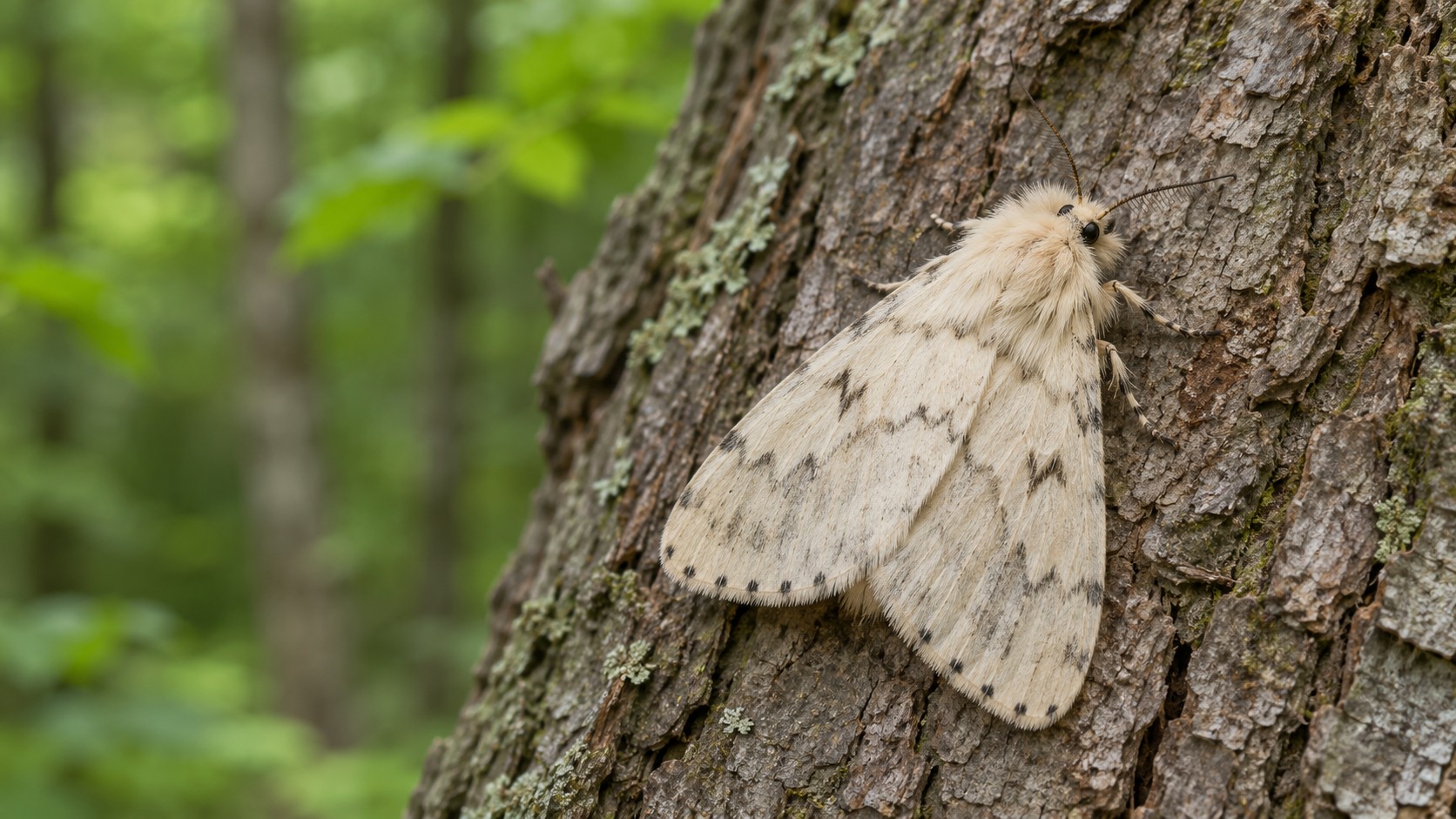
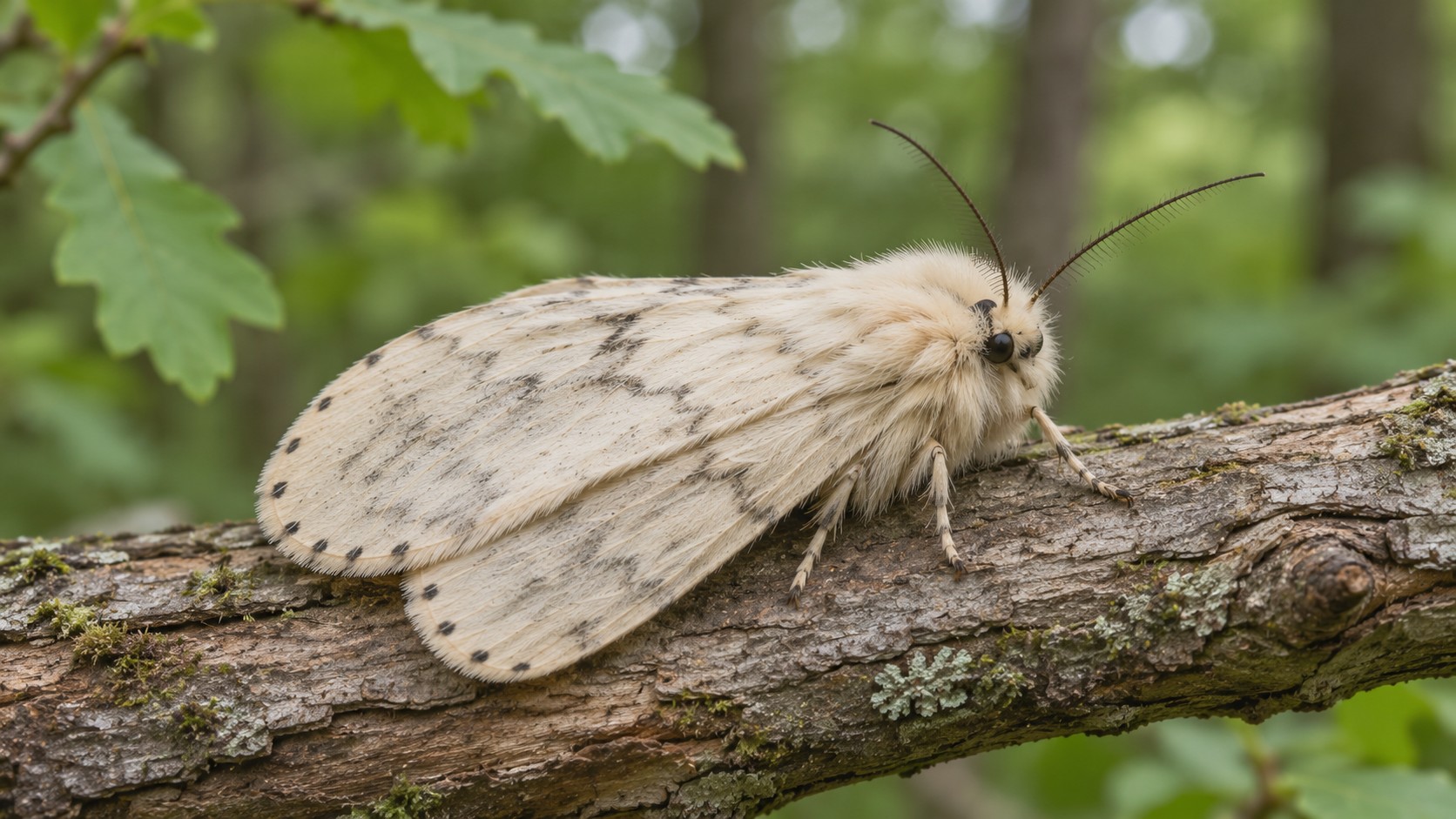
Adult males and females look noticeably different. Males are smaller and brown, with darker wing markings and strongly feathered antennae. Females are larger, creamy white to pale, with dark jagged markings and much finer antennae. These are sex differences within the species, not a brown juvenile turning white with age. Their shared identity becomes clearer when the complete life cycle is considered rather than treating every adult color as a separate species.
Flight needs an equally careful description. Females of Lymantria dispar dispar, the European subspecies established in North America, have wings but do not fly. Males fly in search of mates. That statement should not be expanded into a claim about every female Lymantria dispar worldwide: females in other subspecies can fly. The USDA’s flighted spongy moth complex information explains why that distinction matters to detection and prevention programs.
A photograph alone generally cannot settle the subspecies question. Several life stages look very similar, and specialist testing may be needed in an interception. Pale wing color and dark markings occur in females from more than one subspecies. The moth’s antennae, wing markings, body proportions, and posture remain useful visible details, but an attractive portrait is not a substitute for the location and history needed to interpret a suspected introduction.
A Winter Package Attached to Almost Anything
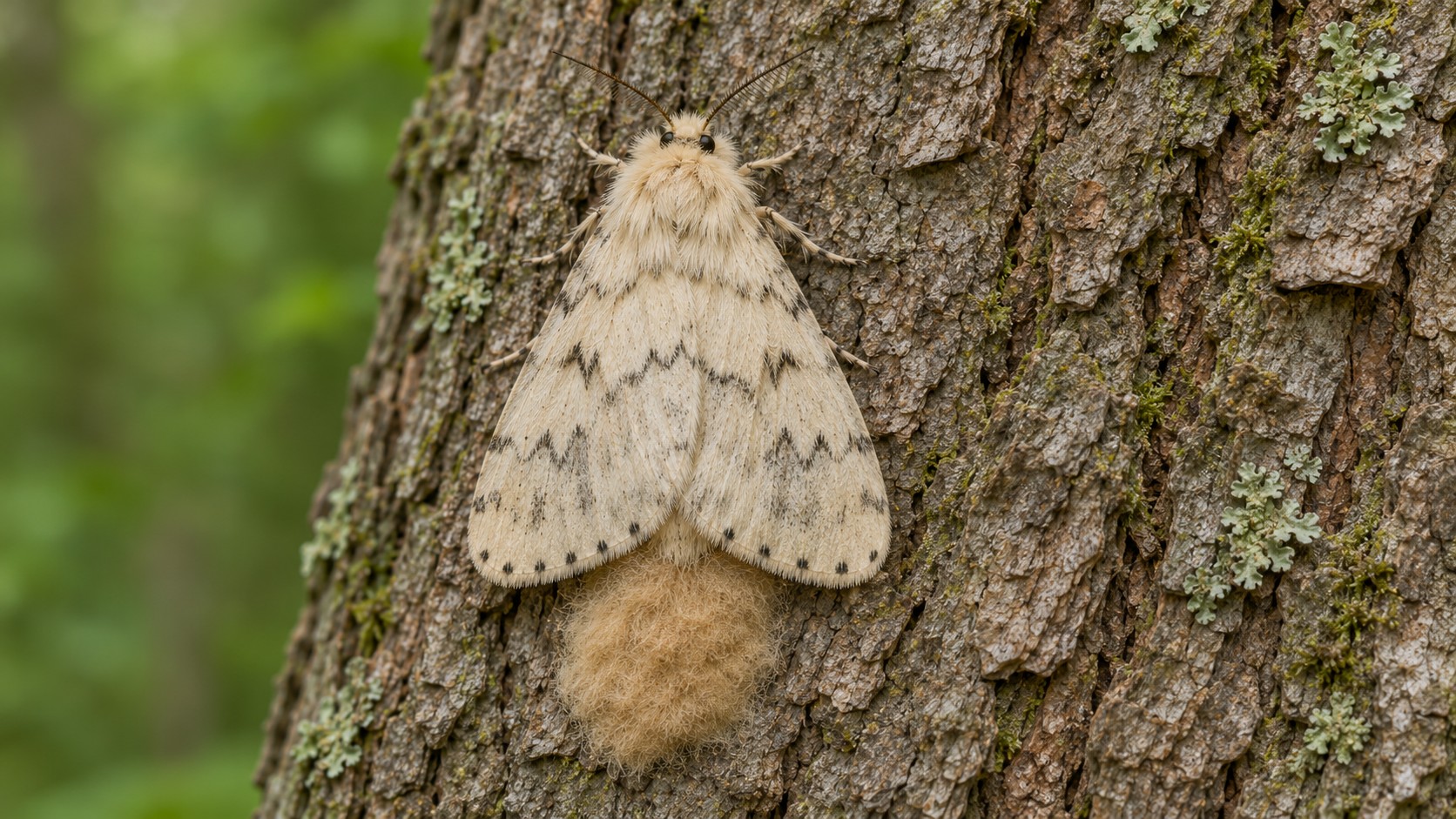
The female covers her eggs with hairs from her abdomen, creating the buff or tan surface behind the modern common name. The covering conceals a cluster of many eggs rather than one oversized egg. Tree bark is a familiar attachment site, but females also use rocks, buildings, outdoor furniture, vehicles, and other surfaces. An egg mass on a lawn chair is therefore not evidence that the chair provides food; it is a durable place to leave the next generation.
Eggs carry the population through winter, making the quiet-looking mass an important seasonal stage. Old coverings can remain after hatching, however, and age is not always obvious from a casual glance. A careful record distinguishes a newly observed patch from a confirmed fresh egg mass. Its surface, attachment, nearby old pupal remains, and location may all help a specialist interpret it, while a distant photograph of an unidentified tan smear leaves more uncertainty.
Spring Hatch Meets Expanding Leaves
The established North American population has one generation per year. Hatch occurs in spring, broadly aligned with the appearance of usable foliage, but the calendar varies with climate and locality. Newly emerged caterpillars are small, dark, and hairy rather than miniature copies of the mature spotted larva. Some disperse on silk threads carried by air, a behavior called ballooning. This is a journey made by a larva and its silk, not powered flight by a tiny moth with undeveloped wings.
Five Blue Pairs, Then Six Red Pairs
As larvae grow, their dorsal markings become an especially useful identification clue: five pairs of blue spots toward the front are followed by six pairs of red spots. The pattern is on the upper surface, so a sideways photograph can conceal part of it. Hairs and the underlying dark body contribute to the appearance as well. Color alone is not enough; the arrangement of paired spots is more informative than the presence of any blue or red mark somewhere on a hairy caterpillar.
A young larva may not yet show that mature pattern clearly. Identification therefore needs to account for stage instead of rejecting every dark early caterpillar because its spots are inconspicuous. Photographing the whole animal from a useful angle is preferable to handling it for a closer inspection. Caterpillar hairs can irritate sensitive people, and observation does not require contact. If the suspected species is unusual for the area, record the site and consult a local plant-health or extension service.
Why Oaks Feature So Often in the Story
Oaks are important hosts, but spongy moth caterpillars can feed on a broad range of woody plants. Apples, birches, poplars, and willows also appear in regional accounts. Host preferences matter because the mix of trees in a woodland influences where feeding becomes concentrated. A stand rich in favored trees presents a different feeding landscape from one dominated by less suitable plants. That does not make every tree equally vulnerable or every missing leaf evidence of this particular caterpillar.
The feeding stage is the larva, not the adult. A pale female resting on a trunk is not chewing the canopy, and an adult capture cannot be used as a direct measurement of leaf consumption. Growing caterpillars create the damage through repeated feeding. During high populations, their combined effect can strip substantial foliage from trees and even produce landscape-scale changes in canopy appearance. An individual insect and an outbreak are different scales of observation, even though they belong to the same biological process.
Diet breadth can also change the appearance of an outbreak as preferred foliage becomes scarce. Caterpillars may move onto less favored plants rather than remaining only where feeding began. A local host list is consequently a record of use under particular circumstances, not an assurance that every listed plant is equally attractive. Correctly identifying both the plant and the caterpillar is essential before a damaged tree is assigned to a specific pest problem.
Bare Branches Do Not Give a Complete Prognosis
Heavy defoliation is serious, but it is not identical to immediate tree death. Many broadleaf trees can produce replacement foliage after losing leaves. That response costs resources, and the consequences depend on the tree’s condition, the severity and repetition of damage, drought, and other stresses. The USDA Forest Service’s detailed leaflet emphasizes both refoliation and the risk of weakening or mortality, especially after severe feeding over successive seasons.
A greener canopy later in the summer does not erase the earlier loss of photosynthetic tissue. Conversely, a single photograph of stripped branches cannot establish that every tree in view will die. Evaluation should follow the same trees through time and consider species and prior condition. Where a valuable landscape tree is involved, an arborist or extension professional can help distinguish pest feeding from additional problems. Broad claims based only on a dramatic outbreak image obscure these differences.
From Feeding Larva to Short-Lived Adult
After larval growth, the insect becomes a dark brown pupa in a sheltered location, attached with silk. Bark crevices, structures, logs, and other protected surfaces may hold this stage. It is not a large furry adult already enclosed in a fully developed outer wing covering. Metamorphosis separates the feeding caterpillar from the reproductive moth, and empty pupal skins can persist after emergence. Those remains belong to an earlier event unless their emergence has actually been observed.
Adults have reduced mouthparts and do not replenish their reserves through normal feeding. Reproduction takes priority in their short adult period. Females attract males with a chemical signal, and males use their antennae while locating mates. This explains why an adult sitting quietly near an egg mass need not be searching for a flower. The reproductive phase connects the completed feeding work of one generation with eggs that will remain through the next winter.
One annual generation does not mean that adults remain present all year. Eggs dominate the long interval outside the spring and summer feeding period, while caterpillars, pupae, and adults each occupy shorter parts of the cycle. Regional schedules shift, so a date from one state should not be imposed on every locality. Stage-based records make those differences easier to understand than a broad statement that moths are active whenever the species exists in a place.
Outbreaks Rise and Fall for Several Reasons
Spongy moth populations can remain relatively inconspicuous and then build into damaging outbreaks. Disease, predators, parasitoids, weather, and food conditions contribute to population change. The fungus Entomophaga maimaiga and a spongy moth nucleopolyhedrosis virus are important mortality agents discussed by the Forest Service, but neither creates a guaranteed calendar for collapse at every site. A quiet year is not proof of permanent disappearance, and a bad year does not by itself predict the same damage the following summer.
The Long-Distance Journey Can Be on a Trailer
Local wind dispersal by young larvae and human-assisted transport are different pathways. An attached egg mass can travel on a vehicle, outdoor furniture, recreational equipment, or other movable material. The female does not need to fly across a state for her offspring to arrive there. That is why preventing introductions includes looking beyond plants themselves. The underside of an outdoor object may be biologically important even when it looks like ordinary household equipment.
USDA APHIS advises checking and cleaning outdoor items before moving them. Where movement restrictions or inspections apply, use current official instructions for the origin and destination rather than relying on a general wildlife article. Do not relocate suspected egg masses to a different woodland in an attempt to help them hatch. In an area concerned about new introductions, clear photographs and a location supplied to the relevant agency are more useful than transporting a live specimen yourself.
A Developing Larva Can Wait Inside a Winter Egg
A spongy moth egg mass often contains hundreds of eggs; regional accounts commonly report 500–1,000, with considerable variation. The hairy covering surrounds many separate eggs rather than forming a single giant egg. Female condition and reproductive output contribute to differences between masses, so the size of one patch is not an exact count of its contents.
Development begins before winter. The U.S. Forest Service describes embryos becoming developed larvae within approximately four to six weeks, then remaining inside the eggs until the following spring. The quiet winter stage therefore already contains the next feeding generation. Spring hatch releases those larvae into the foliage season rather than initiating all their development from the beginning.
Male and Female Caterpillars Follow Different Growth Sequences
In the established North American form, males typically complete five larval instars and females six. An instar is a period between molts, not a separate generation. The additional female growth interval contributes to the larger adult and its reproductive investment. Male larvae can finish their development and enter pupation before many females do.
Measurements at maturity also differ. Michigan State University describes males at about 1.5–2 inches long and females at about 2.5–3 inches. These are caterpillar lengths, not adult wingspans. A smaller individual with the characteristic paired spots can consequently be mature without having reached the size of the largest female larvae nearby.
Older Larvae Often Move Between Feeding and Shelter
During later instars, caterpillars commonly feed at night and move down into protected places during the day. Bark crevices, litter, and other dark spaces supply shelter between feeding periods. A tree trunk carrying resting caterpillars can thus be connected to foliage higher in the same tree, rather than serving as their main food surface.
Behavior changes with stage and population density. Dense populations may feed during daylight as well as darkness, so a nighttime preference is not an absolute prohibition on daytime activity. Movement between the canopy and shelter also means that a daytime count on exposed leaves samples only part of the population using a tree.
Silk Dispersal Does Not Produce a Large Feeding Tent
Young larvae use silk during dispersal, but spongy moth caterpillars do not construct the conspicuous communal tents associated with tent caterpillars. Nor do they normally enclose whole leafy branch ends in the broad webs characteristic of fall webworms. Silk use has different functions among these insects.
The distinction is useful when several kinds of damage occur in the same woodland. A silk thread, a large webbed branch, and a bare branch record different observations. The caterpillar’s body pattern and season help establish identity alongside those traces. Finding silk alone is insufficient to assign every affected tree to the same species.
Acorns Can Influence the Moth Through a Predator
Long-term research in eastern oak forests has linked spongy moth populations with acorns and white-footed mice. The mice consume moth pupae. A large autumn acorn crop can support more mice, which can increase predation on the following season’s pupae. The moth is affected indirectly by a seed crop it does not itself need to eat.
Cary Institute researchers tested the connection by manipulating mice and acorn availability, rather than relying only on matching population curves. The results show how a woodland food web can affect moth survival at a stage after leaf feeding ends. A defoliation event therefore has causes extending beyond the number of leaves initially available to caterpillars.
That relationship is one part of outbreak dynamics, not a universal rule that an acorn count alone predicts the next summer. Disease, weather, host condition, and other natural enemies remain involved. Its value is in identifying a tested ecological pathway between plants, a mammal predator, and an insect population.
A Fungus and a Virus Are Different Mortality Agents
Entomophaga maimaiga is a fungus, whereas spongy moth nucleopolyhedrovirus is a virus associated with the moth’s disease cycle. They are not two names for the same infection. Moist conditions can favor fungal activity, while dense larval populations can help viral transmission become important. Their effects can overlap in an outbreak without following identical patterns.
The Flighted Complex Extends Beyond One Subspecies
USDA uses flighted spongy moth complex for five related taxa: Lymantria dispar asiatica, L. d. japonica, L. albescens, L. umbrosa, and L. postalba. The list includes both subspecies of L. dispar and separately named species. The complex therefore cannot be treated as a single alternative color form of the North American population.
Female flight and attachment of eggs to ships create different routes for spread. International monitoring considers those biological capabilities together with transport history. A general resemblance between pale adult females cannot establish which taxon arrived on a vessel; identification and the origin of the material supply additional evidence.
Surveys Answer Different Questions From Sightings
Monitoring can focus on adult males attracted by pheromone lures, while egg-mass surveys evaluate another stage. These methods do not measure exactly the same thing. A male in a detection trap shows a capture at that site, not a count of all nearby females or a direct forecast of defoliation. Likewise, a few photographed egg masses cannot stand in for a survey with defined search areas, consistent timing, and trained identification.
That distinction matters at the edge of an established range. Detection, suppression of a damaging population, and eradication of a new introduction are different management purposes. A homeowner should not assume that a trap seen in one region means identical conditions or procedures apply somewhere else. Local agencies combine evidence that a casual observer usually does not have, including repeated traps, mapped records, and confirmation of uncertain specimens.
The useful takeaway is a whole-cycle view. Recognize the tan egg covering, learn the caterpillar’s paired spot pattern, distinguish the adult sexes, and remember the limits of a photograph. In its introduced North American setting, appreciating the moth’s biology goes together with avoiding accidental spread. The species is more understandable when its winter eggs and human transport pathways receive as much attention as the conspicuous caterpillars of an outbreak.