
Several Names Describe Different Impressions
Hawk moth and sphinx moth are common names used for the family Sphingidae. Hornworm usually refers to its caterpillar stage, while some flower-visiting adults receive names comparing their hovering with that of small birds. These labels emphasize movement or appearance rather than separate, unrelated animal groups. A caterpillar on a host plant and a moth passing at dusk may therefore represent successive stages within the same family.
The family name is useful precisely because the common names do not describe every member equally well. Not all adults hover at flowers, and not every mature larva retains an obvious horn. Species differ in their flight, feeding, larval hosts, and development despite sharing the family body plan. The species name, local range, and developmental stage supply the detail needed to interpret a particular encounter.
A Streamlined Body With Unequal Wing Pairs
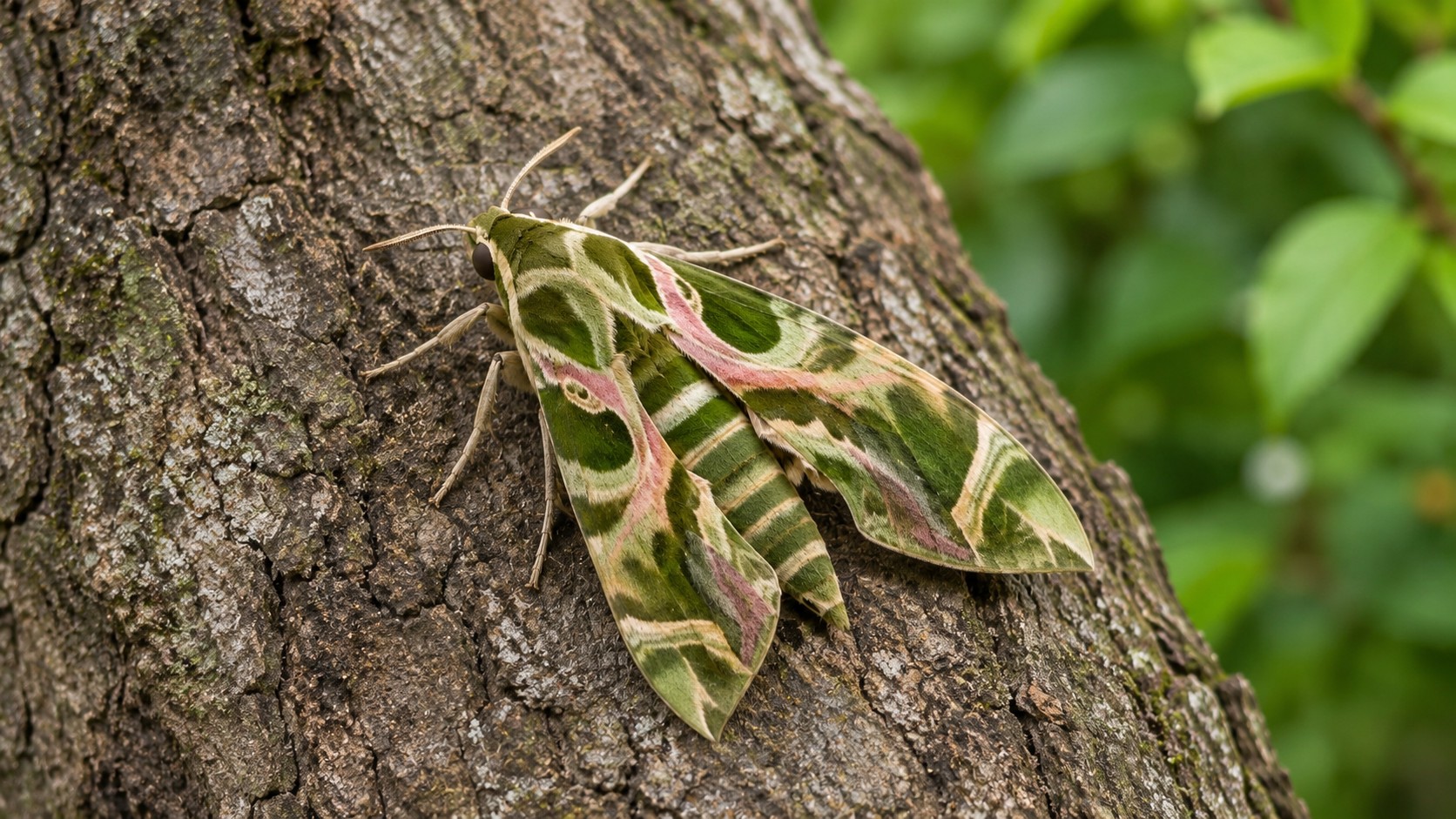
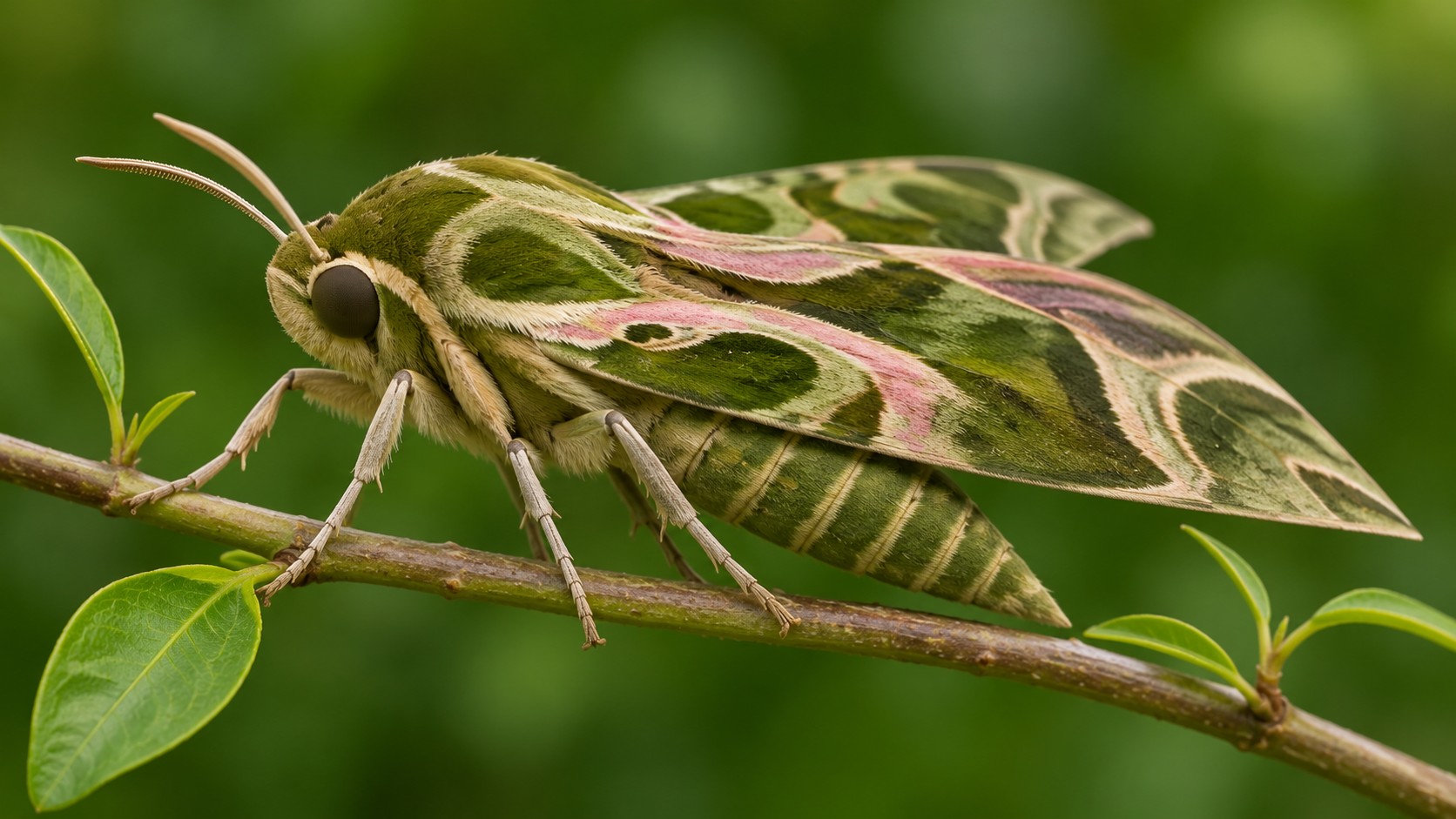
Many adults have a sturdy, spindle-shaped body and long, relatively narrow forewings. The hindwings are shorter and can be partly concealed in a resting view. The pointed forewings and tapered abdomen create the compact, aerodynamic outline familiar from photographs. Antennae and large compound eyes belong to an insect head, not a bird’s. Looking at these features together is more dependable than identifying the animal from an impression of rapid movement or the sound of its wings alone.
Color Ranges Far Beyond Brown
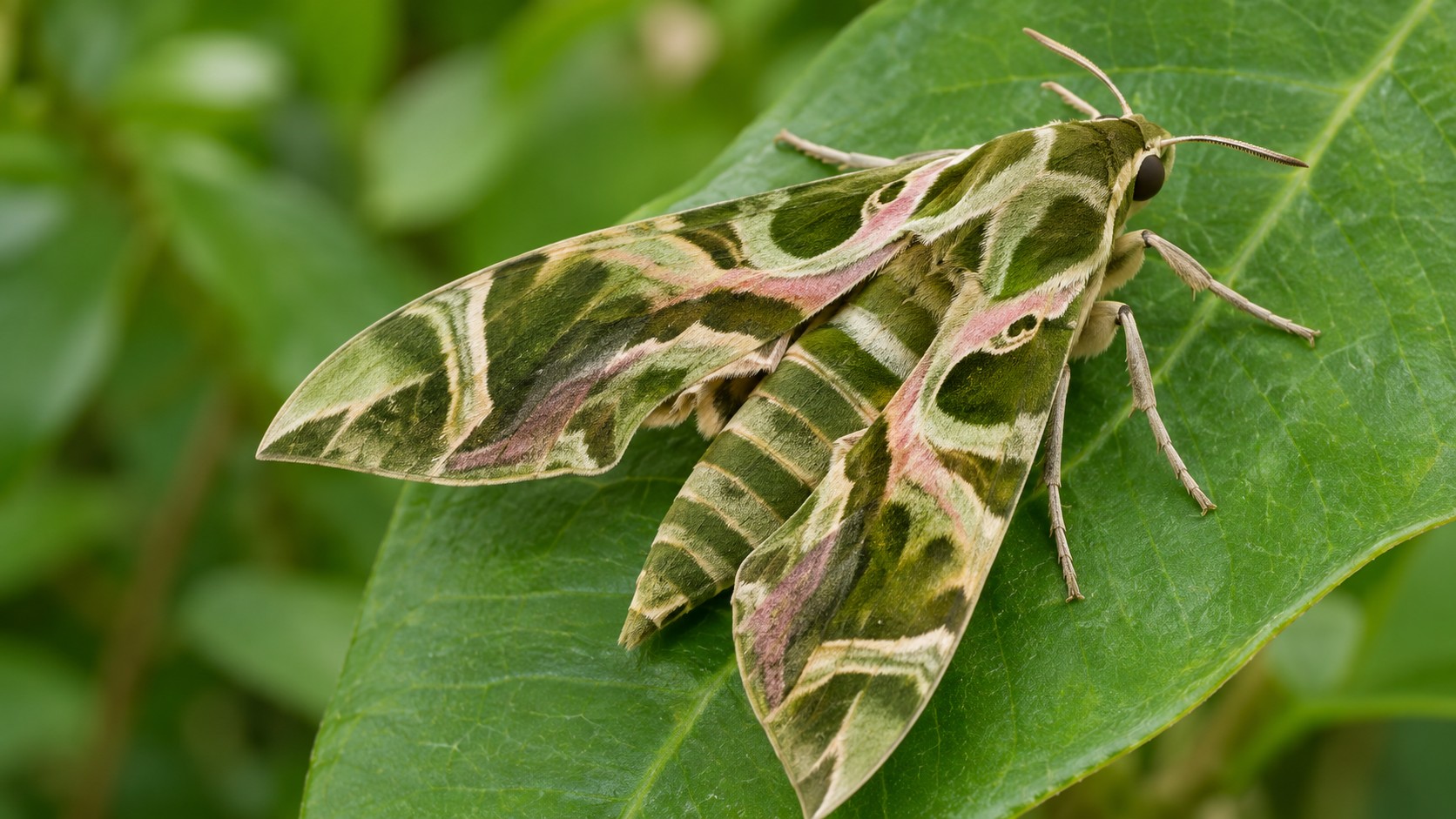
The oleander hawk moth illustrates the patterned end of the range, with green areas broken by pale and pinkish curves. The elephant hawk moth offers a contrasting combination of olive and pink. A white-lined sphinx has prominent pale forewing stripes against a darker background. These are examples from different species and regions, not three color forms that every hawk moth can assume.
Color is also only one layer of identification. Wing shape, line placement, body markings, and location help separate similar-looking species. A pink patch visible in flight may come from a hindwing that is mostly hidden at rest. Comparing a closed resting posture with a spread-wing illustration requires knowing which surfaces are being compared before a difference is treated as a contradiction.
That quiet posture is as much a part of the animal’s life as fast flight. A moth does not become a different kind of creature when its wings stop beating. The stationary view often supplies the features that a dramatic flying impression leaves unresolved.
Hovering Is a Feeding Behavior, Not Bird Anatomy
Some hawk moths maintain position in front of a flower while extending a proboscis toward nectar. The similarity to a hovering bird is behavioral. The moth still has insect antennae, legs, scaled wings, and a flexible feeding tube rather than a beak. Recognizing the distinction avoids imagining a hybrid animal from a brief encounter. The behavior also varies across the family, so a clear view of one nectar-feeding species should not become a description of every moth bearing the hawk name.
The Proboscis Connects Reach With Food
In many nectar-feeding species, the proboscis coils when not being used and extends toward a liquid source. Its length influences which floral rewards can be reached. Deep flowers and a long feeding tube can create an especially noticeable interaction, but the moth still has to encounter a suitable plant at an appropriate time. A long tube is an anatomical opportunity, not proof that every nearby flower provides usable food.
Not all family members follow that feeding strategy. Some hawk moth adults, including the eyed hawk-moth, do not feed. Others have different specializations. This is why an adult refusing offered nectar cannot be interpreted correctly from the family name alone. Establishing the species comes before assigning its menu, lifespan, or expected flower-visiting behavior.
Flower Visits Can Have a Second Outcome
While obtaining nectar, a hawk moth can contact pollen-bearing parts of a flower and transfer pollen during later visits. The relationship depends on how the insect and plant fit together. Feeding and effective pollination are connected possibilities, not synonyms. A photograph of a proboscis entering a bloom documents access more directly than it documents the plant’s eventual reproductive success.
Flower scent, shape, and the timing of nectar availability can influence the encounter. A plant used around dusk may be part of a different activity window from one visited in full daylight. No single flower color or opening time defines all hawk-moth interactions. The diversity of the moths and plants matters more than a rule that every pale tubular flower has exactly one kind of visitor.
The family consequently includes important pollinators without requiring the claim that all of its adults perform the same service. Species that do not feed cannot be folded into a nectar-pollination story simply because their relatives visit flowers. A more accurate explanation retains both the shared body plan and the different ecological roles that evolved within it.
Day, Dusk, and Night All Have Examples
Many hawk moths are most active at dusk or after dark, while other species regularly fly during the day. Regional conditions and season influence when a person is likely to see them. A daytime resting moth does not establish a daytime flight schedule, and a nighttime lamp records only one kind of encounter. Notes about time and behavior help preserve those distinctions when sightings from different observers are compared. The useful question is when this species is active here, not whether every hawk moth must obey one family-wide clock.
Hornworms Belong to the Larval Stage
Many sphingid caterpillars carry a hornlike projection near the rear of the body. It is not a forward-pointing head weapon, and its position helps orient an unfamiliar larva. In some species the projection becomes reduced or is replaced by a raised marking as development proceeds. A caterpillar lacking an obvious long horn is therefore not automatically outside the family.
Larval colors and patterns vary as well. Green forms can blend with foliage, while stripes, dark forms, or large eyespots create very different appearances. Those eyespots are markings rather than the animal’s actual eyes. The real head and feeding mouthparts still occupy the front of the body, which should be identified before interpreting a convincing false face.
The Host Relationship Must Be Named
A hornworm feeds on suitable host plants, not on a universal family menu. Tomato and tobacco hornworms are well-known examples associated with certain cultivated plants, but other sphingids use trees, shrubs, vines, or herbs unrelated to a vegetable bed. Some have narrow host relationships and others use a broader set. Knowing that a larva is a hornworm is only the first step toward understanding what supports its development. A plant photograph and a reliable local species reference add evidence that a body portrait alone cannot provide.
Large Caterpillars Are Not Always Major Pests
A few hornworm species can cause serious feeding damage in particular crops, but their reputation should not be extended to every member of the family. Colorado extension guidance, for example, distinguishes the familiar vegetable pests from many other hornworms that rarely cause significant plant injury. That is a regional statement, not a universal dismissal of damage. The plant, insect identity, abundance, and stage of growth all affect the assessment.
Finding the responsible animal matters because missing foliage is not a species diagnosis. The amount removed by a mature larva can be very different from the feeding of a small one. An adult on a flower is not itself chewing nearby leaves, even if its earlier stage uses a host in the same area. Keeping the stages separate makes the garden story more accurate.
Natural enemies add another layer. Parasitoids and predators can affect larvae and other stages, so the number of eggs or caterpillars present does not equal the number of adults eventually produced. Observation should include these interactions where they are visible. A decision about crop protection is better grounded in actual conditions and local guidance than in the alarming appearance of one large larva.
Pupation Can Lead Below the Surface
Many mature hornworms leave their feeding plant and pupate in soil or protected ground-level material. An underground chamber differs from the conspicuous hanging cocoon associated with some other moths. The brown pupa may have a distinctive external sheath around the developing proboscis in certain species, but that feature is not equally pronounced across the family. Anatomy and location together help interpret the stage.
This movement explains why a large caterpillar crossing bare ground may be searching for a developmental site rather than failing to find food. It also widens the habitat picture beyond the host leaves. The plant supports feeding, while the ground layer can support transformation. Host foliage supports feeding, while a protected ground site can support the following transformation.
Travel Does Not Always Mean Local Breeding
Some hawk moths undertake substantial seasonal movements, while many familiar sightings involve more local activity. An adult beyond its usual breeding area may be a visitor rather than evidence of a permanent population. Geography and weather should therefore accompany unusual records. A mobile adult’s presence establishes where it was seen, not necessarily where it developed or whether another generation can survive there. Eggs, larvae, repeated seasonal records, and appropriate hosts help answer those additional questions.
Putting Named Examples Beside the Family Outline
The green marbling of the oleander hawk moth, Daphnis nerii, belongs to one particular species. A Northern Ireland museum guide gives a wingspan of approximately 8–12 centimeters, with olive-green forewings, pinkish areas, and pale streaks near the tips. Its larvae use oleander and periwinkles in the warmer parts of its range. Those measurements and plants cannot be assigned to every member of Sphingidae.
Its occurrence in northern Europe also differs from that in warm breeding areas. The museum’s regional account describes a rare migrant reaching Northern Ireland from farther south. A visiting adult establishes an arrival, while continued breeding and winter survival require additional conditions. The moth’s ability to move long distances does not give its caterpillars access to suitable foliage everywhere it can fly.
A Clearwing Sphinx Can Be Much Smaller
The North American hummingbird clearwing, Hemaris thysbe, illustrates another family form. Its span is commonly about 3.8–5.7 centimeters, or 1.5–2.25 inches. The furry-looking body and largely transparent wings can produce a beelike impression, especially during short daytime visits to flowers. Dark borders and veins remain visible around the clear wing areas.
The resemblance does not turn it into a bee or place it among the wasp-mimicking clearwings of Sesiidae. Hemaris belongs to the hawk moth family. Watching a brief flower visit may reveal the extended feeding tube, while a resting view makes the antennae and wing margins easier to compare. The familiar word hummingbird describes its hovering impression rather than a close relationship with birds.
Adult flowers and larval plants remain different resources for this small sphinx. Wisconsin extension records identify Viburnum and related plants as larval hosts, while adults can visit many nectar sources. A bee balm flower receiving repeated visits need not be the plant on which any of those moths developed.
Two Common Hornworms Have Useful Differences
Tomato hornworm, Manduca quinquemaculata, and tobacco hornworm, Manduca sexta, provide a practical larval comparison. Both can occur on tomatoes and related crops, so the plant name alone does not settle their identity. Tomato hornworms typically carry eight pale V-shaped side markings and a dark horn; tobacco hornworms have seven diagonal pale stripes and a reddish horn.
These are differences between species, not simply stages in which one caterpillar gradually turns into the other. Color can vary, but the arrangement of markings provides useful supporting evidence. Their adult forms are the five-spotted hawkmoth and Carolina sphinx, respectively. Naming both stages connects the familiar leaf-feeding animal with the large moth that later visits flowers.
The exposed horn lies near the rear. It does not explain how the caterpillar cuts foliage, and it is not a forward-pointing mouthpart. The chewing jaws are at the opposite end. Locating the head first makes both feeding damage and body orientation easier to interpret when a large larva is curled along a stem.
Antennae Help Control Flight as Well as Detect Odors
Hovering requires continual corrections to body position. In the hummingbird hawk-moth, Macroglossum stellatarum, experiments have separated the contributions of vision and mechanical sensing through the antennae. A sensory structure at the antennal base, Johnston’s organ, detects movement that supplies information about disturbances to the moth’s orientation.
The experiments found that antennal feedback was particularly important for rapid maneuvers, while slower movements could be supported by visual feedback. Removing the antennal flagella disrupted fast control, and reattaching them improved performance. That comparison connected the mechanical load of the antenna with flight behavior, rather than attributing the effect only to loss of smell.
A flower visitor therefore does more than aim its eyes at a target and beat its wings. Different sensory channels contribute information on different timescales. The animal must maintain its own position while bringing a flexible proboscis into contact with a resource that may also move. Antennae are working parts of that control system, even when they look motionless in a close view.
Color Can Remain Useful in Very Dim Light
The elephant hawk moth, Deilephila elpenor, has demonstrated color discrimination under illumination comparable to dim starlight. In behavioral experiments, moths learned to associate a color with a reward and could distinguish it under conditions in which human color vision fails. They also retained color recognition when the illumination changed.
These results show why night feeding cannot always be described as following scent in an entirely colorless world. The available visual information depends on the species’ eyes and nervous system as well as the light level. It does not follow that the moth sees exactly the colors or detail a person sees in daytime. Its sensory capacities are adaptations to its own feeding environment.
Keeping Pace With a Moving Flower
Comparative experiments with day-, twilight-, and night-active hawk moths have tested how they track moving artificial flowers. Reducing illumination changed their tracking responses, with delays helping explain part of the variation. Species also differed in responsiveness. The visual system’s ability to work in low light comes with constraints on how quickly information can guide a movement.
A steady-looking hover can consequently contain many small corrections. The flower may sway, the moth may drift, and the proboscis must remain usefully positioned. Performance at one stationary bloom does not measure every challenge posed by wind-driven vegetation. Flight control, food access, and the physical movement of plants form one interaction, extending the pollination story beyond the simple match between tube length and flower depth.
Read the Individual Within the Family
The group becomes easier to understand when each observation keeps its immediate evidence intact. A resting adult supplies wing and body features; a flower visit reveals a feeding interaction; a larva on a known plant supplies a host association. These records can be connected without pretending that any one of them contains the entire life history. Clear descriptions make later identification and comparison more useful.
The oleander, elephant, and white-lined examples show how much variation a shared shape can contain. Behind that recognizable streamlined body are different plants, seasons, and feeding strategies. Hawk Moth is therefore a starting category, not the final explanation. Looking closely enough to name the species and stage turns a fast impression into a specific account of an insect’s place in its surroundings.