
A Hidden Pattern Becomes a Sudden Display
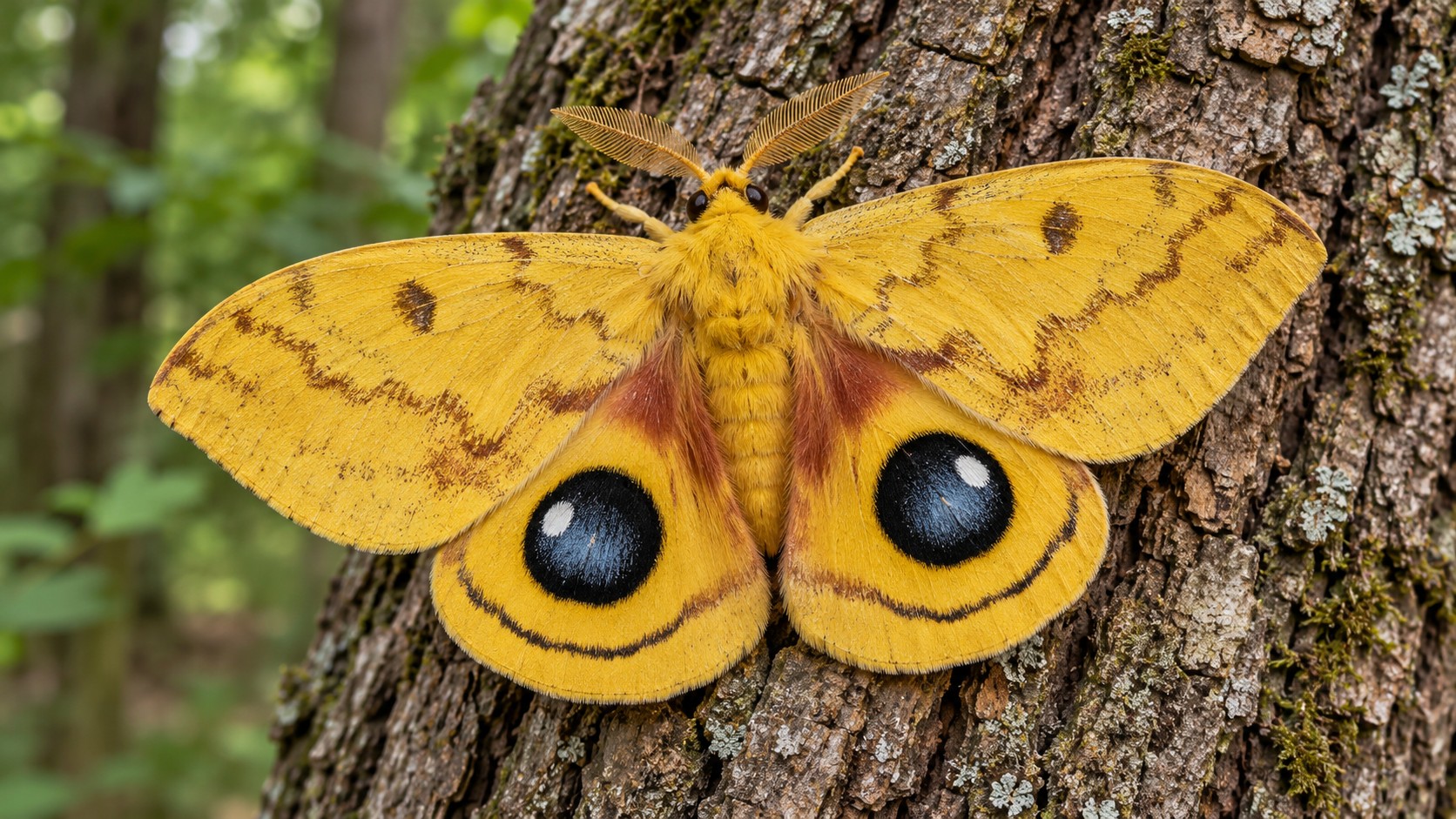
The two large eyespots belong to the hindwings, one on each side. Each contains dark and bluish regions with a pale highlight, surrounded by the warmer colors of the wing. They are not the moth’s actual eyes, which sit on the head. At rest, the forewings can overlap and conceal much of this design. An individual photographed in that position may therefore show little of the feature that made the species famous, even though the markings are intact.
The defensive effect depends partly on the change from an inconspicuous resting outline to a conspicuous display. The Missouri Department of Conservation describes the sudden exposure as startle coloration. A brief interruption in a predator’s approach can be useful without guaranteeing escape from every attack. There is no need to prod a resting animal to demonstrate the mechanism. Comparing undisturbed photographs of different wing positions explains the arrangement while avoiding repeated disturbance of the moth.
Yellow Males and Reddish Females
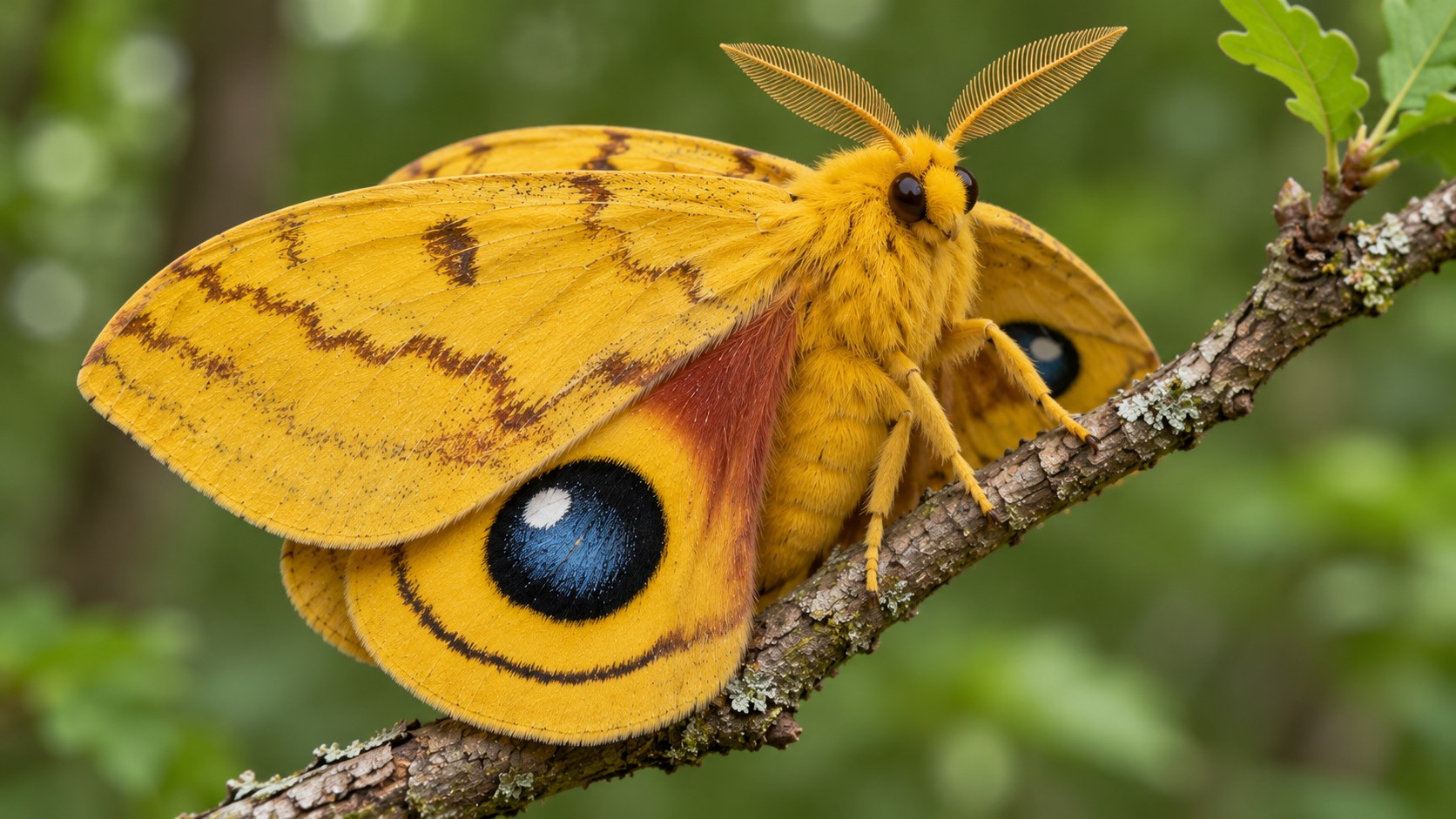
The typical male has yellow forewings patterned with brown markings, while a female’s forewings tend toward reddish brown, rust, or purplish tones. Both sexes have the characteristic hindwing eyespots. This is sexual dimorphism: a difference in appearance between males and females of one species. It is not evidence that the darker animal is an older version of the yellow one, nor does it mean that a red-brown female belongs to an entirely different moth family.
Antennae add another useful comparison. Males have conspicuously feathery antennae, while those of females appear less elaborate. As the Florida Museum explains, sex affects more than the forewing color alone. In photographs, however, antenna detail can disappear against bark or fall outside the plane of focus. A color-based impression is stronger when it agrees with other visible features, and weaker when the image is distant, heavily edited, or taken under unusual lighting.
Color also has limits as a rule. Published identification accounts recognize variation, including males that are browner than the familiar bright yellow form.
Large Enough to Notice, Small Enough to Misjudge
A wingspan of roughly two to a little over three inches places the Io Moth among conspicuous backyard moths without making it one of the largest insects on Earth. Size estimates from photographs deserve caution: a close macro view can make a small twig look like a substantial branch, and a leaf is not a standardized ruler. Wing position matters as well, because a partly folded animal presents less visible width than one with wings fully extended. Identify the characteristic pattern before using apparent size to decide what the animal must be.
Egg Clusters Begin a Shared Childhood
The female lays eggs in groups on host vegetation, giving the young larvae a common starting point. Leaves and stems can carry these clusters, and the developing caterpillars emerge near food rather than having to search across a large landscape immediately. An egg photograph is most informative when it retains the attachment surface and arrangement. A close crop of a few pale shapes may look attractive but lose the context needed to distinguish an actual moth egg cluster from other objects.
After hatching, young larvae can consume the remains of their eggshells before feeding on the host plant. Their first appearance is not the familiar large green caterpillar shown in many identification guides. Early stages can be darker or orange-toned, and they change as they molt. Development therefore affects both the appearance of an individual and the way a group looks on a leaf. Comparing life stages requires more than matching the dominant color in two pictures.
Following the Caterpillar Train
Young Io caterpillars are gregarious, meaning that they spend time together rather than immediately dispersing into solitary feeding sites. One especially memorable behavior is their movement in single-file processions. University of Florida accounts describe young larvae following silk trails to new feeding areas. The line is not a miniature migration across the continent; it is a local movement among places used by developing caterpillars. Seen at that scale, the behavior connects social organization with the practical task of reaching foliage.
A procession deserves to be documented as behavior, not rearranged into a better photograph. Record whether the animals are moving, feeding together, or simply resting near one another. These are different activities even when a still picture makes them appear similar. The leading caterpillar’s position in one image does not establish a permanent leader, and a broken line does not prove the group has lost its way. A short sequence of observations provides more information than an elaborate story attached to a single frame.
As the caterpillars grow, their association generally becomes less tight and older individuals are often found feeding alone. University of Missouri Extension emphasizes this shift from grouped young to more solitary older larvae. Finding one mature caterpillar is therefore compatible with the species’ early social behavior.
Branching Spines Deserve Space
The mature caterpillar is usually green, with contrasting pale and reddish stripes along its sides and numerous clusters of branching spines. Those spines distinguish it from many smooth green caterpillars. They are not harmless decorative fur: contact can cause a painful skin reaction. Looking closely does not require touching, and a camera with a little working distance is a better observation tool than a finger used to turn the animal toward the light.
The caution can extend beyond the living caterpillar. Colorado State University notes that larval spines can become incorporated into the cocoon. A dried brown enclosure should not automatically be treated as safe to handle. This is a contact hazard associated with the larval structures, not a reason to imagine the adult chasing people or delivering a wasp-like sting. Keep observations hands-off, and keep identification separate from any attempt to test an unfamiliar caterpillar’s defenses.
A Broad Menu, Not Unlimited Food
Io caterpillars use many host plants. Documented examples include oak, willow, hackberry, cherry, redbud, and blackberry, among others. This makes the species a generalist compared with a caterpillar restricted to one narrow plant group. It does not mean that every plant in a garden is equally suitable, or that an individual found resting on a plant has been feeding there. Host breadth is a biological pattern established through records, not permission to infer a meal from proximity alone.
Regional lists help keep the evidence grounded. The University of Florida’s Natural Area Teaching Laboratory lists local examples such as sugarberry, Coastal Plain willow, redbud, Rubus, oaks, and Prunus. Elsewhere, other documented plants enter the account. These lists overlap without being identical. Regional host records document different plants used by the same broadly feeding species.
For a garden encounter, the most valuable evidence is often uncomplicated: a correctly identified plant, a clear side view of the caterpillar, and visible feeding. If chewing is not observed, describe the animal as resting or moving rather than feeding. Leaves with missing edges show that something ate them, but do not identify the diner by themselves. This distinction becomes especially important where several caterpillar species share a tree or shrub during the same season.
The Story Moves Down Into the Leaves
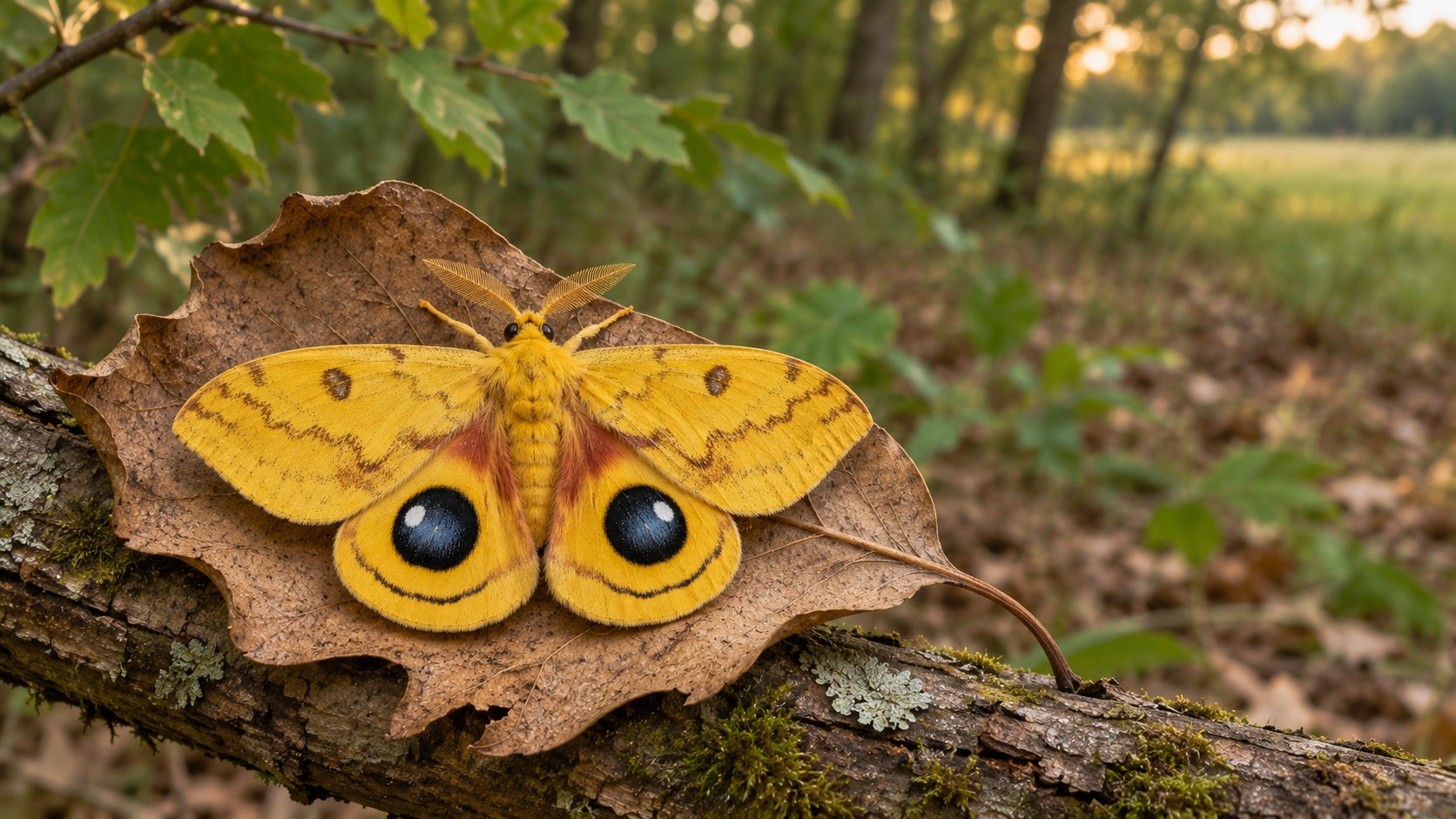
When development reaches pupation, attention shifts from foliage to sheltered places around the plant. Io Moths make cocoons in leaf litter or other protected crevices, sometimes incorporating surrounding plant material. The enclosure shelters the pupa, the stage in which transformation to the adult proceeds. It is not a permanent portable home carried around by the feeding caterpillar. A ground-level phase also means that an apparently empty space beneath a host plant may still contain part of the moth’s life cycle, hidden among ordinary-looking fallen leaves.
One Species, Several Regional Calendars
The annual schedule changes with geography. In Illinois, the state wildlife account describes one generation in the north and two in the south. North Carolina’s moth atlas reports a similar contrast between apparently single-brooded mountain populations and double-brooded Coastal Plain populations. A brochure from one locality is therefore not a universal timetable. The same species can appear on different schedules without requiring a different identification.
Brood number and individual lifespan answer separate questions. Several generations in a warm region do not mean that one adult survives through them all. Each adult occupies a short reproductive period, with eggs and larvae producing subsequent generations under suitable conditions. When recording an encounter, locality and date should stay together. A calendar month without a place can be misleading, especially when records from northern woodland and a much warmer southern habitat are placed side by side.
Night Activity and a Limited Energy Budget
The adult is nocturnal, with mating activity associated with the evening and early night. Chemical signals help males locate females, linking the antennae to a job beyond visual ornament. A moth remaining still in daylight may simply be following its usual activity pattern. The absence of daytime flight is not, on its own, proof that an adult is injured, cold beyond recovery, or in need of being made to move.
Adults do not feed. Their activity depends on resources accumulated during larval feeding, so an Io Moth on a flower should not automatically be described as taking nectar. It could be resting there. This feeding difference makes the whole habitat important: foliage supports the growing stage, sheltered surfaces support resting, and litter or crevices can support pupation.
Artificial lights can make adults more noticeable to people, but a light-side photograph shows an encounter location rather than the complete natural behavior of the insect. It does not identify the larval host or establish how many moths live nearby. Watching briefly, avoiding handling, and reducing unnecessary disturbance allow the animal’s own activity to remain the main event. The best observation need not end with flight or an exposed pair of eyespots.
A Broad Range With Different Local Settings
Io Moths are native across much of eastern North America, extending from parts of southern Canada through the eastern United States and into eastern Mexico. Their habitats include deciduous woodland, forest edges, orchards, parks, and other places containing suitable food plants. A wooded suburban landscape can support them without reproducing the conditions of an uninterrupted forest.
Within that range, plant availability and climate change together. A northern caterpillar on a willow and a southern one on a different recorded host can belong to the same species while experiencing different growing seasons. The broad distribution describes opportunities occupied by populations over a large area, rather than uniform abundance in every town between the northern and southern records.
Small Markings Reveal Development Inside the Egg
An Io egg measures approximately 1.7 by 1.3 by 1.1 millimeters. It is pale with yellow areas, including a spot around the micropyle, the opening through which sperm enters during fertilization. In developing fertile eggs, that top marking becomes dark after several days. The lateral yellow areas can become orange or brown as the egg ages.
Hatching commonly occurs after approximately eight to eleven days in suitable conditions. This is the duration of the egg stage, not the whole interval to adult emergence. Even within an attached group, the developing embryos are individual animals; the pale structure left behind after hatching is an empty chorion rather than another stage waiting to begin.
A Rosette Is Different From a Traveling Line
The young caterpillars’ social behavior includes more than walking single file. Before a molt, they can gather in a rosette, with heads directed outward and rear ends toward the center. This arrangement is a stationary developmental gathering rather than a procession moving toward fresh foliage.
After shedding their coverings and allowing the new outer surfaces to harden, larvae can consume the discarded skins, leaving the head capsules. These remains record growth, not the deaths of a matching number of caterpillars. The arrangement of the living larvae and the presence of cast material help distinguish a molt from an ordinary feeding or resting group.
A Generalist Can Still Struggle on a Particular Plant
A study published in 2013 followed Io larvae found on coral bean, Erythrina herbacea, in north-central Florida. The initial field record established that the plant could be used, but subsequent rearing revealed substantial costs. Young larvae in a later generation suffered much higher mortality on coral bean than controls fed mature water-oak leaves.
The study also recorded seven larval instars, with development lasting 63–100 days under its conditions. That result differs from the common description of five instars. Host quality and the circumstances of rearing matter to growth, so a fixed count cannot replace observations of the population being studied.
Leaf age mattered in the comparison as well: young terminal water-oak leaves were much less suitable than mature ones. The plant’s species name alone did not capture all the feeding conditions. A broad host list can therefore contain meaningful variation within a single tree, as well as differences between tree species.
Branched Spines and Side Stripes Have Different Structures
A mature Io caterpillar can reach approximately six centimeters long. Its contrasting side stripes lie in the body surface, while the branched, black-tipped spines project outward from fleshy supports called scoli. A close view consequently contains flat color markings and raised defensive structures at the same time. They are not all equivalent hairs or spots.
The University of Florida describes the spines as hollow and readily broken by contact. That physical arrangement explains why avoiding handling matters even when the larva remains motionless. The adult’s eyespot display is a separate defense operating at another stage; it does not possess the caterpillar’s covering of branched spines.
Recognizing the arrangement also helps distinguish Io from other large silk moth larvae. A green body alone is shared widely. The side stripes, rows of branched scoli, head, and overall proportions together provide the more useful combination. Identification can be made through observation without testing whether a projection stings.
Defenses Do Not Exclude Parasitoids
Io caterpillars can host parasitoid wasps, including species of Cotesia, as well as tachinid flies. These insects develop through a close association with a host rather than obtaining one quick meal and leaving. A larva can therefore continue feeding for part of an infestation before the parasitoid’s development becomes apparent.
Spines that discourage a large vertebrate do not necessarily prevent a small parasitoid from reaching its host. The effectiveness of a defense depends on the attacker and the way contact occurs. Eggs laid, caterpillars observed, and successful adult emergences are consequently different measures of a local population. Food availability and natural enemies together determine how many individuals complete the transition to the winged stage.
Recognizable Does Not Mean Equally Common Everywhere
The Io Moth occupies a broad range of wooded and human-influenced habitats, yet broad distribution should not be confused with uniform abundance. North Carolina’s moth atlas discusses local vulnerability and contrasts its regional account with declines reported in parts of the Northeast. The sensible conclusion is regional, not a claim that every population is disappearing or that a widespread species needs no attention anywhere. Repeated local records help reveal differences that an overall range map cannot show.
Appreciating this moth means noticing more than the dramatic reveal. The forewings can conceal the hindwing pattern, the sexes can look different, and a solitary mature caterpillar can come from a much more social early life. These are connected parts of one species rather than inconsistencies to be edited away. Give the spined larvae space, leave the hidden stages undisturbed, and observe the adult without demanding a performance. Its natural history remains interesting even when the eyespots stay partly out of view.