
Recognizing the Green Outline
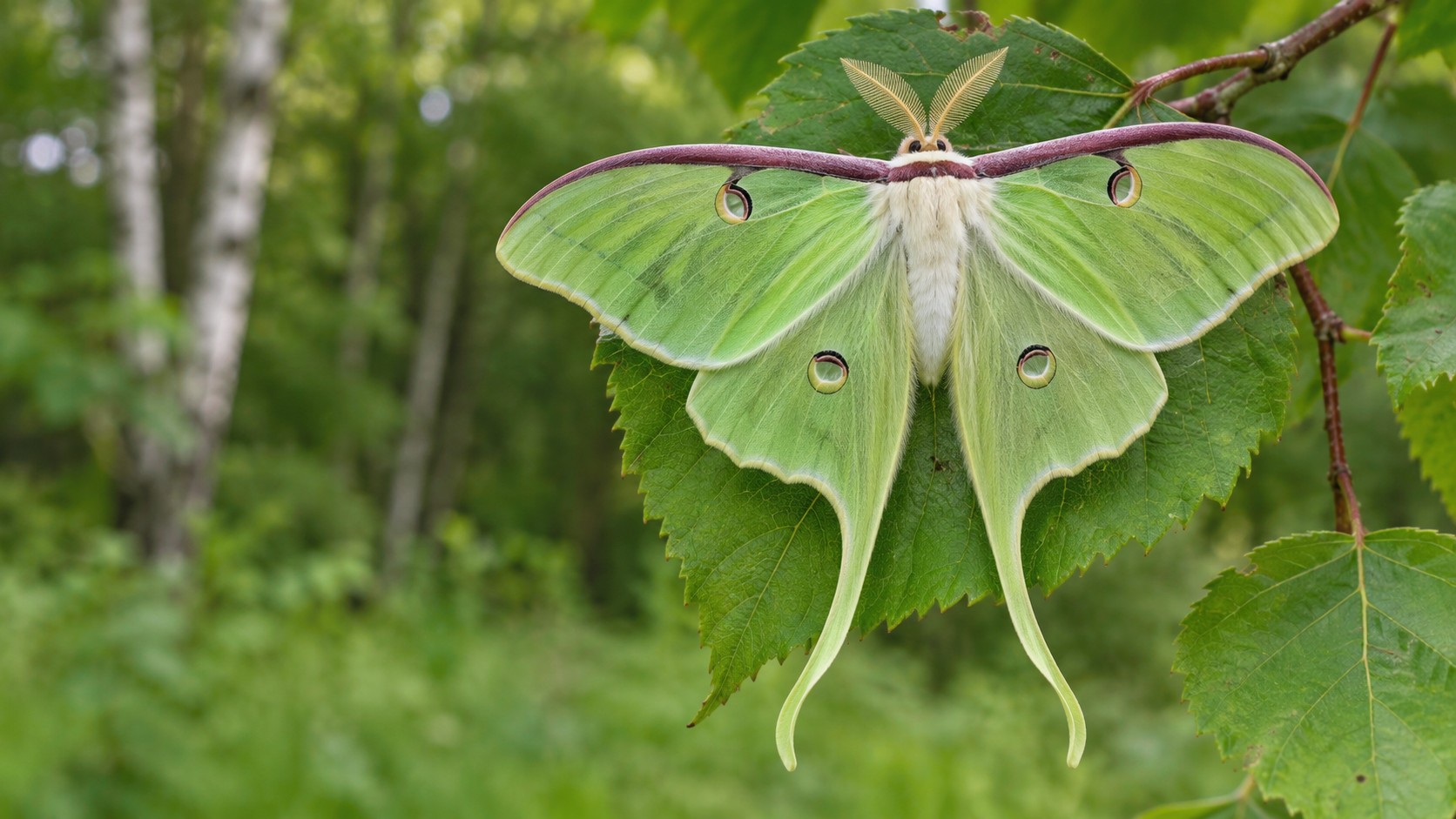
The Luna Moth combines broad pale green wings, long hindwing tails, a fuzzy light-colored body, and a small ringed translucent spot on each wing. Darker reddish or purplish edging along the forewing’s leading margin adds another useful feature. Color can range through yellowish and bluish greens, and seasonal forms differ in some markings. The combination identifies the moth more reliably than green alone. It is a North American species, not a general name for every tailed green moon moth pictured from elsewhere in the world.
The Antennae Belong in the Portrait
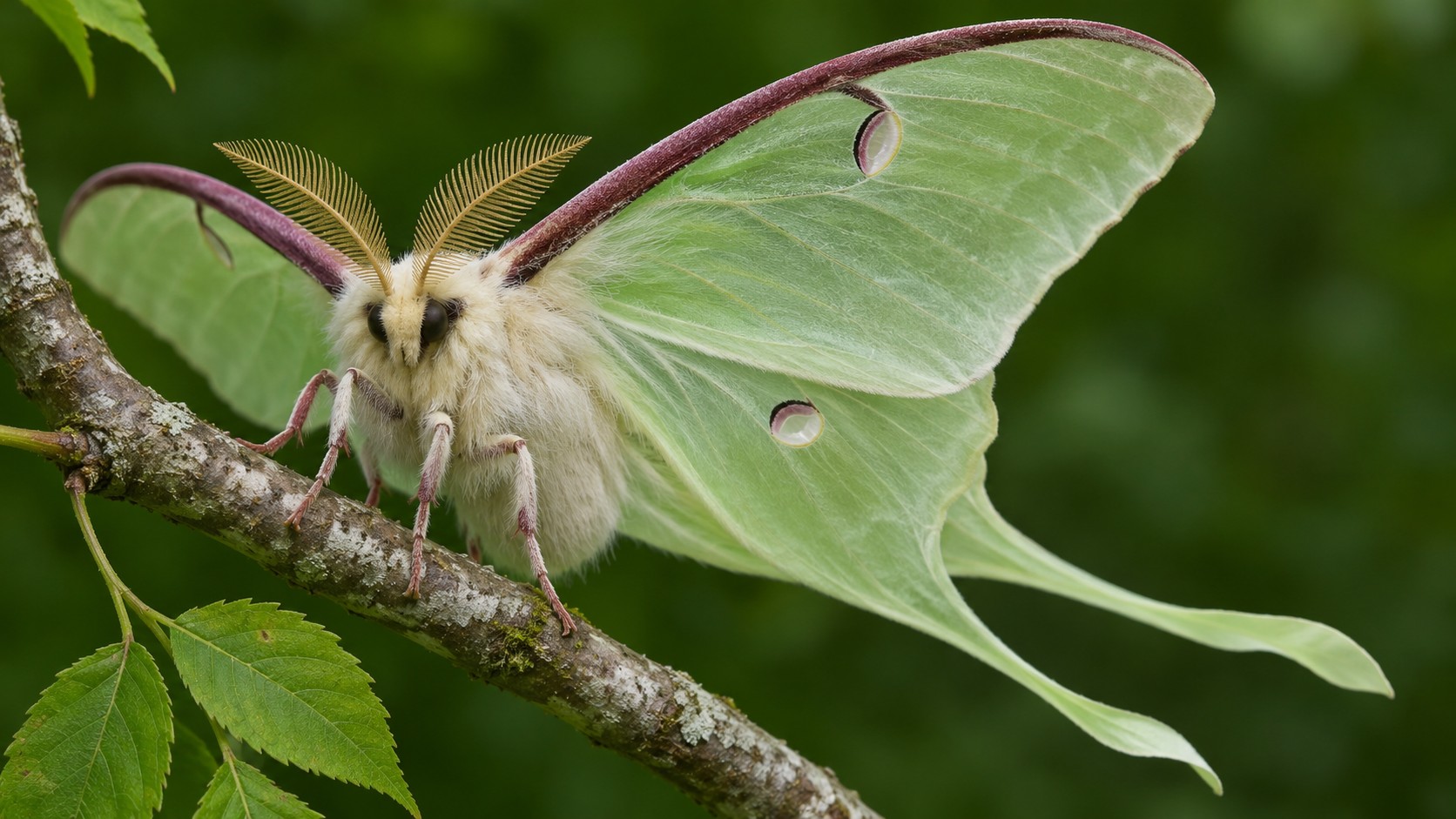
Both sexes have feathery antennae, with males typically showing broader branching. These structures are part of a chemical sensory system rather than decorative plumes. During the reproductive period, a female releases a sex pheromone that helps males locate her. Much of the adult story therefore unfolds through information that is invisible in the most familiar wing photograph.
Antennae can contribute to comparing sexes, but photographic angle and condition affect what is visible. The abdomen and other features also deserve attention before assigning an individual confidently. A clear view of the head records more than a fuzzy face: it connects the moth’s appearance to the sensory work of finding another moth in a complex nighttime landscape. There is no need to touch or spread the antennae to inspect them.
Nonfeeding Does Not Mean the Animal Never Ate
Adult Luna Moths lack functional feeding mouthparts and do not visit flowers for nectar. This is a normal feature of their life history, not an emergency caused by the absence of the right bloom. Offering sugar water cannot turn the adult into a nectar feeder. Its immediate tasks are supported by reserves accumulated before emergence, while mating and egg laying occupy the reproductive stage.
The caterpillar has a very different relationship with food. Its chewing mouthparts remove foliage from suitable hosts, supporting growth and the resources needed for later development. An adult’s beauty is consequently connected to leaves consumed weeks earlier. The life history cannot be supported by adding flowers alone, because nectar does not replace the larval feeding relationship this particular moth requires.
Descriptions of the adult as living for roughly a week are useful as a broad sense of scale, not an exact expiration time for every individual. Conditions and events influence survival. More importantly, the adult interval is not the whole lifespan. Time spent as an egg, growing caterpillar, and developing or overwintering pupa belongs to the same animal’s history, even when those stages were never noticed by the observer.
The Forest Supplies More Than a Backdrop
Luna Moths occur in eastern North American forested habitats, including areas with deciduous hardwoods. Their range extends through parts of southern Canada and the eastern United States. A mature tree canopy offers resources that an ornamental flowerbed cannot reproduce by itself. The moth seen beside a house may have developed on a nearby tree or moved through the area after emergence. Its resting location alone does not establish which plant fed it, so a sighting and a host record should be kept distinct.
Host Trees Differ Across the Range
Recorded caterpillar hosts include birches, sweetgum, hickories, walnuts, persimmon, and other trees, with regional differences in the plants used. A list drawn from the full range should not imply that every larva accepts every tree equally well. Local records and reliable identification of the plant provide the strongest context. The relationship is between a particular caterpillar population and suitable foliage, not simply any green leaf available nearby.
This specificity changes how habitat is evaluated. A host tree can support development without offering the conspicuous flowers people associate with pollinator gardens. Removing it and adding nectar-rich annuals does not automatically replace its contribution to Luna Moths. The relevant resource is larval food, accompanied by places where the animal can complete development and where adults can move through the nighttime environment.
The Caterpillar Is Built for Growth
Luna caterpillars are green, fleshy larvae with small raised structures and markings that differ greatly from the adult pattern. They grow through successive stages, shedding an outer covering as body size increases. The mature form is not a tiny green moth waiting to unfold. It is a leaf-feeding stage with its own mouthparts, legs, behavior, and exposure to predators. Identifying one benefits from photographs of the head, body, and host rather than an assumption that any large green caterpillar becomes a Luna Moth.
A Cocoon Can Become Part of the Leaf Litter
When feeding ends, the mature larva spins a cocoon using silk and leaves. The cocoon surrounds the pupa; it is not the pupa itself. Its papery brown appearance can be easy to confuse with ordinary fallen plant material. This stage is a reminder that an animal famous for green wings can pass an important part of its life in a form that attracts almost no attention.
Luna cocoons can lie among leaves beneath host vegetation. They are not all conspicuous permanent fixtures hanging high on a branch. The habitat therefore includes the ground layer as well as the canopy. Removing or shredding every leaf from a wooded setting can remove more than plant debris, although appropriate management still depends on the particular location and its other needs.
Some pupae develop through to another adult generation within the active season, while others pass the unfavorable period in diapause. A cocoon that does not produce an adult after a short wait should not automatically be declared dead. Season and local developmental cues matter. Bringing a wild cocoon into a different temperature regime can change the conditions under which the animal would normally complete its cycle.
Emergence Is Followed by Preparation
The newly emerged adult initially has soft, unexpanded wings and needs a secure position from which they can develop into flight-ready surfaces. Body fluids help expand them, and the wings then reach working condition. This interval can look awkward compared with a finished portrait, but it is part of normal emergence. Moving or repeatedly handling the animal can interfere with a vulnerable transition.
A moth hanging quietly after emergence should therefore be allowed space and time. The fact that it does not immediately fly is not by itself evidence of injury. An observer can record its posture without forcing an activity test. The successful flight that comes later depends on preparation that is easy to overlook when attention is fixed on the adult’s final shape.
The Long Tails Are Not Just Decoration
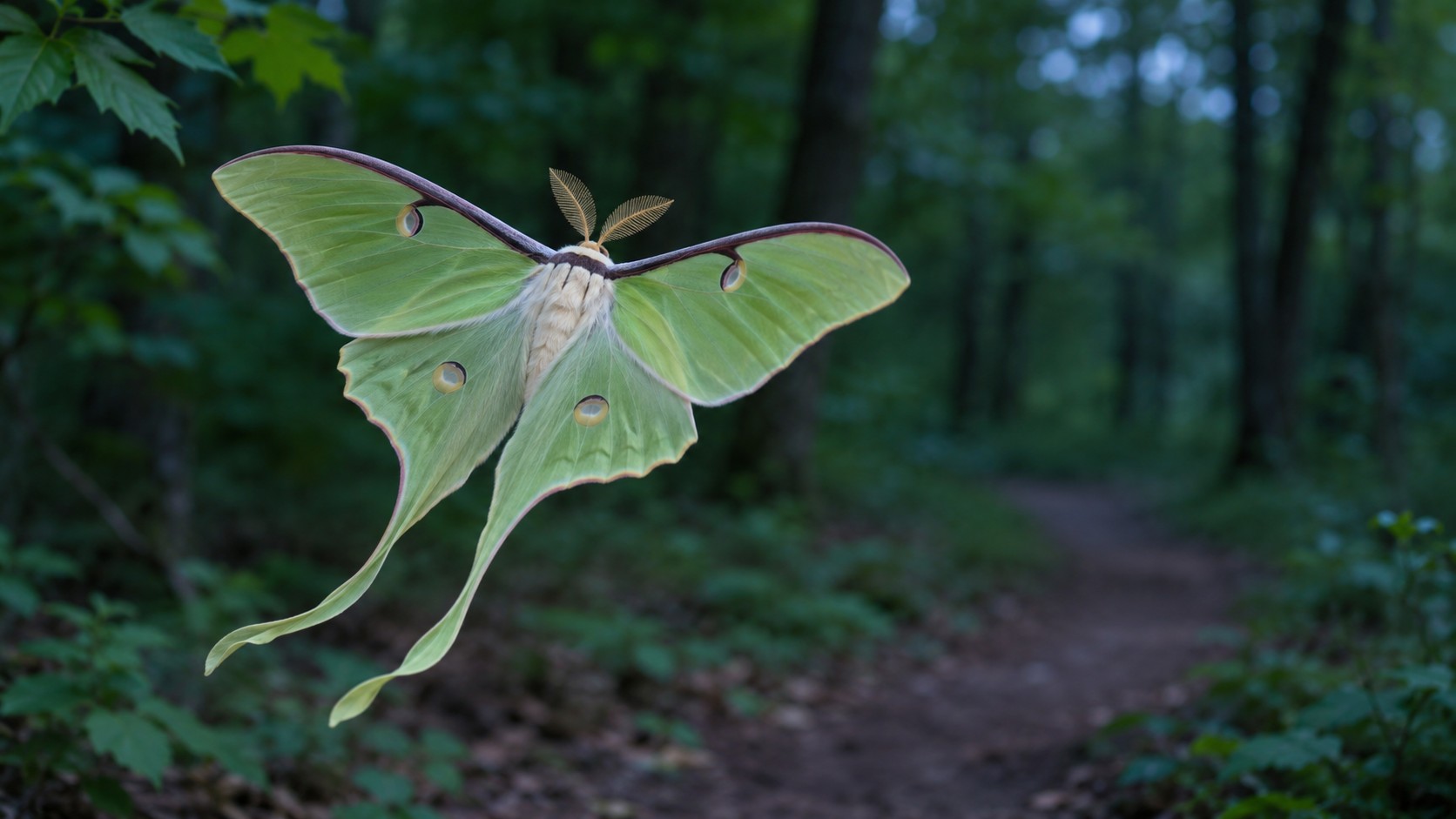
Each hindwing extends into a long, narrow tail. These are wing structures, not extra legs or appendages attached to the abdomen. Their movement during flight has attracted research into interactions with echolocating bats. This is a different sensory setting from a bird looking at a bright eyespot: echoes and flight dynamics can matter as much as the color pattern visible to a person. The tail’s visual elegance does not, by itself, reveal its ecological role.
Research Points Toward Acoustic Deflection
Experiments comparing intact Luna Moths with altered moths found that the tails could draw bat attacks toward the rear wing region rather than the body. The results support acoustic deflection as an important function. Subsequent work manipulating tail features has further examined how wing shape influences predator targeting and escape. These studies connect the trailing structures to a measurable survival interaction, not merely an attractive analogy.
Deflection does not mean the moth emits a universal sonar-jamming signal or becomes undetectable. The bat can still approach and attack; the target of that attack can shift. Nor should a laboratory result be converted into a guaranteed escape probability for every free-flying moth. Predator species, the encounter, and the moth’s condition remain part of the outcome.
A Damaged Tail Does Not Tell the Entire History
A worn moth may have shortened tails, missing scales, or torn margins. Such damage records loss of material but rarely identifies its cause by itself. Predation, abrasion, and other events can leave overlapping traces. A photograph cannot establish that every missing tip was removed by a bat, even though research makes that type of interaction biologically plausible.
The rest of the wing pattern and body can still support identification. Rejecting an otherwise recognizable Luna Moth solely because one tail is incomplete would confuse damage with a different body plan. Equally, an individual able to fly after damage has not demonstrated that the missing structure was useless. Function is evaluated through evidence across encounters, not inferred from one survivor’s appearance.
This distinction also argues against manipulating wild wings to reproduce a research result. Controlled studies involve designed comparisons and animal-care protocols. Cutting, pulling, or testing a moth’s tails during casual observation does not create a useful experiment. The natural condition should be documented rather than changed for the sake of proving what a structure does.
The Calendar Depends on Where You Are
Northern populations commonly have fewer annual generations than southern populations, and flight periods vary accordingly. A late-season adult in one area may fit a local brood rather than represent a universal migration schedule. Location, date, and current conditions are more useful than a single continent-wide emergence day. Regional monitoring records help establish when the species is expected, while unusual sightings should retain the evidence needed for others to evaluate them.
Wingspan, Broods, and Regional Differences
A commonly reported adult wingspan is 7.5–10.5 centimeters, approximately 3–4.1 inches. That measurement describes width across the open wings; the long tails extend in another direction and are not added to the span. A Luna Moth can therefore occupy a surprisingly large area while its central body remains much smaller than the surrounding green surfaces.
Seasonal differences include the wing margins. Southern spring adults can have pinker outer borders, whereas summer broods and northern populations often have yellower margins. These are variations within Actias luna, rather than evidence that every differently edged moth belongs to another moon-moth species. The broad green shape, eyespots, and hindwing tails remain useful in combination.
Hundreds of Eggs Do Not Mean Hundreds of Surviving Adults
A female can lay approximately 200–400 eggs, placing them singly or in small groups on suitable hosts. She distributes them during her short reproductive adulthood rather than tending a communal nest. The offspring begin feeding after hatching, without an adult returning to provide food. The female’s contribution includes the resources placed in the eggs and the choice of an appropriate location.
Young caterpillars face substantial losses before they can become large green larvae. An egg total measures reproductive output at one stage, not the number of moths that will later fly. Even when many eggs hatch, predators, parasitoids, unsuitable foliage, and other hazards can reduce the surviving group. High egg production and a brief adult life fit together without requiring every egg to complete the cycle.
Five Instars Build the Feeding Stage
Luna larvae pass through five instars. Each is an interval of growth bounded by a molt, and the last ends with the transition toward pupation. The caterpillar’s appearance changes during those stages, including the prominence of its raised body structures. Individuals from one egg batch need not have identical markings, and populations can differ as well.
Three pairs of small jointed legs lie near the head, while fleshy prolegs support the abdomen. Hooks called crochets help the latter grip vegetation. This arrangement is useful to a larva that spends its life on leaves and twigs, holding on while its jaws remove foliage. The broad adult wing is built later; it does not provide the growing caterpillar’s foothold.
Body size changes the animal’s exposure to enemies. A tiny larva can fit into spaces unavailable to a mature one, but it also lacks the size and developed structures of its later stages. Camouflage, attachment, and active responses contribute differently as growth proceeds. A late-instar caterpillar is consequently more than a larger version of the hatchling in a predator encounter.
Clicks and Regurgitation Add Active Defenses
A disturbed Luna caterpillar can produce clicks with its mandibles and release defensive regurgitant. These are larval behaviors, separate from the adult’s interactions with echolocating bats. A study of sound-producing silk moth caterpillars documented clicking in Luna as well as other species. Its detailed predator-deterrence assays used polyphemus moth regurgitant, so those particular test results cannot simply be assigned to Luna.
The distinction is between observing a response and measuring its effect on a particular attacker. A click can precede or accompany the release of fluid, but its occurrence alone does not establish that every predator will abandon an attack. Nor is provoking a wild caterpillar necessary to identify it. Its normal posture and host association supply information without forcing a costly response.
Size Can Change the Outcome of an Anole Encounter
Field observations by Florida Museum researcher Andrei Sourakov examined Luna larvae exposed to brown anoles. Small larvae remained vulnerable, whereas larger, later instars were better defended by body size, spines, and gripping crochets. In those observations, the change became apparent around a larval length of three centimeters. That is a result from the studied interaction, not a universal safe size against every predator.
The gripping structures matter because an attack is not always completed at first contact. Holding vegetation can affect whether a lizard manages to remove a caterpillar. A physical defense need not be a sting or a poisonous covering to influence the outcome. Different enemies also handle prey differently, so resistance to a lizard does not establish resistance to parasitoid insects.
Predators Can Have Effects Beyond the Animals They Eat
Experiments with Luna larvae and predatory wasps explored another cost of danger. The wasps were made unable to bite or sting but could move around the caterpillars. Larval survival was lower in the wasp treatments than in controls, with similar findings in two study years. A harmless fly treatment helped distinguish the predator response from the presence of another moving insect alone.
The work indicates that defensive responses themselves can carry costs. Larvae that died gained little weight, consistent with a possible reduction in feeding. It does not prove that every wild wasp encounter causes starvation. It does show why survival depends on more than simply counting caterpillars physically removed by predators: time spent avoiding danger can also change the resources available for growth.
Supporting the Whole Cycle
For Luna Moths, useful habitat includes suitable host trees, appropriate ground-layer shelter, and a nighttime environment that permits ordinary activity. A nonfeeding adult has no need for a specially staged nectar station. Protecting the less visible caterpillar and pupal resources addresses parts of the life cycle that a flower-centered approach would miss. Decisions about outdoor lighting also belong in a broader effort to maintain conditions for nocturnal wildlife rather than continuously illuminating every route and resting surface.
A respectful encounter leaves the moth on its chosen perch whenever possible and records the details that make the observation useful. The pale green wings, feathery antennae, and sweeping tails introduce an animal with an unusual division of labor across its life. Leaves fuel the growing stage; the cocoon protects transformation; the adult carries reproduction and flight into the night. Understanding those connections makes a brief meeting with a Luna Moth more substantial than a beautiful image alone.
There is no need to keep the moth nearby to make that meeting meaningful. A photograph showing the date, habitat, and natural posture can document its presence while allowing the next part of its life to happen elsewhere. The moth on a porch, the caterpillar on a branch, and the cocoon among fallen leaves may never be observed together by the same person. Recognizing their connection is what turns those separate discoveries into an understanding of the species.