

A brown bear of the western Himalaya
The Himalayan brown bear belongs to Ursus arctos, the same species as the brown bears of northern Eurasia and North America. Western Himalayan populations are conventionally called Ursus arctos isabellinus. Himalayan red bear and isabelline bear are alternative names; in Ladakh, the animal is known as Denmo. It is a member of the bear family, Ursidae, within the mammalian order Carnivora, although much of its food comes from plants.
The geographical limits of isabellinus differ among taxonomic treatments. Its familiar western Himalayan range centres on northern Pakistan and northern India, while some assessments apply the name more broadly across the Hindu Kush, Pamir and other Central Asian mountains. Genetic work published in 2017 distinguished Himalayan and Tibetan brown-bear maternal lineages, revealing regional evolutionary history within the brown bear species. Those maternal histories are one part of the evidence used to understand subspecies boundaries. A 2023 Central Asian assessment, for example, used isabellinus for fragmented populations including Afghanistan, parts of Tajikistan and the Tian Shan region.
Nepal illustrates why locality matters. Genetic samples collected in Upper Mustang and Dolpa during 2022–2024 clustered with Tibetan brown-bear references; a 2026 study assigned these sampled bears to U. a. pruinosus. Farther west, photographs from Limi Valley in Upper Humla established brown-bear presence without a genetic subspecies identification. A bear’s occurrence in the Himalaya therefore does not, by itself, identify it as isabellinus.
The 2017 genetic investigation also examined materials attributed to yeti stories and identified local bear lineages among the samples. This gives Himalayan bears a concrete connection to regional folklore, while leaving the identification limited to the materials actually studied.
Recognizing the bear
A heavy body, broad head and powerful forequarters give Himalayan brown bears their substantial outline. The shoulder hump consists of muscle, and the facial profile is concave. Long, non-retractile front claws work with the shoulders during excavation. At Deosai, bears use this equipment to dig into golden marmot colonies and reach underground food. Their short tail is inconspicuous beside the stocky body.
Reddish coats account for the name Himalayan red bear, but colour varies considerably. Deosai observers recognized blond, silvertipped, light-brown and dark-brown individuals. Bears generally darkened with age in that monitored population, and females were often lighter than males. Pale snouts, ear tips and shoulder patches also occurred, sometimes with pale areas extending towards the neck and chest.
The Deosai account reported adult females weighing 60–80 kg and adult males 120–150 kg. These local masses show the pronounced size difference between sexes. A Ladakh field guide gives a body length of 180–245 cm, a shoulder height near 100 cm and a tail around 10 cm long. Seasonal fat accumulation adds another source of variation in weight, alongside sex, age and feeding conditions.
The Asiatic black bear, Ursus thibetanus, is a different species that can overlap with brown bears in Himalayan subalpine habitats. Its conspicuous ears, usual pale chest crescent and strongly curved climbing claws contrast with the brown bear’s hump and digging build. A pale marking alone is less useful than the combination of body structure and habitat. North American grizzlies share the brown-bear anatomy because they too belong to Ursus arctos.
The brown bear and Asiatic black bear also differ in their typical use of mountain vegetation. Black bears are closely associated with forests, whereas regional brown-bear accounts emphasize open alpine and subalpine feeding grounds. Brown bears nevertheless enter scrub and forest pockets. Where those environments meet, habitat can support both species, making shape and the full set of recognition features useful.
Grizzlies are geographically separate from Himalayan brown bears, occurring chiefly in Alaska and Canada, with remaining populations in parts of the northwestern contiguous United States. Their familiar shoulder hump, concave face and digging claws identify a shared brown-bear build, rather than a uniquely North American appearance. Coat shade alone cannot distinguish these regional forms of the species.
Mountain valleys and summer plateaus
Deosai, east of Nanga Parbat in Pakistan’s Gilgit-Baltistan region, is an important research landscape for these bears. Much of its plateau lies at 4,000–4,500 m, within a life-history study area spanning approximately 3,500–5,200 m. Treeless ground supports perennial herbs, grasses and sedges. Feeding researchers distinguished marshy, grassy, stony and rocky habitats across this surface. Marshy patches offer productive vegetation and marmot colonies, whereas expanses of bare rock provide little forage.
Snow generally covers Deosai from October through May. In the feeding-study account, bears reached the plateau in June and departed around early October. Most winter dens were in surrounding valleys, so arrival in the summer feeding grounds was a later event than emergence from a den. Bubind, Minimerg and Karabosh were among the adjoining valleys included in feeding research. Coniferous forest, shrubs, grassy slopes and rocky ground make those valleys quite different from the open plateau.
In India, important western Ladakh landscapes include Drass, Suru, Rangdum, Shargole and Zanskar. Bears also occur in Kashmir and Lahaul in Himachal Pradesh; regional accounts extend into Uttarakhand, including Gangotri, Govind and the Bhagirathi basin. This distribution follows particular mountain landscapes rather than covering every part of the states and territories in which the bear occurs.
Western Ladakh models based on field signs recorded in 2019–2020 associated bear use with rangelands and proximity to water. Favourable conditions occurred mainly at 3,000–4,500 m in moderately rugged terrain. The regional field guide also describes summer use reaching about 5,500 m. Productive feeding ground helps explain where bears spend time within this large elevational setting; the highest or most rugged terrain is not necessarily the most useful.
Seasonal movements make valley connections important. Recognizable Deosai bears sometimes disappeared from the plateau for one or more summers before returning, and monitoring documented movement into neighbouring areas. An individual encountered in a protected summer meadow may also depend on habitats beyond that meadow during the rest of the year.
Grazing, digging and opportunistic meals
Himalayan brown bears eat grasses, sedges, broad-leaved herbs, roots, bulbs and seasonally available fruit, together with insects, small mammals and carrion. Broad molars with rounded cusps process plant material, while canines serve animal feeding. Their digestive tract lacks the elaborate fermentation compartments of ruminants. At Deosai, extensive grazing involves taking in large amounts of vegetation whose structural carbohydrates bears digest relatively poorly.
Golden marmots supply an important local source of meat. Bears excavate their colonies, combining sustained plant feeding with bouts of forceful digging. Deosai’s marshy ground brings these resources together: productive grass and sedge patches support grazing bears as well as marmot colonies.
Grasses and sedges dominated visible remains in Deosai scats, but animal foods contributed more energy than their small residue volume suggested. Meat and vegetation leave different amounts of recognizable material after digestion. Researchers therefore used food-specific corrections to estimate dietary energy, while plant DNA helped identify the diversity of plants eaten. A scat full of grass fibres does not mean that all of the bear’s nutritional intake came from grass.
Deosai has relatively few fruit resources compared with forested or cultivated valleys. Even so, bears sampled on the plateau had a more diverse and nutritionally richer diet than those in the surrounding valleys in that study comparison. Valley scats were more dominated by grasses, sedges and crops. Roots became less frequent towards the end of the plateau’s active season, while most major food categories showed no significant monthly change.
Other Himalayan settings offer different seasonal menus. The Ladakh field guide describes fresh grass, roots, bulbs, insects and rodents in summer, followed by valley feeding on buckwheat, fruit and berries later in the season. In Lahaul, analysis of scats collected during 2018–2022 found grasses, sedges, herbs and berries prominent after hibernation. Before hibernation, grasses and horticultural crops featured strongly, and human-derived foods supplied the largest estimated energy contribution.
An Indian Himalayan dietary study published in January 2026 also found predominantly plant-based feeding, with grasses and sedges the most frequent foods. Some scats held only plant material, while others contained both plant and animal remains. Its corrected energy estimates gave animal foods a smaller role than the Deosai analysis did.
Carrion adds another feeding route. Ungulate remains in Deosai scats could include scavenged livestock; shepherds and dogs commonly guarded local herds, and researchers considered scavenging a plausible explanation for those remains. Evidence that a bear consumed livestock tissue does not establish that the bear killed the animal. In agricultural valleys, crops and stored food also bring bears close to people, including recorded feeding on yoghurt kept in drying skin bags around Deosai.
Activity and encounters with other bears
A Himalayan brown bear is often seen alone, or as a female accompanied by dependent young. Solitary adults nevertheless interact. Brown bears can tolerate neighbours at abundant foods and use overlapping home ranges, with dominance relationships among individuals. Posture, head and mouth positions, and vocal sounds communicate during close encounters. Across the species, rubbing and scent marking also carry information, especially during the mating season.
Activity varies among places. A Deosai camera survey conducted in 2021 found peaks around midday and sunset, demonstrating substantial daylight activity. The Ladakh field guide describes movement by day and night, with resting often occurring at midday. These regional observations show how a daily schedule can differ even among mountain populations. Camera detections record visits through sampled locations, rather than the complete daily routine of every individual.
Winter inside a den
Before winter, feeding supports the accumulation of fat reserves that sustain the bear through dormancy. The Ladakh account places denning approximately between November and May and records both caves and excavated dens. Local snow and feeding conditions shape this calendar. Around Deosai, most den sites lie in adjoining valleys rather than on the plateau used for summer foraging.
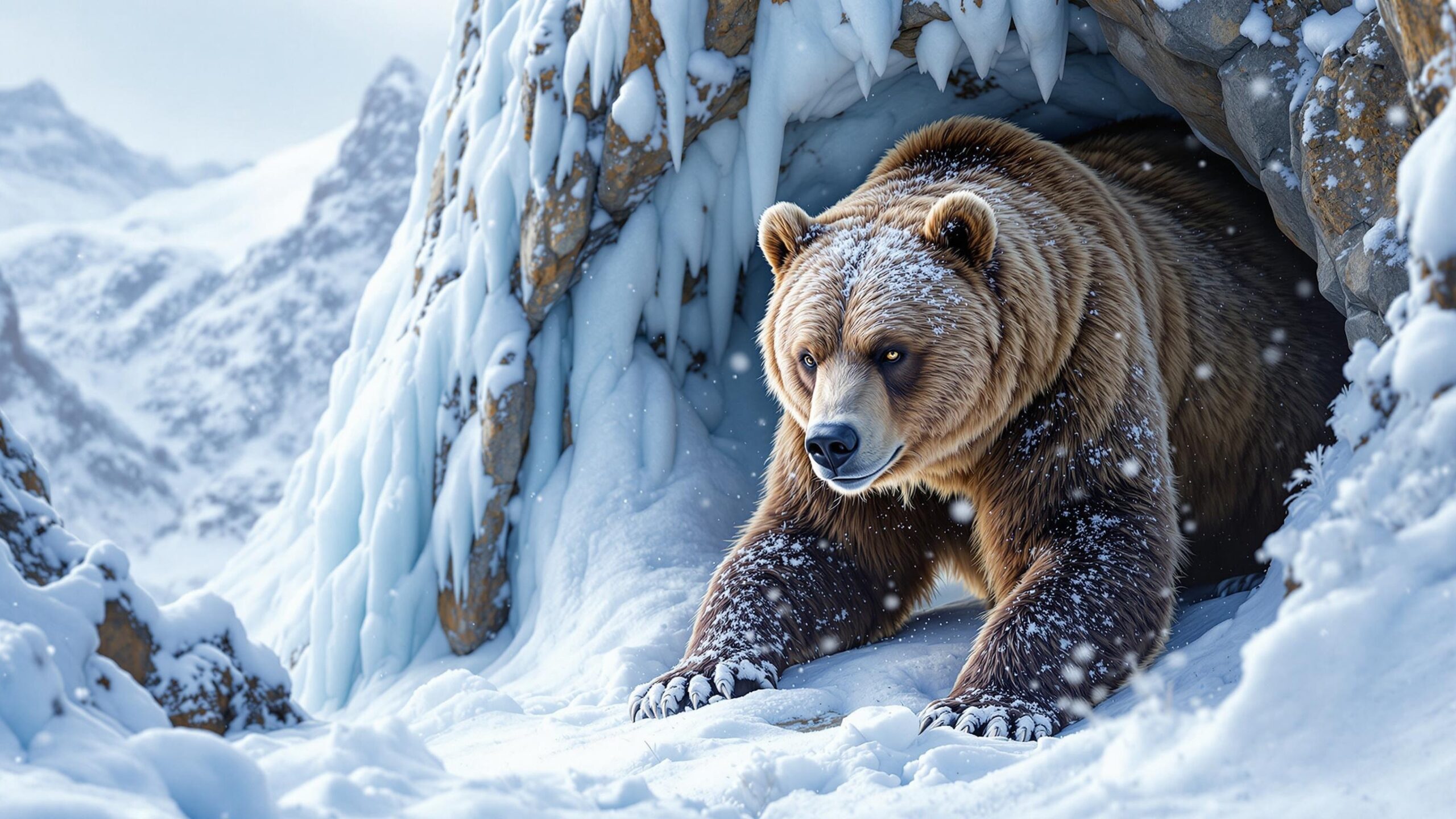
Brown-bear hibernation reduces metabolism and heart rate, lowering the energy needed during the winter fast. It differs physiologically from the deep torpor cycles of small rodent hibernators. A disturbed bear can become active inside its den. For a pregnant female, stored energy must also support reproduction: she gives birth in the winter shelter and nurses her tiny cubs there before the family begins travelling outside.
Cubs and a long maternal investment
The Ladakh field guide places mating in May and June. Brown bears have delayed implantation: an early embryo can remain unimplanted until development resumes in autumn. The interval between mating and birth thus includes a prolonged pause, followed by a much shorter period of active fetal development. Cubs are born during winter, blind and helpless, dependent on their mother’s warmth and milk.
Later, cubs accompany their mother outside the den and learn to forage. Deosai researchers followed recognizable bears from 1993 to 2006 and recorded litters after den emergence. Those visible litters contained one or two cubs, averaging 1.33. This describes young surviving to the observed stage outside the den; it is a different measure from counting newborns inside winter shelters.
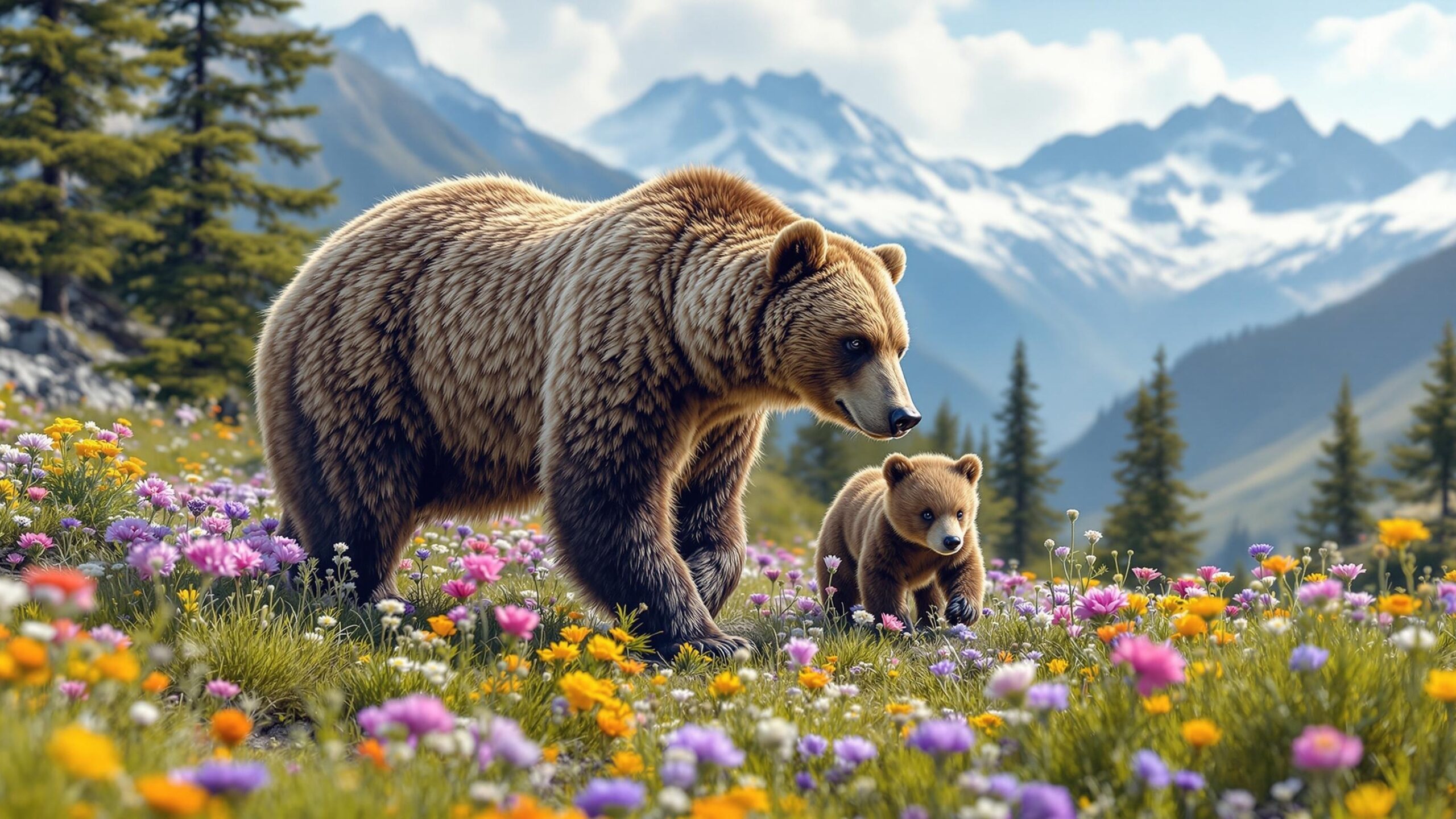
No female of reliably known age in that Deosai study was observed with cubs before seven years old. The estimated mean age at first reproduction was 8.25 years, incorporating incomplete histories and an assumed later first litter for one female. These results concern production of a litter, rather than the physiological onset of sexual maturity. Across the brown bear species, males generally become sexually mature near five years old, while female first reproduction varies greatly between populations.
Maternal association was also prolonged. Researchers estimated that mother and young remained together for an average of 4.2 years; completed associations observed for 11 young ranged approximately from 2.5 to 4.5 years. Remaining in a family group is distinct from continuing to suckle. The estimated mean interval between litters was 5.7 years, a measure that included incomplete intervals as well as fully observed ones.
Small litters, late first reproduction and long family associations make recovery through births a slow process. Deosai researchers linked this reproductive performance to a demanding seasonal environment with relatively low-energy feeding opportunities. For broader lifespan context, brown bears can live around 30 years in the wild. An exceptional North American individual reached 37 years, according to the specialist species account. Those figures describe the longevity possible within the species, rather than average survival or a maximum established for Himalayan populations.
A large omnivore in the alpine food web
Brown bears connect several parts of the mountain food web. At Deosai they consume meadow vegetation and prey on marmots; in valleys they add fruit, crops and carcasses. Excavating burrows turns alpine soil and leaves conspicuous digging traces. Fruit seeds also pass through bears, creating a possible route for dispersal as the animals move, although the diet studies did not follow those seeds through germination.
In Lahaul, bears share the landscape with snow leopards, wolves, foxes and wild ungulates. Their extensive plant feeding gives them a different dietary role from more meat-dependent carnivores. Pastoral use intersects with this ecology: Deosai researchers found bears avoiding areas with higher livestock density. Access to productive vegetation can therefore be affected by how people distribute grazing across summer pastures.
Farms, food waste and mountain communities
For mountain residents, sharing a valley with bears can bring direct costs. Interviews with household representatives in 37 Lahaul villages during 2018–2019 recorded reports of crop and orchard damage, including iceberg lettuce and apples, and losses of sheep, goats and cattle. These accounts describe residents’ experiences, rather than independently verified kills. Crop losses and livestock depredation were also concerns in the 2021 Deosai community survey.
Food disposal creates a further meeting point. Cameras in the 2021 Sonamarg pilot study recorded bears feeding at garbage sites associated with Sarbal, army transit camps and the Amarnath area. Discarded chicken parts and other food waste offered concentrated resources near human facilities. Scats contained cultivated food remains and plastic packaging, showing that bears swallowed debris along with discarded food.
The local management responses proposed by Lahaul researchers included crop-waste management, supervised grazing and community participation. Such measures address the resources and daily activities that bring people and bears together. Encounter circumstances also matter: brown bears can react defensively when surprised at close range, and mothers can defend their cubs. A bear feeding near a settlement remains a wild animal with those responses.
Conservation at the right geographical scale
The brown bear species, Ursus arctos, is classified as Least Concern globally. Its large northern populations strongly influence that assessment. The Gilgit-Baltistan government’s 2022 report distinguished this global listing from the Himalayan subspecies, which it described as not separately assessed on the IUCN Red List. Isolated southern mountain populations face more serious pressures from illegal and retaliatory killing, fragmentation and development. For bears producing young slowly, additional adult losses and reduced movement between neighbouring groups can have lasting consequences.
Pakistan’s Critically Endangered label cited in the Gilgit-Baltistan government’s 2022 report comes from a 2004 national assessment. Separately, the 2016 brown-bear population supplement treated its Himalaya Mountains unit as Endangered conditionally on disconnection from Tibet and assessment as one population. It classified Pakistan’s Hindu Kush unit as Critically Endangered and the Karakoram–Pamir–Hissaro-Alai unit as Vulnerable. These geographical units have different boundaries from a single subspecies.
Legal protection addresses another part of conservation. Brown bears are listed under Ursus arctos in Schedule I of India’s Wild Life (Protection) Act. The regional form U. a. isabellinus is included in CITES Appendix I for international trade protection. Neither instrument is a global extinction-risk category. In western Ladakh, infrastructure expansion, grazing pressure and unregulated tourism place additional demands on the valley habitats bears use.
Deosai offers a dated example of improvement. Monitoring recorded 19 bears in 1993 and a minimum count of 43 in 2006. Researchers attributed the increase to reproduction together with immigration from neighbouring areas. Protection and monitoring were combined with community participation and pasture zoning: a core bear area reduced grazing pressure, while designated areas retained local grazing access. The combination addressed the need for productive summer feeding habitat while accommodating pastoral livelihoods. Immigration also showed why the protected plateau’s connections with neighbouring bear areas mattered to its recovery.