A bear shaped by bamboo
The giant panda, Ailuropoda melanoleuca, belongs to the bear family, Ursidae, within the mammalian order Carnivora. That ancestry helps explain an unusual combination: a head and forepaws specialized for handling tough vegetation, coupled with a digestive tract still resembling those of carnivorous relatives. Its staple is bamboo, a grass whose shoots, leaves and woody stems offer very different meals as the growing season unfolds.
Two living subspecies are recognized in the bear-specialist treatment. Ailuropoda melanoleuca qinlingensis inhabits the Qinling Mountains of Shaanxi; A. m. melanoleuca occupies the other mountain populations, principally in Sichuan and neighboring Gansu. The 2005 subspecies description found smaller skulls, larger molars, darker brown chest patches and browner belly fur in its Qinling sample than in Sichuan animals. These are population comparisons, so coat color alone is an unreliable guide to an individual’s subspecies.
Rare brown-and-white pandas are also members of this wild species. Their unusual coloration is distinct from the broader geographic differences used to describe the Qinling subspecies. Most pandas have the familiar black ears and eye patches, dark shoulders and limbs, and largely white head and trunk. A short muzzle, broad head and compact body give even a standing adult a rounded outline.
Recognizing a mountain bear
Adults measure about 120–180 cm from head to rump, excluding a tail of roughly 10–15 cm, and stand about 60–90 cm at the shoulder on all fours. Reference mass ranges are approximately 70–100 kg for females and 85–125 kg for males. The sexes overlap in size, although males tend to be larger. Managed males can be heavier still, sometimes reaching 150 kg or more.
The coat combines woolly underfur with coarser, slightly oily guard hairs. The underfur insulates, while the outer hairs help shed water in cool, damp forest. Its contrasting colors can conceal as well as distinguish the bear. A 2021 analysis of wild photographs found that black fur matched shadows and dark trunks, white fur matched foliage or snow, and intermediate tones blended with rocks or ground.
Vision models in that study also supported disruption of the panda’s outline at longer distances. A pattern conspicuous against a plain background can become less obvious among broken patches of light, vegetation and shade. Camouflage is therefore a supported function of the coat, although it does not establish the evolutionary role of every marking around the head.
Forests across six mountain systems
Wild giant pandas survive only in China, in Sichuan, Shaanxi and Gansu. Their distribution spans six mountain systems: Qinling, Minshan, Qionglai, Daxiangling, Xiaoxiangling and Liangshan. These support separated populations across a mountainous landscape. Today’s range occupies a restricted western portion of the animal’s former distribution, following the loss of lowland habitat to farming, settlement and forest clearance.
Fossils assigned to Ailuropoda occur beyond modern China, but that genus includes extinct forms. Those records do not all represent the surviving species. Pandas seen in zoos overseas live under institutional management.
Pandas use coniferous, broadleaf and mixed forests where a substantial bamboo understory supplies food and cover. Streams and rivers provide drinking water, while mature trees offer places to rest and potential birthing hollows. Bamboo abundance is central to whether a forest can support pandas, but a female raising a newborn also needs shelter with quite different properties from a feeding patch.
The broad reported elevation envelope is approximately 1,200–4,100 m, with regional differences and brief excursions near its upper limit. A high alpine observation does not mean pandas live there throughout the year. Seasonal access to different forest elevations matters because bamboo growth changes along the slopes, creating feeding opportunities at different times.
Holding and breaking tough food
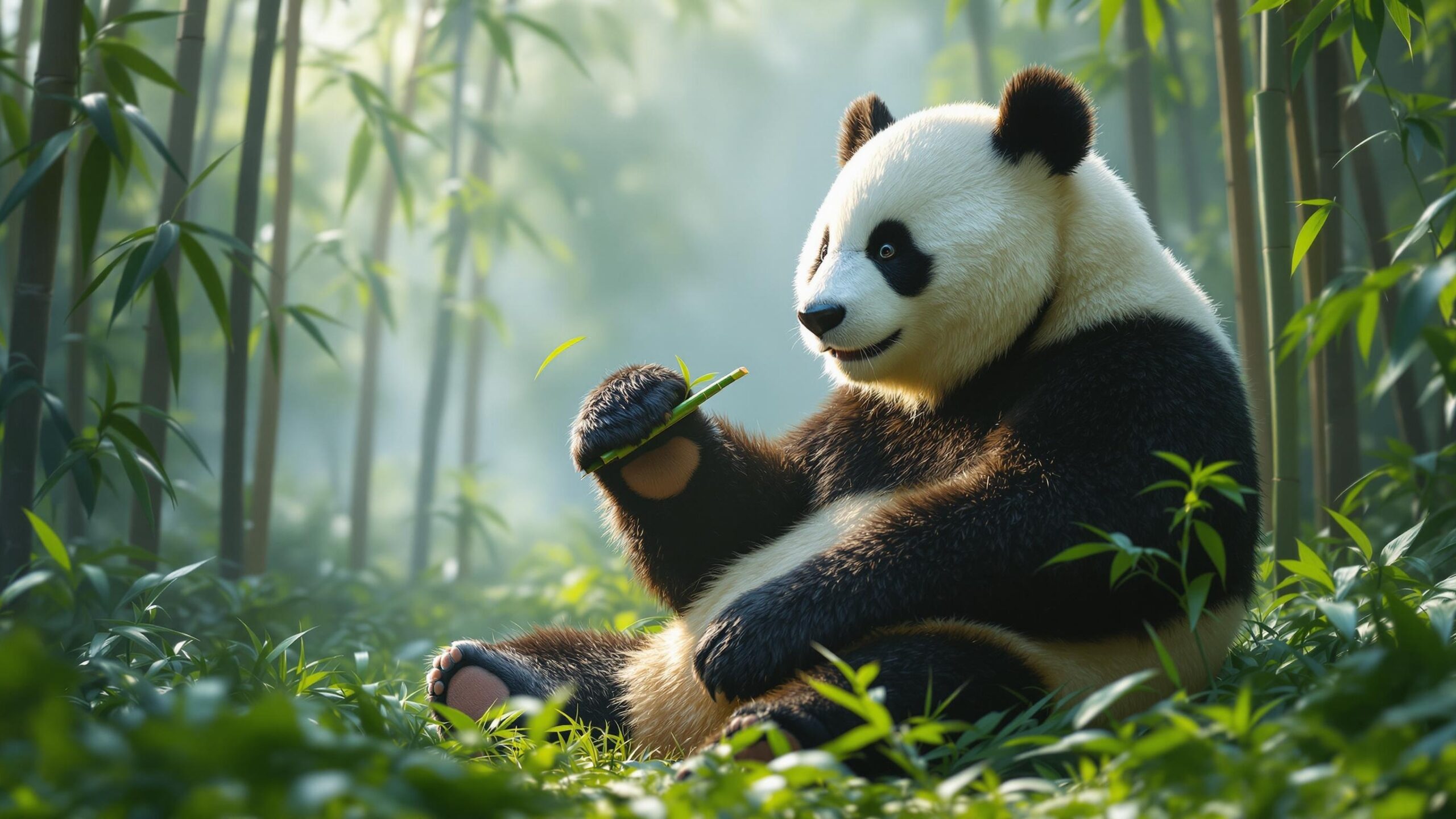
A feeding panda often sits or reclines, bringing bamboo to its mouth with its forepaws. Its apparent extra thumb is an enlarged wrist bone, the radial sesamoid, alongside five true digits. As the fingers bend around a stem, this structure acts as a passive stop. It helps secure a stalk while the teeth strip away tough outer material and break the exposed portion into smaller pieces.
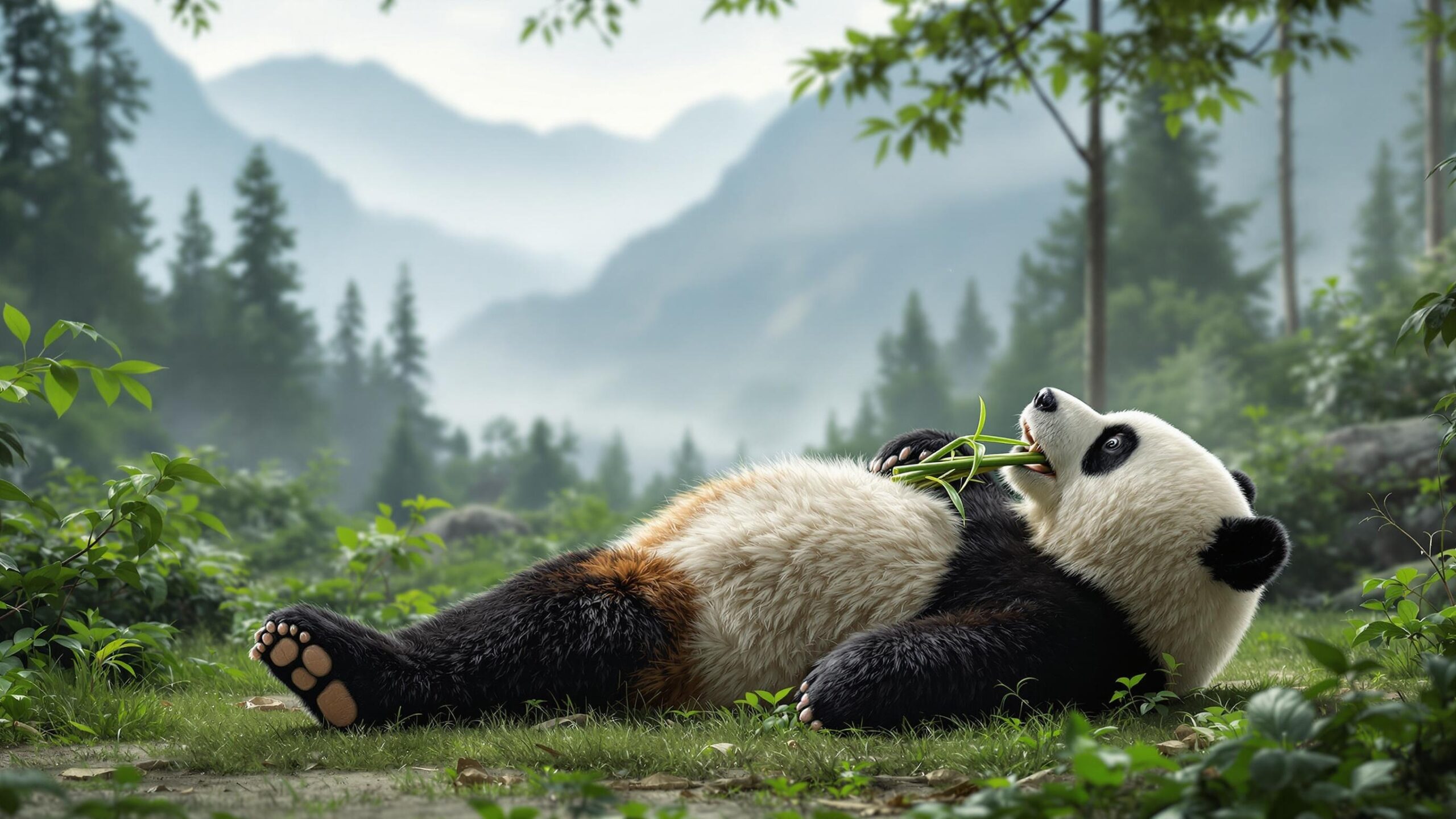
The same wrist also helps support the animal while it walks on its palms. A 2022 anatomical study interpreted the modern false thumb’s short, hooked form as a compromise between grasping bamboo and bearing weight. A longer projection might help encircle food yet interfere with walking.
This adaptation has deep roots. Fossils of the ancestral panda Ailurarctos from Shuitangba in Yunnan include an enlarged radial sesamoid dating to roughly 6–7 million years ago. The researchers interpreted it as evidence that bamboo handling was already established in that ancestral lineage.
Inside the head, broad cheekbones and a prominent ridge along the skull provide attachment for powerful chewing muscles. Large, flattened molars supply crushing and grinding surfaces. Grip, muscular force and tooth shape work at successive stages of a meal: the paw steadies the stem, the front teeth expose edible material, and the rear teeth crush it.
The energy balance of a bamboo diet
The panda’s digestive system has changed less dramatically than its feeding equipment. It retains a simple stomach and a comparatively short intestine with limited specialization for prolonged fermentation. Much of its nutritional return comes from accessible contents of plant cells, rather than efficiently breaking down fibrous cell walls. Processing large amounts of bamboo takes time: foraging and eating commonly occupy about 10–16 hours a day.
A 1982 managed-care study illustrates that limited digestion. In two pandas observed during three one-week trials, average bamboo dry-matter digestibility was below 20%. The apparent digestion coefficients were 27% for hemicellulose and 8% for cellulose. The particularly low cellulose result reflects the difficulty of extracting energy from this structural component of plant cell walls.
Food quantities also depend on which bamboo parts a bear eats. For a panda weighing roughly 100 kg, a reference synthesis reports about 12–15 kg of fresh leaves and stems daily, compared with about 23–38 kg of fresh shoots. These are fresh masses, including water; the plant parts differ in composition. They cannot be compared directly with measurements of food intake expressed as dry matter.
Energy use is another part of the panda’s dietary puzzle. A study published in 2015 measured five captive and three wild pandas and found a combined mean expenditure of 5.2 megajoules per day, about 38% of the value predicted for mammals of comparable size. This was a combined result for the eight studied animals, rather than a wild-only average.
The 2015 researchers linked low expenditure partly to limited physical activity and reduced sizes of several vital organs. They also found circulating thyroid hormone levels below those expected for a mammal of comparable size. A panda-specific variant in DUOX2, a gene involved in thyroid hormone synthesis, was proposed as a possible explanation for those hormone levels.
A separate study published in 2016 found a different degree of energy economy in managed pandas at Chengdu. Resting metabolism was somewhat below expectations for their size, while daily expenditure measurements in outdoor enclosures were substantially higher than the earlier study reported. Its activity analysis comprised seven measurements on six individuals across summer and winter. The discrepancy leaves the magnitude of energy savings unsettled; neither study supplies a universal daily requirement for every wild panda.
Feeding occurs in bouts separated by rest, with activity during both day and night. Pandas keep eating bamboo through winter rather than entering prolonged winter hibernation. Occasional field records include other leaves, roots or fruits, as well as carrion, bones or hides. Bamboo nevertheless dominates their natural diet.
Following seasonal growth
At Foping in the Qinling Mountains, low-elevation Bashania fargesii produces shoots in May, while higher-elevation Fargesia qinlingensis shoots in early June. Changes in food availability occur at different heights as the season progresses. Pandas there generally move higher in June and remain high through August. In a comparison with Wolong, however, pandas at Wolong generally moved lower in April and stayed lower through June.
GPS records from six Foping animals, one female and five males monitored for unequal periods during 2007–2018, showed first arrivals in summer habitat between 20 May and 20 June. Returns to winter habitat occurred from August to October.
Food quality changes as well as food location. A separate Foping nutritional study followed six collared pandas, three of each sex, and analyzed paired food and fecal samples collected in 2009 and 2010. The animals switched among leaves and shoots of the two bamboo species. Young low-elevation shoots contained more nitrogen and phosphorus than the leaves they replaced, but those concentrations declined as the shoots matured.
When the pandas changed to young shoots higher on the mountain, their food again contained higher concentrations of both nutrients than the older shoots below. Nitrogen served as a measure of protein content, and the analysis also examined calcium balance. These local results connect seasonal travel with the changing nutritional value of particular plant tissues, beyond the simple presence of bamboo on a slope.
The tracked animals repeatedly used the same or similar seasonal home ranges. The authors interpreted this consistency as support for spatial memory, which could help a bear return to familiar feeding areas, although their tracking study did not experimentally demonstrate memory.
Solitary lives connected by scent
Giant pandas generally forage alone within overlapping home ranges. Males tend to range more widely than females, while mothers restrict their movements during early cub care. Overlap gives individuals opportunities to encounter one another’s signals even when the animals themselves do not meet. Urine and anogenital-gland secretions deposited on trees, rocks and travel routes convey information about identity, sex and reproductive condition.
Some males lift their hindquarters into a handstand-like posture while urine marking, placing the scent higher on a trunk than a low squat would. Vocal signals become useful during closer encounters. Bleats and chirps commonly accompany courtship or nonaggressive interactions; barks, growls and roars are also part of the repertoire, with lower-pitched calls occurring during aggression or avoidance.
Indirect connections can be studied through traces left in the forest. A fecal-genetic survey at Sanguanmiao in Foping, conducted from November 2017 to April 2018, analyzed networks for 33 identified pandas with genetic, sex and age information. Genetic identification connected traces to individual bears, while sampling locations revealed their use of shared space. Adult males were more centrally connected than adult females in the spatial associations. These were relationships inferred from fecal locations among largely solitary bears, rather than observations of animals traveling as a permanent group.
A short mating window and a long dependency
Most wild mating activity occurs from March to May, when scent and calls help males and females locate one another. Several males may compete around a receptive female. A female usually has one spring estrus cycle, with peak receptivity lasting about one to three days within a longer period of reproductive changes.
Sexual maturity is generally placed around four to six years in managed care, with wild animals sometimes maturing as late as seven or eight. Maturity is different from a first successful birth. The interval from mating to birth is also variable, approximately 90–180 days, because implantation of the embryo is delayed. Ultrasound research in managed females has demonstrated this delay; fetal development occupies only part of the elapsed interval.
In a 2009 ultrasound study of managed females, the average interval from first fetal detection to birth was about 17 days. That clock began when ultrasound examinations could detect the fetus, after implantation had already occurred. It therefore describes a late stage of pregnancy, distinct from the much longer and more variable interval measured from mating.
Birth commonly occurs in late summer in a sheltered tree hollow or rock cavity. Newborns are pink, blind and helpless, requiring close maternal contact for warmth and nursing. Reported newborn masses include a range of about 75–150 g; a later study in managed care reported averages of about 150–160 g.
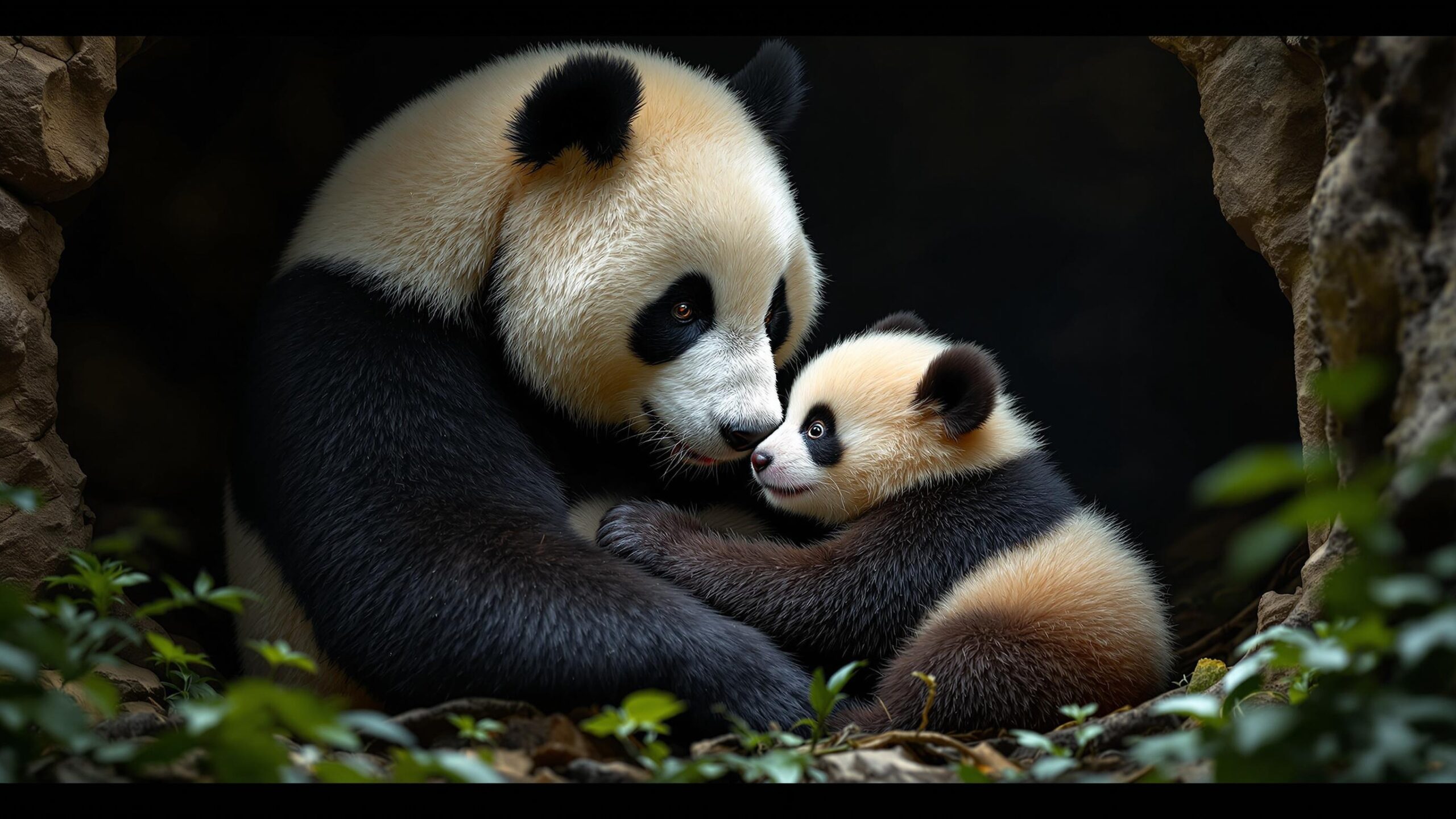
A Qinling field study followed reproductive activities of six females from 1989 into early 1995, obtaining mating, birth and den-use details for three. Pregnant females moved downslope earlier than other pandas to find birthing dens. One mother and cub were videotaped from birth until denning ended at 94 days; early contact was nearly continuous. Postpartum fasting in the study observations lasted up to three weeks.
Mothers in that Qinling study moved cubs between dens three or four times during a birth season. Cubs left their dens at about three to four months, fully furred and able to withstand winter conditions without continued den shelter. That departure was an early developmental transition, long before the end of maternal feeding and care.
The San Diego Zoo’s developmental account describes dark markings appearing at one to two weeks and walking well and playing with the mother by about three to five months. Cubs may begin eating bamboo leaves around six months while still depending on milk. Wild-population syntheses place weaning around 18–24 months. Limited field studies suggest intervals between births of roughly two to three years.
Old trees, livestock and forest connections
Den structure can alter the conditions experienced by a dependent cub. A study published in 2019 compared occupied tree dens at Fengtongzai with rock cavities at Foping. Both buffered temperature and humidity relative to outside conditions, with the tree dens buffering extremes more effectively in that comparison. At Fengtongzai, pandas selected concealed hollows with larger interiors and relatively small entrances compared with interior size.
Old cavity-bearing trees consequently provide a reproductive resource alongside the bamboo beneath them. Forest use by people can also affect food directly. A Wolong study published in 2014 documented free-ranging horses consuming bamboo and using suitable panda habitat. Its small local samples showed potential overlap in food and space, identifying a management issue where livestock enter panda forest.
Fragmentation presents a broader problem by separating populations and restricting exchange between them. Giant Panda National Park was formally established on 12 October 2021. An official October 2026 review reported ecological corridors reconnecting 13 local panda populations.
Recovery with continuing risks
The giant panda is classified as Vulnerable on the IUCN Red List. Its change from Endangered was announced in September 2016, reflecting improvement attributed to forest protection and reforestation. The assessment recorded an increasing population trend for its evidence period. Continuing loss and fragmentation of habitat remain concerns, and climate-driven changes to bamboo habitat pose a projected future risk.
China’s fourth national survey, conducted during 2011–2014, estimated 1,864 wild pandas with an end-of-2013 population reference date. Announced in 2015, that estimate was 268 animals higher than the third survey’s estimate, a reported increase of 16.8%. Surveyors combined field transects, vegetation sampling and DNA analysis of wild panda material; fecal DNA supplied individual genetic information without requiring a sighting of every bear.
An official report in October 2026 described the wild population as nearly 1,900, a rounded update rather than a newly detailed national census. Separately, a November 2026 announcement reported 830 captive pandas in China. These figures describe different populations, and growth in a national total can coexist with risks to small, isolated wild populations.
Other pandas, other bears and life in human care
Red pandas share bamboo feeding and climbing habits with giant pandas, but belong to Ailuridae. Their reddish fur, pale facial mask and long, ringed tail distinguish their much smaller bodies. The Mammal Diversity Database recognizes the Eastern Red Panda, Ailurus styani, in China and Myanmar, while acknowledging debate over species versus subspecies rank. Local forest overlap does not give red and giant pandas identical ranges.
The Asian black bear, Ursus thibetanus, is a fellow ursid with a mostly black coat, conspicuous ears and a pale chest crescent. Its range extends from western Asia through parts of southern and eastern Asia to the Russian Far East. Seasonal fruits, nuts and animal foods give it a much more varied diet than the giant panda’s.
Institutional panda programs have contributed hormone monitoring, ultrasound and assisted-breeding research. Keepers can alternate twins between maternal nursing and assisted care, whereas wild mothers usually rear one cub. Estimated wild lifespan is about 15–20 years, with uncertainty; pandas in human care can live around 30 years. The Smithsonian’s male Hsing-Hsing died at 28 in 1999, an individual recorded lifespan rather than an average for managed pandas.