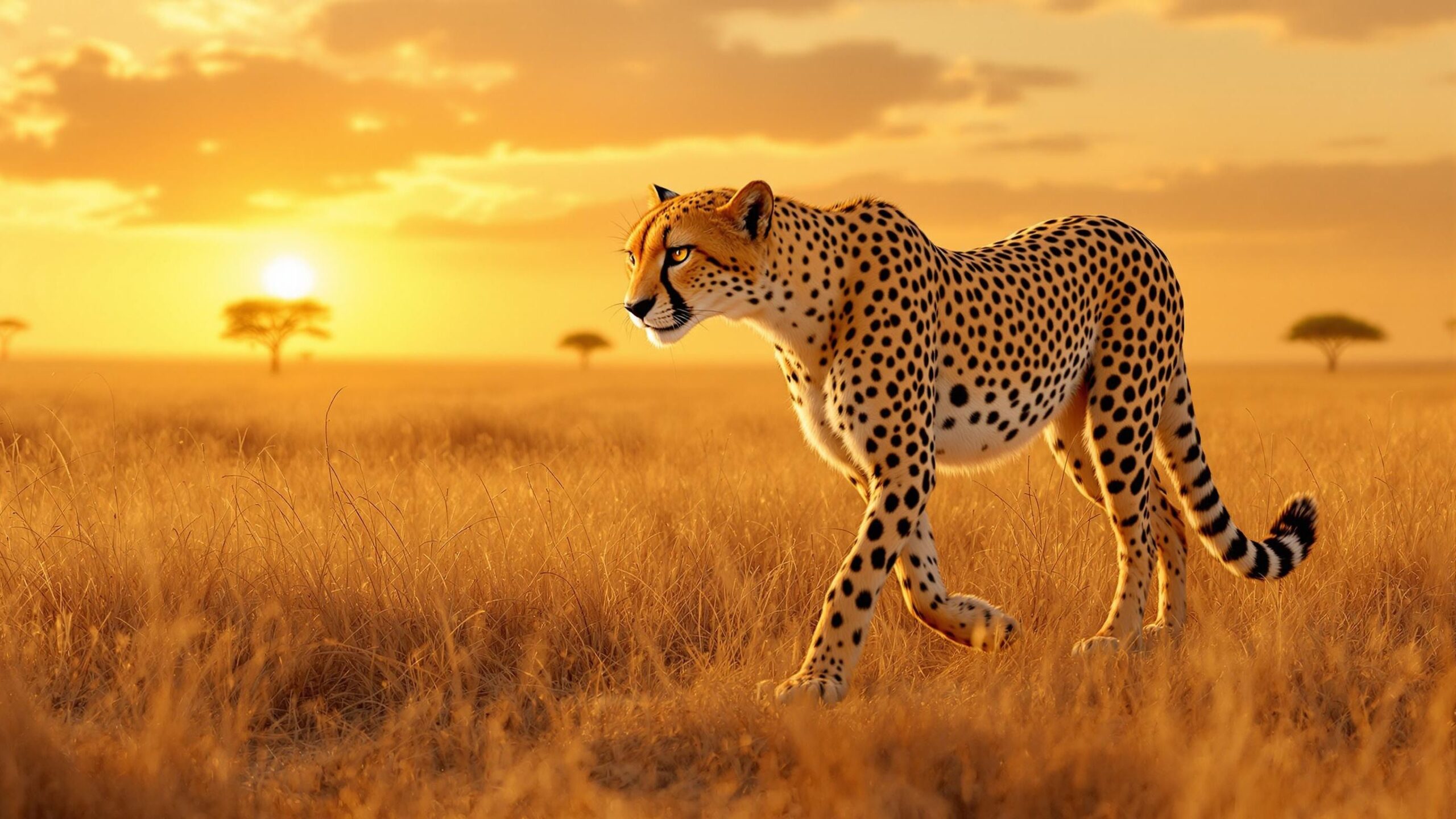
A cheetah of Central Africa’s savanna belt
In southeastern Chad, cheetahs survive in a landscape of floodplains, woodland and seasonally dry grassland. Greater Zakouma sits between the Sahel and the Congo Basin rainforests, within the broad savanna belt that separates those very different environments. Its cheetahs belong to Acinonyx jubatus, the same species found elsewhere in Africa and in Iran. “Central African cheetah” describes their geographic setting; it has no separately established subspecies rank.
The ancestry of the Greater Zakouma animals remains unresolved between the Northwest African cheetah, A. j. hecki, and the Northeast African cheetah, A. j. soemmerringi. The regional field study and the conservation strategy published in 2025 both retain that uncertainty. A photograph can establish that a cheetah visited a locality and sometimes identify the individual, but its locality and coat do not settle this lineage question.
Genetic work helps explain the difficulty. Mitochondrial DNA follows maternal ancestry, whereas nuclear DNA represents a broader inheritance from both parents. Studies of cheetah samples from Chad have found maternal sequences that do not fit a simple geographic division. Historical specimens also bring possible labeling and contamination problems. Separately, a 2022 genomic study distinguished an East African raineyi group alongside four other groups; that finding does not establish a Central African subspecies.
Where cheetahs are still documented
The regional range revision made in March 2024 and published in the 2025 strategy locates known resident Central African cheetahs in southeastern Chad. Zakouma, Siniaka Minia and the Melfi area form parts of this wider landscape, linked by intervening land. A photograph taken in the Roukoum/Melfi hunting zone north of Siniaka Minia in 2024 adds a locality record beyond the best-studied Zakouma camera sites.
Much of Chad remains poorly known for cheetahs. The southeastern resident range is therefore more securely established than a complete national distribution. It is geographically distinct from the remaining cheetah areas of the W-Arly-Pendjari complex in West Africa and the Saharan populations in Algeria and Niger. These surviving areas should not be imagined as one continuous occupied belt.
Across the border, the Central African Republic has no resident cheetah range in the 2024 mapping, although possible range and connecting areas remain. Cameroon is listed as regionally extinct by the Cat Specialist Group. The regional strategy places its last reliable sighting in the 1970s and records unsuccessful searches in the Bénoué Complex in 2007 and 2010. Possible or recoverable areas on a map describe different prospects from an established breeding population.
Recognizing the animal
A cheetah has a small head above a deep chest, long legs and a sharply narrowed waist. Solid black spots cover a tan or yellowish coat, with a paler underside. Black tear stripes extend from the inner corners of the eyes toward the mouth, and dark rings mark the outer part of the long tail.
Species reference measurements from Smithsonian give adults a mass of 34–64 kilograms, a head-and-body length of 112–142 centimeters and a tail measuring another 66–84 centimeters. Shoulder height is around 77 centimeters. These describe cheetahs generally rather than a measured Central African series. Males tend to be somewhat larger and broader-headed than females, but the difference is modest, making distant sex identification from size unreliable.
Leopards, which also occur in Zakouma, have rosettes rather than the cheetah’s simple spots, heavier bodies and relatively shorter legs. They climb extensively and occupy a broader variety of wooded and forest habitats. A serval presents another possible confusion in a brief view: it is also spotted and long-legged, but much smaller, with conspicuously large ears and a short tail. Its small-prey hunting in grassy cover differs from a cheetah’s pursuit of antelope.
Acceleration, grip and the ability to turn
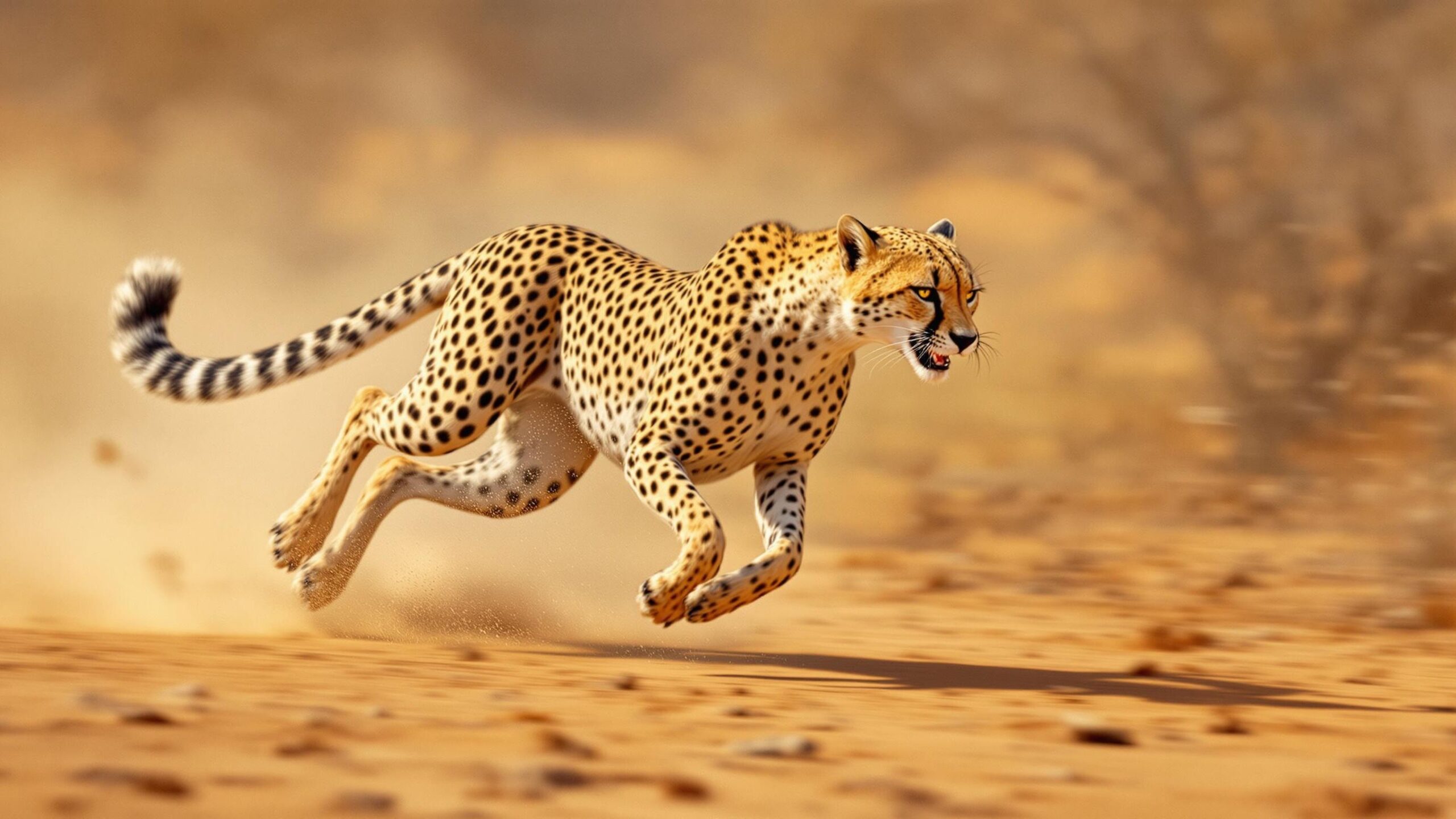
The cheetah’s flexible spine and long limbs extend its running stride. Mobile shoulders and hips permit large limb excursions, while partly retractile claws and specialized paw pads supply traction as the animal accelerates or changes direction. Its tail counteracts body movement during turns. This light body plan favors acceleration and brief pursuits rather than the muscular grappling associated with a leopard. Enlarged nasal passages and lungs support rapid air intake, and a large heart helps meet the demands of a sprint.
Field measurements elsewhere in Africa show why running ability involves more than a peak speed. A Botswana study published in 2013 used tracking collars on five wild cheetahs and recorded 367 runs, predominantly associated with hunting. Most hunts involved moderate speeds, alongside powerful acceleration, braking and sideways acceleration. These are observations of free-ranging Botswana animals, rather than performance measurements from Chad.
Another 2013 study followed six free-ranging cheetahs in Kgalagadi Transfrontier Park. Its detailed GPS records covered six chases, supplemented by accelerometer records of another 35. Cheetahs reduced speed near the end of pursuits while turning more rapidly; the precise movement pattern varied with prey. Faster travel tended to involve straighter routes. Braking gives the hunter room to match an evasive animal’s directional changes, because a tight turn at high speed imposes greater forces on the body.
A landscape reshaped by water
Rainfall around Zakouma is concentrated between June and October. Seasonal rivers spread water across parts of the park, changing which ground is accessible. As the dry season progresses, surface water retreats toward a few permanent pans. Floodplain, woodland and open ground consequently offer a changing arrangement of travel routes, cover and animal concentrations rather than a fixed hunting landscape.
Cheetahs use open and semi-open habitats, with vegetation that can conceal a stalk or provide a resting place. Across their species range they occupy grasslands, shrublands, open woodland, dry forest and semi-desert, but not tropical rainforest. Their presence in Central Africa therefore belongs to the region’s savannas rather than its deep equatorial forests. A treeless plain is only one version of suitable cheetah country.
Greater Zakouma’s protected areas are unfenced. Wildlife shares the surrounding landscape with permanent settlements and transhumant herders, whose livestock move north in the wet season and toward southern Chad or the Central African Republic during the dry season. Herds concentrate near the park boundary in dry months and sometimes enter it. Seasonal movement changes the location and intensity of contact between wildlife and people.
The eastern side of Zakouma is especially affected by seasonal flooding, which usually begins around July. A cool dry season from October to February gives way to a hotter dry period. Wildlife concentrates in the eastern half as dry-season water becomes restricted. The wider wildlife community also redistributes with the rains: hartebeest and tiang move north of the park, while elephants disperse west toward Siniaka Minia. These are movements of other wildlife in the cheetah’s ecosystem; the cheetahs’ own wet-season movements have much more limited tracking evidence.
What the Zakouma cameras reveal
Between January and April 2023, cameras in Zakouma identified nine independent adolescent or adult cheetahs: four females, four males and one whose sex could not be determined. Researchers matched flank spots, supported by facial or tail markings, to recognize animals across repeat photographs. The same cat can trigger several encounters, so identifying individuals is essential before treating camera records as evidence about abundance.
The resulting model estimated 0.37 independent cheetahs per 100 square kilometers, with a 95 percent confidence interval of 0.18–0.76. Dependent young were excluded. This is a density estimate for that Zakouma survey, with uncertainty, rather than a count for all southeastern Chad. The nine photographed independent animals supplied the individually recognized sample for estimating density.
A female accompanied by two dependent cubs provided direct evidence of local reproduction. Those two cubs represent the family group encountered later in development, however, rather than a measurement of the mother’s original litter size or a regional cub-survival rate.
Why a wet-season absence is difficult to interpret
A separate camera study collected Zakouma field data in 2020 and was published in July 2026. Its dry-season cameras recorded 14 independent cheetah events at 12 stations. In that study, encounters separated by at least an hour counted as independent events; the total did not mean 14 different animals. The researchers interpreted their spatial models as intensity of site use, since a wide-ranging carnivore can visit several small sampling cells.
No cheetahs appeared in its wet-season photographs, but coverage was reduced: 93 retained stations and 7,933 trap nights in the dry season compared with 49 stations and 2,022 trap nights in the wet season. Flooding made cameras inaccessible, batteries ran down, memory cards filled and growing grass blocked views. The cheetah-focused surveys also had no wet-season detections in Zakouma and Siniaka Minia in 2022.
These results do not establish a seasonal exodus. The 2026 paper separately reports unpublished collar observations of one cheetah in 2013 and one in 2023 that remained inside Zakouma during the wet season. Two individuals cannot describe every animal’s movements, but they show how wet-season park use can escape camera detection.
Stalking, pursuit and local prey
A hunting cheetah uses sight to select a target, sometimes scanning from elevated ground before approaching low through cover. Stalking shortens the distance that must be covered during the final pursuit. After catching a medium-sized ungulate, the cheetah commonly grips the prey’s throat until the prey suffocates. Feeding then takes place at a carcass that other carnivores may discover.
Across the species, prey commonly includes small and medium antelope, young of larger hoofed mammals, hares and birds. The Cat Specialist Group describes a preferred prey range of roughly 10–56 kilograms. Hunting party composition also matters: male coalitions can capture larger animals than a solitary cheetah. Local diet depends on the prey available and the animals doing the hunting, so an East African menu cannot simply be transferred to Chad.
Prey age can alter what is within reach of a cheetah. A young animal of a large antelope species presents a different capture problem from its full-grown parent. At the fenced Lapalala Wilderness Reserve in South Africa, a study published in 2023 combined observed kills, GPS-located kills and prey surveys to reveal seasonal changes in cheetah selection among prey ages. Newborn, juvenile and subadult prey were preferred during the wet season; adults and juveniles were preferred during the dry season. This illustrates how a seasonal supply of young ungulates can broaden a cheetah’s food base, while the timing and strength of such a change in Zakouma require local feeding observations.
Zakouma’s camera-based prey assessment included kob, warthog, bushbuck, reedbuck, red-fronted gazelle, oribi and common duiker in its small wild-herbivore category. These animals describe part of the local prey community. Their appearances at cameras measure availability and spatial distribution, not how often each was eaten. Neither regional camera study supplies dietary percentages or the share of cheetah food contributed by each prey species.
Lions, leopards, spotted hyaenas and striped hyaenas were also recorded in Zakouma. Larger competitors affect a cheetah’s feeding opportunities: lions and spotted hyaenas can displace cheetahs from their kills, and carnivore predation contributes to cub mortality at species level. Catching prey and retaining enough of the carcass to feed are separate challenges for this relatively light predator.
Solitary females, male coalitions and scent messages
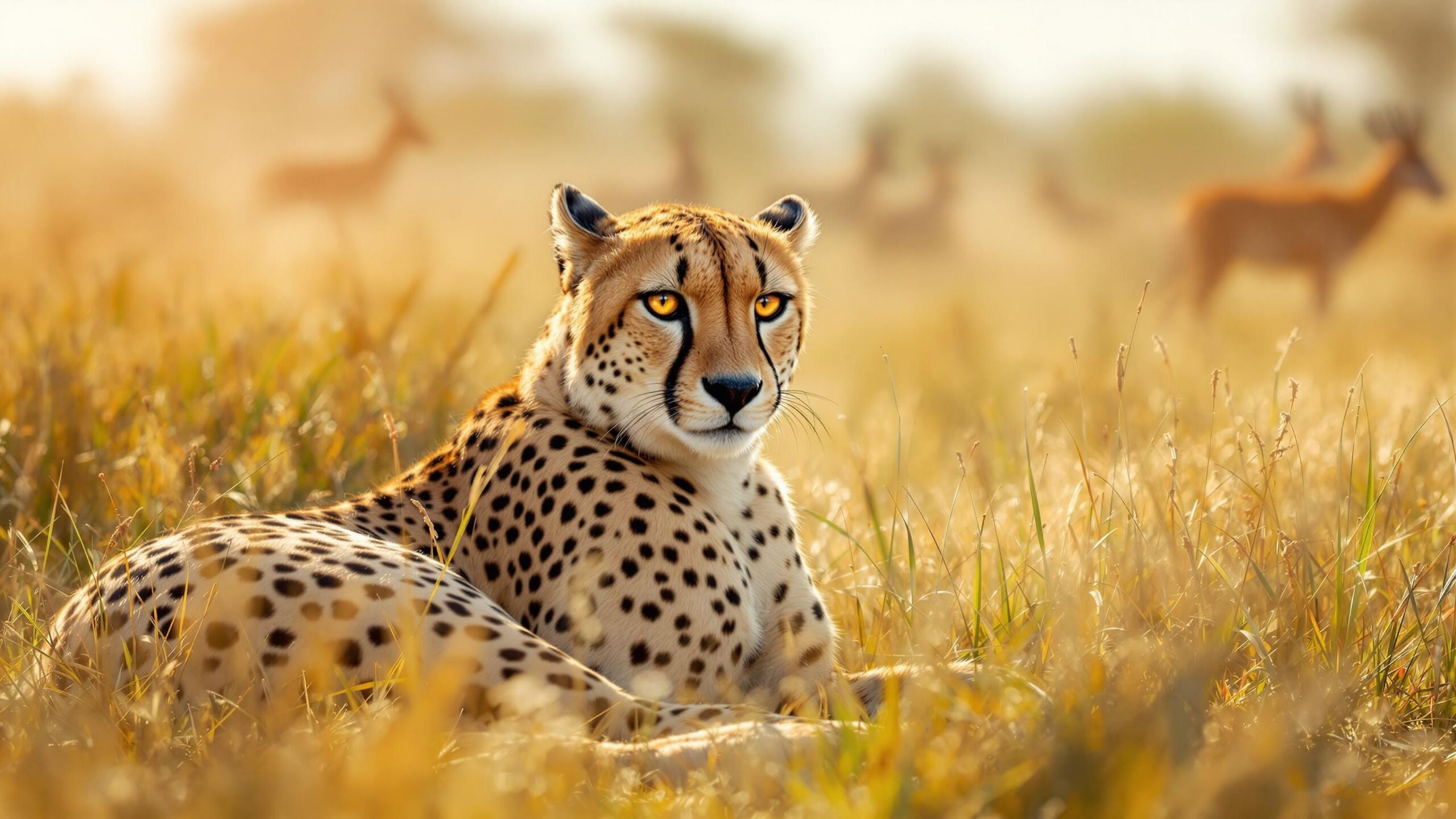
Adult female cheetahs generally live alone unless accompanied by dependent young. Males may live singly or form coalitions, commonly of two or three animals. Coalition partners are often relatives, although unrelated males can also associate. Some males defend territories, while females and nonterritorial males range across larger, overlapping areas. The dimensions of these spaces vary geographically with resources, prey and competing carnivores.
Urine, feces and scratching leave messages at prominent features. Trees, termite mounds and raised ground can become repeatedly visited communication points. Greater Zakouma researchers used such features, alongside trails and water access, to position cameras; marking sites produced more cheetah detections than the other placement categories.
Camera placement can also influence which social categories appear. Adult males tend to frequent marking sites, while females with cubs may avoid places used heavily by males. Zakouma’s four identified females and four males came from a survey with several placement types, and do not establish an exact population-wide sex ratio.
Cheetahs also chirp, purr, growl and hiss. Chirps help maintain contact between mothers and young or separated coalition members. They do not roar like lions. Although often active by day, cheetahs can also be active at night, including under moonlight; their schedule has flexibility rather than an absolute division between daylight hunting and nighttime rest.
Growing up with a hunting mother
A female raises her cubs without a male’s help. Species-level accounts give pregnancy as about three months, commonly around 93 days, and usual litters of one to six cubs, with larger litters recorded. Births can occur throughout the year, with seasonal peaks varying among regions. The photographed Zakouma family establishes breeding there without supplying a local birth calendar.
Young cubs have a long pale or smoky mantle along the neck and back, standing out against their darker-looking juvenile coat. This dorsal hair diminishes as they mature; camouflage is among its proposed functions. The mother moves her young between hiding or resting places.
Smithsonian describes cubs beginning to follow their mother at around six weeks and practicing with live prey at about six months. Following an adult is different from consistently catching enough food to survive. The mother supplies both nourishment and opportunities to develop hunting skills, while the cubs gradually learn to coordinate stalking, pursuit and capture.
Independence commonly comes during the second year, at approximately 13–20 months in the specialist account. Siblings may then remain together for several months before females separate; surviving brothers may continue as a coalition. Smithsonian summarizes wild cheetah lifespan as averaging 8–10 years, compared with 12–15 in human care. These broad species figures are not life-table estimates for Central African animals.
Protecting a sparse regional population
The cheetah is globally classified as Vulnerable. Northwest African hecki and Asiatic venaticus are classified as Critically Endangered, but applying a subspecies category to Greater Zakouma requires resolving its lineage. The geographic name Central African cheetah carries no separate assessment. Conservation of the resident animals and their landscape remains necessary while that taxonomic question is investigated.
Habitat fragmentation, depletion of wild prey and retaliatory killing threaten cheetahs across their range, alongside illegal live-animal trade. In the Sudano-Sahel, insecurity and difficult access also interfere with sustained monitoring and protection. For southeastern Chad, maintaining habitat beyond reserve boundaries matters because the protected areas sit within a wider, shared landscape rather than an enclosed system.
The 2020 Zakouma analysis found greater cheetah site use where livestock detections were more frequent in the dry season. That association establishes spatial overlap, not livestock consumption or the reason for the overlap. Resolving conflict requires evidence about actual losses and encounters, rather than treating a shared camera location as a recorded attack.
People living around Zakouma experience this carnivore community in different ways. A household interview study published in January 2026 found spotted hyaena predation and disease to be leading reported causes of livestock loss. Village residents and mobile pastoralists also described different seasonal patterns of losses to lions and leopards. The findings concern reported experience around the park, rather than verified cheetah kills. They show why identifying the responsible predator and the affected households matters when planning protection for both livestock and carnivores.
The same interviews conveyed how elusive cheetahs can be to their human neighbors. Of the 186 respondents interviewed across 146 households, 59 percent said they had never observed a cheetah. Respondents’ reports of population change express local perceptions, rather than a measured cheetah trend. Mobile pastoralists were more likely than village respondents to express an intention to retaliate after depredation. Such differences in attitudes mean that conservation measures must address the circumstances of particular livestock owners.
Chad and African Parks renewed co-management agreements on 2 July 2026 covering Zakouma and its ecosystem, Siniaka Minia and Ennedi, with support also reaffirmed for Aouk-Keita. These arrangements provide a framework for management, funding, public oversight and local development. Demonstrating cheetah recovery will still require repeated observations of individuals and breeding, alongside protection of prey and connected habitat. Areas identified as potentially recoverable in Chad, Cameroon and the Central African Republic represent restoration opportunities whose habitat, prey and human conditions must support returning animals.