
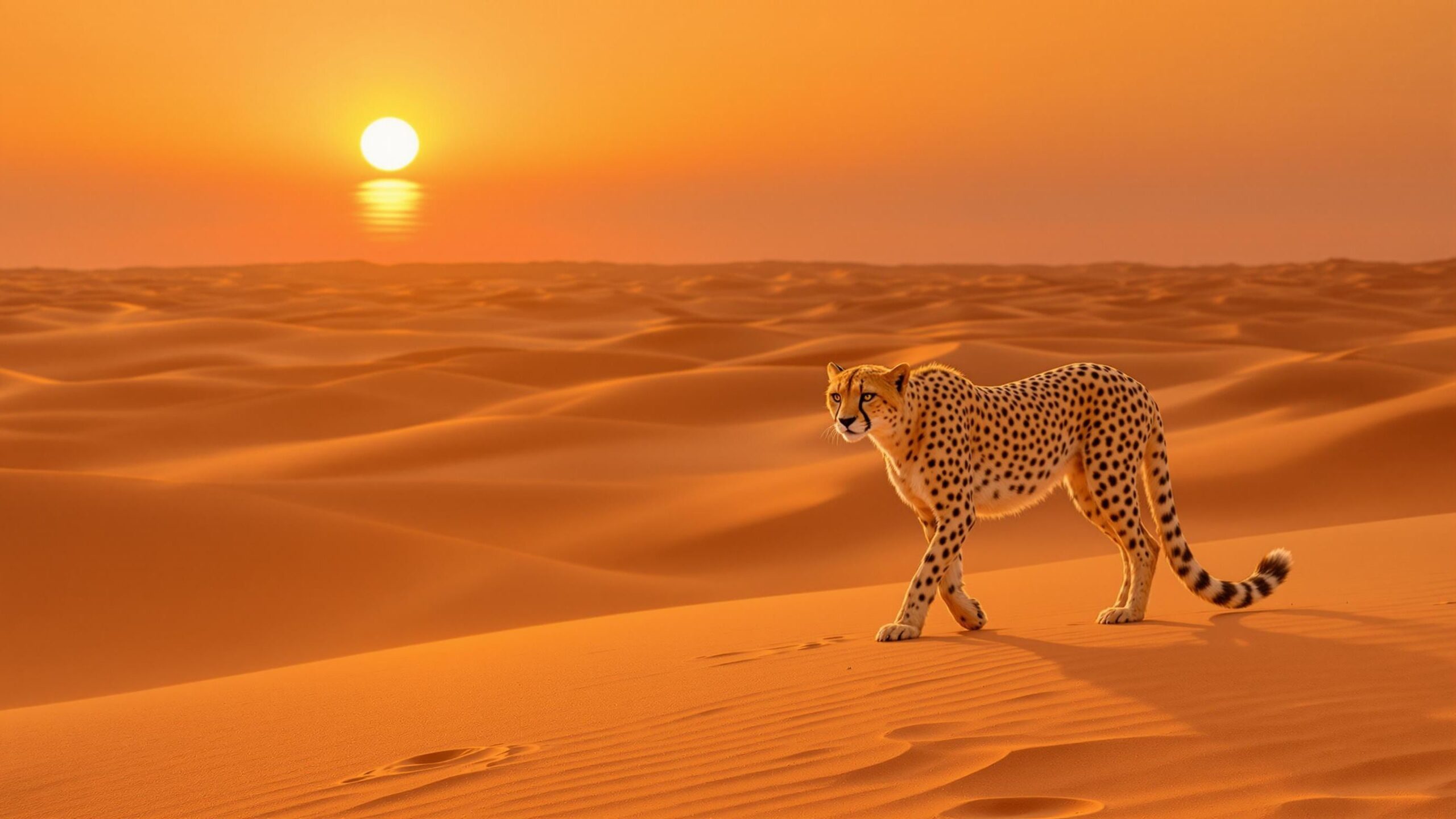
A cheetah with a regional identity
The name Acinonyx jubatus hecki places this animal within the cheetah species. Hilzheimer described the subspecies in 1913. “Northwest African cheetah” identifies a regional form within a much more widely distributed cat.
Specialists differ over how many cheetah subspecies to recognize. A four-subspecies classification groups eastern and southern African cheetahs together as A. j. jubatus; a five-subspecies interpretation separates the eastern form as A. j. raineyi. Both retain hecki in western and northwestern Africa. The northeastern form is A. j. soemmeringii, but its boundary with hecki in Chad remains unresolved. Greater Zakouma cheetahs consequently require caution in regional comparisons.
Arid habitat alone does not identify a subspecies. The Asiatic cheetah, A. j. venaticus, survives in Iran and also inhabits dry country. These regional forms have geographically separated surviving populations.
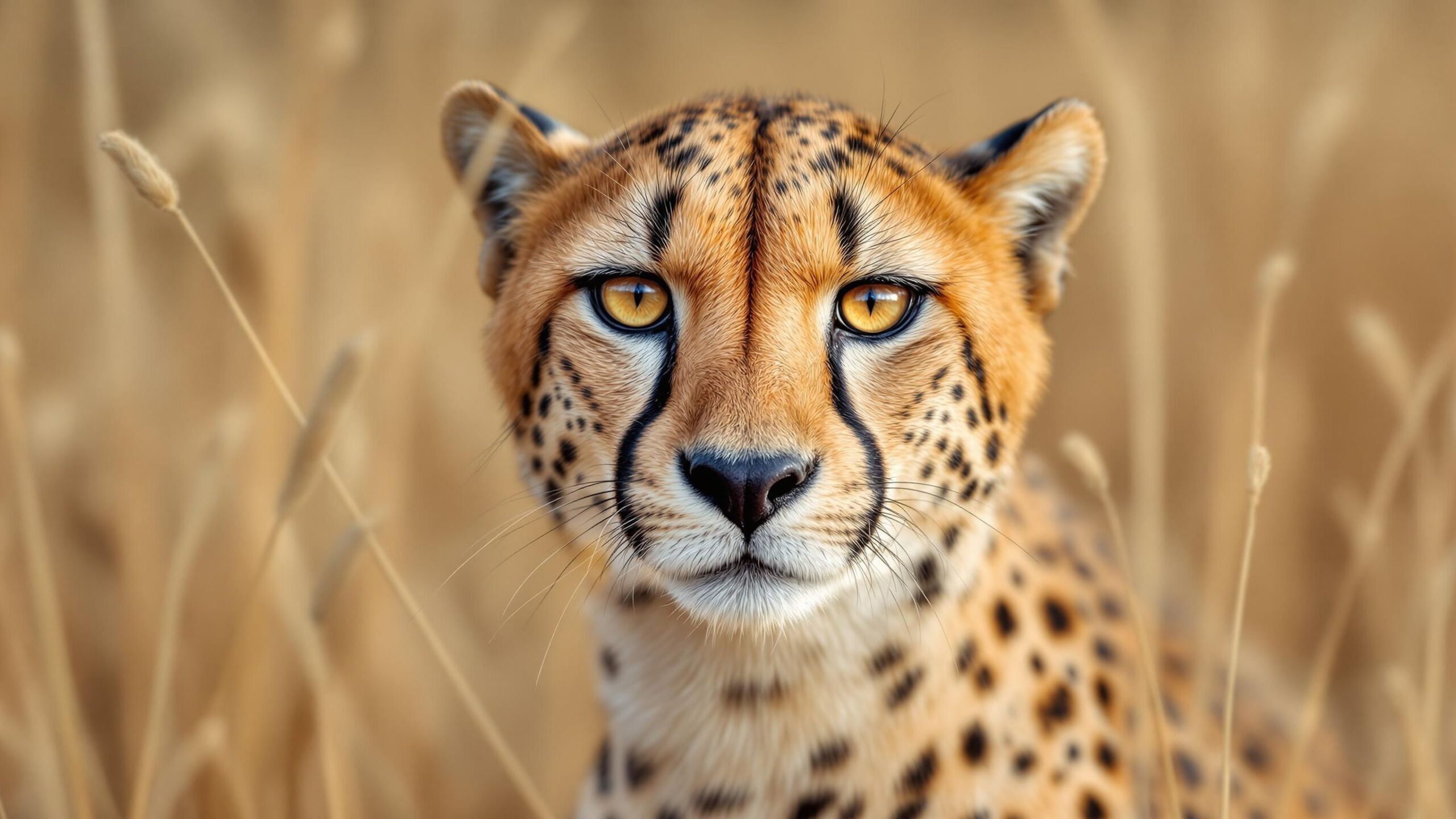
Cheetahs photographed in Niger’s Termit massif in 2010–2011 had pale coats, faint spots and light facial tear stripes. Their appearance resembled the Saharan form, although those individuals do not define the full range of variation throughout the subspecies. One photographed animal could be identified as male.
For a sense of scale, the Smithsonian’s account of the wider cheetah species gives adult mass as 34–64 kg, shoulder height around 77 cm, and head-and-body length as 112–142 cm. The tail adds another 66–84 cm. These are general cheetah measurements, rather than a measured size range for Northwest African animals. Spot patterns and tail markings differ between individuals, allowing fieldworkers to recognize particular cheetahs across photographs. Such recognition helps distinguish a returning animal from a new visitor, especially when encounters are infrequent.
Desert mountains, plains and savanna
In south-central Algeria, camera surveys documented Saharan cheetahs at Ti-n-hağğen in Ahaggar Cultural Park. Two surveys, each lasting two to three months, used a camera grid covering 2,551 square kilometres. That figure describes the survey’s footprint, not the territory of a single cheetah. The cameras recorded detections concentrated in the middle of the night. Because relatively few individuals contributed to the records, the pattern is best understood as local evidence of nighttime movement, rather than a fixed timetable for every Saharan cheetah. A moving animal passing a camera also need not be hunting at that moment.
The Ahaggar is a mountain environment within the Sahara. Monitoring at Wa-Helleğen and Atakor combined cameras with local ecological knowledge, and a paper published in 2022 confirmed cheetah presence in the Atakor context. Rainfall in this region is rare and irregular; the study-area description gives mean annual precipitation at Tamanrasset station as 46.4 mm. A weather-station average describes regional conditions, rather than the rain falling at every cheetah location. Rainfall is also uneven in time: an annual mean does not imply regular monthly rain.
Termit records provide a separate Niger history. Single cheetahs were seen directly in 2007, 2009 and 2010; cameras recorded animals on 22 July and 19 August 2010 and again on 30 October 2011. The first two camera encounters were around dawn, between 05:00 and 06:00. These repeated encounters suggested residency. Dunes, sand sheets, rocky ground, plains and washes formed their surroundings, with sparse grasses, shrubs and scattered trees.
The wider Termit–Tin Toumma landscape includes mountains, valleys, grassy plains, open desert and sand seas. Its conservation fauna includes Saharan cheetahs alongside addax, dama gazelles and Barbary sheep. These animals belong to a shared desert community; their presence together does not establish which herbivores cheetahs regularly catch. The variety of landforms also gives “desert habitat” a more precise meaning. Habitat protection here encompasses valleys, mountain terrain and vegetated plains as well as the expanses between them.
Finding prey and controlling a chase
In the general cheetah hunting sequence, sight locates the target and stalking reduces the distance before pursuit. Bushes can conceal the approach, while detection by the intended prey may cause the cheetah to pause. Once close enough, the hunter launches a short chase. A forepaw can trip the fleeing animal before the cheetah secures a throat grip. If it cannot gain quickly, it may abandon the attempt. The sequence depends on approach, interception and restraint as well as running speed; reaching prey is only one stage in obtaining a meal.
Across the cheetah species, prey includes small to medium-sized antelopes, hares, birds, rodents and calves of larger herbivores. Regional availability changes the menu, so the food of one population need not mirror that of another.
The wider cheetah’s gallop repeatedly changes the shape of the body. Its flexible spine extends as the limbs reach out and flexes as they gather beneath it. Freedom of movement around the shoulders and hips, together with long legs, increases the reach of the stride. There are two airborne phases: one with the animal stretched out and another with the legs tucked in.
Cheetah claws are only partly retractile, leaving them more exposed than the claws of most cats. Contact between claw and ground supplies traction as the animal pushes off or changes direction.
The long, muscular tail counterbalances the cheetah’s body during quick changes of direction. Its contribution becomes especially useful when a pursuit involves turns alongside forward acceleration.
Firm, ridged foot pads help provide purchase during acceleration and turns. Scattered cover and open ground serve different phases of hunting: concealment helps the approach, whereas pursuit requires room to move. General cheetah accounts also describe drinking when water is available and occupying habitat without permanent drinking water. That flexibility permits use of dry country without implying that a desert cheetah never drinks.
Elevated mounds and sloping branches can provide lookout points. From these features, cheetahs scan for prey and approaching competitors. Looking over surrounding ground can precede a hunt, adding an observation phase before the concealed approach.
Wild cheetahs in Botswana show why maximum speed tells only part of the hunting story. A study published in 2013 recorded 367 predominantly hunting runs from five animals, with a highest speed of 25.9 metres per second, about 93 kilometres per hour. Most hunts involved more moderate speeds and substantial acceleration, braking and turning. Their movements describe a predator adjusting its pace and direction, rather than maintaining maximum speed throughout every pursuit. Braking matters because matching a fleeing animal’s changing path can require giving up speed before accelerating again. These Botswana results illustrate running performance elsewhere in the species, not a measured sprint record for hecki. Speed describes how fast the animal moves; acceleration describes how quickly its speed changes. A pursuit with repeated adjustments can therefore demand considerable control even when its highest speed falls below the maximum the cheetah could reach on another run.
Heat and the timing of activity
A study published in 2013 followed four free-living cheetahs and found that they ended chases without reaching an overheating limit. Their body temperatures rose more after successful hunts than after unsuccessful ones, despite similar hunting activity. The researchers proposed a stress response to explain the larger rise after success. A temperature increase following a kill therefore cannot simply be read as the point at which heat forced the animal to stop running.
A separate seven-month study of five free-living cheetahs in Namibia found activity shifting toward dawn, dusk and night as air temperatures increased. Hunts followed opportunities encountered during movement, occasionally taking place in midday heat or complete darkness. Activity timing can thus be flexible even within one population. Moving at night and being exclusively nocturnal are different patterns.
Social lives and information left behind
Across cheetahs more broadly, females live alone or with dependent cubs, while males may live alone or form stable coalitions, commonly of two or three. Coalition members are often brothers, although unrelated males can associate. A male group is therefore a partnership among males, rather than a permanent breeding family. The presence of a solitary adult does not by itself indicate whether that animal is female, an unassociated male or a male observed away from companions. Social membership describes who associates with whom, leaving a separate question about how those animals use space.
Namibian field research distinguishes territorial males from “floaters.” Territory holders, whether single males or coalitions, mark and defend relatively small areas. Floaters use larger areas and visit occupied territories, where they sniff marking sites. Females in that study used ranges intermediate in size between those of the two male categories. These differences allow information to pass among animals that do not travel together. A floater may enter an area to investigate signals without becoming a member of the resident male group.
For some males, floating and territorial residence are successive tactics: a non-territorial male may eventually take over a territory. Other adults remain floaters. Coalition membership and territorial status consequently answer different biological questions. One concerns companionship; the other concerns possession and use of an area. The Namibian findings describe a flexible spatial system, rather than a permanent division into males destined from birth to hold territories and males destined to wander.
Scent can remain at a tree after the cheetah that deposited it has moved on. Urine and scats at prominent marking places create opportunities for later visitors to investigate another animal’s presence. Cameras on Namibian farmland compared nine cheetah marking trees with nine control trees. African wildcats, black-backed jackals and warthogs visited and sniffed the marking trees more often, whereas common duikers visited them less often. The contrast suggests that different mammals respond differently to these information sites. Sniffing alone does not establish exactly what a visitor learned or why it approached. A shared tree can therefore connect species through scent without their meeting face to face, while the differing responses caution against assigning every visitor the same motive.
Sound operates over a different setting from a scent left on a tree. Cheetahs use chirrup-like calls in contact with cubs, and chirping can accompany separation from companions and reunion. Purring is a closer-range sound heard between mothers and cubs, produced during both inhalation and exhalation.
Growing into a hunter
Across the cheetah species, gestation lasts approximately 90–98 days, with litters ranging from one to six cubs.
Cheetah young begin life altricial: their eyes are closed, their movement is limited and they depend on their mother. In the species-level developmental account, the eyes open during the early days after birth and walking develops afterward. Milk teeth appear before permanent teeth, and weaning comes before replacement of the milk teeth. Beginning to eat meat is one transition within development, not the moment at which a cub acquires all the abilities of an independent hunter. Females raise the litter without male parental care; association with males for mating does not become a shared parenting partnership.
The mother’s association with her litter extends beyond the transition from nursing to meat. Juveniles accompany her and gain experience of hunting over a much longer period. A young cheetah can therefore eat solid food while still relying on maternal provisioning and opportunities to practise. The development of teeth, changes in food and independence are separate milestones. These are broader cheetah life-history patterns; they do not supply a measured age of independence or a reproductive schedule for Northwest African mothers.
For the species overall, the Smithsonian reports average longevity of eight to ten years in the wild and twelve to fifteen years in human care.
Young cubs generally remain concealed for roughly six to eight weeks, with the mother changing their hiding place and leaving them while she hunts. Later, play with siblings and climbing exercise balance and coordination. Juvenile activity supplies practice while the mother continues provisioning the family.
Food, travel and larger competitors
The relationship between vegetation and hunting becomes more complex where lions share the landscape. At Phinda in South Africa, researchers studied a reintroduced cheetah population in a fenced reserve, using 28 months of tracking information and 200 kill locations. Cheetahs selected more open, prey-rich areas within their home ranges, but selected more closed vegetation for kill sites. The broad choice of where to live and the finer choice of where to catch prey thus pointed toward different habitat features. Access to prey was balanced against lion avoidance, and habitat selection and feeding ecology differed with sex and reproductive status. Those results explain why a cheetah’s use of open country need not mean every kill occurs in the most open available patch. The findings come from that South African reserve, rather than measuring a lion–cheetah relationship in the Sahara.
Travel also contributes to the cost of feeding. A cheetah energetics study published in 2014 found daily energy expenditure increasing with distance travelled. Its models indicated some flexibility in replacing food lost to theft, distinguishing the extra travel required to obtain food from the cost of an individual sprint. A conspicuous chase is therefore only one part of a predator’s daily energy budget. The modeled ability to compensate does not measure how frequently theft occurred, nor does it make lost food cost-free. Searching for another feeding opportunity can involve movement before a chase ever begins.
Cheetah or leopard?
A leopard, Panthera pardus, has a more muscular build and relatively short legs, whereas the cheetah has the slender proportions of a pursuit runner. Strong climbing adaptations allow a leopard to carry prey into trees where larger scavengers occur. Most cheetah body spots are solid circles or ovals; a leopard typically has rosette-shaped markings.
An elevated cache puts a leopard’s food beyond the immediate reach of competitors moving along the ground. Taking that food requires reaching the branch supporting it, making access to the carcass depend on climbing ability as well as finding the kill.
Leopards occupy habitats ranging from forest to savanna and dry country, but their North African distribution has contracted severely. The previously confirmed populations in Algeria and Morocco are considered to have vanished. Historical accounts of suitable leopard habitat in those countries consequently describe an earlier distribution, not assured modern neighbours for the Northwest African cheetah.
Protection across a broken range
Prey depletion is a conservation concern in northern Africa. Habitat fragmentation, changing land use and retaliatory killing create additional pressures across the cheetah’s wider range.
Pendjari National Park in northern Benin documents hecki in a savanna conservation landscape. In 2021, cameras distinguished nine cheetahs during the dry-season survey and four during the wet-season survey. These separate detections cannot be added into a population total. A further study modeled very low density across the park and adjacent hunting zones, concentrated inside the park. Sudano-Sahel research also describes extensive movements varying by region and season, with fragmentation and insecurity impeding conservation. Particular monitored Pendjari cheetahs were killed by armed poachers and spotted hyenas. Protecting movement therefore involves both human pressures and encounters with other carnivores.
Within studied Sudano-Sahel protected landscapes, habitat-selection analyses suggested a preference for open areas with relatively little human disturbance. Preferred prey availability and larger carnivores also constrained habitat use. Even within protection, the distribution of food, competing predators and human activity can shape the ground available to a cheetah.
In Termit, pastoralists raised camels, sheep and goats around wells. Interviews in May–July 2010 found negative attitudes toward carnivores even though respondents reported no livestock predation by cheetahs. Perceived danger and documented attacks were different issues for conservation.
Niger established the Termit Tin Toumma National Nature and Cultural Reserve on 6 March 2012, following work by conservation partners. Wildlife and habitat monitoring formed part of the conservation effort. The reserve’s desert community gives that protection a wider purpose than safeguarding cheetahs alone.