
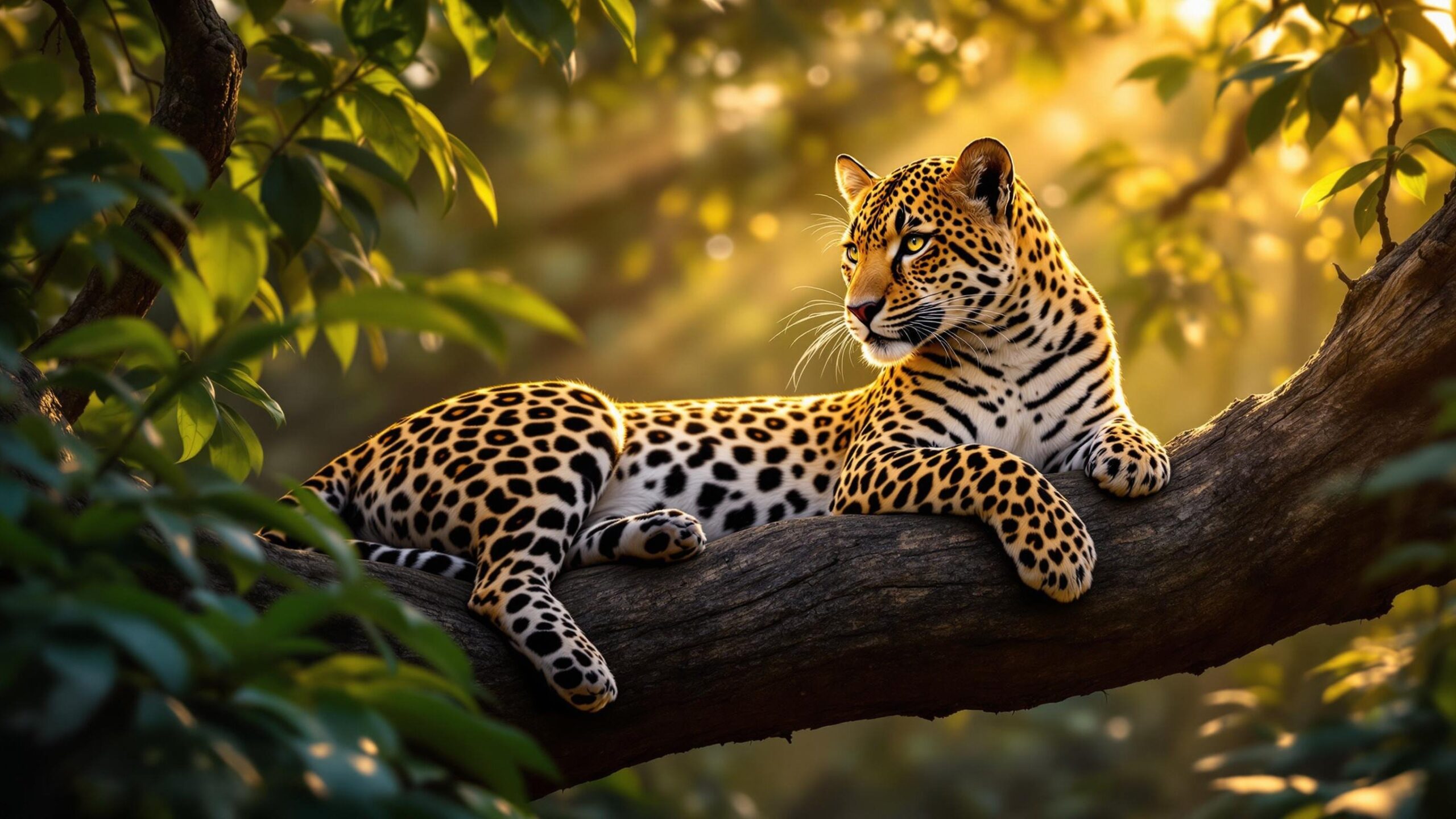
Leopards (Panthera pardus) are rosette-marked wild cats native to Africa and Asia. Their muscular bodies, stealthy hunting and climbing ability suit habitats from rainforest to rocky mountains. Usually hunting alone, they lead more connected social lives than their elusive reputation suggests, with prolonged maternal care and familiar neighbors.
Leopards are adaptable carnivores whose food varies with local prey communities, from forest mammals to savanna antelope. Females raise cubs through a long period of dependence, often well beyond weaning. The species is globally Vulnerable and decreasing, with more severe extinction risk in several regional populations.
Scientific name: Panthera pardus (Linnaeus, 1758). Class: Mammalia. Order: Carnivora. Family: Felidae. Subfamily: Pantherinae. Eight living subspecies are recognized in the current Mammal Diversity Database framework, with some Asian boundaries unresolved. Javan and Sri Lankan leopards belong to this species; snow leopards and both clouded leopard species are distinct cats.
A leopard’s markings can identify an individual across years of photographs. Its voice may carry individual information too: Tanzanian research paired recorded roaring bouts with photographed cats and detected differences between callers. Scent marks provide another channel of communication when neighbors use the same paths at different times.
Is a black panther a leopard?
In Africa and Asia, the name commonly refers to a melanistic leopard. In the Americas it can mean a melanistic jaguar. Both retain markings beneath their dark coloration.
Do all leopards carry their food into trees?
No. They also feed on the ground and hide carcasses in vegetation. Hoisting can reduce theft, but prey size and the competitors present affect the benefit.
Are leopards only active at night?
No. Many populations are most active at night, but substantial daytime activity occurs in some relatively undisturbed rainforest populations.
When do cubs become independent?
Monitored Sabi Sand litters ended their association with the mother at an average of 19 months, with considerable variation. Weaning happens much earlier; a successful hunt can also precede permanent independence.
Do leopards live on Borneo?
Borneo’s leopard-named native cat is the Sunda clouded leopard, Neofelis diardi. Indonesia’s native Panthera pardus population lives on Java.
A muscular cat with a variable coat
A leopard has a long body, powerful shoulders and relatively short, muscular legs. Broad paws and rounded ears complete a compact outline. Its long tail is especially conspicuous when the cat walks along a branch or negotiates uneven ground. Males generally outweigh females, although size varies considerably between regions.
A broad zoological compilation gives adult head-and-body lengths of 91–191 cm, excluding the tail, and separate tail lengths of 58–110 cm. It reports males at 37–90 kg and females at 28–60 kg. These ranges combine varied populations; Arabian leopards, for example, are relatively small, generally around 25 kg.
A separate compilation covering Namibia, Côte d’Ivoire and South African localities reports males at 20–72 kg and females at 18–43 kg. The overlap between sexes and differences between samples make locality useful alongside sex when interpreting a leopard’s mass. Large individuals occur in both Africa and the mountains of Iran and Central Asia.
Most leopards have dark flank rosettes formed by spots around an unspotted center. Smaller solid spots cover the face and neck and occur on the lower limbs. The arrangement differs between individuals, allowing researchers to recognize particular cats in photographs and follow mothers, cubs and neighbors over many years.
The background ranges from pale cream and buff-gray to tawny or reddish tones. Arid-region leopards tend to be paler, while forest animals are often darker. Amur leopards develop long, dense fur with thick-edged, relatively widely spaced rosettes; Arabian leopards have a much shorter coat. Rosettes conceal the animal against broken vegetation, assisting a close stalk and reducing its visibility to larger competitors.
Black leopards and their spotted relatives
Melanistic leopards retain their rosettes against a very dark background. They are particularly frequent in some humid-forest populations of Java and the Malay Peninsula, but occur elsewhere too. These dark cats belong to Panthera pardus. The name “black panther” also describes melanistic jaguars in the Americas.
In a 2012 genetic study of captive leopards of Asian origin, melanism was associated with a mutation in ASIP, a gene involved in pigment regulation. The sampled inheritance pattern was consistent with a recessive trait, and the mutation was inferred to disable the gene’s function. Other populations need not share that particular variant.
Jaguars usually have a stockier body, broader head and relatively shorter tail. Their larger rosettes often contain central spots, unlike typical leopard flank rosettes. Geography is another useful clue: jaguars are American cats, while native leopards live in Africa and Eurasia. Cheetahs have longer legs, a lighter build, solid spots and dark tear lines, reflecting a greater emphasis on running pursuit.
One species, eight living subspecies
The leopard belongs to the cat family, Felidae, and the genus Panthera, alongside lions, tigers, jaguars and snow leopards. The current Mammal Diversity Database recognizes eight living subspecies. Boundaries among some Asian populations remain under study, so regional names describe related populations within one species rather than eight separate species.
The eight are the African P. p. pardus, Persian P. p. tulliana, Indian P. p. fusca, Sri Lankan P. p. kotiya, Indochinese P. p. delacouri, eastern Asian P. p. orientalis, Javan P. p. melas and Arabian P. p. nimr. This arrangement includes saxicolor under tulliana and japonensis under orientalis, explaining some differences from older lists.
Several other cats share the leopard name. Snow leopards, Panthera uncia, are a separate species with a thick pale coat, bushy tail and broad feet associated with high mountains. Clouded leopards belong to Neofelis and have large cloud-shaped markings. The Sunda clouded leopard inhabits Sumatra and Borneo; Java’s native leopard is Panthera pardus melas.
Where leopards still live
Living populations occupy a fragmented range across Africa and Eurasia. Confirmed countries include South Africa, Namibia, Tanzania, Kenya and Gabon, as well as India, Nepal, Bhutan, Iran, China, Russia and Malaysia. Sri Lanka and Java support native island populations. Extensive losses separate many surviving populations.
Morocco, Algeria, Tunisia, Israel, Jordan, Singapore and the United Arab Emirates are listed as parts of the leopard’s former range where the species is extinct. In Southeast Asia, the global Red List distinguishes confirmed occurrence in Thailand, Myanmar and Malaysia from possibly extinct populations in Cambodia, Laos and Viet Nam.
Arabian leopards persist in Oman and Yemen. Saudi Arabia remains uncertain: the Arabian subspecies assessment lists it as possibly extinct, while the broader species assessment lists it as possibly extant. Persian leopards have confirmed populations in Iran, Afghanistan, Armenia, Azerbaijan, Iraq, Pakistan, Russia, Turkmenistan and Türkiye. Uzbekistan is listed as possibly extant, and Kazakhstan as possibly extant or vagrant.
Across its range, the species occurs from sea level to 5,200 m. African habitats include rainforest, wooded savanna, coastal scrub, swamps, mountains and semi-desert. Persian leopards use steep, rocky slopes with forest, woodland and scrub. Prey, stalking cover, shelter and the intensity of human persecution all affect whether these landscapes sustain leopards.
Leopards also use tea-growing areas, farmland and rocky outcrops on the Indian subcontinent. Javan leopards occupy primary and secondary forest, plantations, production forests, shrub and mixed agricultural landscapes. On Java, forests outside protected areas form important remaining habitat. Such flexibility brings wild cats close to domestic animals and people.
The equipment of an ambush hunter
Leopards usually approach prey in a low crouch, using cover before making a short rush. In forests, they may ambush along animal trails or near feeding sites such as fruiting trees. Research from Phinda in South Africa found that hunting habitat reflected prey catchability: intermediate cover allowed concealment while leaving a workable route for attack.
Forward-facing eyes provide binocular depth information for the final approach. Behind the retina, the reflective tapetum lucidum returns light through the light-sensitive tissue, helping vision in dim conditions and producing eyeshine. Mobile, rounded ears turn toward sounds. Whiskers are enlarged hairs with sensory nerves around their bases, registering contact near the muzzle as the leopard negotiates vegetation. Vision and hearing guide an approach at a distance, while these facial hairs supply tactile information about the immediate space around the head.
Curved, retractile claws secure a grip on prey. The forefeet are larger than the hindfeet. Each forefoot has four main weight-bearing toes and a raised dewclaw that adds another gripping point above them. Large prey are commonly subdued with a throat bite and suffocation; smaller animals may receive a bite to the back of the skull or neck.
Robust canines grip and penetrate, while the opposing carnassial cheek teeth slide past one another like blades to slice flesh. The tongue’s backward-pointing, hardened papillae help strip hair and flesh from food. These same rough projections also assist grooming, moving through the coat as the leopard licks itself.
A diet shaped by local opportunities
Leopards eat hoofed mammals, primates, rodents, small carnivores, birds and reptiles. At Sabi Sand in South Africa, records from 2013–2015 included at least 41 prey species. Impala were important throughout the year, with greater contributions during the November–January birth period and April–May rut. Those seasonal pulses in prey vulnerability made a year-round prey animal more important at particular times.
Rainforest prey include duikers, red river hogs, primates and large rodents. In South Africa’s Cape mountains, leopards take rock hyraxes, small antelope and porcupines. Indian prey include chital, sambar and wild pigs; roe and sika deer are important in the Amur region. Persian leopards feed on wild goats, wild sheep and wild boar where these occur.
The contrast can be striking near settlements. In an irrigated agricultural valley around Akole in western Maharashtra, a dry-season study spanning December 2007–April 2009 used 85 scats with identifiable food remains. Domestic animals supplied an estimated 87% of consumed prey biomass, with dogs contributing about 39%. These are local dietary biomass estimates; the remains cannot distinguish hunting from scavenging.
Scavenging supplements active hunting elsewhere too. At Sabi Sand, leopards fed on carcasses obtained from other leopards and several other predators, as well as animals that died from nonpredatory causes. Food passes between carnivores as opportunities arise, and a leopard feeding at a carcass may have killed the prey itself, found the animal already dead or taken the food from another predator.
Climbing, caching and competition
Climbing draws on powerful forequarter and shoulder muscles that lift the trunk while curved claws grip bark. The long tail helps maintain balance on branches. Leopards rest both on the ground and in trees, sometimes draping their legs over a broad branch; climbing can also provide refuge during encounters with larger carnivores.
A leopard may conceal a carcass in dense vegetation or lift it into a tree and return to feed. In the 2013–2015 Sabi Sand study of 104 identified leopards, excluding dependent cubs, 51% of 2,032 food items considered leopard kills were hoisted.
The observations linked hoisting with reduced theft risk. At least 21% of considered kills were stolen, most often by spotted hyenas; lions and other leopards also took food. Trees changed which competitors could reach a carcass. Male leopards and lions could still take elevated food, while hyenas chiefly obtained ground-level food or hoisted items that fell.
Intermediate-sized prey relative to the leopard’s own mass were most often hoisted. Small items could be consumed promptly, while very large carcasses were harder to lift. Hoisted kills also had longer recorded use, measured through repeated game-drive sightings of leopards at their kills rather than continuous timing of meals.
Solitary hunters with familiar neighbors
Leopards often travel and hunt alone, but their social lives include mating pairs, mothers with young and relationships between neighboring residents. Many savanna and woodland populations are most active between sunset and sunrise. In relatively undisturbed Gabon rainforest, substantial daytime activity shows how much daily schedules can vary with local conditions.
Home-range size also varies with habitat, food distribution and social conditions. Particularly extensive ranges occur in the arid Kalahari, and males commonly range farther than females. Females often settle near their birthplace, forming neighborhoods of related females, while males generally disperse farther. Dispersing animals need connections between habitat patches.
A researcher’s account from high-density Sabi Sands described substantial range overlap between animals of both sexes. Mothers and daughters shared more space than other female relationships in that analysis. Using the same ground does not require traveling together: the researchers proposed that neighbors could avoid direct conflict by visiting shared areas at different times.
Urine and other scent secretions leave information along familiar paths and on conspicuous objects. Scraping the ground, rubbing the cheeks and scratching trees add chemical or visible marks. These signals allow a leopard to communicate about space use and reproduction even when the animal receiving the message arrives later.
The characteristic sawing call consists of repeated low, rasping strokes. Both sexes call, with mate attraction and territorial communication proposed as functions. A paired camera-and-audio study in Tanzania detected individual differences in roaring bouts. Close encounters draw on a wider repertoire: friendly chuffs, antagonistic growls and hisses, and softer contact sounds between mothers and cubs.
Birth, dens and growing cubs
At Sabi Sand, a long-term study spanning 1979–2010 recorded births in every month, with more in the wet season and a December peak. Among 41 observed mating associations, the average recorded duration was 2.4 days, with a range of one to seven days. Actual associations could last longer because pairs might already be together when first found. Females were observed mating with one to three males between litters; researchers considered confusion over paternity a possible response to the danger of male infanticide.
Gestation lasts approximately 90–106 days. A female gives birth in shelter such as dense vegetation, a cave, spaces among rocks or roots, or an old animal burrow. She hides small cubs, moves them between den sites and leaves them while foraging, later giving them access to carcasses she has obtained.
Among 140 countable Sabi Sand litters, the observed average was 1.9 cubs, with twins most common and a range of one to three. Litters were counted an average of 49 days after birth, so cubs lost before discovery made these minimum litter-size estimates.
A zoological synthesis places eye opening at roughly six to ten days, the offering of meat at about 65 days and weaning around 100 days. Dependence continues much longer. Cubs stalk, rush, wrestle and tumble with siblings or their mother, practicing movements resembling later hunting and social encounters while still receiving maternal food and protection.
In 52 monitored Sabi Sand litters, independence averaged 19 months and ranged from nine to 31 months. It meant the end of observed maternal association. Successful hunting can precede that separation: a South African observation described 11-month-old siblings killing an adult impala.
Contact with female relatives can occasionally extend to care. During the same long-term study, a grandmother adopted a six-month-old cub abandoned by its mother, and the youngster survived to independence. Adoption by a relative was an exceptional observation.
Survival and adult life
Young leopards face lions, spotted hyenas and infanticidal leopards. Of 98 cub deaths with determined causes at Sabi Sand, 39 were assigned to infanticide, 27 to lions and 14 to spotted hyenas. Estimated survival to independence was 47% among 251 known cubs, with eight still alive at the study’s end treated as incomplete observations. Allowing for entire litters lost before cubs were counted lowered estimated survival to 37%.
Reproductive development involves several distinct stages. In Sabi Sand, nine observed females first showed estrus at an average of 26 months, while first birth averaged 46 months among 26 known-age females, ranging from 33 to 62 months. Birth intervals averaged 25 months after litters with at least one cub reaching independence, compared with 11 months after unsuccessful litters.
The oldest known-age female in that field study reached 18.6 years, and the oldest female observed giving birth was 16.3. Managed populations offer a different comparison: a 2023 AZA estimate cited in a zoological compilation gives Amur leopards a median life expectancy of 18.1 years in care. Neither statistic is a global average lifespan for wild leopards.
Conservation alongside people
The leopard is globally Vulnerable, with a decreasing population trend. The assessment was made in November 2023 and published in an amended form in 2025, updating Javan leopard information and the distribution map. Regional risk differs: Arabian leopards are Critically Endangered, while Javan and Persian leopards are Endangered, all with decreasing trends.
Agriculture, development, roads, railways, mining and logging remove or divide habitat. Hunting and trapping kill leopards directly, while hunting of wild prey can leave forests standing but depleted of food. Livestock losses can trigger retaliatory killing; in parts of southern Africa, conflict also involves valuable wild game. Illegal demand for skins and other body parts adds pressure.
The leopard is listed in CITES Appendix I and, separately, in the European Union’s Annex A. These classifications concern wildlife trade; they operate alongside Red List categories describing extinction risk.
Livestock protection depends on local husbandry. Near Iran’s Golestan National Park, most of 39 reported attacks with known circumstances occurred while shepherds and dogs were present. The reported losses involved sheep and goats. Those selected reports show that presence alone did not reliably prevent losses there; without experimental comparisons on the same flocks, they do not measure how much protection either provided.
Conservation work includes safeguarding prey, maintaining connections and responding to conflict. Caucasus projects monitor Persian leopards and wild prey across a landscape divided by national borders, where roads, fences and land conversion can interrupt movement. On Java, fragmented forest patches isolate populations and increase contact with human land uses; remaining links between patches are a focus of conservation work. The Java-Wide Leopard Survey, begun in 2024, combines cameras, field observations and genetic samples to inform habitat protection, connectivity and conservation planning.
Cultural partnerships address demand for real skins. Furs for Life, begun in 2013 with leaders of the Nazareth Baptist Church eBuhleni, supplies synthetic Heritage Furs for ceremonial regalia. Zambia’s Saving Spots partnership, launched in 2019 with the Barotse Royal Establishment, provides alternatives for garments traditionally using leopard, serval and lion fur.
Animal Product Reviews
Dive into Animal Streets’ Animal Product Reviews – your guide to the best gear, gifts, books, and gadgets inspired by the animal kingdom. From land-roaming lions to ocean-gliding whales, from household pets to prehistoric giants, we explore top-rated products for enthusiasts, educators, and animal lovers alike. Whether you’re shopping for toys, decor, field gear, or fun collectibles, we’ve sniffed out the best so you can discover it all in one wild place!