
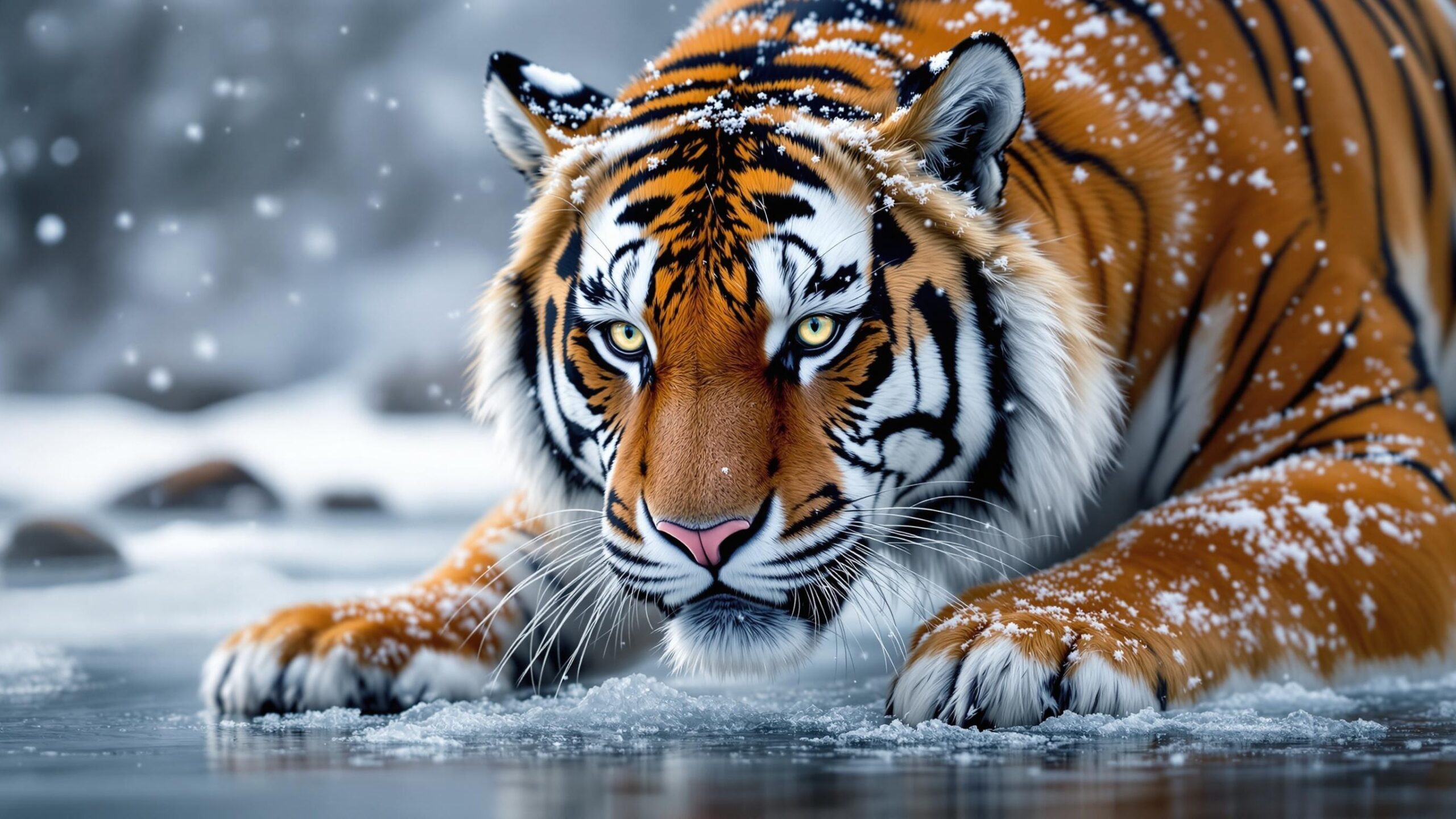
Siberian Tiger: The Silent King of the Frozen North
The Siberian tiger, scientifically named Panthera tigris altaica, is the largest of all tiger subspecies and one of the most awe-inspiring predators to walk the Earth. Roaming the snowy forests and rugged mountains of eastern Russia, particularly the Russian Far East, this big cat embodies survival against the odds. It is a master of stealth, power, and endurance in a world of harsh climates and dwindling wilderness. Known for its thick fur, massive size, and quiet grace, the Siberian tiger is more than just a beautiful creature—it’s a symbol of nature’s tenacity and a living relic of a wilder world. This article takes you deep into the realm of the Siberian tiger, exploring its biology, behavior, habitat, and cultural impact, while offering an insightful look at the efforts to protect one of the world’s most endangered and enigmatic predators.
Physical Characteristics of a Giant Predator
Siberian tigers are true giants among cats. Males can weigh up to 660 pounds and stretch over 10 feet from nose to tail, making them the largest cats in existence. Females are smaller, generally weighing around 300 to 370 pounds. These powerful animals are designed for both strength and endurance, with muscular bodies, large forelimbs, and immense paws that allow them to move silently through snow and dense underbrush. Their fur is paler than that of Bengal tigers, appearing more golden-orange or even beige in winter, with widely spaced black stripes. This adaptation helps them blend into snowy and forested landscapes. Beneath that outer beauty lies a thick layer of insulating fat and a long, luxurious coat that allows the Siberian tiger to survive temperatures that often drop well below zero. One of the most distinct features of the Siberian tiger is the ruff of fur around its neck, which resembles a mane and offers additional warmth during the coldest months. Their large nasal passages also help warm incoming air, a crucial adaptation for life in extreme climates.
Taxonomy And Identity
Known for its thick fur, massive size, and quiet grace, the Siberian tiger is more than just a beautiful creature—it’s a symbol of nature’s tenacity and a living relic of a wilder world. This article takes you deep into the realm of the Siberian tiger, exploring its biology, behavior, habitat, and cultural impact, while offering an insightful look at the efforts to protect one of the world’s most endangered and enigmatic predators. Physical Characteristics of a Giant Predator Siberian tigers are true giants among cats.
This adaptation helps them blend into snowy and forested landscapes. Their large nasal passages also help warm incoming air, a crucial adaptation for life in extreme climates. Siberian tigers are highly territorial and solitary, often claiming territories that range from 200 to 600 square miles depending on prey availability.
Identification And Appearance
Known for its thick fur, massive size, and quiet grace, the Siberian tiger is more than just a beautiful creature—it’s a symbol of nature’s tenacity and a living relic of a wilder world. Males can weigh up to 660 pounds and stretch over 10 feet from nose to tail, making them the largest cats in existence. Their fur is paler than that of Bengal tigers, appearing more golden-orange or even beige in winter, with widely spaced black stripes.
One of the most distinct features of the Siberian tiger is the ruff of fur around its neck, which resembles a mane and offers additional warmth during the coldest months. Body form, markings, movement, and habitat work together to separate this animal from close relatives and lookalikes. Body form, markings, movement, and habitat work together to separate this animal from close relatives and lookalikes.
Anatomy And Adaptations
This adaptation helps them blend into snowy and forested landscapes. Their large nasal passages also help warm incoming air, a crucial adaptation for life in extreme climates. For the first few weeks, she will leave them only briefly to hunt, and she remains fiercely protective.
In the wild, their intelligence is often expressed in the form of adaptive behavior. They also have fewer and more widely spaced stripes, likely an adaptation for camouflage in snowy environments. Body form, markings, movement, and habitat work together to separate this animal from close relatives and lookalikes.
Range And Wild Habitat
Their fur is paler than that of Bengal tigers, appearing more golden-orange or even beige in winter, with widely spaced black stripes. Their home lies in the boreal forests and mountainous terrain of the Russian Far East, particularly the Sikhote-Alin Mountains near the Sea of Japan. The region’s isolation, low human density, and vast tracts of protected land have played a role in keeping this subspecies alive.
Siberian tigers are highly territorial and solitary, often claiming territories that range from 200 to 600 square miles depending on prey availability. Males generally maintain larger ranges that overlap with several females but not with other males. Roaming the snowy forests and rugged mountains of eastern Russia, particularly the Russian Far East, this big cat embodies survival against the odds.
Wild Diet And Feeding
Siberian tigers are highly territorial and solitary, often claiming territories that range from 200 to 600 square miles depending on prey availability. They prefer to ambush rather than chase, often creeping within 20 to 30 feet of their prey before launching a deadly pounce. Their diet includes large ungulates such as red deer, roe deer, sika deer, and wild boar.
In leaner times, they may prey on smaller animals such as hares or badgers. Tigers have even been known to cache their kills under leaves and snow, returning periodically to feed. Their hunting success rate is relatively low, requiring them to hunt often and travel vast distances in search of food.
Behavior
This article takes you deep into the realm of the Siberian tiger, exploring its biology, behavior, habitat, and cultural impact, while offering an insightful look at the efforts to protect one of the world’s most endangered and enigmatic predators. Siberian tigers are highly territorial and solitary, often claiming territories that range from 200 to 600 square miles depending on prey availability. Behavior is easiest to understand when daily movement, social contact, communication, and risk avoidance are considered together.
Reproduction And Life Cycle
Mating, Cubs, and the Cycle of Life The reproductive cycle of the Siberian tiger is closely tied to its solitary nature and harsh environment. Mating pairs will stay together for several days, during which they may copulate numerous times before separating. After a gestation period of approximately three and a half months, the female gives birth to two to four cubs in a hidden den, often located in a sheltered area such as a rocky cave or hollow tree.
Siberian Tigers in Captivity and the Role of Zoos Thousands of Siberian tigers exist in captivity around the world, where they are part of breeding programs, educational exhibits, and genetic research efforts. Captive environments allow for close observation of tiger behavior, health, and reproduction, contributing to scientific knowledge that informs wild conservation. Poorly managed facilities can contribute to inbreeding, stress, and unethical trade.
Ecology And Role In The Environment
This article takes you deep into the realm of the Siberian tiger, exploring its biology, behavior, habitat, and cultural impact, while offering an insightful look at the efforts to protect one of the world’s most endangered and enigmatic predators. Physical Characteristics of a Giant Predator Siberian tigers are true giants among cats. Siberian tigers are highly territorial and solitary, often claiming territories that range from 200 to 600 square miles depending on prey availability.
These apex predators rely heavily on their sense of sight and hearing rather than smell. They prefer to ambush rather than chase, often creeping within 20 to 30 feet of their prey before launching a deadly pounce. In leaner times, they may prey on smaller animals such as hares or badgers.
Conservation Status And Threats
This article takes you deep into the realm of the Siberian tiger, exploring its biology, behavior, habitat, and cultural impact, while offering an insightful look at the efforts to protect one of the world’s most endangered and enigmatic predators. Smaller populations have historically roamed parts of China and North Korea, but the Russian taiga remains their stronghold. It appears in literature, films, folk art, and conservation campaigns.
Conservation Status and Population Trends The Siberian tiger was once perilously close to extinction. By the 1940s, its population had plummeted to fewer than 50 individuals due to unregulated hunting and habitat loss. Thanks to sustained conservation efforts, the population rebounded.
Human Relationship
This article takes you deep into the realm of the Siberian tiger, exploring its biology, behavior, habitat, and cultural impact, while offering an insightful look at the efforts to protect one of the world’s most endangered and enigmatic predators. The region’s isolation, low human density, and vast tracts of protected land have played a role in keeping this subspecies alive. Silent Stalkers and Master Hunters A Siberian tiger’s hunting strategy is a refined balance of stealth, patience, and explosive strength.
They typically hunt at night, moving silently through the forest with practiced precision. Its daily life is shaped by where it moves, what it eats, how it avoids danger, and how it interacts with other animals. Its daily life is shaped by where it moves, what it eats, how it avoids danger, and how it interacts with other animals.
Captive Care
Beneath that outer beauty lies a thick layer of insulating fat and a long, luxurious coat that allows the Siberian tiger to survive temperatures that often drop well below zero. In the best facilities, Siberian tigers live in spacious, enriched enclosures that stimulate their natural behaviors. After being raised in a semi-wild enclosure, she was successfully released back into the wild and later gave birth to cubs—an unprecedented conservation success story.
Wild And Captive Variation
Similar Species
Unlike many predators, tigers are not gluttons. Their lives are quieter and more solitary compared to tropical tigers that may encounter other individuals more frequently. Its daily life is shaped by where it moves, what it eats, how it avoids danger, and how it interacts with other animals.
Common Misconceptions
Cultural Reverence and Symbolic Power The Siberian tiger holds a special place in the cultural mythology of the Russian Far East and neighboring regions. These stories, grounded in both science and myth, offer a glimpse into a world that is as mysterious as it is beautiful. Its daily life is shaped by where it moves, what it eats, how it avoids danger, and how it interacts with other animals.
FAQ
How does the Siberian Tiger behave?
This article takes you deep into the realm of the Siberian tiger, exploring its biology, behavior, habitat, and cultural impact, while offering an insightful look at the efforts to protect one of the world’s most endangered and enigmatic predators. Siberian tigers are highly territorial and solitary, often claiming territories that range from 200 to 600 square miles depending on prey availability. Its daily life is shaped by where it moves, what it eats, how it avoids danger, and how it interacts with other animals.
Additional Natural History Notes
Siberian Tiger is best interpreted through habitat, seasonal food supply, movement, social behavior, breeding timing, and the pressures created by predators, competitors, and people. Coat color, limb shape, ears, teeth, and body size connect to how the animal travels, finds food, avoids danger, and raises young. Wild behavior also differs from observations made in parks, zoos, farms, rescue settings, or neighborhoods, where space, diet, risk, and human influence can change daily activity.
A complete account also benefits from scale and season. Many animals change their movements, calls, feeding choices, or visibility as weather, water, prey, nesting sites, or shelter change through the year. Those rhythms can make the same species look secretive in one setting and bold in another. By connecting anatomy, habitat, and seasonal behavior, the animal becomes easier to understand as a living part of its ecosystem rather than a list of isolated facts.
Regional history adds another layer. Islands, mountains, deserts, forests, rivers, and grasslands can isolate populations long enough for small differences in size, color, diet, or behavior to matter. Local names, field reports, museum records, and modern genetic work often fit together slowly, especially when the animal is rare, nocturnal, migratory, or difficult to observe. The strongest interpretation treats those clues as part of one natural history rather than separate trivia.