
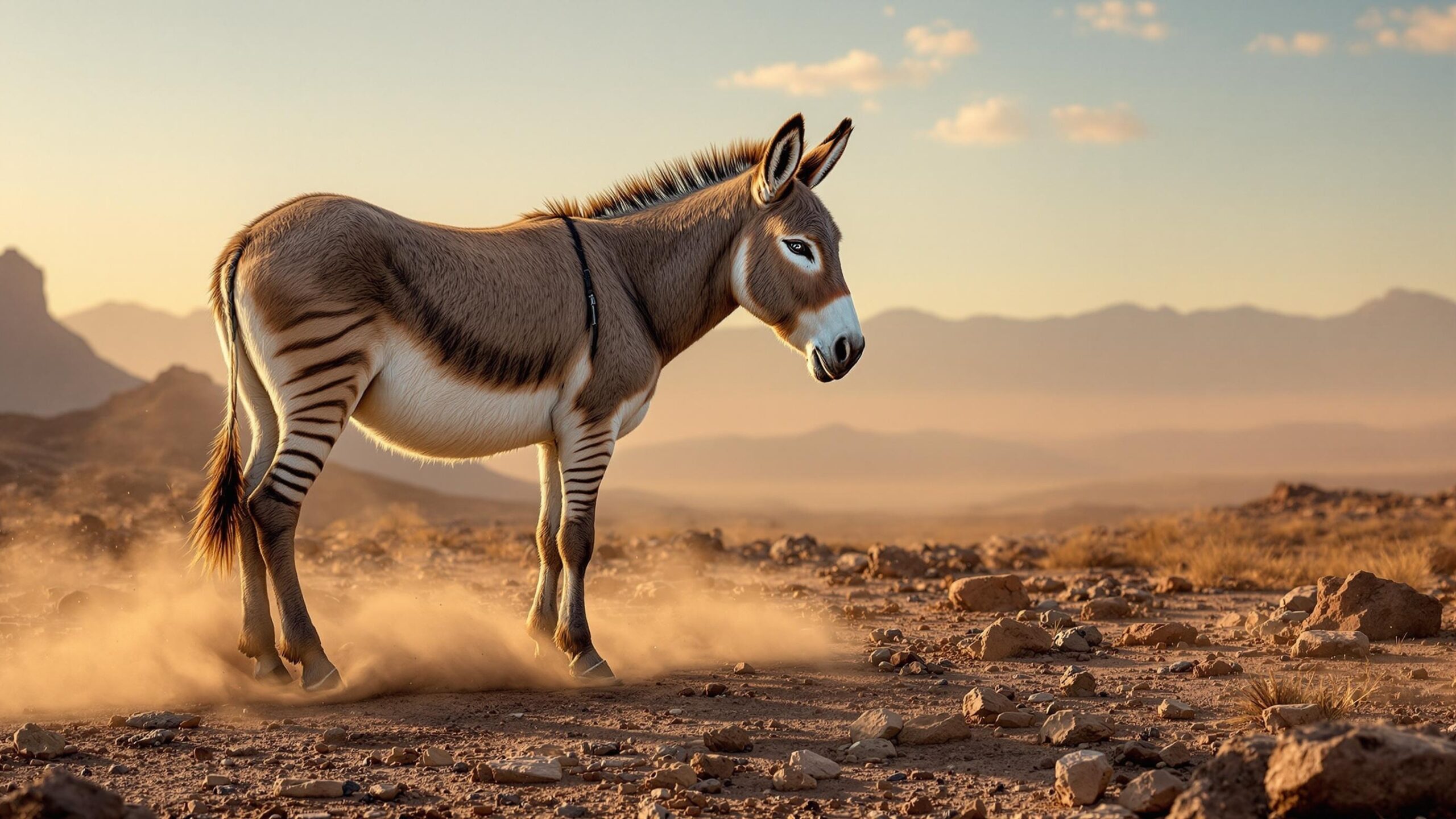
The Endangered Equine of East Africa
The Somali Wild Ass (Equus africanus somaliensis) is a striking and rare subspecies of African wild ass that calls the arid landscapes of the Horn of Africa home. With its silvery-gray coat and distinctive zebra-like stripes on its legs, the Somali Wild Ass blends beauty, resilience, and rarity in one compact, agile form. While its presence may be little-known outside wildlife conservation circles, this endangered equid carries centuries of evolutionary history, uniquely adapted to thrive in some of Earth’s harshest environments. As both a symbol of survival and a mirror of ecological fragility, the Somali Wild Ass tells a story worth exploring—one gallop at a time.
Appearance: Striped Legs and Streamlined Elegance
At first glance, the Somali Wild Ass could be mistaken for a hybrid of zebra and donkey. Its most defining visual feature is the set of black horizontal stripes adorning its lower legs—nature’s own barcode. The rest of its body is typically a light gray or bluish-gray color, with a pale white underbelly and a sleek, short mane. A dark dorsal stripe runs from the mane down to the tail, providing additional contrast to its otherwise muted coat. Adults generally stand about 4 to 4.5 feet (1.2 to 1.4 meters) at the shoulder and weigh between 400 to 600 pounds (180 to 270 kilograms). Compared to their domestic donkey cousins, Somali Wild Asses have longer legs and more slender builds, an evolutionary edge for covering large distances in the open and often unforgiving terrain they inhabit.
A: Start with body shape and habitat, then use color, markings, size, and behavior as confirmation.
A: Because Somali Wild Ass has its own mix of structure, habitat, feeding, and comparison clues.
A: Compare it with the nearest parent, child, or lookalike pages before treating one trait as final.
A: No. Age, season, lighting, region, and posture can all change the first impression.
A: Look for the setting that explains the animal: water, cover, vegetation, substrate, altitude, reef, burrow, branch, or open ground.
A: The exact diet depends on the animal, but mouth shape, movement, and habitat usually reveal the feeding strategy.
A: Many animals change size, color, pattern, diet, risk, or habitat between young and adult stages.
A: Use the photo to check eye position, body outline, limbs or fins, texture, posture, and surrounding habitat.
A: Yes. Every animal affects food webs, habitat structure, competition, nutrient movement, or predator-prey balance in some way.
A: It should connect the animal's visible traits to how it survives, moves, feeds, and fits the taxonomy.
Habitat and Distribution: Life on the Edge of Deserts
The Somali Wild Ass is primarily found in the rocky deserts and arid grasslands of Eritrea and northeastern Ethiopia, with historical populations ranging into Somalia—hence the name. This region is among the most ecologically challenging in the world, where rainfall is unpredictable, temperatures are extreme, and vegetation is sparse. Despite the harshness of their habitat, Somali Wild Asses are incredibly well adapted. They favor rugged terrain and stony plains where they can see predators from a distance and navigate steep, rocky inclines with their tough hooves. Water is often scarce, but these animals have developed a physiological resilience that allows them to go without drinking for several days, surviving on moisture extracted from the plants they graze.
Behavior: Solitary Yet Socially Aware
Somali Wild Asses are primarily solitary creatures, but they maintain a loosely structured social awareness. Adult males often claim and defend territories that can range from 9 to 23 square kilometers (3.5 to 9 square miles), which they mark with dung piles and vocalizations. These territories usually overlap with the ranges of females, who do not maintain strict territorial boundaries themselves.
Though not highly gregarious, individuals occasionally form temporary groups—especially females with foals or young males. These associations are usually fluid, forming and dissolving as food and water availability shifts. Communication among Somali Wild Asses includes braying calls, ear postures, and other subtle body language. When confronted by a potential threat, they rely on flight rather than fight, darting away with surprising speed and agility over rocky terrain.
Diet and Foraging: Masters of Scarcity
The Somali Wild Ass is a true grazer, though it sometimes browses when necessary. Its diet consists mainly of hardy desert grasses, shrubs, and acacia pods—whatever can be found in the drought-prone environments it inhabits. These animals have a slow and deliberate foraging pattern, maximizing every bite in a landscape where each blade of grass might be the last for miles. Unlike some ungulates, Somali Wild Asses do not follow a strict migratory pattern, but they do move across wide home ranges in search of food and water. Their digestive systems are extremely efficient, capable of extracting nutrients from tough, dry vegetation. During droughts, they are known to dig for water in dry riverbeds, showcasing both intelligence and survival instinct.
Reproduction and Lifespan: A Slow Rhythm of Life
Reproduction among Somali Wild Asses is governed by the rhythm of the desert. Breeding can occur year-round but typically peaks after seasonal rains when food is more abundant. After a gestation period of around 12 months, the female gives birth to a single foal. Newborns are precocial, able to stand and walk within an hour of birth. The foal remains close to its mother for the first several months, nursing while gradually learning to graze. Weaning typically occurs around six to eight months of age, though the bond between mother and offspring may persist longer. Females reach sexual maturity at about two years, while males mature later, around three years of age, often waiting even longer before being able to hold territory and attract mates. In the wild, Somali Wild Asses can live up to 25 years, though this is increasingly rare due to external pressures.
Evolution and Taxonomy: A Legacy of the African Wild Ass
The Somali Wild Ass is one of two subspecies of the African wild ass (Equus africanus), the other being the Nubian Wild Ass (Equus africanus africanus). It is also believed to be the direct ancestor of the domestic donkey, making it a vital link in the evolutionary chain of one of humanity’s oldest animal companions.
Genetic studies support this lineage, revealing that domestic donkeys share many mitochondrial DNA similarities with Somali Wild Asses. This ancestral relationship adds not only to their scientific value but also to their cultural significance across human history. In taxonomy, the Somali Wild Ass falls under the family Equidae, which includes horses and zebras. Despite its donkey-like features, its wild nature and unique adaptations make it a distinct and irreplaceable part of the equid family tree.
Threats and Challenges: Living on the Brink
The Somali Wild Ass is critically endangered, with fewer than 1,000 individuals believed to remain in the wild. Its primary threats are habitat loss, hunting, and competition with livestock. As human populations expand into the Ass’s native range, grazing land is increasingly converted to agricultural use or overrun by domestic herds, leaving little room for wild equids to roam.
In some areas, Somali Wild Asses are hunted for meat or medicinal purposes. In others, they fall victim to crossbreeding with domestic donkeys, a process that dilutes the wild gene pool and threatens the integrity of the species. Add to this the impact of climate change—longer droughts, shifting vegetation patterns, and unpredictable weather—and it becomes clear that the Somali Wild Ass is under siege on multiple fronts. Yet, it continues to survive, thanks to its hardiness and the tireless efforts of conservationists.
Conservation Efforts: Hope in Action
Though the Somali Wild Ass’s situation is dire, not all is lost. Conservation programs in Eritrea and Ethiopia are working to monitor populations, protect habitat, and promote community education. In Eritrea’s Danakil region, one of the animal’s last remaining strongholds, local governments and international NGOs collaborate to implement protective policies. Captive breeding programs have also played a role. Several zoos around the world, including in Europe and North America, maintain managed populations of Somali Wild Asses as a genetic safeguard. These efforts are coordinated through species survival plans that aim to maintain genetic diversity and, potentially, reintroduce animals into safe wild habitats. Education and community engagement are key aspects of these conservation strategies. By involving local populations in stewardship—through eco-tourism, ranger training, and educational outreach—conservationists foster a sense of ownership and pride that strengthens long-term protection efforts.
Cultural Significance: Echoes of the Ancient Past
Although often overlooked, the Somali Wild Ass carries deep cultural and historical significance. It is widely regarded as the living ancestor of the domestic donkey, which has played a crucial role in human civilization for thousands of years—from the caravans of ancient Egypt to the farms of contemporary Africa. Some nomadic groups in the Horn of Africa still revere wild asses as symbols of strength and independence. Their presence in remote landscapes is seen as a sign of ecological balance and natural purity, a rare thread of wilderness in an increasingly domesticated world. This link to both human history and natural heritage adds an intangible but powerful reason to safeguard the Somali Wild Ass—not just for its own sake, but for what it represents about our connection to the wild and the ancient.
Adaptations: Built for Survival
Few animals are as well engineered for survival as the Somali Wild Ass. From its water-efficient physiology to its sturdy hooves, every part of its body has adapted to serve a specific purpose in its harsh environment. Its hooves are narrow and tough, ideal for gripping rocky surfaces and climbing steep inclines—unlike the wide, splaying hooves of desert camels or soft-soled predators. Its coat reflects sunlight during the day but retains warmth at night, a crucial balance in areas with dramatic temperature swings.
Additionally, Somali Wild Asses have exceptional eyesight and hearing. Their large ears not only pick up distant sounds but also help regulate body temperature, radiating excess heat like natural radiators. These adaptations aren’t just remarkable—they’re essential. In a land where food is scarce, water is rarer, and predators may include lions or hyenas, such evolutionary gifts are the difference between survival and extinction.
Somali Wild Ass vs. Domestic Donkeys: What Sets Them Apart
It’s tempting to lump Somali Wild Asses together with domestic donkeys, given their physical similarities. But in reality, they differ significantly in behavior, physiology, and ecology. Domestic donkeys are generally more docile, less agile, and more adaptable to human-managed environments. Somali Wild Asses, on the other hand, are independent, territorial, and built for endurance. Their behavior is guided by instinct honed over millennia of surviving without human assistance. They are faster, stronger climbers, and more alert to danger—wild in every sense of the word. Moreover, while domestic donkeys can be found across six continents, the Somali Wild Ass is confined to just a few remote pockets in East Africa. Its rarity makes it more vulnerable—but also more unique.
The Future: Where Do We Go From Here?
The Somali Wild Ass stands at a crossroads. On one side lies extinction—a quiet fade from a world that may not even notice. On the other is survival, a path carved by conservation, public awareness, and ecological stewardship. Its future depends on more than just policy or funding. It depends on curiosity, on education, and on the willingness of people around the world to care about an animal they may never see in the wild. It depends on the small, daily decisions made by communities living alongside these animals—choices about grazing, poaching, and water access. Hope lies in the fact that the Somali Wild Ass has not yet disappeared. It’s still out there, trotting across the gravelly plains of Eritrea, its striped legs catching the sunlight. It’s still braying defiantly into the desert wind, a living echo of our shared natural history.
Why the Somali Wild Ass Matters
Beyond its rarity, beyond its beauty, the Somali Wild Ass matters because it represents resilience. It’s a creature that has thrived in an environment where most animals wouldn’t last a week. It has endured centuries of environmental changes, human encroachment, and natural threats—and it’s still standing. Protecting it means protecting not just a species, but an entire way of life that values balance between human needs and ecological integrity. It means preserving an animal that teaches us something essential about survival, adaptation, and the fragile line between wild and tame.
A Wild Wonder in Need of Guardians
The Somali Wild Ass is more than just a rare equid—it’s a wonder of evolution, a marvel of desert survival, and a silent witness to millennia of environmental change. Its story is one of determination, both its own and that of those working tirelessly to keep it in the wild.As we look to the future, perhaps the most important step is simple: to pay attention. To learn. To care. Because sometimes the fate of an entire species depends on the willingness of strangers to become its guardians.
Animal Product Reviews
Dive into Animal Streets’ Animal Product Reviews — your guide to the best gear, gifts, books, and gadgets inspired by the animal kingdom. From land-roaming lions to ocean-gliding whales, from household pets to prehistoric giants, we explore top-rated products for enthusiasts, educators, and animal lovers alike. Whether you’re shopping for toys, decor, field gear, or fun collectibles, we’ve sniffed out the best so you can discover it all in one wild place!