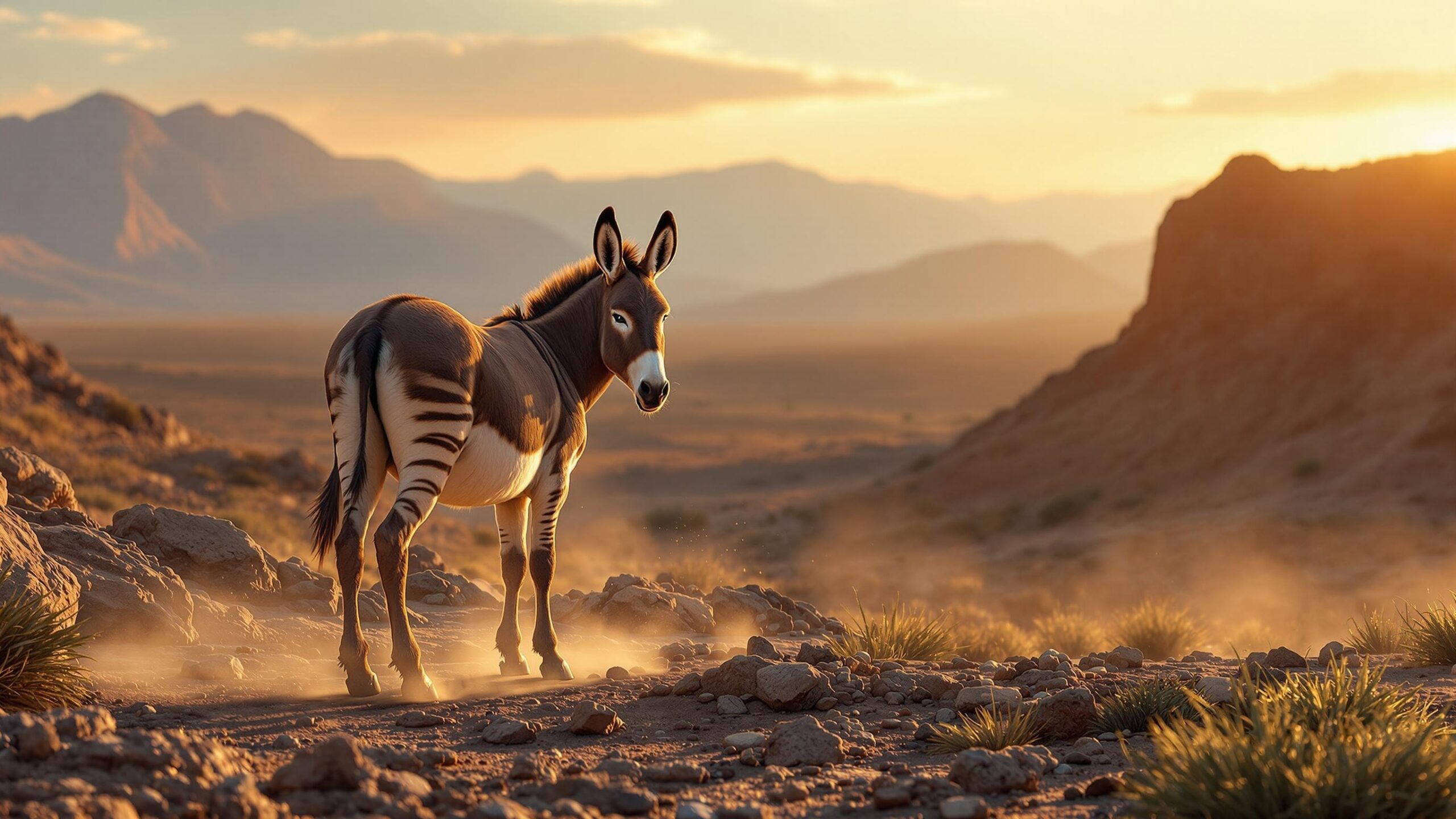
The wild African donkey, or African wild ass (Equus africanus), is the Critically Endangered wild ancestor of the domestic donkey. Surviving native populations inhabit dry northeastern Africa, where access to scattered grass and water shapes their movements, breeding and changing social groups.
Natural-history snapshot: This northeastern African equid feeds chiefly by grazing, with browse adding flexibility. Its remaining established wild populations are in Eritrea and Ethiopia.
Family life: A female and her offspring form the most persistent social bond. Adult companions change, and breeding males may defend resource-rich areas.
Reproduction: Pregnancy lasts roughly a year and normally ends in the birth of one foal.
Classification: Kingdom Animalia; phylum Chordata; class Mammalia; order Perissodactyla; family Equidae; genus Equus; subgenus Asinus.
Species: Equus africanus. The Nubian form, E. a. africanus, and Somali form, E. a. somaliensis, are recognized subspecies. The Nubian form's present survival remains unresolved.
Domestic relationship: The domestic donkey is treated as Equus asinus in this classification. Horses and zebras are other members of Equus.
Individual signatures: Researchers can distinguish Somali wild asses by photographing the differing patterns of bands on their legs.
Seasonal connections: Eritrean habitat modelling predicts that areas separated by dry-season conditions become connected in the wet season as water and forage conditions change.
Responsive routines: At Messir Plateau, permanent Asaila water was approached at night, while temporary pools away from settlements also received morning visits.
Is a free-roaming donkey an African wild ass?
Its ancestry matters. A donkey descended from domestic stock is feral even when it lives and breeds without human care. North American burros are examples.
Are Somali wild asses small zebras?
No. They are a subspecies of African wild ass. Their leg bands contrast with the extensive body striping of zebras.
Has the Nubian wild ass been rediscovered?
A report published in 2026 described possible Nubian animals in Sudan, but their wild ancestry remains uncertain because identification relied on appearance.
Do young foals stay behind when their mothers drink?
In the Messir Plateau field study, foals accompanied their mothers on nighttime water journeys.
A wild species behind a familiar name
The wild African donkey, more often called the African wild ass, is Equus africanus. It belongs to the horse family, Equidae, within the odd-toed hoofed mammals of the order Perissodactyla. The species gave rise to the domestic donkey, now dispersed far beyond Africa through its use as a transport animal. Native wild asses occupy a much smaller northeastern African range, with their daily lives tied to scattered feeding grounds and drinking places.
Two geographic forms are recognized within the species: the Nubian wild ass, Equus africanus africanus, and the Somali wild ass, Equus africanus somaliensis. Much of the detailed knowledge of living wild animals comes from Somali wild asses in Eritrea and Ethiopia. The Nubian form has a historical range farther northwest, and its present survival remains unresolved.
Domestic donkeys are treated as Equus asinus in a widely used modern classification, although other naming systems combine domestic and wild forms. A donkey living without human care can still be of domestic ancestry. Feral burros in North America’s Death Valley, for example, descend from animals abandoned by miners; their desert surroundings do not make them native African wild asses.
Recognizing an African wild ass
A lean, muscular body carries a short, smooth coat ranging from gray to reddish buff. The underside and muzzle are pale, the mane stands upright, and the tail ends in a tuft. Against this largely plain body, the location of dark stripes is particularly useful for recognition. Somali wild asses have conspicuous horizontal bands across their legs, while historical Nubian animals usually show a back stripe and shoulder cross with much weaker leg markings.
Markings vary within those broad patterns. A Somali animal’s dorsal stripe may be incomplete or absent, and a shoulder stripe is not guaranteed. Its leg bands can be distinctive enough to recognize an individual: on Eritrea’s Messir Plateau, photographs of both sides allowed researchers to follow known animals across several years.
The Mammals of Africa species account gives a head-and-body length of about 1.95–2.05 metres, a tail of 40–45 centimetres, shoulder height of 1.15–1.25 metres and mass of 270–280 kilograms. Domestic donkey breeds span approximately 80–150 centimetres at the shoulder, overlapping wild-ass height, so body size alone cannot settle a free-roaming animal’s identity.
Grévy’s zebra is another large-eared equid of dry eastern Africa, with surviving native populations in Kenya and Ethiopia. Its extensive black-and-white body stripes immediately distinguish it from the African wild ass’s much plainer trunk and localized markings. Like wild asses, Grévy’s zebras form loose social associations and males can hold territories.
Feet, teeth and the desert day
Small, narrow hooves, with the relatively upright walls characteristic of asses, suit movement over stony ground. In the Eritrean Danakil, journeys between feeding plains and water cross volcanic ridges and lava rubble.
Different teeth handle the two main stages of feeding. Incisors at the front of both jaws clip plants; the cheek teeth crush and grind the cropped vegetation before swallowing. High-crowned cheek teeth, with enamel patterns simpler than those of horses, process rough forage through repeated chewing.
San Diego Zoo’s reference account gives Somali wild-ass ear lengths of about 18.7–20 centimetres. The long ears may help dissipate heat. Somali wild asses also avoid the strongest daytime heat by resting in available shade, resuming grazing in late afternoon and early morning.
A contracted northeastern African range
Well-established surviving wild populations occur in Eritrea and Ethiopia. Their core landscapes include the Danakil ecosystem and Ethiopian Afar. Historical distribution was broader: the Nubian form occupied northeastern Sudan east of the Nile toward the Red Sea and south to the Atbara River, extending into northern Eritrea. Historical records of the Somali subspecies include parts of Eritrea, Ethiopia’s Danakil and Awash Valley, the Ogaden, western Djibouti and northern Somalia.
Recent survival in Somalia, Djibouti and Egypt remains unresolved. A report published in May 2026 described asses observed in Sudan’s Red Sea State during April 2025 and provisionally assigned some to the Nubian form by appearance. Their wild, domestic or mixed ancestry and subspecific identity remain genetically unverified.
Ethiopian field studies describe animals in remote areas away from settlements but close to permanent water. Local remnants include adult females encountered at Hillu in 2023 and adults with a foal at Afdera in late 2024.
Rain changes the usable landscape
In the Danakil, sparse grasses and other herbs grow among shrubs and scattered trees across dry plains and broken volcanic terrain. Permanent water is localized. Rain creates temporary surface water and changes where animals can feed without returning to a distant permanent source. Across Ethiopia and Eritrea, the species has been described from below sea level in the Dalool Depression to rocky mountains around 1,500 metres high. Its desert habitat includes grassland and bushland across this varied relief.
The Messir Plateau covers about 124 square kilometres, with rocky ridges above lower plains. The local nutrition study describes elevations of roughly 100–475 metres. Wild asses forage on the plains and cross ridges between feeding areas and water.
Rainfall varies sharply from year to year. At Massawa, in the northern part of the Eritrean study region, a 50-year record averaged about 160 millimetres annually. Most rain there usually falls from December to February, with smaller amounts in March and April; the dry season begins in May or June and extends into October or November. Temporary pools can remain for a few months after rain ends.
Scattered woody plants in the Eritrean habitat include Vachellia tortilis, Salvadora persica and Ziziphus spina-christi. These occur amid low herbaceous cover, alongside shrubs such as Suaeda monoica and tamarisk.
An Eritrean habitat analysis identified distance to water and precipitation in the driest month as leading predictors of dry-season suitability. Its predictions separated two principal habitat areas in the dry season but connected them during the wet season. Seasonal temperature variation and rainfall during the warmest quarter contributed most strongly to the wet-season predictions. Messir Plateau emerged as important habitat in both seasons, linking the breeding area to the surrounding seasonal landscape.
Rain also draws livestock into useful grazing areas. On the Messir Plateau, highland cattle and their herders concentrated on northern plains during rainfall months, while wild asses became more widely dispersed. This redistribution was associated with reduced access to preferred forage near seasonal water.
What they eat in the wild
African wild asses mainly graze but also take browse. Grasses reported among preferred foods in Ethiopia’s Mille-Serdo area include Aristida, Chrysopogon, Dactyloctenium, Digitaria, Lasiurus and Sporobolus. Browse adds woody vegetation to this grass-based diet; the San Diego natural-history account includes scrub and bark among wild-ass foods.
On the Messir Plateau, carbon-isotope signatures in dung indicated grass-dominated feeding in both dry and rainfall periods. Wild-ass signatures resembled those of cattle and domestic donkeys more closely than those of the locally sampled camels and goats, which showed more browsing-oriented diets.
Tooth wear offers another view of feeding. Comparisons among equids found an intermediate grazing-and-browsing signature in African wild asses. Wear accumulates through abrasive food and contact between teeth. The African wild ass combines substantial grass consumption with the flexibility to feed on other vegetation as local conditions change.
Food quality varies too. Messir wild-ass dung contained less nitrogen than domestic-donkey dung in the wet-season comparison and again in March 2019, indicating a difference in dietary quality between the two grazers.
Water journeys with a foal
The demands of motherhood are especially visible around water. On Messir Plateau, females with young foals were recorded making daily journeys toward permanent Asaila water during dry conditions. These foals were within approximately their first three months, when their mothers had high lactation demands. Morning feeding locations averaged about nine kilometres from the water point in geographic separation, rather than the length of the walked route.
The Messir study followed three mothers with foals in this youngest age group. Mothers and young foals traveled to water together at night. Animals returning from Asaila crossed high ridges in the early morning and descended to feed on the plains, then began the journey back toward water in late afternoon or evening.
Water around the plateau is not equally accessible. During the 2016–2019 fieldwork, wells and boreholes east and north of Messir were covered with wood or concrete and unavailable to wildlife. The next accessible permanent source, Alad, lay about 30 kilometres southwest of the plateau. It was in extremely rocky terrain, with the nearest vegetation about 15 kilometres from the water.
During rainfall periods, mothers with young foals were commonly within about three kilometres of temporary water; later locations reached about seven kilometres away.
Timing also changed with the setting. Permanent Asaila was visited at night, whereas temporary water away from settlements was used in the morning too. Recorded visit times were not significantly correlated with temperature in the study. The pattern linked night use of Asaila more closely to daytime human and livestock presence. Non-reproductive females and bachelor males had longer gaps between detections at monitored water. Alternative routes and drinking sources leave their actual drinking intervals unresolved.
Changing company and territorial males
The lasting social association is a mother with her offspring. Adults gather in temporary groups whose membership changes, including mixed groups and groups of one sex. Some males live alone or associate with other males. At Messir, temporary groups of adult females included two to eight animals.
Low plant biomass helps explain this loose organization. Where little forage is available, animals feeding close together can reduce one another’s access to it. Abundant food permits closer spacing and larger gatherings, while shortages limit the size and stability of groups. Even within a fluid social system, daughters may retain a connection to home: female foals often stay with their mothers and remain in their natal area, according to the specialist account.
Breeding males can defend areas containing resources females need. This mating system is called resource-defence polygyny: a male’s opportunities depend on females entering useful feeding and watering areas within his territory. Females change associates as they move through the landscape, crossing between the areas they need for feeding and drinking.
Territorial males mark with dung piles, and male contests can involve rearing and biting. A male may defend an area for several weeks. In the specialist wild account, only territorial males had been observed mating with receptive females, linking reproductive opportunities to territorial status. Somali wild asses also produce a loud bray, a conspicuous vocal signal from an animal whose adult companions can be widely spaced. At Messir, one territorial male followed during the drinking study was often associated with females and temporary water on the plains in rainfall periods. Bachelor males were encountered less regularly in that core area.
Birth and the first year
Gestation lasts about 12–13 months, and a birth usually produces one foal. Females have repeated reproductive cycles, and some produce a surviving foal every other year. Rainfall during pregnancy is associated with the birth rate, while wetter conditions are also associated with better foal survival. The resources available during a long pregnancy and the following period of nursing therefore connect reproduction with conditions spanning more than a single season.
The specialist species account describes births concentrated from October to April, with a December–April peak reported locally for Messir. Sexual maturity is described at approximately two years. One known-age wild female produced her first live foal at six years, illustrating the distinction between becoming sexually mature and successfully producing young.
Somali foals can follow their mothers within hours of birth. Woburn Safari Park reported a newborn walking beside its mother on the day it was born.
A study of five Somali wild-ass mother–foal pairs at Saint Louis Zoo followed behavior early in life and again at six to twelve months. Nursing became less frequent and total nursing time declined with age, yet some continued at eleven to twelve months. Individual nursing bouts did not become shorter, so the reduction in total nursing time reflected fewer feeds. Younger foals interacted chiefly with their mothers; interactions among foals were common in the older observation period.
Wild offspring can remain with their mothers well beyond the earliest water journeys. All three mothers with young foals in the Messir study were seen the following year with those offspring as yearlings. Four of seven mothers followed with older foals were also seen with their surviving yearlings the next year.
The Saint Louis pairs showed both friendly and antagonistic interactions between mothers and foals. Male foals initiated and received more antagonistic behavior than female foals in this small cohort. African wild asses can live for three decades in zoos.
Play, grooming and close contact
Young Somali wild asses in the San Diego zoo account chase one another, wrestle with their necks, rear, buck and leap.
Mutual grooming brings two animals together in a different way. Standing side by side and facing opposite directions, they nibble at one another’s sides and necks. The same zoo account describes rolling, biting and scratching at their own coats, and grooming as a way of loosening hair during the spring molt.
Predators and other pressures
Lions and spotted hyenas are potential predators, especially of younger animals. Their importance varies by place: the Messir drinking study reported little or no observed hyena predation locally. An Ethiopian project report described deaths in the small Hillu group in July 2025 after water sources dried and forage was depleted, attributing the losses to drought-related shortage. Strongyle parasites have also been recorded in wild-ass dung samples from the Danakil Desert.
From wild ancestry to domestic transport
African wild-ass ancestry underlies one of humanity’s most widespread transport animals. A major genomic analysis supports a single African domestication around 5000 BCE, followed by dispersal within Africa and into Eurasia. Later ancestry also moved back into Africa, giving modern domestic populations a history of travel and mixing.
Maternal DNA provides a more specific part of that story. Historical Nubian wild-ass sequences closely match one major domestic donkey maternal lineage. Sampled Somali wild-ass maternal sequences were distinct from both major domestic lineages. The source of the second major domestic maternal lineage remained unresolved in that mitochondrial work. Multiple maternal lineages within domestic donkeys do not by themselves establish separate domestication events; whole-genome ancestry and mother-to-offspring lineages trace different aspects of the past.
Archaeological donkeys at Abydos in Egypt retained wild-like body dimensions while showing skeletal changes associated with carrying loads. Human use could therefore precede conspicuous changes in body size. The domestic donkey’s later abundance reflects breeding, transport and dispersal under human management, while its wild ancestor remained dependent on a restricted native landscape.
Keeping wild populations alive
The African wild ass is Critically Endangered. The IUCN assessment published in 2015 estimated fewer than 600 wild individuals. The species has also been listed on Appendix I of the Convention on Migratory Species since 2017.
Documented pressures include hunting for food and traditional medicine in Ethiopia, competition over forage and water, and habitat change. Interbreeding with domestic donkeys is a potential threat where the two meet, because domestic ancestry could enter small wild populations. Recent Ethiopian monitoring described agricultural expansion near Aila Manda water and mining within the Serdo wildlife area. Development around a drinking place can affect animals feeding well beyond it because their journeys converge on scarce water.
Local Afar communities in Eritrea have protected wild asses through cultural practice. Ethiopian conservation work has trained and employed pastoralists as scouts and involved elders, researchers and government authorities. A community conservation area and revised reserve boundaries were proposed in the November 2025 project report. The proposals were still open to consultation at that time.
Managed Somali wild-ass breeding provides an insurance population alongside this field work. The European programme coordinated from Basel supports research, training, education and fundraising, with cooperation involving researchers and local communities in Eritrea and Ethiopia.
Animal Product Reviews
Dive into Animal Streets’ Animal Product Reviews – your guide to the best gear, gifts, books, and gadgets inspired by the animal kingdom. From land-roaming lions to ocean-gliding whales, from household pets to prehistoric giants, we explore top-rated products for enthusiasts, educators, and animal lovers alike. Whether you’re shopping for toys, decor, field gear, or fun collectibles, we’ve sniffed out the best so you can discover it all in one wild place!