
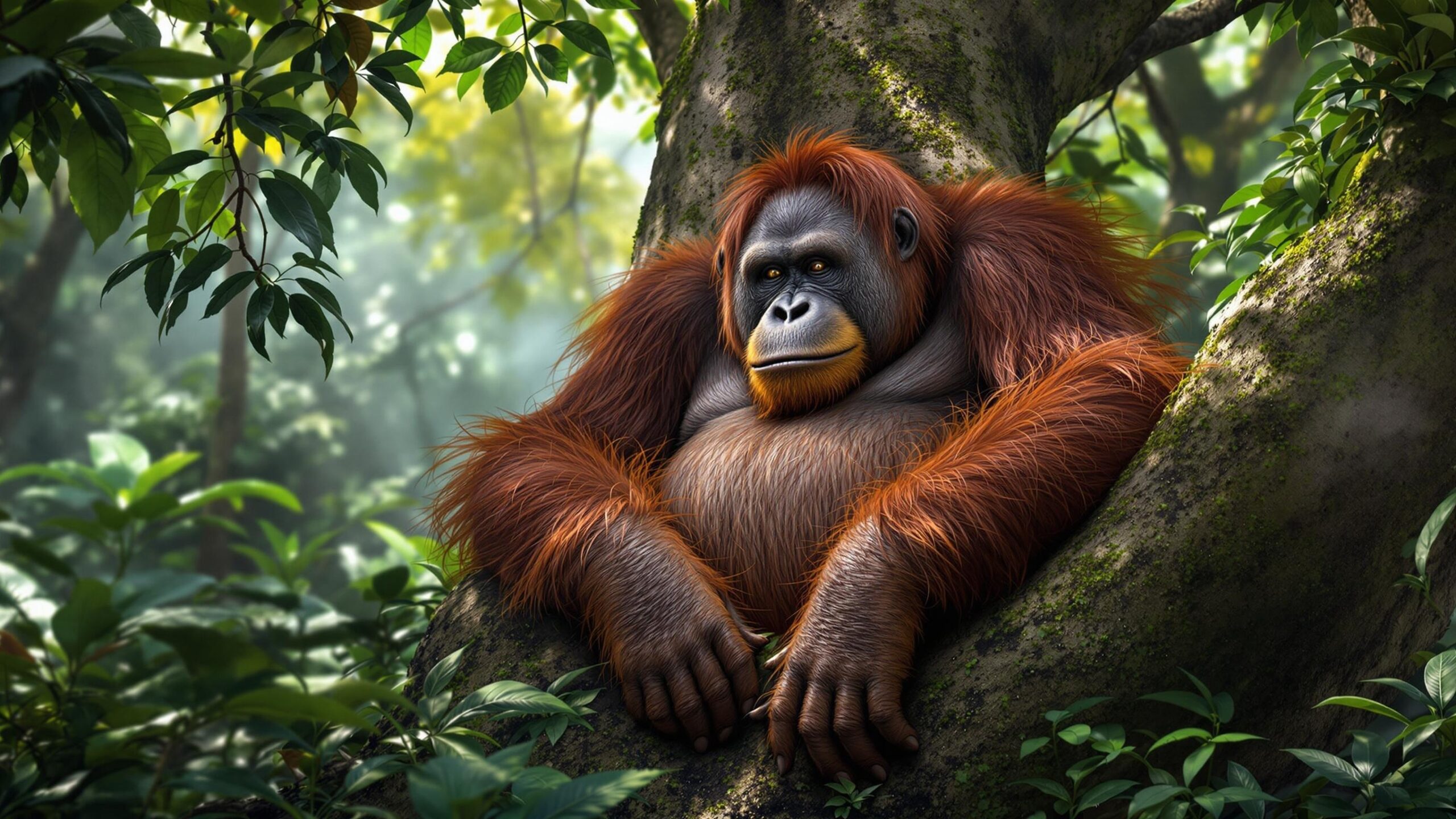
Bornean Orangutan (Pongo pygmaeus): The Wise One of the Rainforest Canopy
High in the treetops of one of the oldest rainforests on Earth, a flame-colored figure moves slowly and deliberately. With long, powerful arms, expressive eyes, and a deeply thoughtful demeanor, the Bornean Orangutan (Pongo pygmaeus) is among the most intelligent and iconic great apes in the animal kingdom. Native to the lush tropical forests of Borneo, this gentle arboreal primate is not only biologically fascinating but also plays a vital ecological role in its environment. It is a species whose story is one of survival, adaptation, and growing urgency in the face of rapid environmental change.
From its unique social structure and slow-paced life to its surprisingly human-like behavior and remarkable problem-solving skills, the Bornean Orangutan remains one of the most captivating primates on the planet. This article takes you deep into the world of this “person of the forest,” exploring its biology, habitat, diet, behavior, reproduction, conservation status, and the cultural legacy it carries within the green heart of Borneo.
Physical Characteristics: The Arboreal Giant
The Bornean Orangutan is the largest tree-dwelling animal on Earth and one of only three surviving species of orangutan—the others being the Sumatran and Tapanuli orangutans. Males can weigh between 110 and 220 pounds and stretch up to 4.5 feet in height, with arm spans that can reach over 7 feet. Females are considerably smaller, typically weighing around 80 to 120 pounds.
Their shaggy, reddish-brown fur varies in shade across individuals and regions, with some appearing deep chestnut and others bearing a lighter, almost golden hue. One of the most striking features of adult males is the development of cheek pads, or flanges, which are large pads of flesh on either side of the face that grow more prominent with age and social status. These flanges, along with a throat sac used to produce long calls, signal maturity and dominance. Bornean Orangutans have opposable thumbs and great toe flexibility, allowing them to grip branches and manipulate objects with incredible precision. Their movement is slow and methodical—an energy-conserving strategy ideal for their tree-bound lifestyle and diet.
Taxonomy And Identity
Native to the lush tropical forests of Borneo, this gentle arboreal primate is not only biologically fascinating but also plays a vital ecological role in its environment. It is a species whose story is one of survival, adaptation, and growing urgency in the face of rapid environmental change. From its unique social structure and slow-paced life to its surprisingly human-like behavior and remarkable problem- solving skills, the Bornean Orangutan remains one of the most captivating primates on the planet.
This article takes you deep into the world of this “person of the forest,” exploring its biology, habitat, diet, behavior, reproduction, conservation status, and the cultural legacy it carries within the green heart of Borneo. Their movement is slow and methodical—an energy-conserving strategy ideal for their tree-bound lifestyle and diet. Their home ranges can span several square kilometers, depending on habitat quality and food availability.
Identification And Appearance
Bornean Orangutan ( Pongo pygmaeus ): The Wise One of the Rainforest Canopy High in the treetops of one of the oldest rainforests on Earth, a flame-colored figure moves slowly and deliberately. It is a species whose story is one of survival, adaptation, and growing urgency in the face of rapid environmental change. Their shaggy, reddish-brown fur varies in shade across individuals and regions, with some appearing deep chestnut and others bearing a lighter, almost golden hue.
Bornean Orangutans have opposable thumbs and great toe flexibility, allowing them to grip branches and manipulate objects with incredible precision. Body form, markings, movement, and habitat work together to separate this animal from close relatives and lookalikes. Body form, markings, movement, and habitat work together to separate this animal from close relatives and lookalikes.
Anatomy And Adaptations
It is a species whose story is one of survival, adaptation, and growing urgency in the face of rapid environmental change. In times of shortage, orangutans adapt by eating more fibrous foods like young leaves, pith, and even soil or mineral-rich mud. This low social density is an evolutionary adaptation to the relatively patchy and seasonal distribution of food in the Bornean rainforest.
It is a species whose story is one of survival, adaptation, and growing urgency in the face of rapid environmental change. In times of shortage, orangutans adapt by eating more fibrous foods like young leaves, pith, and even soil or mineral-rich mud. Body form, markings, movement, and habitat work together to separate this animal from close relatives and lookalikes.
Range And Wild Habitat
Native to the lush tropical forests of Borneo, this gentle arboreal primate is not only biologically fascinating but also plays a vital ecological role in its environment. Their shaggy, reddish-brown fur varies in shade across individuals and regions, with some appearing deep chestnut and others bearing a lighter, almost golden hue. These regions house some of the oldest and most biologically diverse tropical rainforests on Earth, with trees towering over 150 feet high and forming dense canopies where orangutans thrive.
They prefer lowland dipterocarp forests, peat swamp forests, and mangrove areas, though they are known to occupy higher elevations in some parts of their range. Their home ranges can span several square kilometers, depending on habitat quality and food availability. Bornean Orangutan ( Pongo pygmaeus ): The Wise One of the Rainforest Canopy High in the treetops of one of the oldest rainforests on Earth, a flame-colored figure moves slowly and deliberately.
Wild Diet And Feeding
With long, powerful arms, expressive eyes, and a deeply thoughtful demeanor, the Bornean Orangutan ( Pongo pygmaeus ) is among the most intelligent and iconic great apes in the animal kingdom. This article takes you deep into the world of this “person of the forest,” exploring its biology, habitat, diet, behavior, reproduction, conservation status, and the cultural legacy it carries within the green heart of Borneo. Bornean Orangutans have opposable thumbs and great toe flexibility, allowing them to grip branches and manipulate objects with incredible precision.
Their movement is slow and methodical—an energy-conserving strategy ideal for their tree-bound lifestyle and diet. They prefer lowland dipterocarp forests, peat swamp forests, and mangrove areas, though they are known to occupy higher elevations in some parts of their range. They travel, feed, and sleep in the canopy, rarely descending to the forest floor unless necessary.
Behavior
From its unique social structure and slow-paced life to its surprisingly human-like behavior and remarkable problem- solving skills, the Bornean Orangutan remains one of the most captivating primates on the planet. This article takes you deep into the world of this “person of the forest,” exploring its biology, habitat, diet, behavior, reproduction, conservation status, and the cultural legacy it carries within the green heart of Borneo. One of the most striking features of adult males is the development of cheek pads, or flanges, which are large pads of flesh on either side of the face that grow more prominent with age and social status.
From its unique social structure and slow-paced life to its surprisingly human-like behavior and remarkable problem- solving skills, the Bornean Orangutan remains one of the most captivating primates on the planet. This article takes you deep into the world of this “person of the forest,” exploring its biology, habitat, diet, behavior, reproduction, conservation status, and the cultural legacy it carries within the green heart of Borneo. Behavior is easiest to understand when daily movement, social contact, communication, and risk avoidance are considered together.
Reproduction And Life Cycle
This article takes you deep into the world of this “person of the forest,” exploring its biology, habitat, diet, behavior, reproduction, conservation status, and the cultural legacy it carries within the green heart of Borneo. Food-sharing is rare among adults, but mothers will occasionally share with their offspring as a form of teaching. Juvenile orangutans spend many years learning what to eat, where to find it, and how to access it—skills critical to survival in such a complex environment.
Despite their solitary nature, orangutans do have social interactions, particularly during mating, at abundant food sources, or when juvenile siblings cross paths. A mother will care for her offspring for six to eight years—the longest dependency period of any land mammal besides humans. Females reach maturity at 12 to 15 years old, while males may not achieve full flanged status until 15 to 20.
Ecology And Role In The Environment
Native to the lush tropical forests of Borneo, this gentle arboreal primate is not only biologically fascinating but also plays a vital ecological role in its environment. Orangutans also consume leaves, bark, flowers, seeds, and insects. They use sticks to extract seeds, open fruit, or access insects, and leaves as sponges or shields against rain.
To protect the Bornean Orangutan is to safeguard an entire ecosystem and to affirm our commitment to coexistence on this planet. Its daily life is shaped by where it moves, what it eats, how it avoids danger, and how it interacts with other animals. Its daily life is shaped by where it moves, what it eats, how it avoids danger, and how it interacts with other animals.
Conservation Status And Threats
This article takes you deep into the world of this “person of the forest,” exploring its biology, habitat, diet, behavior, reproduction, conservation status, and the cultural legacy it carries within the green heart of Borneo. This extraordinarily slow life cycle means that orangutan populations are highly vulnerable to disruption. The loss of even a few adult females can significantly impact local population stability.
In modern times, they have become global symbols of rainforest conservation and environmental responsibility. It is estimated that fewer than 100,000 individuals remain in the wild, and numbers continue to fall due to habitat loss, illegal hunting, and human-wildlife conflict. Conservation organizations such as the Borneo Orangutan Survival Foundation, Orangutan Foundation International, and WWF work with governments and local communities to protect habitats, rehabilitate orphaned orangutans, and promote sustainable land use.
Human Relationship
From its unique social structure and slow-paced life to its surprisingly human-like behavior and remarkable problem- solving skills, the Bornean Orangutan remains one of the most captivating primates on the planet. A mother will care for her offspring for six to eight years—the longest dependency period of any land mammal besides humans. Orangutans also express emotion in ways strikingly similar to humans—exhibiting curiosity, joy, frustration, affection, and even grief.
From its unique social structure and slow-paced life to its surprisingly human-like behavior and remarkable problem- solving skills, the Bornean Orangutan remains one of the most captivating primates on the planet. A mother will care for her offspring for six to eight years—the longest dependency period of any land mammal besides humans. Its daily life is shaped by where it moves, what it eats, how it avoids danger, and how it interacts with other animals.
Captive Care
A mother will care for her offspring for six to eight years—the longest dependency period of any land mammal besides humans. Responsible care depends on matching space, diet, social conditions, climate, and veterinary oversight to the animal’s biology. Responsible care depends on matching space, diet, social conditions, climate, and veterinary oversight to the animal’s biology.
Wild And Captive Variation
While they do not live in large social groups, they communicate with a variety of vocalizations, facial expressions, and gestures. Its daily life is shaped by where it moves, what it eats, how it avoids danger, and how it interacts with other animals. Its daily life is shaped by where it moves, what it eats, how it avoids danger, and how it interacts with other animals.
Similar Species
Unlike some primates that roam in large troops, orangutans tend to be semi-solitary, a trait thought to be linked to the uneven and seasonal distribution of food resources in their environment. Orangutans also express emotion in ways strikingly similar to humans—exhibiting curiosity, joy, frustration, affection, and even grief. Its daily life is shaped by where it moves, what it eats, how it avoids danger, and how it interacts with other animals.
Common Misconceptions
FAQ
Sources
- https://animalstreets.com/mammals/land-mammals/primates/orangutans/bornean-orangutan/ Organization: animalstreets.com Source type: Live page or linked source URL: https://animalstreets.com/mammals/land-mammals/primates/orangutans/bornean-orangutan/ Information verified: Used for current-page extraction and source discovery; independent fact verification may still be required. Date checked: 2026-08-27 Reliability notes: Current page / internal source; use for audit context, not independent verification
- https://animalstreets.com/mammals-product-reviews/land-mammals-product-reviews/ Organization: animalstreets.com Source type: Live page or linked source URL: https://animalstreets.com/mammals-product-reviews/land-mammals-product-reviews/ Information verified: Used for current-page extraction and source discovery; independent fact verification may still be required. Date checked: 2026-08-27 Reliability notes: Current page / internal source; use for audit context, not independent verification
- https://animalstreets.com/animal-product-reviews/ Organization: animalstreets.com Source type: Live page or linked source URL: https://animalstreets.com/animal-product-reviews/ Information verified: Used for current-page extraction and source discovery; independent fact verification may still be required. Date checked: 2026-08-27 Reliability notes: Current page / internal source; use for audit context, not independent verification