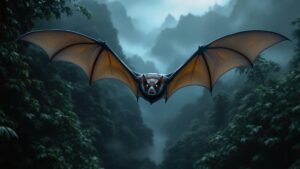
A mammal built around a flying hand
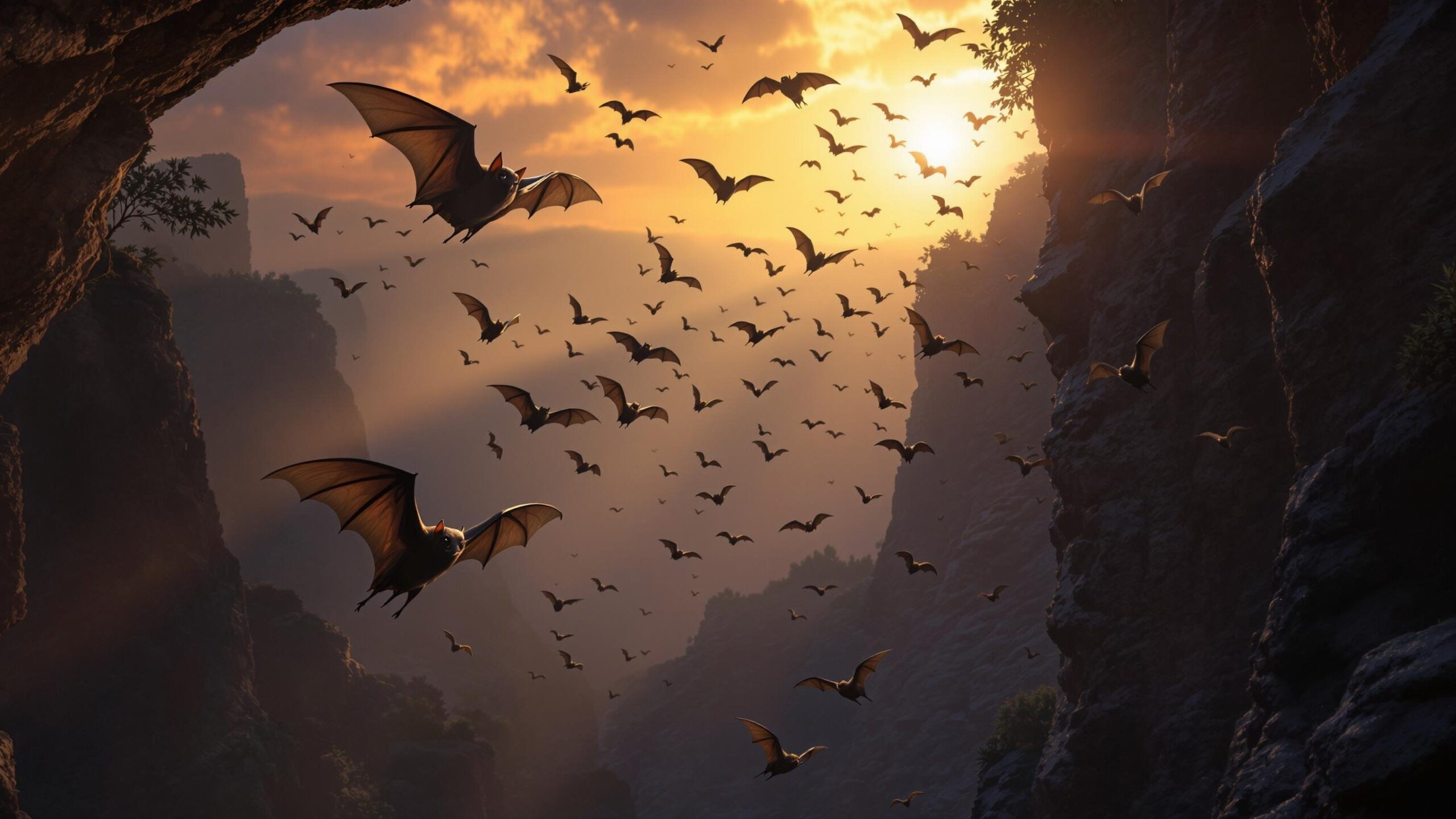
A bat turning above a pond is reshaping its wings as it flies. Four elongated fingers support a flexible skin membrane, and movements at the finger joints change the flight surface. The membrane commonly continues along the body to the hindlimbs. In many species, another sheet stretches between the legs: the uropatagium, or tail membrane. Together these surfaces give a small mammal an extraordinarily adjustable set of wings.
Wingbeats generate the lift that supports the body and the thrust that carries it forward. Changes in the positions of the wrists, feet and thumbs alter wing curvature, while both the outer hand-wing and the membrane nearer the body contribute to flight forces. This flexibility helps a bat turn around an obstacle or follow moving prey. Flying squirrels glide between elevated places; bats sustain powered flight.
Different hunting spaces favor different wings. Free-tailed bats typically have long, narrow wings suited to relatively fast insect hunting in open air. Horseshoe bats have broader, rounded wings that help them maneuver through cluttered surroundings. The brown long-eared bat can fly slowly among leaves and branches. These contrasts connect the silhouette overhead with the places where an animal finds its meals.
At rest, many bats suspend themselves by the feet. Tendons and ligaments help maintain the grip with little effort, and an elevated position leaves room to drop into flight. Many species can also take off from the ground. Hanging is part of a broader relationship between shelter and movement: a suitable roost must provide somewhere to rest as well as usable access to the surrounding feeding landscape.
Finding a route through sound, sight and scent
An echolocating bat sends out sound and listens for echoes returning from its surroundings. During an insect chase, calls can accelerate into a rapid feeding buzz as the hunter closes on its target. Most bat sonar is ultrasonic, above human hearing, although the spotted bat produces calls that some people can hear. Specialized microphones reveal much of the acoustic activity otherwise missing from a quiet evening outdoors.
Many bats produce sonar in the larynx, or voice box. This mechanism occurs in both of the major living bat branches, Yangochiroptera and Yinpterochiroptera. Old World fruit bats, the pteropodids, lack laryngeal sonar and commonly use their well-developed vision and smell to find food. Across bats, functional eyes, scent, echoes and sounds made by other animals contribute in different proportions to navigation and feeding.
Egyptian fruit bats have another acoustic solution. Rousettus aegyptiacus clicks its tongue, producing paired sonar beams that can alternate toward the left and right. The bat can scan rapidly without matching each change in beam direction with a large head movement. Measurements and acoustic modeling support a role for tongue position in steering these clicks through the mouth opening.
Wing-generated clicks add a further variation. Experiments documented them in three pteropodids: Eonycteris spelaea, Cynopterus brachyotis and Macroglossus sobrinus. In the tested Eonycteris and Cynopterus, acoustic information helped the bats distinguish large reflecting objects in darkness. Tongue clicks, wing clicks and voice-box calls illustrate several ways bats can obtain information from returning sound.
The most striking ears do more than catch echoes. Europe’s brown long-eared bat, Plecotus auritus, also listens for prey moving on vegetation. Its quiet echolocation works alongside this passive listening. Ears nearly as long as its body accompany broad wings and slow, maneuverable flight, allowing it to glean insects and spiders from leaves or bark. At rest, it may fold those ears back or tuck them beneath its wings.
Insect hunters sharing the evening
Several familiar brown bats hunt flying insects, yet their bodies and meals differ. North America’s little brown bat, Myotis lucifugus, has glossy brown fur, a paler underside and dark wing membranes. At about 5–14 grams, with a wingspan around 22–27 centimeters, it can exploit swarms of small flying insects. Its small body opens into wings much broader than a resting animal might suggest.
The big brown bat, Eptesicus fuscus, is generally larger, with a broad muzzle, robust skull and rounded ears. Its wingspan is around 33 centimeters. Strong jaws and teeth help it process hard-bodied prey such as beetles. Both brown bats occupy North American landscapes that include buildings and woodland, so body size and head shape provide more useful distinctions than their shared brown coloring.
In Britain, common pipistrelles hunt small flies and other insects around hedgerows, woodland edges, farmland and urban areas. Pipistrellus pipistrellus weighs roughly 3–8 grams, with wings spanning about 20–23.5 centimeters. The similar-looking soprano pipistrelle, Pipistrellus pygmaeus, has a stronger association with wetland feeding habitats there. Their calls typically peak near 45 and 55 kilohertz respectively, although call characteristics change with context.
In African savannas and open woodland, the yellow-winged bat takes a different approach. Lavia frons watches from a perch, sallies out after insects and often returns to eat. Seasonal flights of termites provide feeding opportunities. Grayish fur contrasts with yellow-to-orange wings and ears, making this tree-roosting bat visually distinctive as well as behaviorally different from an insect hunter continuously coursing through open air.
Faces that shape sound
Horseshoe bats carry a horseshoe-shaped lower noseleaf around their nostrils. In these members of Rhinolophus, sonar emerges through the nose, and the facial structures help shape the outgoing sound. Their specialized calls include long constant-frequency components useful in detecting fluttering insects among background echoes. They inhabit Old World regions extending through Europe, Africa and Asia to Australia, hunting insects in flight or taking them from surfaces.
Old World leaf-nosed bats in Hipposideridae also have elaborate nasal structures associated with echolocation. Their noseleaf includes an upright transverse component but lacks the central sella found in horseshoe bats. Both families lack a tragus, the small projection inside the ear present in many other bats. Facial shape and ear anatomy therefore help distinguish animals whose general coloring can look very similar.
New World leaf-nosed bats belong to a separate family, Phyllostomidae, chiefly in the Americas and Caribbean. This radiation includes fruit eaters, nectar feeders, insect hunters, vertebrate predators and vampire bats. Many use short, broadband, relatively quiet sonar calls. A facial leaf is consequently compatible with very different meals, and geography helps separate these American bats from the Old World lineages sharing the leaf-nosed name.
Molecular comparisons place horseshoe bats and Old World fruit bats together within Yinpterochiroptera, alongside mouse-tailed bats and megadermatids. Yangochiroptera contains the familiar brown bats, pipistrelles and free-tailed bats as well as the American leaf-nosed radiation. Close relationships can therefore encompass substantial differences in food and appearance, while similar diets have developed in separate branches of the bat family tree.
From blossoms and fruit to fish and blood
Old World fruit bats, Pteropodidae, range across Africa, parts of southern Eurasia, Australasia and western Pacific islands. Many have relatively large eyes and elongated muzzles and feed on fruit, nectar or pollen. Flying foxes are large members of this family, which also contains much smaller species. Plant feeding connects them ecologically with fruit-eating phyllostomids in the Americas, despite their separate ancestry and different sensory equipment.
One American nectar feeder makes a seasonal journey through flowering desert landscapes. Migratory lesser long-nosed bats, Leptonycteris yerbabuenae, follow blooms northward from Mexico into the Sonoran Desert. Elongated muzzles and tongues allow them to reach nectar in cactus and agave flowers. Later, ripening cactus fruits change the available menu, and the bats shift toward fruit as the season advances.
Along tropical American waterways, the greater bulldog bat, Noctilio leporinus, uses enlarged hindfeet and powerful hooked claws to catch prey at the surface. It echolocates while hunting and takes fish, insects and crustaceans. On Culebra, Puerto Rico, observed diets contained more insects in the wet season and more fish in the dry season. Its close relative, the lesser bulldog bat, is primarily an insect eater.
Australia’s ghost bat, Macroderma gigas, hunts large insects as well as frogs, lizards, birds and small mammals, including other bats. It uses sight and echolocation, swooping onto prey and sometimes carrying a catch to a feeding site. The whitish American ghost bats, Diclidurus, are insect-hunting members of another family. Their shared common name links pale appearances across continents, while their diets and relationships differ substantially.
The common vampire bat, Desmodus rotundus, specializes in vertebrate blood. It lives in warm parts of the Americas from Mexico southward and often feeds on livestock where these hosts are abundant. Sharp enlarged incisors open the skin, while anticoagulant activity in saliva helps blood keep flowing. Developed thumbs and strong hindlimbs support movement near a host; smell and passive listening join vision and echolocation in its sensory repertoire.
Tails, scents and social signals
Tail anatomy distinguishes several insect-hunting families. A free-tailed bat’s tail projects beyond the rear edge of the membrane between its legs. In sheath-tailed bats, Emballonuridae, the tip emerges through the membrane’s upper surface. Mouse-tailed bats, Rhinopoma, have a long, slender tail largely free of a reduced membrane. These different arrangements explain the names even when an animal’s folded wings conceal much of its body.
Many emballonurids also have scent-associated sacs along the leading wing membrane. The greater sac-winged bat, Saccopteryx bilineata, combines two pale stripes along its back with an elaborate courtship repertoire. Males use odor-bearing wing sacs as well as vocal displays. Chemical analyses have found differences associated with age, year and distance between colonies in the sac liquids, revealing variation within this scented component of courtship.
Mexican or Brazilian free-tailed bats, Tadarida brasiliensis, have rounded ears, wrinkled upper lips and conspicuously projecting tails. Their voices include social songs with multiple syllables alongside navigation calls, isolation calls and begging calls. Soprano pipistrelle males advertise mating territories with songflights. A bat’s acoustic life thus includes exchanges with other bats as well as the echoes that guide it toward food.
A shelter for each stage of life
Bats occupy tropical and temperate forests, deserts, grasslands, wetlands, farmland and cities, with especially rich diversity in tropical forests. A feeding area and a resting place may be separate parts of the same home landscape. A bat can shelter in a cavity or crevice and hunt over nearby water or open land. Food and access to a suitable roost together determine where it can live.
Tree hollows, caves, mines and building crevices offer different shelter conditions. British bats generally use existing structures and may change roosts with season, weather and reproductive needs. Common pipistrelles squeeze into narrow building crevices or use tree holes. Little brown bats use summer nursery roosts for females and pups, then commonly hibernate in caves or abandoned mines during winter.
Other bats alter the shelter itself. Honduran white bats chew the ribs of broad leaves, causing the blade to fold into a protective tent. Many pteropodids instead hang from exposed tree branches, although the family also includes bats that shelter in caves, foliage or buildings. Social arrangements range from small groups to large aggregations; immense colonies represent only one way of living among bats. An exposed tree roost also places its occupants in a different thermal setting from a sheltered cavity. The contrast is especially apparent in flying-fox camps during extreme heat, when access to shaded vegetation can become critical.
Mouse-tailed bats occupy arid Old World regions, sheltering in caves, rock fissures, wells and buildings. Their slit-like nostrils can close against dust, and some populations use seasonal torpor when food declines. Yellow-winged bats offer another social pattern: territorial pairs roost near one another in trees, and both adults participate in protecting a youngster while the female provides its nourishment.
Winter reserves and the next generation
For British insect-eating bats, winter brings a shortage of flying prey. Torpor lowers body temperature, breathing and metabolic rate, stretching stored fat through periods when feeding is difficult. Bats build reserves before winter, and extended torpor bouts form part of hibernation. Warmer conditions can bring renewed activity. This seasonal economy differs from following food to another region.
North American migratory populations of Mexican free-tailed bats move between the United States and Mexico. Summer females gather in maternity colonies, while males may occupy smaller bachelor colonies. Lesser long-nosed bats track seasonal flowers along their migration route. Movement, torpor and changes of shelter are distinct responses to the timing and location of food, with different combinations occurring across bat populations.
In temperate little brown bats, autumn mating is separated from spring fertilization by winter sperm storage in females. A mother usually produces one pup and nurses it in a maternity roost. Temperate big brown bats also store sperm through winter, later giving birth to one or two young. Birth and early growth consequently coincide with the warmer part of the year in these populations.
British common pipistrelles usually have a single pup in June or early July. The youngster initially drinks milk, begins flying at around four weeks and becomes an independent forager at about six weeks. Common vampire-bat pups make a different dietary transition: mothers first supply milk and later regurgitated blood. Their dependence continues over months as they approach the highly specialized adult feeding life.
Some bats can live for decades. A male little brown bat recaptured in southeastern Ontario reached a documented age of 31 years, an exceptional individual record. Survival involves hazards at different stages: owls and falcons take flying big brown bats, while snakes, raccoons and domestic cats can catch accessible bats or fallen young near roosts. Shelter quality matters to juveniles and adults alike.
Ecological connections that begin with a meal
A nectar visit can also be a pollination event. As lesser long-nosed bats feed at saguaro and organ pipe cactus flowers, pollen adheres to their heads and travels to other flowers. Later fruit feeding moves seeds through their digestive tracts and deposits them elsewhere. The same seasonal journey connects flowering, fruit ripening and movement of the next generation of plants.
Across tropical landscapes, fruit-eating bats transport seeds in carried fruit and droppings. Deposition away from parent plants can help vegetation regenerate in cleared or degraded areas. Insect hunters make another connection with people and plants. A two-season corn experiment in southern Illinois found more corn-earworm larvae and kernel damage where bats were excluded at night, demonstrating pest suppression in that farming system.
The same experiment linked bat exclusion with greater fungal growth and contamination by fumonisin, a fungal toxin. Its measured benefits concerned pest damage and crop condition; the difference in yield by weight was not statistically significant. By following consequences beyond the insect itself, the experiment revealed how a flying predator can influence several connected parts of a crop ecosystem.
These ecological roles follow from different feeding habits. A beetle-hunting big brown bat interacts with insect populations, a nectar-feeding lesser long-nosed bat moves pollen, and fruit eaters carry seeds. Maintaining this variety means retaining the places where those foods occur as well as the shelters from which bats reach them.
Conservation follows the animal’s needs
Losing a roost can break the connection between shelter and feeding grounds. Building renovation and exclusion can remove crevices used by British pipistrelles. Australia’s ghost bat depends on caves for breeding and shows strong fidelity to roosts. Its patchy northern populations face pressures including roost loss, disturbance, feeding-habitat loss, altered fire regimes and barbed-wire entanglement. It is listed Vulnerable under Australia’s national conservation framework.
For susceptible North American hibernators, white-nose syndrome disrupts the winter energy budget. The fungus Pseudogymnoascus destructans damages bare skin during hibernation, and extra arousals consume fat reserves. Little brown bats and northern long-eared bats have been severely affected. The northern long-eared bat, Myotis septentrionalis, is endangered under the U.S. Endangered Species Act, with white-nose syndrome identified as the principal driver of its decline.
Tree-roosting Australian flying foxes face a different physiological challenge during extreme heat. They may fan their wings, lick wrists and membranes, pant or move toward shade and lower vegetation. Shade, nearby water and the structure of a camp affect access to cooler conditions. Conservation therefore extends beyond retaining a tree: the surrounding vegetation and local shelter conditions influence the animals resting there.
Wind-farm operation offers another practical point of intervention. A synthesis covering six North American facilities found that curtailing turbine operation to prevent blade rotation at low wind speeds reduced bat fatalities, with the size of the reduction varying among treatments and years. Protecting bats involves such specific responses alongside maintaining roosts and feeding habitat: the needs of a cave-breeding predator, a hibernating insect hunter and a tree-roosting fruit eater differ.