
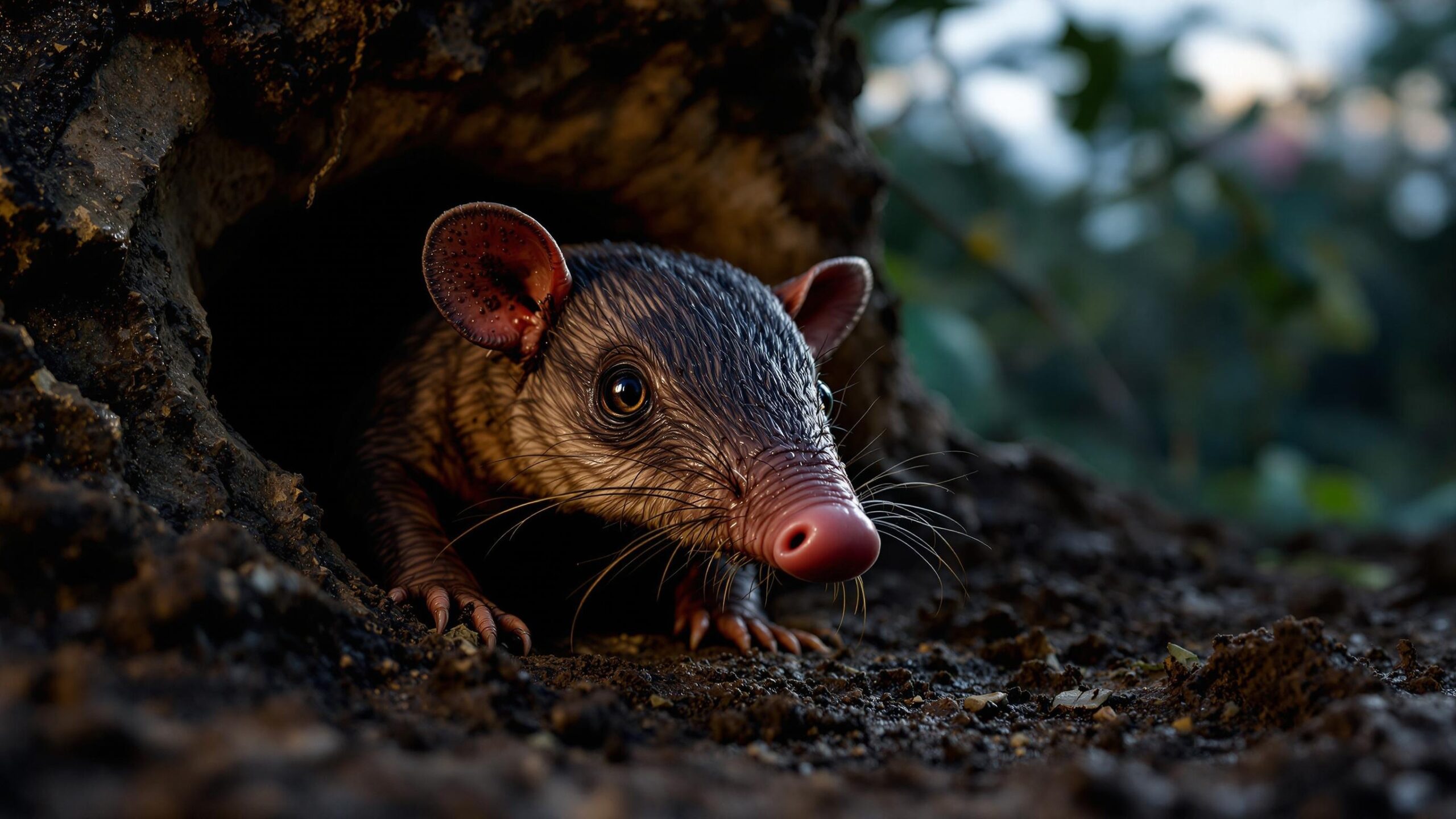
After dark in Cuba and Hispaniola, solenodons search for food with remarkably mobile snouts. These Caribbean mammals belong to the family Solenodontidae, represented by two living species. Their shared appearance conceals important differences in habitat use, family life and conservation status.
Daily rhythm: chiefly active after dark, with daylight hours usually spent in concealed refuges.
Cuba: the almiquí inhabits eastern forest refuges and roots for animal food, including insects and worms.
Hispaniola: its relative occupies varied forest types and some cultivated landscapes, feeding mainly on invertebrates but also taking small vertebrates.
- Class: Mammalia.
- Order: Eulipotyphla.
- Family: Solenodontidae.
- Living Cuban species: Atopogale cubana, formerly called Solenodon cubanus.
- Living Hispaniolan species: Solenodon paradoxus, native to Haiti and the Dominican Republic.
The common name solenodon spans these two genera. The Hispaniolan hutia is a rodent belonging to a different mammalian order.
Captive Cuban solenodons have used the tail and hind legs together for support while handling objects. Captive Hispaniolan solenodons have greeted familiar companions with quiet squeaks and rested against one another. These observations describe the animals in those settings; they do not establish identical social behavior on both islands.
Are both solenodon species endangered?
The Cuban solenodon is Endangered. The Hispaniolan species is Least Concern, although habitat loss and severe local pressures remain concerns.
Do solenodons have venom?
Both living species have venomous saliva. Research on the Hispaniolan species suggests a role in capturing vertebrate prey.
How many babies do solenodons have?
Cuban accounts report one or two per litter. For Hispaniolan solenodons, the 2018 synthesis describes one as typical and two as its maximum, while other summaries report three.
Can solenodons live for more than ten years?
One captive Hispaniolan animal was estimated at 12.1 years old at death. The Cuban record described here is six years and eleven months after adult capture, not an age measured from birth.
Two island mammals with separate identities
Solenodons are placental mammals in the family Solenodontidae, within the order Eulipotyphla. The family has two living species: the Cuban solenodon, Atopogale cubana, and the Hispaniolan solenodon, Solenodon paradoxus. Their accepted names place them in separate genera. Older writing calls the Cuban animal Solenodon cubanus; that name refers to the same Cuban species now classified in Atopogale.
The Cuban solenodon is also known as the almiquí. The Hispaniolan species is sometimes called the Haitian solenodon, although its native range includes the Dominican Republic as well as Haiti. The island names are useful for identification: neither living species naturally spans both Cuba and Hispaniola.
Solenodons represent an evolutionarily distinctive branch of Eulipotyphla. A nuclear DNA analysis published in 2016 recovered them as an early-diverging lineage within that order and proposed an over-water origin for the Cuban lineage during the Cenozoic. Other molecular investigations have produced different time estimates and explanations for their Caribbean history. The broad finding is their evolutionary distinctiveness; the precise sequence of ancient separations and island colonization remains a subject of different historical models.
Recognizing a Cuban or Hispaniolan solenodon
The Cuban solenodon
A Cuban solenodon has an elongated, flexible muzzle, small eyes, clawed feet and a thick, scaly tail with little hair. Its head and body measure about 280–390 mm, with a further 175–255 mm of tail, and its mass is approximately 1 kg. The tail accounts for a substantial part of the animal’s outline, but is measured separately from the head and body.
The Cuban species has longer, finer fur than its Hispaniolan relative. A generally blackish-brown back and flanks contrast with pale areas that may be white, buff or yellowish, especially around the muzzle and shoulders. In Luis Varona’s observations of Cuban animals, individuals differed in coloration and in the extent of those pale areas. Brown shades occur in both, so color alone offers less of a distinction than the combination of coat, markings and island of origin.
The Hispaniolan solenodon
Adult Hispaniolan solenodons weigh about 600–1,000 g, and their tails measure approximately 200–250 mm. This mass range reaches the approximate kilogram reported for Cuban solenodons, so weight alone does not separate the two species. Their short, sparse coat has little underfur and varies from dusky brown to reddish or chestnut brown, usually darkening over the head and back. Some have a small oval white patch at the nape. Hair is reduced on the face and feet, while an extensive bare glandular area covers parts of the thighs and rump.
Male and female Hispaniolan solenodons look broadly alike externally. Regional differences in body size and skull and tooth proportions occur within the species, but these geographic differences are separate from differences between the sexes. The elongated snout has an unusual internal support: a small separate bone, the os proboscis, at the front of the skull. This structure is described in juveniles and subadults as well as adults.
Forests, limestone and cultivated landscapes
The Cuban solenodon occurs naturally only on Cuba, with surviving forest refuges concentrated in the east and southeast. Alejandro de Humboldt National Park and Sierra del Cristal are important areas for the species. These humid mountain forests can be difficult to reach, adding to the challenge of observing an animal that usually emerges after dark.
A 2024 Almiquí Project update described fieldwork in pristine mountain forest above 740 m in Alejandro de Humboldt. That elevation describes the project’s reported sites, rather than the full elevational distribution of Cuban solenodons. Shelter records include hollow logs, rock crevices and spaces beneath roots, including shallow burrows under tree roots.
The Hispaniolan solenodon is endemic to Hispaniola. Within that island, it has a broader described habitat range than its Cuban relative. It occurs in dry, moist and wet broadleaf forests, high-elevation pine forest and secondary regrowth, as well as pasture and agricultural landscapes. Records extend from sea level to above 2,000 m, although the species is reported less frequently above 1,000 m. It is comparatively widespread in the Dominican Republic, with a more restricted and fragmented distribution in Haiti.
Limestone terrain is particularly important in accounts of Hispaniolan shelter use. Caves, rock clefts and underground cavities provide dens, alongside soil tunnels and hollow logs or trees. In southwestern Haiti, the Massif de la Hotte population occupies disturbed broadleaf forest patches in an agricultural matrix on a limestone plateau, approximately 750–1,400 m above sea level.
Tracking research published in 2019 found Hispaniolan solenodons using forest, pasture and cropland in the southwestern Dominican Republic, with dens in all three. Their use of modified land included shelter as well as nighttime activity. In that same landscape, Hispaniolan hutias concentrated their activity more strongly in forest. The hutia, Plagiodontia aedium, is a rodent in the family Echimyidae, whereas the solenodon belongs to Eulipotyphla.
Geographic divisions within Hispaniola
Hispaniolan solenodons have differentiated northern, southeastern and southwestern populations. A 2016 genetic analysis found region-specific mitochondrial variants alongside differences in skull and tooth form, supporting separate evolutionary histories within the island. The analysis inferred very little migration among the three regions. These biological divisions follow parts of the island’s landscape rather than simply matching the boundary between its two countries.
The Neiba Valley, or Cul-de-Sac/Hoya de Enriquillo depression, separates northern and southern populations in the 2018 specialist account. Farther southwest, the Jacmel–Fauché depression separates the Massif de la Hotte population from populations to the east. That account recognizes three subspecies: S. p. paradoxus in northern and eastern Dominican Republic, S. p. woodi around Sierra de Baoruco–Barahona and adjacent southeastern Haiti, and S. p. haitiensis in Massif de la Hotte. This is the 2018 treatment’s classification of regional forms within S. paradoxus.
Finding food beneath litter and inside wood
The Cuban solenodon is described as an omnivore with a strong preference for animal food, especially invertebrates. Insects and worms are among its reported foods. It roots with its long snout and uses its claws to expose or dig out prey in soil, litter and decaying wood.
For the Hispaniolan solenodon, soil and leaf-litter invertebrates form the usual diet. Its documented wild prey include insects at both larval and adult stages, spiders and other arachnids, worms, terrestrial snails, land crabs and many-legged invertebrates called myriapods. Frogs, lizards and birds also occur in its prey list.
Detailed captive observations by John Eisenberg and Edwin Gould show how Hispaniolan solenodons reach concealed food. The mobile snout investigated cracks, strong forelimbs opened soil and rotten wood, and the narrow lower jaw reached insects in crevices and larval tunnels. The jaw’s access to narrow tunnels complements the broader disturbance produced by the forefeet: opening a log and reaching into a small passage are different parts of obtaining the insects concealed there.
Feeding links solenodons to the communities of animals living in soil, fallen leaves and dead wood. They are mammalian consumers of those invertebrates, and the Hispaniolan species also connects with small vertebrate prey. Their searches physically disturb the material being investigated as the snout probes and foreclaws dig. These are direct interactions with the forest floor; the observations do not supply a measurement of how much soil an entire wild population turns over.
Venom as a feeding adaptation
Both living solenodon species are described as having venomous saliva. In the Hispaniolan solenodon, the grooved second lower incisor forms part of the oral venom system, within a dentition of 40 teeth. A 2019 comparative study interpreted this adaptation as likely helping S. paradoxus capture vertebrate prey. It also concluded that solenodon and shrew oral venom systems evolved independently. The proposed vertebrate-capture role comes from the Hispaniolan study; it is more specific than the general description of venomous saliva in both living solenodons.
Nighttime exploration and daytime rest
Both species are principally nocturnal. Hispaniolan solenodons make successive nighttime feeding trips separated by variable intervals, with substantial exploration along the way. The 2018 specialist account describes activity beginning around or after 18:00, with peaks between 20:00 and midnight in the observations it summarizes. Those times describe the reported activity pattern rather than a fixed schedule for every place and season.
Daytime sheltering is not completely uninterrupted: Hispaniolan animals may make brief trips outside to drink or eliminate. Cuban solenodons observed by Varona at Havana Zoo rested curled on one side, with the snout tucked toward the abdomen and often the forearms above the head. Their muscular tails also braced them during climbing and formed a supporting tripod with the hind legs while they manipulated objects.
The captive behavioral study followed four Hispaniolan solenodons of Dominican origin. Animals rested in bodily contact. Familiar individuals produced soft squeaks on reunion, while sharp clicks accompanied exploration of unfamiliar surroundings. The observations did not experimentally establish an echolocation function for the clicks.
Family associations and the arrival of young
For Hispaniolan solenodons, the 2018 synthesis describes family groups containing an adult pair and one or two young. Young can remain with the group after early nursing, with subadult departure described at approximately 10–18 months.
Cuban solenodon accounts describe young staying with their mother for several months, while also using solitary labels for adults. These descriptions support maternal association but do not establish one exclusive grouping pattern across Cuban wild populations.
Reproduction in the Hispaniolan species
Hispaniolan solenodons have small litters. The 2018 treatment describes one young as typical and two as its reported maximum, while other summaries also report litters of three. Its gestation estimate of at least 84 days is a lower bound, not a precise duration for every pregnancy. It also suggests roughly two litters per year, with an interval between births of about 145 days. These are reproductive estimates, rather than a fixed output achieved by every female in the wild.
Breeding may occur throughout the year. The same synthesis proposes a dry-season breeding peak, followed by births at the start of or during the rains. Newborn Hispaniolan solenodons are reported to weigh 40–55 g, with closed eyes and sparse hair. A denser coat develops over approximately the first 14 days. Females supply milk through a single pair of teats positioned far back near the rump, nursing the small litter as the offspring develop.
Growth and reproductive development follow different schedules. Sexual maturity refers to the capacity to breed, while first reproduction concerns the later point at which an animal actually produces offspring. The 2018 account describes both sexes reaching adult body size before eight months, with sexual maturity after about a year and first reproduction near 18 months offered as tentative estimates. Placed beside the reported departure ages of 10–18 months, this sequence suggests that a family group can include young that have attained adult size but have yet to leave.
Reproduction in the Cuban species
The Cuban species account reports one or two offspring born in a nesting burrow. They remain with their mother for several months, so the family association lasts beyond the immediate birth and early nursing period. The newborn masses and estimated developmental ages described for Hispaniolan solenodons apply to that species alone.
What individual longevity records show
One captive Hispaniolan solenodon was estimated to be 12.1 years old when it died. The longevity record rests on a small sample and describes an individual age, rather than average survival in the wild. For Cuba, Varona reported an adult female captured in July 1975 that lived a further six years and eleven months in captivity. The two records measure different things: estimated total age for the Hispaniolan animal and observed survival after capture for the Cuban female. A maximum lifespan for Cuban solenodons has not been established, and neither record gives an average wild lifespan.
Different conservation pressures on the two islands
The Cuban solenodon is classified as Endangered, while the Hispaniolan solenodon is classified as Least Concern. The Cuban animal faces loss of preferred forest to agriculture and development, together with introduced predators including cats, dogs and mongooses. Its eastern forest refuges are central to conservation work. Conserving these forest areas addresses the habitat component of the threats; introduced predators remain a separate concern within occupied landscapes.
Hispaniolan solenodons still face habitat pressure from agricultural encroachment, charcoal production and urban development. Forest degradation also affects occupied protected landscapes. The Massif de la Hotte population is particularly threatened by forest destruction, fragmentation, small population size and opportunistic consumption by subsistence farmers. The ability to use pasture and cropland does not establish that every altered landscape sustains a population. In the Dominican tracking study, denning and activity demonstrated use of those habitats, while continuing forest loss and local threats remain conservation concerns. The broader distribution of the species coexists with particularly vulnerable regional populations.
Genetic evidence adds another concern for southern Hispaniolan populations. The 2016 analysis inferred low long-term effective female population sizes, a measure of breeding ancestry and genetic diversity rather than the number of animals alive today. The researchers interpreted this genetic impoverishment as potentially reducing resilience to environmental change. Preserving separate regional populations matters because their evolutionary histories and inherited variation differ.
Introduced predators also enter the Hispaniolan conservation picture. Camera traps have photographed feral cats entering known solenodon den sites, documenting access to the animals’ shelters. Interview-based work summarized by the Last Survivors project identified free-ranging dogs as important in reported deaths of native mammals in southwestern Dominican communities. Those mortality records combined solenodons and hutias. Cat visits to dens and interview reports of dog-related deaths document different aspects of predator contact. Specialist accounts describe severe local dog impacts, while the overall effects of introduced dogs, cats and mongooses on the Hispaniolan species have not been quantified.
Local names, recognition and conservation work
In the Duchity region of Haiti, April 2007 fieldwork recovered solenodon remains near limestone outcrops in degraded secondary vegetation adjoining fields or grazed land. The remains provided physical evidence that the animal persisted in this modified Haitian landscape at the time of the survey. Some informants used Creole names such as nen long and bouche long, referring to the snout. Others confused solenodons with hutias and blamed them for crop damage. Distinguishing the mammals affected both reports of their presence and interpretations of conflict with farmers.
In Cuba, the almiquí has appeared on national stamps and coins and in an animated film. Yet a March 2012 questionnaire in Arrollo Bueno near Alejandro de Humboldt found recognition gaps alongside expressed willingness to help conserve it. The survey was small, nonrandom and weighted toward children, so it describes that community sample. Cultural familiarity with an animal’s name need not mean familiarity with its appearance.
A museum report published in 2017 described Cuban solenodons being studied and released in Alejandro de Humboldt, together with additional signs found inside and outside the park. Signs beyond the park boundary placed the animal in the surrounding landscape as well as inside the protected area. These presence records identify occupied places without supplying a total number of Cuban solenodons.
The 2024 Almiquí Project account describes teams searching Alejandro de Humboldt for dens, scat and distinctive feeding signs, alongside camera trapping. Local biologist Norvis Hernández and her team worked with the IUCN Small Mammal Specialist Group and Zoo New England. These approaches help locate nocturnal animals in difficult mountain forest, where a brief daytime visit may reveal signs of feeding and shelter use without a sighting.
On Hispaniola, the Last Survivors project ran in the Dominican Republic from October 2009 to November 2012. Durrell, Dominican conservation organizations, the national zoo, the environment ministry and ZSL collaborated on ecological research, local capacity, awareness and conservation planning for solenodons and hutias. The collaboration combined ecological surveys with education and action planning, linking the investigation of wild populations with the people and institutions involved in their conservation.
Animal Product Reviews
Dive into Animal Streets’ Animal Product Reviews – your guide to the best gear, gifts, books, and gadgets inspired by the animal kingdom. From land-roaming lions to ocean-gliding whales, from household pets to prehistoric giants, we explore top-rated products for enthusiasts, educators, and animal lovers alike. Whether you’re shopping for toys, decor, field gear, or fun collectibles, we’ve sniffed out the best so you can discover it all in one wild place!