
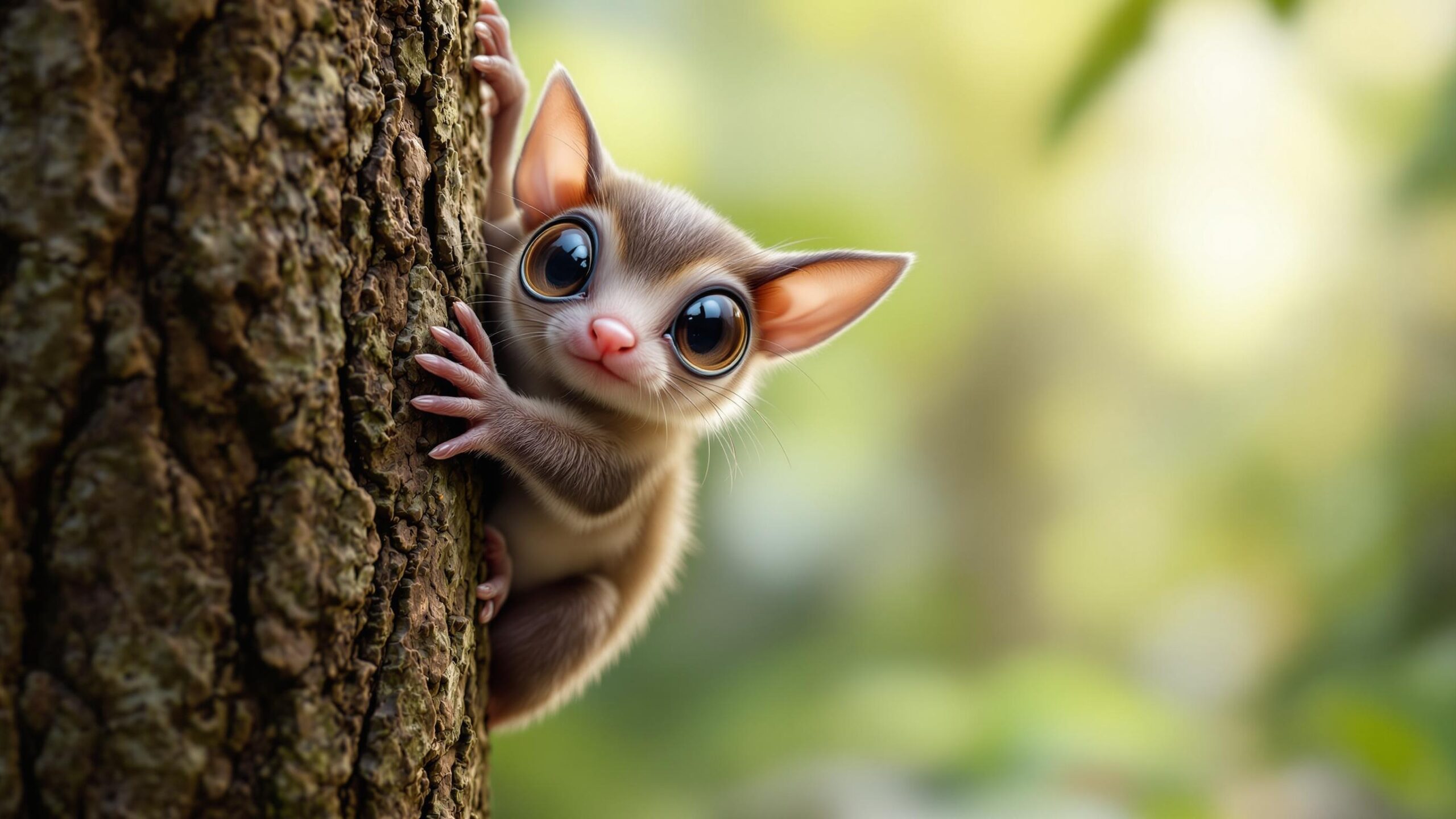
Meet the Feathertail Glider
High in the eucalyptus canopies of eastern Australia, a creature no larger than your thumb glides silently between trees under the moonlit sky. This remarkable animal is the Feathertail Glider (Acrobates pygmaeus), the world’s smallest gliding mammal. Weighing just 10 to 15 grams and stretching barely 8 centimeters from nose to tail, this tiny marvel defies its size with acrobatic feats that would impress even the largest of marsupials.
Named for the feather-shaped tail that helps stabilize it during flight, the Feathertail Glider is a living example of evolutionary innovation. It’s a marsupial, a glider, a climber, and a social forager—wrapped in a velvet-soft coat and adapted perfectly to life in the treetops. Despite its minute stature, it plays a significant ecological role and has fascinated scientists, wildlife lovers, and native communities for generations.
In this in-depth exploration, we’ll climb into the treetops to uncover the secrets of Acrobates pygmaeus: its biology, behavior, gliding mechanics, habitat preferences, and the subtle threats it faces in a rapidly changing environment. Prepare to be charmed and astonished by one of the most delicate, daring, and endearing animals on Earth.
Closer Look at This Mini Marvel
The Feathertail Glider belongs to the family Acrobatidae, which contains just one genus—Acrobates—and a single living species: Acrobates pygmaeus. While it is occasionally confused with other small gliding marsupials like sugar gliders or squirrel gliders, the Feathertail Glider stands apart due to its tiny size and signature tail, which is flat and fringed with stiff hairs arranged like the vanes of a feather.
Its body is exquisitely designed for its environment. The glider’s fur is silky and dense, colored in soft gray-brown tones on the back and paler underneath. Its large, protruding eyes provide superior night vision, a crucial trait for this nocturnal animal. Underneath each limb stretches a thin membrane of skin known as the patagium. When the glider extends its limbs, the patagium forms a surface that allows it to glide between branches. The namesake tail is not just for show—it acts as both rudder and stabilizer during glides and provides support while climbing. The tail’s unique structure makes the Feathertail Glider one of the most agile of all arboreal marsupials.
A: Start with body shape and habitat, then use color, markings, size, and behavior as confirmation.
A: Because Feathertail Glider has its own mix of structure, habitat, feeding, and comparison clues.
A: Compare it with the nearest parent, child, or lookalike pages before treating one trait as final.
A: No. Age, season, lighting, region, and posture can all change the first impression.
A: Look for the setting that explains the animal: water, cover, vegetation, substrate, altitude, reef, burrow, branch, or open ground.
A: The exact diet depends on the animal, but mouth shape, movement, and habitat usually reveal the feeding strategy.
A: Many animals change size, color, pattern, diet, risk, or habitat between young and adult stages.
A: Use the photo to check eye position, body outline, limbs or fins, texture, posture, and surrounding habitat.
A: Yes. Every animal affects food webs, habitat structure, competition, nutrient movement, or predator-prey balance in some way.
A: It should connect the animal's visible traits to how it survives, moves, feeds, and fits the taxonomy.
Where They Live: Habitat and Distribution
The Feathertail Glider is endemic to eastern Australia, where it ranges from the tropical rainforests of northern Queensland down through New South Wales and into parts of Victoria and South Australia. Its distribution spans a wide range of habitats, including sclerophyll forests, woodlands, urban parks, and even farmland with suitable vegetation.
Although highly adaptable, this species is almost exclusively arboreal, spending its life in the canopy. It uses tree hollows, bark crevices, and even man-made nest boxes for shelter. Because of its small size and delicate build, the Feathertail Glider avoids the ground entirely, relying on its gliding membrane to navigate the vertical world of the trees. In suburban areas with plenty of flowering trees, the Feathertail Glider has demonstrated a surprising ability to thrive near human habitation. This adaptability has likely contributed to its continued stability despite increasing urbanization.
The Art of Gliding: Aerial Acrobatics in Miniature
When a Feathertail Glider leaps from a tree, it transforms into a living kite, with its outstretched limbs tautening the patagium into a wide, triangular parachute. This membrane connects its elbows to its knees, forming a surface that allows it to glide distances of up to 20 meters—an astonishing feat given the animal’s size. The glider uses its feathered tail for steering and stability mid-air, adjusting pitch and angle as it cruises between branches. Unlike larger gliders, which may depend on open space between trees, the Feathertail Glider can maneuver through dense foliage with exceptional control, landing with pinpoint precision on twigs or trunks.
Gliding not only conserves energy but also provides a crucial escape mechanism from predators. Terrestrial threats like snakes or cats are easily avoided, and the glider can quickly move between feeding grounds without descending to the dangerous forest floor. These aerial feats are all the more impressive when you consider the animal’s minute mass. It has been described as a “parachuting mouse,” though that sells short the refined aerodynamic finesse this species brings to the treetops.
Physical Features: Small but Mighty
At full length, including the tail, a Feathertail Glider measures just 6.5 to 8 centimeters. Its weight averages around 12 grams, lighter than a AA battery. But within this tiny package lies a toolkit of adaptations that make the glider a formidable forest navigator. Its hands and feet are equipped with broad, ridged pads and large claws that act like suction cups and crampons, giving it excellent traction on bark and leaves.
These features allow it to cling vertically to smooth surfaces, scramble quickly across branches, and grip tenaciously even when upside down. The glider’s short, rounded ears swivel independently to pick up sounds, while its whiskers and large eyes help it judge distances accurately during night flights. Its metabolism is high but flexible, and under extreme environmental conditions, it can enter a state of torpor—a short-term hibernation that conserves energy and water. Despite its small body, the Feathertail Glider is a tough survivor, perfectly calibrated for life in Australia’s varied climates.
Diet and Foraging Behavior
Feathertail Gliders are omnivorous with a preference for sugary, energy-rich foods. Their diet primarily consists of nectar, pollen, and the sweet exudates of trees such as acacias and eucalyptus. They also consume soft-bodied insects like moths, small beetles, and the occasional spider, particularly during breeding season when protein requirements increase. Foraging is typically a group activity, with individuals gliding from flower to flower in search of food. Their long tongues and brush-tipped fingers help them lap up nectar and pick pollen from flowers. They often feed in mixed-species assemblages, sharing trees with sugar gliders, birds, and bats. Remarkably, Feathertail Gliders are also important pollinators. As they move between blossoms, they transfer pollen grains on their fur and snouts, helping to fertilize plants and maintain healthy ecosystems. Their foraging behavior may appear random, but it follows established paths and patterns tied to flower bloom cycles and seasonal insect availability.
Family Life and Social Bonds
The Feathertail Glider is a highly social creature that often lives in communal groups of up to 20 individuals, particularly during cooler months when shared body heat is beneficial. These groups typically consist of overlapping families and unrelated individuals, all cohabiting a nest hollow or shared refuge. Breeding can occur year-round but is most common in spring and summer. Females usually give birth to two to four young after a gestation period of about two weeks. Like all marsupials, newborns are extremely underdeveloped and crawl into the mother’s pouch immediately after birth. The pouch contains four teats, accommodating the usual litter size.
Young remain in the pouch for about 60 to 70 days before transitioning to riding on the mother’s back. They begin gliding and foraging on their own within weeks but may stay close to the family group for several months. Parental care is primarily provided by the mother, though group nesting offers additional warmth and protection, indirectly benefiting all young. The species’ cooperative social structure enhances survival and may be one reason why Feathertail Gliders have persisted across such a wide range of environments.
Sensing the World: Communication and Perception
Feathertail Gliders communicate through a mix of soft vocalizations, body language, and scent marking. High-pitched chirps and clicks are used during social interactions and to maintain contact during foraging. When alarmed, they may emit a short squeak or retreat silently into the shadows. Scent plays a key role in maintaining social hierarchies and identifying group members. Glands located near the mouth and tail base secrete pheromones that gliders rub on tree branches and nest entrances. These markings establish territory boundaries and help individuals recognize each other in the dark. Although their vision is adapted for nocturnal activity, their acute hearing and long whiskers provide critical spatial awareness in complete darkness. Together, these senses allow them to navigate complex canopies with near-perfect precision, even at high speed.
Conservation Status: Stable but Watchful
Unlike many of Australia’s native mammals, the Feathertail Glider is currently classified as a species of “Least Concern” by the IUCN. Its wide range, adaptable nature, and tolerance for semi-urban environments have helped buffer it from many of the pressures that threaten other small marsupials. Still, this doesn’t mean the species is immune to risk. Deforestation, land clearing, and the fragmentation of eucalyptus forests reduce available nesting sites and foraging areas.
Cats and foxes, both introduced predators, remain significant threats, especially near rural communities. Climate change may also influence flowering cycles and insect abundance, subtly altering food availability. Efforts to protect native forests and install nest boxes in developed areas have shown positive results for local populations. Citizen science initiatives and ecological surveys continue to monitor the species’ distribution and population trends, helping ensure this tiny glider remains a fixture of Australia’s treetop ecosystem.
The Feathertail Glider in Australian Culture
Although less well-known than koalas or kangaroos, the Feathertail Glider has long captured the affection of Australians. Indigenous Australians have traditional knowledge of this glider’s habits and seasonal behaviors, often observing it as an indicator species for changes in flowering trees or insect hatches. Wildlife carers and conservation groups often use the glider as a symbol of Australia’s unique biodiversity. Its miniature size, gentle demeanor, and acrobatic prowess make it a favorite among educators and zookeepers working to promote appreciation for native fauna. Feathertail Gliders are occasionally kept in specialized wildlife enclosures for educational outreach, where their spectacular gliding demonstrations leave lasting impressions on visitors.
Why the Feathertail Glider Matters
In the ecological theater of Australia’s treetops, the Feathertail Glider is a star performer. Its tiny form belies a remarkable blend of strength, coordination, and adaptability. From pollinating flowers to dispersing seeds and balancing insect populations, this miniature marsupial contributes far more to its environment than its size would suggest.
Its story reminds us that nature’s most extraordinary adaptations often evolve not in the largest or loudest animals, but in the smallest, most subtle, and most specialized. The Feathertail Glider exemplifies the beauty of balance—between agility and delicacy, sociality and independence, flight and stillness. As we navigate a world of increasing environmental change, this tiny glider offers a poignant message: that survival often belongs to those who can glide, pivot, and adapt with grace. In protecting the forests it calls home, we also preserve a symbol of evolutionary ingenuity and ecological harmony.
Animal Product Reviews
Dive into Animal Streets’ Animal Product Reviews — your guide to the best gear, gifts, books, and gadgets inspired by the animal kingdom. From land-roaming lions to ocean-gliding whales, from household pets to prehistoric giants, we explore top-rated products for enthusiasts, educators, and animal lovers alike. Whether you’re shopping for toys, decor, field gear, or fun collectibles, we’ve sniffed out the best so you can discover it all in one wild place!