
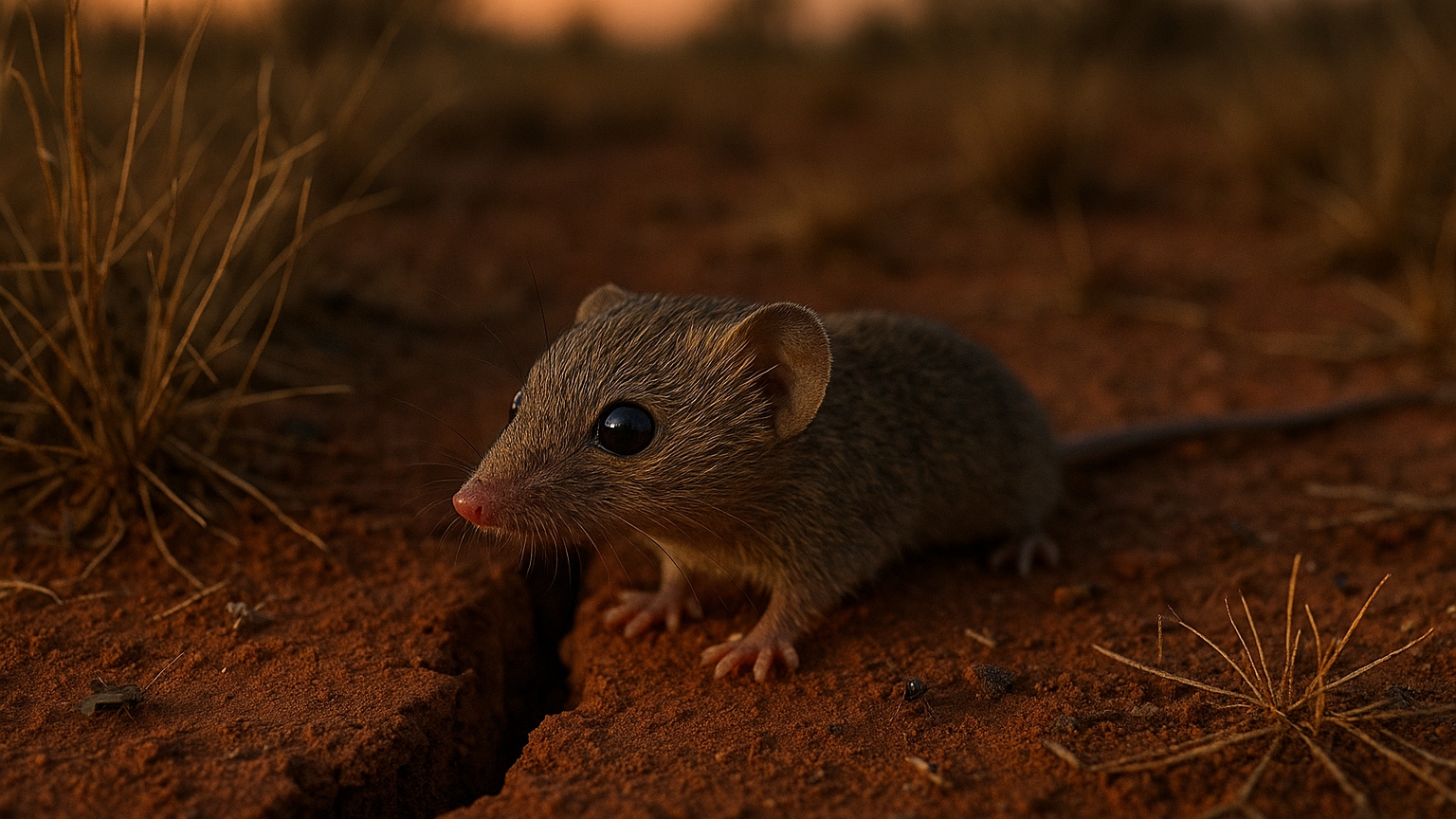
Planigales are tiny carnivorous marsupials that hunt through soil cracks, rocky crevices and sheltered ground in Australia and New Guinea. Their flattened heads open routes into narrow spaces, but the nine recognized species differ in size, habitat and life history—from Pilbara clay specialists to a little-known sandstone dweller in Arnhem Land.
Natural history: Planigales eat animal prey, especially arthropods, with small vertebrates also recorded for some species. Hunting and shelter may occur beneath the surface or among rocks, logs and bark.
Daily life: Activity varies with species and season. Laboratory simulations found a shift toward daytime activity in Giles's planigale under winter conditions, while narrow-nosed planigales remained primarily nocturnal.
Classification: Mammalia; marsupials; order Dasyuromorphia; family Dasyuridae; subfamily Planigalinae; genus Planigale.
Recognized diversity: Nine species following the 2023 Pilbara and June 2026 northern revisions. The Papuan planigale is the New Guinea representative; the other eight occur in Australia. The little planigale was formerly widely called the long-tailed planigale.
A hidden hunting surface: Narrow-nosed planigales cling to vertical soil-crack walls and use sound and smell to find prey. Their recorded foods include centipedes and small lizards as well as insects and spiders.
Different neighbours: Pilbara orange-headed planigales use sandy and rocky ground, while cracking-clay Pilbara planigales are strongly associated with heavy clay. Their ranges overlap regionally.
Are planigales mice?
They are marsupials in Dasyuridae. House mice are placental rodents with a different tooth arrangement.
Do all planigales live in cracking clay?
No. Some use rocky and sandy ground, and northeastern NSW common planigales also occupy covered forest, heath and wetland habitats.
How long do they live?
For narrow-nosed planigales, the Australian Museum gives about one to two years in the wild; a captive maximum of 5.2 years comes from a small sample. Those figures do not describe every species.
Are planigales threatened?
Seven species have global Least Concern categories, while the Arnhem Plateau and Kimberley species are Not Evaluated in the Mammal Diversity Database. Common planigales are Vulnerable under NSW protection, despite their global Least Concern category.
A genus of small marsupial hunters
Planigales belong to Dasyuridae, the family of carnivorous marsupials that also includes dunnarts and antechinuses. Their small bodies, pointed snouts and low heads give them a distinctive way of exploring the ground: spaces between soil blocks, beneath bark and among stones become places to hunt and shelter. The genus Planigale spans inland floodplains, tropical woodland, rocky plateaus and New Guinean savanna.
Nine species are recognized following two recent revisions. In 2023, the orange-headed Pilbara planigale, P. kendricki, and cracking-clay Pilbara planigale, P. tealei, were formally described. The June 2026 northern revision reinstated the Kimberley planigale, P. subtilissima, as a species and described the Arnhem Plateau planigale, P. petrophila. Genetic comparisons and skull anatomy revealed distinctions concealed by their outwardly similar bodies.
Eight species occur in Australia. The ninth, the Papuan planigale, P. novaeguineae, inhabits New Guinea, including both its Indonesian and Papua New Guinean portions. Some diversity remains unresolved: the common planigale complex and a divergent population at Piccaninny Plains on Cape York need further taxonomic work. The latter remains within the little planigale complex pending suitable specimens for anatomical comparison.
Size, teeth and a head that fits
The scale of a planigale becomes clearer when body and tail measurements are separated. Adult Giles’s planigales, P. gilesi, are described in the Victorian action statement as 60–80 mm in head-and-body length, with another 55–70 mm of tail, and a mass of 5–16 g. The narrow-nosed planigale, P. tenuirostris, weighs less than 10 g in the Australian Museum account. Small rounded ears, short legs and a low stance contribute to the compact appearance of Giles’s planigale.
Colour and proportions help place an animal within this range of forms. A narrow-nosed planigale has a flattened triangular head, brown to reddish-brown upper fur, a pale-grey underside and a white chin. Its caramel-coloured claws are a useful recognition feature. Common planigales in northeastern New South Wales (NSW) are grey-brown above and paler below, sometimes with tiny white spots; their bodies measure about 8 cm, with a separate tail of approximately the same length.
The two Pilbara species show substantial differences even within this small scale. Reported male maxima for P. kendricki were 12.5 g and 74 mm snout-to-vent length; female maxima were 9.5 g and 69 mm. For P. tealei, male maxima were 6.1 g and 62.5 mm, and female maxima 4.7 g and 60 mm. These are separate recorded maxima, not population averages, and the mass and length maxima need not belong to the same individual. All these lengths exclude the tail.
Orange-tan fur, a pale-orange eye ring and relatively large rounded ears distinguish P. kendricki from the grey-brown, dark-ticked P. tealei, which lacks a distinct eye ring. The former has a longer, more pointed head; the latter a shorter wedge-shaped head. Their feet differ too: P. tealei has a much smaller forefoot relative to its hindfoot, and six hindfoot pads compared with seven in P. kendricki.
Flattening from the top to the bottom of the skull allows access to narrow crevices, but the shape varies. P. tealei has a particularly low braincase, whereas the little planigale, P. ingrami, combines a more domed braincase with a strongly flattened auditory region. Common and Papuan planigales have relatively deeper skulls. The Papuan species is also larger-bodied and broader-snouted than the orange-headed Pilbara planigale.
Tail proportions provide another comparison. The three known Arnhem Plateau specimens measured 60–69.5 mm from snout to vent and 80.5–91.9 mm from tail tip to vent: their tails were 132–142% of snout-to-vent length. Narrow-nosed planigales have thin tails approximately as long as, or slightly shorter than, the body. Among eastern inland species, overlapping measurements make tail length alone an unreliable identification character.
Some close relatives require much more than external inspection. Little and Kimberley planigales remain very similar in appearance, although the 2026 comparison found a wider snout in male little planigales. The little species also showed stronger differences between the sexes in external and skull characters. Genetic data separated the two species readily. This combination of subtle anatomy and marked genetic distinction helps explain why geographic records changed when their boundaries were revised.
The Arnhem Plateau planigale combines its unusually long tail with dark grey-brown grizzled fur and a long, flattened skull. Papuan planigales are darker brown and deeper-skulled.
Teeth offer firmer distinctions than a mouse-like silhouette. Planigales have differentiated incisors, canines, premolars and molars; a house mouse, Mus musculus, is a placental rodent with conspicuous chisel-shaped incisors. Giles’s planigale has two premolars on each side of each jaw, compared with three in the other planigales. Its alternative name, paucident planigale, refers to this reduced premolar count.
Small size and a pointed snout can obscure very different relationships. The Etruscan shrew, Suncus etruscus, is a placental mammal in Soricidae, whereas planigales are marsupials. The brown antechinus, Antechinus stuartii, is a fellow dasyurid, but its 70–140 mm body and crinkled, notched ears help distinguish it.
Clay plains, sandstone and sheltered ground
The overlapping Pilbara species illustrate how the same region can contain different planigale environments. P. tealei is overwhelmingly associated with heavy clay soils that develop cracks. Its distribution is centred on the Pilbara, with limited extensions including a southern record at Waldburg Station. P. kendricki uses a wider range of sandy and rocky substrates, including scree, cobbled creek beds and sandy plains adjoining rock, often with spinifex hummock grasses.
The orange-headed species also ranges farther afield, with records from Cape Range, Barrow Island, the Great and Little Sandy deserts, and the Ashburton and Gascoyne regions. Re-examination of museum specimens transferred older Pilbara records assigned to common or little planigales to the newly described species. Such revisions matter when comparing surveys: a familiar old name can have covered animals with different soil associations.
Farther north, P. petrophila is known from specimens collected around Mount Brockman in Kakadu National Park, western Arnhem Land. One was trapped on a shallow sandy patch on an otherwise largely bare sandstone platform; the others came from sandstone pavement with sparse woodland and hummock grass, and a scree slope. All three collection sites lie within about 12 km of one another, giving a localized picture of a rocky plateau animal.
The Kimberley planigale extends from the Kimberley into western Northern Territory. Habitat records include broad blacksoil plains with open woodland and grassland. The revised little planigale range lies farther east, across central and eastern Northern Territory, much of Queensland and extreme northeastern South Australia. Most of Cape York lies outside that main range, with the genetically distinctive Piccaninny Plains population an important exception.
Eastern inland planigales occupy another mixture of soils and vegetation. Historical Giles’s planigale records from Lindsay and Walpolla islands on Victoria’s far northwestern Murray floodplain were on grey cracking alluvial soils in or near Black Box woodland. Lignum, Nitre Goosefoot and Old-man Saltbush formed patches of dense cover. In the South Australian comparison, Giles’s planigale occupied a wider variety of vegetation communities than the little planigale, despite using similar environments.
Narrow-nosed planigales range through eastern Australian tussock grassland, low shrubland, woodland, gibber plains and river floodplains. Surveys published in 2004 extended records to near Mount Isa and Newlands mine west of Mackay, including subhumid cracking-clay woodland with relatively dense groundcover. They are less closely tied to flood-prone habitats than little planigales in the eastern-interior comparison.
Common planigales, P. maculata, occur across northern and northeastern Australia. In northeastern New South Wales they use rainforest, eucalypt forest, heath, marshland, grassland and rocky ground with surface cover, commonly near water. Their day shelters include crevices, hollow logs, loose bark and spaces beneath rocks. Across the sea, Papuan planigales inhabit coastal savanna and grasslands on the New Guinea plains south of the highlands.
Finding prey in confined spaces
A narrow-nosed planigale can hunt on the ground or descend into soil cracks, clinging to their vertical walls. Observational accounts describe movement across horizontal, vertical and overhead surfaces, with the nose pushed under leaves or wedged into gaps. Sound and smell help it locate prey, which it kills with quick bites to the prey’s head. Its low head and slender body allow pursuit beyond the open surface.
A two-year field study of Giles’s and narrow-nosed planigales found beetles and spiders to be important foods. Comparisons between faecal remains and potential prey caught in light and pitfall traps indicated broadly opportunistic feeding through the seasons. Both species ate small prey, while larger planigales also took some larger prey classes. Narrow-nosed planigales rarely consumed items exceeding 800 cubic millimetres in volume; adult Giles’s planigales did take prey above that boundary.
The narrow-nosed species’ recorded menu also includes centipedes, grasshoppers, moths and small lizards. Common planigales take insects and small vertebrates, sometimes prey approaching the hunter’s own size.
Other small dasyurids share some of this feeding ground. The fat-tailed dunnart, Sminthopsis crassicaudata, is a carnivorous marsupial of southern Australian grassland and semiarid habitats, with a cited mass of 15–20 g. In semiarid NSW, its abundance was negatively associated with vegetation height and crack depth and density, whereas Giles’s planigale showed positive associations. For narrow-nosed planigales, vegetation height was the only important measured predictor in that analysis. All three studied dasyurids, including the narrow-nosed planigale, used habitat flexibly; these measured features predicted abundance poorly overall.
Activity, cool refuges and torpor
The underground environment offers more than access to food. During winter fieldwork at Kinchega in western NSW, shaded surface temperatures ranged from −1.0 to 21.5°C, while a sensor 25 cm down a soil crack recorded 11.0–15.5°C. The much narrower underground range demonstrates the thermal shelter available beneath an exposed surface.
Activity can also shift with season and species. In a laboratory chamber containing surface and underground crack spaces, Giles’s planigales were nocturnal under simulated summer conditions and more active by day under simulated winter conditions. Narrow-nosed planigales remained primarily nocturnal in both simulations. Infrared monitoring over three consecutive days also detected recurring short activity cycles, rather than a single uninterrupted period of movement.
Giles’s planigales can lower body temperature and metabolic demand through torpor. In a laboratory study of five siblings, torpor occurred in eight of 25 morning observations at 19°C with food and water freely available. For separate respirometry measurements, the animals received no food or water for approximately a day. Undisturbed induced bouts lasted 2–15.3 hours, averaging 8.8 hours over 21 bouts at ambient temperatures of 10–27°C.
During torpor, oxygen consumption fell well below that of resting animals maintaining their usual body temperature at the same cool ambient temperature. The lowest individual body temperature recorded in that laboratory study was 14.3°C. Planigales could still move rapidly at a measured body temperature of 20°C, a useful ability for an animal negotiating exposed entrances and confined underground spaces.
Winter fieldwork at Kinchega in May–July 2006 showed torpor in a free-ranging Giles’s planigale. Useful temperature records came from one animal over 11 days, and it became torpid every monitored night. Two fully recorded bouts lasted 15.4 and 18.2 hours; its lowest recorded body temperature was 10.5°C. Researchers observed that individual basking three times while rewarming near a crack entrance. Sunlight supplied external warmth during the transition back toward activity.
Breeding and the long transition to independence
Vocalizations and glandular changes accompany breeding in the two well-studied eastern inland species. Read recorded mate-attracting calls by female Giles’s and narrow-nosed planigales in oestrus. Free-living breeding males showed conspicuous fur discoloration associated with the sternal gland on the chest.
In Read’s laboratory and western NSW field research, breeding extended from July or August to mid-January, with most wild litters born in September. Some females of both species produced two litters in a season. Giles’s planigales had three days of oestrus in a 21-day cycle, compared with one day in a 33-day cycle for narrow-nosed planigales. The measured 19-day gestation applies to the narrow-nosed species. The months-long breeding season of these two planigales contrasts with that of the brown antechinus, whose males die after a short winter mating period.
Females of both species had 12 teats, but teat number and litter size describe different things. The Australian Museum gives an average litter of six for narrow-nosed planigales. Newborns reach the pouch and attach to teats. In a laboratory developmental series covering three litters, first teat detachment occurred at 36 days, eyes opened at 51 days and weaning occurred at 95 days. Field developmental observations agreed with the laboratory series.
Growth was followed to 200 days in that study. A separate life-history compilation gives female sexual maturity at 240 days for narrow-nosed planigales; this describes maturity rather than an age of first birth. Early teat detachment therefore marks one stage in a much longer period of development. Reports of winter communal sleeping in this species describe shared nests lined with insect wing cases, a seasonal association rather than evidence of permanent family groups.
Museum specimens reveal regional reproductive details elsewhere. Orange-headed Pilbara females have up to 12 nipples, with a skin fold developing around pouch young; the corresponding fold in cracking-clay Pilbara females is shallower. Specimens showed reproductive development in September–November for the former and October–November for the latter. Kimberley females with pouch young were collected in August, October and January. In northeastern NSW, common planigales breed from October to January, with females lining nests with grass, eucalypt leaves or shredded bark.
Predators, prey and lifespan
Planigales also become prey. Eastern barn owl pellets from an abandoned wool shed at Toorak in northwestern Queensland contained planigale jaw bones. Analysis published in 2025 suggested that both little and narrow-nosed planigales could be represented, although some remains could not be assigned confidently to species. The pellets document a direct route from small ground-dwelling predators into an owl’s diet.
For the narrow-nosed planigale, the Australian Museum describes a wild lifespan of approximately one to two years. AnAge records a captive maximum of 5.2 years from a small sample.
Conservation at the scale of a species and a site
Seven species have global Least Concern categories: Giles’s, little, orange-headed Pilbara, common, Papuan, cracking-clay Pilbara and narrow-nosed. The Arnhem Plateau and Kimberley species are Not Evaluated in the Mammal Diversity Database. The 2026 taxonomic authors recommended Least Concern for the widespread Kimberley species, but that recommendation is distinct from a formal assessment. For the Arnhem Plateau species, the three known specimens date from 1977, 2003 and 2004; its wider distribution and current population status remain unresolved.
The October 2026 dasyurid synthesis identified a possible decrease in the cracking-clay Pilbara planigale, based on suspected habitat loss, degradation and predation. In central Queensland, narrow-nosed planigales were recorded on lightly grazed land and in buffers beside mined landscapes. The survey authors also highlighted regional land-clearing pressure. Those occurrence records show use of particular remaining habitats, without measuring the effects of mining itself.
Legal protection has a regional scale too. The common planigale is Vulnerable in NSW, while globally Least Concern and not listed as threatened under Commonwealth legislation. The NSW account identifies fragmentation, development-related changes to waterways, and loss of ground vegetation, logs and bark through clearing or frequent burning. Overgrazing and trampling around water reduce cover, while foxes, cats—including domestic cats—and cane toads add regional threats.
Responses to toads have been studied experimentally. In northeastern Queensland feeding trials, many common planigales initially seized or partly ate a cane toad, then tended to ignore toads in later trials. The tested animals survived ingestion without overt illness. Researchers interpreted rapid learned avoidance as contributing to their responses and suggested greater physiological tolerance in long-exposed Queensland populations as a possibility.
At Koala Beach Estate in Pottsville, NSW, a dedicated management plan was adopted in 2005 following surveys associated with residential development. Subsequent monitoring used pitfall traps and artificial cover objects. Sampling recorded an adult female and an adult male common planigale in November 2020 pitfall sampling, plus a separate September detection beneath artificial cover. These encounters demonstrated persistence after severe drought, although detections were too sparse to establish a population trend. Protecting ground vegetation, hollow logs and bark, limiting cattle damage near water and controlling introduced predators address the shelters and pressures identified for NSW common planigales.
Animal Product Reviews
Dive into Animal Streets’ Animal Product Reviews – your guide to the best gear, gifts, books, and gadgets inspired by the animal kingdom. From land-roaming lions to ocean-gliding whales, from household pets to prehistoric giants, we explore top-rated products for enthusiasts, educators, and animal lovers alike. Whether you’re shopping for toys, decor, field gear, or fun collectibles, we’ve sniffed out the best so you can discover it all in one wild place!