The quokka (Setonix brachyurus) is a small wallaby native to southwestern Western Australia. Famous for close encounters on Rottnest Island, it also lives in mainland forests and on Bald Island. Selective browsing, bacterial fermentation and a long period of pouch development shape the life of this Vulnerable marsupial.
Natural history at a glance: A nocturnal plant-eater that shelters in dense vegetation and browses shrubs as well as grasses. Adult size differs between sexes and populations. Rottnest supports the largest offshore concentration; mainland animals occupy scattered forest, wetland and coastal habitats.
Longevity: Wild individuals can exceed ten years. A captive record of 13.8 years represents exceptional recorded survival, rather than average life expectancy.
Classification: Class Mammalia; marsupial infraclass Marsupialia; order Diprotodontia; family Macropodidae; genus Setonix; species Setonix brachyurus.
A quokka is a small wallaby. Pademelons belong to the same family but a different genus, Thylogale. Woylies belong to Potoroidae, a separate family within Diprotodontia, and differ in their fungus-digging diet and specialised tail.
Two routes to a meal: Quokkas can climb to reach vegetation, and forest animals select particular shrubs rather than simply eating whichever plant is most abundant.
Resting away from the dining area: Radio-tracked Rottnest animals associated with the settlement sheltered outside developed areas by day before entering them to feed at night.
Is a quokka a rodent?
No. It is a marsupial in the kangaroo and wallaby family, Macropodidae.
Do quokkas live beyond Rottnest Island?
Yes. Their native range includes Bald Island and scattered populations in southwestern mainland Western Australia.
When does a joey become independent?
Pouch departure occurs around six to seven months, with nursing continuing afterward. Managed research animals depended on milk for roughly 300 days; this is not a fixed timetable for every wild joey.
Can quokkas pause a pregnancy?
They can pause an embryo at the blastocyst stage. Suckling helps inhibit further development, linking the pause to lactation.
Are quokkas endangered?
Their global conservation category is Vulnerable, and they are also listed as Vulnerable under Australian national law. Local abundance on Rottnest coexists with a contracted, fragmented mainland distribution.
Can visitors feed or touch them?
Rottnest Island Authority advises watching from a respectful distance without touching, feeding or giving water.
A compact member of the kangaroo family
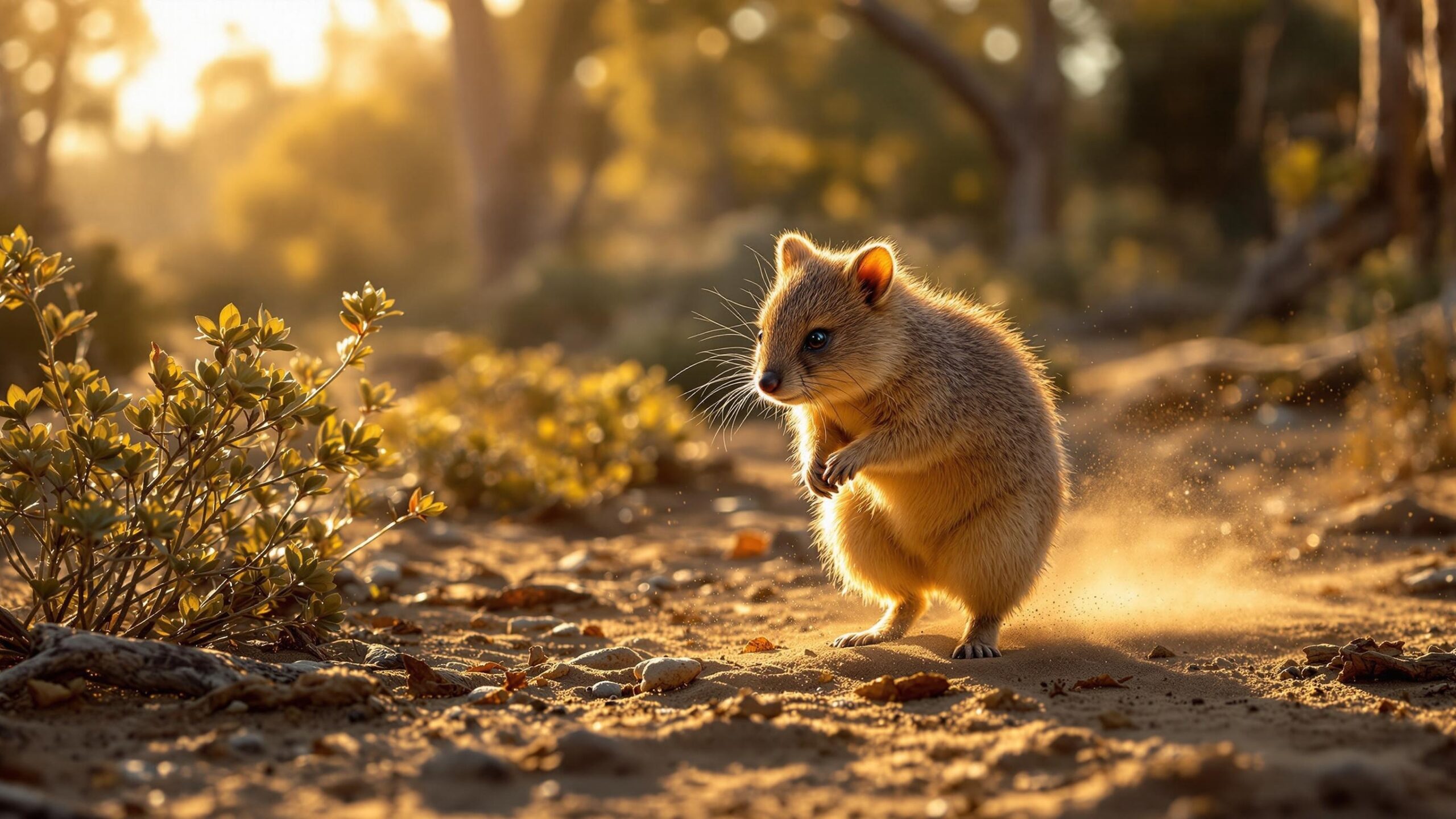
The quokka has the proportions of a small, stocky wallaby: a rounded body, broad short face and short ears covered in fur. Its nose is bare, its dense grey-brown coat becomes paler underneath, and hair extends over the claws of its feet. The tail is much less densely furred than the body. At 25–31 cm long, it is shorter than the head and body together, which measure 40–54 cm.
Males generally outweigh females. The 2013 recovery plan gives descriptive mass ranges of 2.7–4.2 kg for males and 1.6–3.5 kg for females, although a northern jarrah forest study captured a male weighing 4.79 kg. The plan’s average lengths excluding the tail were 48.7 cm for males and 46.8 cm for females. Hind feet measured 10–12 cm. Size also varies geographically: a comparison of two island and five mainland populations found males larger at every locality, with a general decrease in size toward higher latitudes.
Scientifically, the quokka is Setonix brachyurus, a member of Macropodidae, the kangaroo and wallaby family, within the order Diprotodontia. Its movements include hopping and a slower, five-point gait called pentapedal walking. During the slow gait, the forepaws and tail support the body while the hind legs advance. Quokkas can also climb vegetation to reach food, extending their feeding beyond plants immediately accessible from the ground.
The species’ formal description is tied to King George Sound on the mainland, its type locality. Quoy and Gaimard described it in 1830 under the name Kangurus brachyurus; it is now placed in Setonix. Alternative common names include Short-tailed Wallaby and Short-tailed Pademelon. Despite the shared common name, the quokka is classified separately from pademelons in the genus Thylogale.
Two islands and a fragmented mainland range
Quokkas are native to southwestern Western Australia, including Rottnest Island near Perth and Bald Island near Albany. On the mainland, quokkas formerly occupied a much wider area, but their distribution contracted substantially during the twentieth century. Surviving populations occur in the northern jarrah forest, Swan Coastal Plain, southern jarrah–marri–karri forests and south-coast reserves.
The familiar island setting represents only part of their habitat. In the northern jarrah forest, studied populations occupied dense swamp shrublands near the heads of creek systems. Bullich–blackbutt forest adjoined these wet areas, with jarrah–marri forest on drier slopes. Farther south, quokkas use forest, woodland and wetlands, while south-coast habitats also include gullies, streamside vegetation and dense coastal heath.
Living vegetation structure matters within these habitats. Southern-forest research linked occupancy with multiple vegetation layers, relatively little near-surface woody debris and nearby vegetation of a different fire age. Layered plants provide shade, insulation and protection from weather; heavy fallen debris can obstruct movement and smother accessible understorey growth. Researchers detected quokkas at 88 of 327 surveyed sites, in vegetation ranging from six months to 50 years since fire. Vegetation age itself was not a significant predictor of occupancy in that analysis. On Rottnest, they also inhabit comparatively dry dunes, grass and heath, woodland and the tourism settlement.
Selective browsing through the seasons
Wild quokkas eat grasses and shrub vegetation, including fresh young growth. Their feeding varies with the plants available locally. Rottnest quokkas eat succulent plants and wattle leaves, whereas northern forest animals browse a diverse collection of swamp and swamp-edge plants. A northern jarrah study identified 29 plant species in faecal material, with leaf and stem fragments dominating the recorded food occurrences. Microscopic examination connected the plant fragments in droppings with foods growing in the surrounding habitat, allowing the investigator to compare consumption with local availability.
These forest quokkas selected some plants more strongly than others. Thomasia species and Dampiera hederacea were relatively preferred foods. Other frequently recorded plants included Mirbelia dilatata, Bossiaea aquifolia and Agonis linearifolia. The last plant illustrates a useful distinction: it appeared often in the diet but was relatively avoided when consumption was compared with its abundance. A very common shrub can supply many meals even when an animal selects it less frequently than its availability would predict.
Food location changed seasonally. Plants from inside swamps appeared more in winter and spring samples, while swamp-edge plants became more prominent in summer and autumn. Small quantities of seeds, pollen, flowers, insect remains and fungi also occurred. The researcher interpreted much of that material as incidental intake during browsing. Seeds passing through the gut demonstrate ingestion, but their occurrence alone does not establish successful seed dispersal or improved germination.
Turning fibrous leaves into usable energy
A quokka’s large, sacculated stomach supports bacteria that ferment plant carbohydrates, including cellulose and starch. Fermentation produces volatile fatty acids, which enter the blood travelling toward the liver and are taken up by the liver and other tissues. This microbial processing gives the animal access to energy contained in fibrous plant food. Some fermentation also occurs in the caecum and upper colon, though less than in the stomach.
The arrangement resembles ruminant digestion in its use of foregut fermentation, despite the quokka’s separate marsupial ancestry. Feeding experiments with adult males originating on Rottnest found fibre digestion less efficient than in domestic ruminants but more efficient than in rabbits on the compared rations. Food moved through the digestive system more slowly when the ration was coarser and when intake was lower.
Water and energy during a dry summer
Rottnest provides a close view of the physiological demands of summer. In a midsummer comparison, quokkas at waterless West End had lower water turnover and higher circulating concentrations of lysine vasopressin than animals using brackish water near the lakes. The West End animals were conserving water, but still showed slight dehydration. Those with access to brackish drinking water were in better physical condition at summer’s end.
Quokkas store fat in the tail as an energy reserve for periods when food is scarce. In the 2013–2015 Rottnest study, animals captured in the settlement had a mean tail-base circumference of 65.90 mm, compared with 62.00 mm in coastal dunes. Tail-base circumference served as an indirect indicator of body condition across captures, including repeat captures of the same individuals. The habitat difference concerned this condition indicator, rather than a direct weighing of stored fat.
Night feeding and encounters with neighbours
Quokkas are mainly active at night and spend the day sheltered in dense vegetation. Repeated travel through cover creates runways used for feeding and retreat. Their social encounters include sniffing and mutual grooming, but also displacement, chasing and boxing.
On Rottnest, observed quokkas in larger aggregations spent more time foraging and less time looking around. In groups of about ten or more, individuals devoted almost all of some five-minute observation periods to feeding. Competition and retained antipredator behaviour were both considered as explanations. These were short focal observations under Rottnest’s low-predation conditions.
Movement depends on the landscape
Radio tracking reveals striking regional differences in space use. A Rottnest study reported a mean seasonal home range of 1.91 hectares. Settlement-associated animals often rested outside developed areas by day and travelled into them to feed at night.
Southern-forest quokkas in another tracking study used mean home ranges of about 71 hectares and travelled up to 10 km in a night. Movements between habitat patches reached 14 km where dense streamside vegetation linked the patches. These forest animals spent about 40% of their time in riparian habitat while also using other vegetation. Connected stream corridors can thus form part of a much broader movement network.
Birth, a waiting embryo and a growing joey
A normal quokka pregnancy without developmental delay lasts about 27 days. The newborn is extraordinarily small: a captive study reported a mean birth mass of about 0.39 g among 22 newborns. A single joey normally continues its development in the mother’s pouch, receiving milk through a prolonged period of growth.
The female can enter oestrus again after giving birth. Fertilisation then produces another embryo that can pause at the blastocyst stage while the existing young is nursing. This embryonic diapause is linked to suckling-associated inhibition of development. Experimental cessation of the suckling stimulus allowed both the dormant embryo and the corpus luteum, the ovarian structure involved in supporting pregnancy, to resume development.
The youngest animals recorded as reproductively mature in John Shield’s captive study were a female aged 252 days and a male aged 389 days. Field observations give a different measure: the youngest female documented giving birth in the northern jarrah study was about 15 months old.
Leaving the pouch takes time
Feeding on plants begins before a joey finishes pouch life. Managed-animal research found herbage in the forestomach at about 150 days. Excursions outside the pouch begin around 180 days; Shield’s animals vacated it at 185–195 days, while a specialist lactation synthesis places permanent departure at about 200 days. These findings describe a transition lasting weeks, with plant feeding and nursing overlapping.
Milk remains important after permanent pouch exit. Research animals depended on milk for roughly 300 days, so a young quokka outside the pouch may still return to its mother to suckle. In the northern jarrah demographic study, juveniles were animals that had permanently left the pouch but had not yet begun breeding.
The mother’s milk changes as her offspring develops. Measurements from 70 to 300 days after birth showed rising protein and lipid concentrations later in lactation and shifts in milk carbohydrates around developmental transitions. Estimated daily milk consumption rose from 1.6 mL at 55 days to 32.5 mL at 165 days in another study.
Developing temperature control
A growing joey also develops the ability to keep its body warm outside the pouch. In Loh and Shield’s temperature-regulation experiments, young quokkas were exposed to air temperatures of 17.5°C and 24°C. Animals younger than 166 days cooled toward the surrounding temperature, whereas pouch young aged 166 days or more could maintain a body temperature of about 35°C.
The ability to sustain a high rate of oxygen consumption in response to cooling emerged between 144 and 169 days. Only after that response was fully developed could the young maintain body temperature in cool surroundings. This adds a physiological dimension to pouch development: readiness for life outside includes the capacity to sustain heat production, as feeding gradually shifts from milk toward vegetation. These ages describe experimental animals under the tested conditions.
Different breeding calendars
Rottnest quokkas studied during 2013–2015 retained a seasonal breeding cycle, with most births between February and April. Settlement births occurred earlier than births in the other sampled habitats, but there was no evidence that settlement animals eliminated or shortened their seasonal period without oestrus.
Birth rates did not differ significantly among the Rottnest habitats, whereas inferred weaning rates were highest in the settlement and lowest in coastal dunes. The weaning comparison came from mothers’ teat condition. It distinguished habitats in which young were apparently more likely to reach that later stage, even when the rate of producing newborns was similar.
Mainland births in the northern jarrah study occurred throughout the year, with fewer in summer. Repeatedly recaptured females averaged 2.2 young produced annually, a figure the researchers interpreted as including replacements for young lost before successful rearing. Bald Island quokkas also changed their reproductive pattern after being moved into captivity, breeding without their wild seasonal pause.
Some quokkas survive beyond ten years in the wild. The recorded captive maximum is 13.8 years, based on a small sample. These records establish achievable longevity; neither gives the average lifespan of a wild population.
Quokkas, pademelons and woylies
The Tasmanian or rufous-bellied pademelon, Thylogale billardierii, shares the quokka’s compact macropod build and habit of sheltering in dense cover before feeding at night. Its red-brown belly differs from the quokka’s paler underside, and large male pademelons can reach 12 kg. The pademelon survives natively in Tasmania and nearby islands after extinction on mainland Australia, in wet forests and forest-edge feeding areas.
A woylie is another small hopping marsupial of southwestern Australian conservation landscapes, but belongs to Potoroidae rather than Macropodidae. It digs for fungi, builds a daytime nest and uses its brush-tipped, prehensile tail to carry nesting material. The Mammal Diversity Database recognises the living woylie as Bettongia ogilbyi; conservation accounts may still use Bettongia penicillata or B. p. ogilbyi. Remnant and reintroduced woylie populations have their own distribution, including the Mt Gibson project in the Western Australian Wheatbelt.
Genetic differences across the range
Separation among quokka populations is reflected in their DNA. A range-wide genetic study published in 2020 used microsatellite markers from 412 adults sampled at 33 locations. The analysis inferred nine population groupings, revealing divisions that were difficult to identify through ordinary ecological observations. Genetic diversity was highest in a large central population in the southern forests and lower toward the edges of the species’ distribution.
The island populations differed from one another too. Rottnest retained about 70% of the diversity measured across mainland populations, while Bald Island had markedly less. Only the sampled northern jarrah forest populations showed genetic evidence of recent or older population bottlenecks. Quokkas at Muddy Lakes on the Swan Coastal Plain were genetically associated with the southern forest population. Overall, the northern forest animals formed small, isolated genetic groups, whereas the southern forests appeared to support a large interbreeding population. The geography of quokka ancestry therefore includes both isolated remnants and broader connections within the surviving range.
A visible island animal with a vulnerable future
The quokka is classified as Vulnerable globally by the IUCN and under Australia’s national environmental law. The global assessment dates to 2012 and was published in 2020. Island abundance sits alongside a contracted and fragmented mainland range: the Australian Government estimated 3,000–4,000 mainland animals across five subpopulations in 2022. For Rottnest, the 2013 recovery plan estimated 8,000–12,000 animals, with strong seasonal fluctuations. Those differently dated figures are not a simultaneous census.
Introduced foxes and feral cats are predators. In 25 months of northern jarrah monitoring of 58 radio-collared quokkas, carcass evidence attributed two deaths to foxes and one to a feral cat. Two males were killed by vehicles near a road crossing through swamp habitat. Earlier records also associate quokkas with raptor predation, including ospreys on Rottnest, although the northern jarrah tracking study recorded no raptor-attributed deaths.
Habitat loss, fragmentation, severe fire, feral pigs and phytophthora dieback compound these pressures. Pig disturbance and dieback can damage food and shelter vegetation, leaving more open conditions in which quokkas are exposed to predators. A drying climate and more severe disturbances add pressure to already separated populations. Protecting wet refuges and connections between habitat patches addresses both local shelter needs and the longer movements documented in forest animals.
Fire severity and the survival of cover
Quokka responses to fire depend on what remains unburnt. In southern-forest research, relatively mild burns with scorch heights below 10 m and more than 20% unburnt area were recolonised within a year. The intensely burnt wildfire treatment lost vegetation structure and remained uncolonised after four years. During the first post-fire year, all quokka detections were within 230 m of unburnt vegetation.
Tracking in the northern jarrah forest showed animals shifting toward unburnt habitat when their ranges overlapped prescribed burns. Two animals directly exposed to fire survived by using unburnt cover: one temporarily stayed in a small unburnt patch before moving, while the other moved into adjoining suitable habitat. Occasional short nocturnal returns to burnt areas were recorded from three months afterward.
Living alongside people
Tourism-site quokkas on Rottnest allowed people to approach more closely before withdrawing than animals at non-tourism sites. Attempts to touch them and noisy interactions were associated with withdrawal. Researchers proposed both learning through experience and differences in which temperaments occupied particular sites as explanations for the greater tolerance. The observations did not conclusively separate those mechanisms.
Rottnest Island Authority advises observing from a respectful distance without touching, feeding or giving water. Mainland conservation also extends beyond reserve boundaries. A Wellington National Park resilience project, completed in 2024–25, coordinated predator and feral-pig control on adjoining private properties. That work targets threats shared across neighbouring landholdings. Measures of quokka population change, habitat condition and reduced introduced-animal impacts are among the possible indicators for the Australian Government’s scheduled 2027 evaluation.
Animal Product Reviews
Dive into Animal Streets’ Animal Product Reviews – your guide to the best gear, gifts, books, and gadgets inspired by the animal kingdom. From land-roaming lions to ocean-gliding whales, from household pets to prehistoric giants, we explore top-rated products for enthusiasts, educators, and animal lovers alike. Whether you’re shopping for toys, decor, field gear, or fun collectibles, we’ve sniffed out the best so you can discover it all in one wild place!