
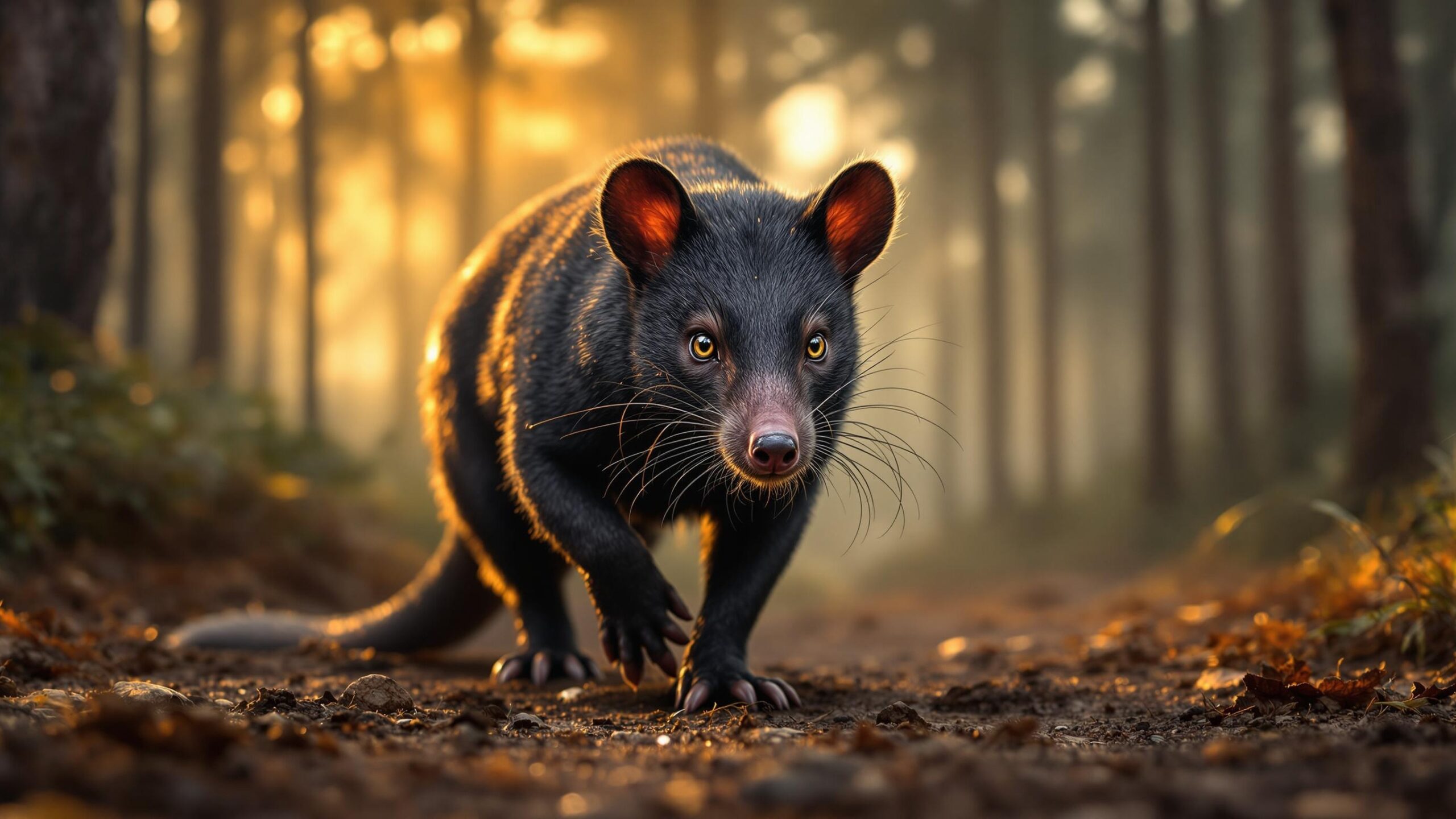
The Tasmanian devil is a carnivorous marsupial with a misleadingly doglike outline. Its history reaches beyond Tasmania: fossils document an earlier mainland Australian range, long before the managed mainland breeding populations of today.
A wide gape can express fear or uncertainty.
Devils amble or gallop; young climb more agilely than adults.
Sarcophilus harrisii belongs to Dasyuridae, within Dasyuromorphia and Marsupialia. Its doglike outline does not make it a dog.
During six filmed den encounters in northwest Tasmania, the occupying devil displaced the visitor. Immediate possession of a den does not demonstrate exclusive territories around all dens.
How long do wild devils live?
The government account gives up to six years, rather than an average.
Can a solitary devil recognize another?
A controlled scent experiment found discrimination between familiar and unfamiliar devils’ feces, supporting recognition through smell.
Do other scavengers replace the devil’s role?
Not fully in the carcass experiment: other scavengers ate more carrion where devils had declined, yet carcasses lasted longer.
Recognizing a Tasmanian devil
The scientific name is Sarcophilus harrisii. The Mammal Diversity Database places its genus, Sarcophilus, in the family Dasyuridae and the order Dasyuromorphia, within the marsupial infraclass Marsupialia. The spelling Sarcophilus harrisi, with a single final i, sometimes appears in older usage; the database treats it as an incorrect subsequent spelling, not another living species.
Devils have squat bodies, broad heads, thick tails and mostly black fur, with variable white patches on the chest, flanks or rump; some are entirely black. Males exceed females in size. Tasmania’s wildlife program gives upper male values of 14 kg and about 30 cm at the shoulder, rather than measured averages.
The spotted-tailed quoll, Dasyurus maculatus, has spots along its body and tail, contrasting with a devil’s larger patches. Both occur in Tasmania; the quoll also inhabits eastern mainland states.
The feet supply another part of the devil’s feeding equipment. Sharp claws remain extended rather than retracting, and are used for digging and holding prey. There are five digits on each forefoot and four ground-contacting digits on each hind foot. Owen and Pemberton’s anatomical description, reproduced in the San Diego Zoo Wildlife Alliance compilation, identifies these tools for gripping and digging.
Tasmania, older ranges and changing landscapes
Tasmania is central to the devil’s natural history, but its name can obscure a much older Australian distribution. Fossils establish that devils once lived on the mainland. The Australian Museum places reliable evidence for their mainland extinction approximately 3,200–3,500 years ago. That interval is approximate: it neither identifies the last individual nor demonstrates what caused the disappearance.
Wild devils range from Tasmania’s coast to its mountains, using coastal heath, open dry sclerophyll forest and mixed sclerophyll–rainforest, including woodland interfaces with agricultural paddocks.
In the Surrey Hills production-forest mosaic, tracking showed adult females using native forest, native grassland and plantation without an overall preference among those broad habitat types in the modeled behavioral states. The April–October 2021 study fitted collars to 15 adults, including 12 females and three males; habitat-selection analyses excluded the males. Devils moved faster along roads and plantation edges, and the female analyses favored these linear features. Only 23% of attempted GPS fixes succeeded, and movement models inferred approximate activities rather than observing every feeding event. The inferred states approximated resting or feeding, foraging and travel. Local use of a plantation consequently does not make it ecologically interchangeable with native forest. Even the estimated selection ratio of 1.52 for four- to seven-year-old stands was imprecise: its 95% confidence interval, 0.98–2.05, included neutral selection at 1. The estimate does not establish a preferred plantation age throughout the species’ range.
Jaws and teeth that change with age
The broad head contains a short muzzle, a pronounced crest along the skull’s midline and wide cheek arches. These structures accommodate strong jaw muscles. Anatomical literature links that arrangement with bone-crushing feeding, while different molar surfaces contribute complementary actions: upper-molar basins and cusps crush, and a sharp crest and notch on the lower molars slice. On each side, the upper jaw normally has four incisors, one canine, two premolars and four molars; the lower jaw has three incisors, one canine, two premolars and four molars. The expected adult arrangement totals 42 teeth, although an individual may have missing or damaged teeth. A 2021 museum study discussed this anatomy while examining 28 skulls containing 1,028 teeth. Its account of normal structure and function draws partly on earlier literature; the specimen survey was not a live bite-force experiment. Postmortem damage was common among the skulls, so a fracture in that collection cannot automatically be counted as an injury sustained during life. Nor does the collection establish how common dental injuries are among living wild devils.
A devil’s visible canine teeth also change as it ages. Research published in 2023 combined repeated measurements of 153 wild devils with comparisons involving 33 museum individuals for the canine series. The live measurements came from Cradle Mountain National Park during 1990–1993. As animals grew and aged, more of each canine emerged from the jaw, exposing additional root; molars showed a smaller version of the effect. This over-eruption is different from replacing a worn tooth. The authors proposed that it helps keep the teeth matched to an enlarging jaw when functional replacement is suppressed, but that adaptive explanation remains a hypothesis. Wear and emergence can happen together. In illustrated older individuals, the exposed canine could become wider while its length stabilized or decreased as the tip wore down. Visible canine length is consequently not a simple age scale, and emergence does not mean continuously renewed enamel.
Finding food, from small scraps to carcasses
Animal-borne cameras reveal meals that would be easy to miss from a roadside or feeding hide. In Arthur–Pieman Conservation Area and neighboring livestock properties, 13 wild devils provided 173 hours of footage during 2013–2017. Most activity occurred at night, although resting was still the commonest behavior in every daily time period. The animals spent more time scavenging than hunting, and 63 of 84 scavenging events involved items classified as small. Carrion feeding thus included scattered pieces, not just conspicuous gatherings around large carcasses. Hunting nevertheless occurred. One 10.6 kg male grabbed an animal identified as either a European rabbit or a juvenile Tasmanian pademelon, which escaped. Three days later the same male caught and consumed a bird or rodent whose exact identity remained uncertain. These were two attempts by one animal, not two confirmed kills. The population was unaffected by devil facial tumor disease during the study; short video windows and local food supplies limit wider conclusions.
Food remains show how varied those meals can be. A six-site Tasmanian study collected 44 scats between October 2006 and April 2007: 27 from coastal Temma, Discovery Beach and Sandy Cape, and 17 from inland Togari, Fentonbury and Bronte. The coastal samples contained ten mammal species alongside birds, fish and insects; inland samples contained six mammal species, birds and invertebrates. Wallaby, pademelon and ringtail-possum remains were prominent, whereas wombat occurred in fewer than 5% of scats. These are local dietary records from a limited collection period, not fixed coastal and inland menus. Hair and other undigested remains demonstrate consumption without showing whether a devil hunted or scavenged the animal. They can also underrepresent highly digestible foods and do not establish the original size or age of the animal eaten. The researchers therefore did not turn occurrence in scats into a ranking by consumed biomass.
Solitary lives with a rich social vocabulary
A carcass can temporarily bring usually solitary devils together. Pemberton and Renouf’s feeding-site observations, published in 1993, distinguished 20 postures and 11 sound forms. Urination and dragging the anal and genital region were interpreted as probable chemical signaling as well. These categories describe communication observed around food, not an exhaustive dictionary of everything a devil can express. Agonistic encounters seldom became physical clashes, although some caused injuries to the muzzle or rump. Adult males carried the most frequent and serious scars; the suggested link with longer feeding and mating aggression was an interpretation. The investigators found no apparent hierarchy governing feeding order, while time spent feeding appeared related to satiation. A crowded carcass need not represent a pack with fixed ranks. Nor do white patches supply a complete explanation of recognition: 13% of the observed animals lacked conspicuous markings. The authors inferred that such markings were unnecessary for individual recognition, rather than demonstrating exactly how each animal recognized another.
Smell provides information even when another devil is absent. In a controlled ex situ experiment, devils distinguished feces from familiar and unfamiliar members of their own species. A separate field manipulation at Narawntapu National Park followed 12 latrines during 2015, adding feces from animals intended for release to six sites and retaining six controls. Residents initially visited and performed scent behaviors more often at the treated latrines. Investigation later declined, consistent with increasing familiarity, although a response to scent quantity remained another explanation. The experiment measured responses to scent, not a demonstrated improvement in survival or a reduction in injuries after release. A June 2015 survey there also associated latrines with shrubs and transitions between habitats. Such locations could help scent communication, but the local association did not directly demonstrate that benefit.
Living separately also does not require completely separate ranges. On the Freycinet Peninsula, female range overlap fell from a reported 40% in 2001 to 18% in 2015–2016. Female home ranges and core areas were smaller in the later comparison, whereas an equivalent change was not apparent in males. The study reported 19 usable animals in 2001, seven females and 12 males; later samples comprised three females and two males in 2015, and five females and two males in 2016. Two females occurred in both later years, so those counts cannot simply be added as different individuals. The comparison followed a local disease outbreak, but it was not an experiment isolating disease effects. Tracking equipment and seasons differed. Females carried small pouch young during May 2001, whereas later tracking chiefly in August–October followed females with young in dens. Reproductive stage could therefore influence the distances they traveled. None of the tracked animals showed clinical signs of the facial tumor disease.
Mating, pouch young and recruitment
The female’s pouch opens toward the rear. This anatomical description is attributed to Guiler’s reproduction work in the San Diego Zoo Wildlife Alliance compilation.
Females have four teats; the number of newborns exceeds the number that the pouch can support. Growing young later occupy a secure, dry den outside the pouch.
Birth count, pouch litter and later recruitment describe different stages of reproduction. Guiler’s historical study, published in 1970, reported more offspring born than the pouch could accommodate, without giving the full birth count in its abstract. Across 69 litters, the mean number of pouch young was 2.95, and litter size varied with the mother’s age. The abstract does not establish the exact observation localities, field years or division between wild and captive animals, so that measured mean should remain attached to its historical sample. It reported March mating, variation among years and sites in the proportion breeding, and pseudopregnancy. No embryonic diapause was found in that study. It also described retention of pouch young alongside poor juvenile recruitment into the population. Young remaining with the mother and juveniles subsequently entering the population are different outcomes; the latter finding is not a measured rate of entry into adulthood.
Breeding changes the way males and females interact. The Dasyuridae chapter in Fauna of Australia, published in 1989, recounts male dominance around breeding onset, including males confining females in dens after mating. It describes greater female aggression in late pregnancy and after birth. The chapter attributes that account to Fleay’s 1935 breeding notes, so it is a historical description rather than a quantified rule for all present populations; the underlying sample and setting are not specified in the available account. The chapter separately reports wild males sniffing female urine and feces. Assessment of the female’s reproductive condition is the presumed function, rather than a demonstrated chemical diagnosis.
What carrion removal changes
The ecological effect of scavenging depends partly on how quickly a carcass disappears. In a Tasmanian field study published in 2018, placed carcasses persisted longer in areas where devils had declined, even though other scavengers found and consumed more carrion. Smaller consumers did not fully replace rapid removal by the larger scavenger. The consequences also differed among other carnivores. Native mesopredator consumption was associated with competition for carrion, while feral-cat consumption was better predicted by landscape devil abundance. A release from fear for cats was the proposed explanation for that pattern, rather than a directly demonstrated mechanism operating everywhere. Forest ravens benefited from additional carrion in the experiment. Their broader population increase during 1998–2017, however, occurred across Tasmania, and the authors explicitly left its cause unclear. Those years describe the raven trend, not the timing of every carcass experiment.
Two transmissible cancers and an unsettled outlook
Devil facial tumor disease involves cancer cell lineages that pass between animals. The discovery of DFT2 showed that this process had arisen in a second distinct lineage, alongside DFT1. Five southern Tasmanian devils sampled in 2014–2015 carried tumors that could look similar to DFT1 externally but differed in tissue structure and genetics. Differences between DFT2, its hosts and DFT1 supported its interpretation as an independently transmissible graft. The discovery work also found a Y chromosome in DFT2, contrasting with the reported female origin of DFT1. Those descriptions concern the founding cancer cell lineages, not the sex of every devil that can acquire them. The paper’s background account describes spread through biting, tumors usually on the face or inside the mouth, and the potential for metastasis. These background mechanisms were drawn from earlier research, rather than measured as transmission or metastasis rates in the five discovery cases. The historical sample likewise does not describe DFT2’s present distribution or incidence.
Genome research follows the cancers at a different scale from a count of affected animals. The Sanger Institute’s account of the 2023 study describes an improved devil reference genome compared with DNA from 119 DFT1 and DFT2 tumors. Its associated sequencing project, PRJEB51704, separately lists biopsies from 63 DFT1s, 39 DFT2s and one non-transmissible carcinoma, plus normal tissues from 72 animals. These records refer to the same study. Their counts describe different stated endpoints, and their precise overlap or subset relationship is unknown. The counts cannot be added into a total of sampled devils or used as a population census. The 119 tumors are the number reported by the institute, not an independently reconciled final total. Exact sample localities and collection years are not specified in those summaries.
A stable future for the host population also cannot be assumed from one interpretation of cancer evolution. A genomic reanalysis published in 2024 challenged an earlier modeled inference that DFT1 had shifted from emergence to endemism. It identified problems involving mutation calls and methodology in that inference. Because it reanalyzed an earlier dataset, it was a reassessment of the evidence rather than an independent field replication. The result leaves that particular stabilization claim disputed. It does not show that every devil population is declining, and it does not describe current DFT2 dynamics.
Dens, roads and managed populations
The Tasmanian government profile recorded on 19 November 2026 displayed the devil as endangered under Tasmania’s Threatened Species Protection Act and the national Environment Protection and Biodiversity Conservation Act. Its habitat guidance identifies shelter in dense vegetation, hollow logs, burrows and caves. Breeding dens can occupy well-drained, burrowable ground or sheltered rock and earth features, including existing wombat burrows, log piles and windrows. A shelter den can serve a maternal role at another time. Denning in diseased areas can occur throughout the year, although the profile gives July–December as the most likely period. Blocking, destroying or disturbing regularly used breeding dens can affect local reproduction, especially where suitable dens are scarce or clustered. Roads present two connected hazards: devils can be struck while traveling, and carcasses of other road-killed animals attract feeding devils into further danger. Their nighttime activity extends beyond dusk and dawn. Poisoned wildlife and contaminated carcasses provide additional potential pathways of harm, linking the condition of food with the safety of the scavenger.
Managed conservation populations introduce another distinction between where a devil lives and how it arrived there. A Stony Head reinforcement study followed a resident Tasmanian population receiving 33 animals in August 2016. Seventeen came from the free-ranging, DFTD-free Maria Island donor population, itself founded from managed insurance animals; 16 came from a zoo-based insurance group. The groups differed markedly in sex composition: Maria Island supplied 15 males and two females, while the zoo-based group supplied seven males and nine females. In this cohort, only Maria Island animals were assigned as successful breeders. That outcome did not isolate a single effect of captive upbringing, because source management and sex composition differed together. The 2025 paper describes a resulting stepwise approach using Maria Island-born offspring for reinforcement. Its monitoring covered 2014–2021, making this a dated case study rather than a current count of insurance animals or a universal verdict on zoo breeding.
On mainland Australia, Aussie Ark describes breeding and insurance management of devils free of devil facial tumor disease. Those managed animals belong to a conservation program. Their presence is distinct from evidence that a native mainland wild population persisted without interruption, and the program account does not establish a current nationwide animal total.
Animal Product Reviews
Dive into Animal Streets’ Animal Product Reviews – your guide to the best gear, gifts, books, and gadgets inspired by the animal kingdom. From land-roaming lions to ocean-gliding whales, from household pets to prehistoric giants, we explore top-rated products for enthusiasts, educators, and animal lovers alike. Whether you’re shopping for toys, decor, field gear, or fun collectibles, we’ve sniffed out the best so you can discover it all in one wild place!