
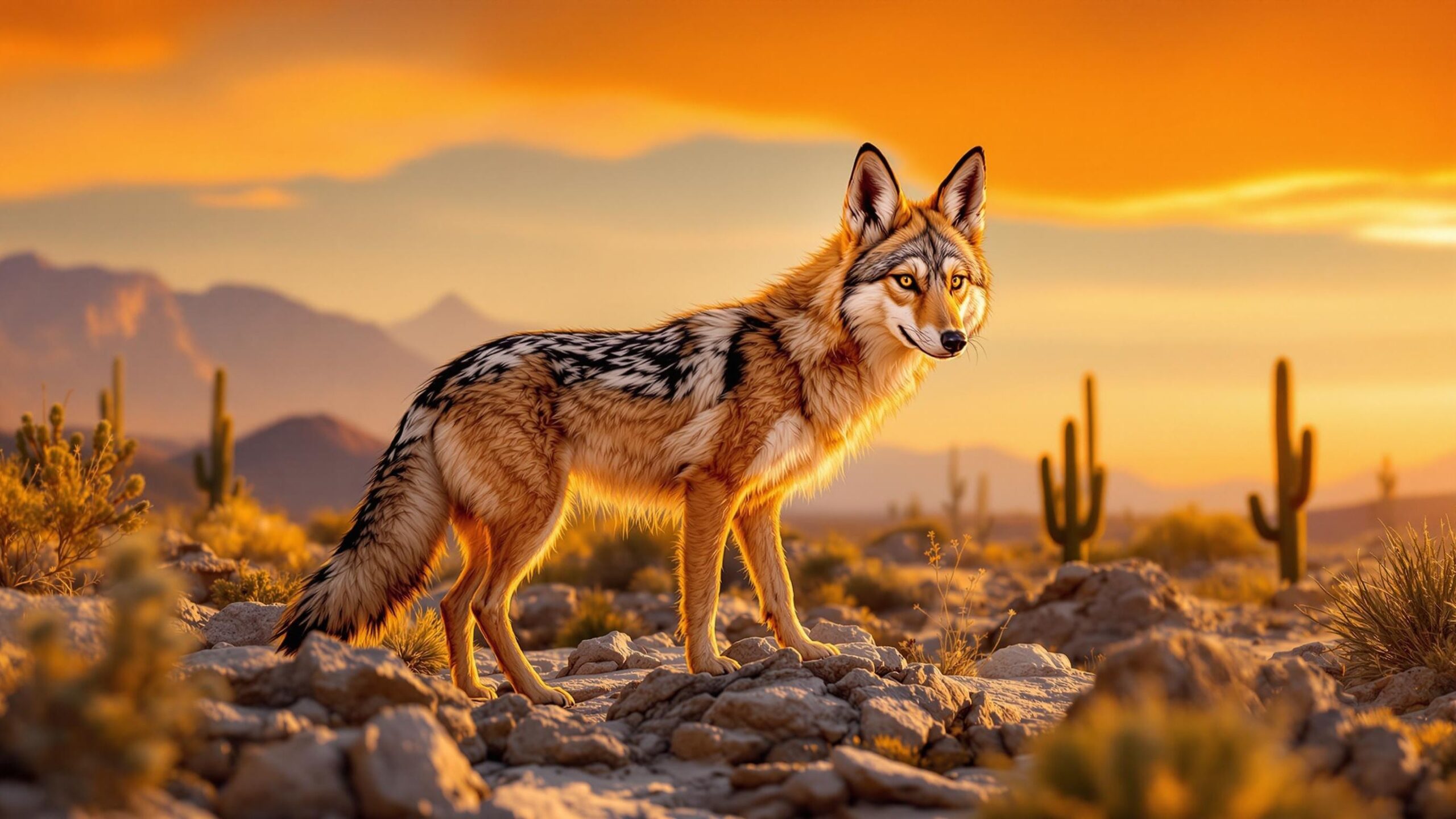
Mexican coyotes inhabit deserts, high mountain forests and tropical landscapes. These regional populations of Canis latrans connect with coyotes of the southwestern United States, varying locally in size, diet and daily movements. Their lives combine solitary hunting, lasting pair bonds and intensive care of growing pups.
Across Mexico, coyotes use both native vegetation and land altered by farming, grazing and settlement. Their foods range from desert hares and arthropods to mountain voles, fruit and carrion.
Regional guides place pregnancy at roughly two months. Pups begin life in a den, then progress through emergence, weaning and increasingly independent foraging. Parents continue feeding them during this transition.
Scientific identity: Canis latrans Say in James, 1823; genus Canis, family Canidae, order Carnivora, class Mammalia.
“Mexican coyote” can denote regional populations or the narrower subspecies C. l. cagottis. Mexico's coyotes span several traditionally named subspecies. Mexican wolves, by comparison, are Canis lupus baileyi, a subspecies of the gray wolf.
Coyote scent marks can accumulate at conspicuous rocks, bushes and posts as animals inspect and mark the same places. Their road-side scats may also carry fruit seeds: Sierra Fría samples contained manzanita and juniper seeds transported through the gut.
In Jalisco, a landfill-associated group of four adults occupied the same seasonal-forest setting in which other tracked coyotes ranged more widely without comparable grouping.
Are Mexican coyotes found only in deserts?
No. They also inhabit pine-oak forest, high-elevation pine and fir landscapes, tropical deciduous forest and agricultural mosaics.
Does a coyote hunting alone lack a family?
No. An individual may hunt small prey alone while belonging to a bonded pair or family group.
Does livestock hair in scat prove a livestock kill?
It establishes ingestion, which may follow hunting or scavenging. The remains alone do not identify how the livestock died.
Are Mexican coyotes endangered?
The species Canis latrans is globally Least Concern, with an increasing global trend. That classification is not a separate assessment of every Mexican population.
Should coyotes be fed near homes?
No. Secure garbage and remove outdoor pet food to reduce feeding opportunities close to people; supervise small pets where coyotes occur.
A regional coyote with many local forms
The Mexican coyote belongs to Canis latrans, the same species found across much of North and Central America. Mexican populations connect geographically with those of the southwestern United States. Their shared identity accommodates substantial differences in body size, surroundings and feeding opportunities, from Baja California scrub to the cool forests above Mexico City.
The name also has a narrower taxonomic use: Canis latrans cagottis is a traditionally named subspecies called the Mexican coyote. It does not encompass every coyote in Mexico. Other names in the traditional framework include clepticus, mearnsi, microdon and peninsulae. Geographic variation can be gradual: a Baja California investigation found overlapping skull measurements between some named groups, and tooth measurements did not separate them. A coyote seen beside a road cannot reliably be assigned to one of these groups by coat color.
Recognizing a Mexican coyote
A narrow muzzle, conspicuous pointed ears and a lightly built body give adult coyotes their characteristic outline. Gray and brown upperparts contrast with a paler underside, but buff and reddish tones also occur. The bushy tail usually hangs low and commonly has a dark tip. These features are most useful together, particularly when distance makes size difficult to judge.
Mexico’s mammal-tracking manual gives an approximate adult mass of 8–16 kg. Actual measurements show the importance of locality, sex and age. In González Quintero’s 2004 Baja California study, mean total lengths at Vizcaíno were 1,042 mm for males and 998 mm for females; at Los Cabos they were 1,051 and 1,006 mm, respectively. These lengths include the tail. Across the peninsular and adjacent comparison regions, adult males were generally larger than females, while body and skull dimensions generally decreased southward and eastward.
Four collared coyotes at Ixtepeji, Oaxaca, weighed 7–12 kg and measured 1,000–1,164 mm in total length. Only one was an adult male; the others were a subadult male, a young male and a subadult female. Their measurements therefore include immature growth stages. Across the border, Arizona’s reported averages are about 9.5 kg for males and 7.9 kg for females, with total length including the tail reported at about 1.07–1.22 m. These are Arizona figures rather than a size definition for all Mexican populations.
Mexican wolves usually have a heavier frame, broader head and proportionally smaller ears. Typical adult Mexican wolves weigh about 23–36 kg, although young wolves can resemble coyotes. Gray foxes, Urocyon cinereoargenteus, are smaller and have a black stripe along the tail’s upper surface; they also climb trees readily. In northern drylands, the roughly 2 kg kit fox, Vulpes macrotis, combines a much smaller body with disproportionately large ears. Free-ranging dogs create greater ambiguity because their shapes and sizes vary so widely. Erect ears, a slim muzzle or a low-carried tail can occur in dogs too. Neither a doglike appearance nor unusual coat color establishes coyote-dog ancestry.
On suitable ground, coyote foreprints show four toes and claws and measure roughly 6 by 5 cm; hindprints are narrower. A trotting animal often places its hind feet over or just ahead of the foreprints. Dog tracks overlap these features, so an isolated footprint offers less certainty than a clear trail and a good view of the animal.
Jaws, nose and the search for food
An adult coyote normally has 42 teeth. The canines help seize food, the carnassials shear flesh, and grinding surfaces farther back help process a broader mixture that includes plant material. Jaw-closing muscles attach to the skull’s sagittal crest and zygomatic arches. This combination equips an animal that may switch between catching rodents, feeding on a carcass and eating fruit.
Smell also links feeding with social behavior: the same animal searching for a meal can pause to investigate a scent left by a neighbor. The elongated nasal region contains turbinal structures associated with olfaction. Hearing and vision supply additional cues during hunting. Arizona Game and Fish describes coyotes standing still before pouncing on mice. The agency also reports coyotes following badgers and catching animals that emerge from the burrows the badgers are digging. This gives a coyote another route to burrowing prey, beyond searching and pouncing on its own.
Experimental sensory evidence comes from broader coyote biology. In Michael Wells’s outdoor-enclosure experiment, four captive coyotes located rabbits under altered sensory conditions, and the contribution of different cues depended on the circumstances tested. It demonstrates flexible use of available information, without establishing a fixed hierarchy of senses or a detection distance for wild Mexican animals.
Ancient presence and new expansion
Coyotes are native American canids, with a distribution extending through Mexico and Central America to Panama. Their southern history is older than the recent spread often associated with ranching. A historical synthesis documented fossil, pre-Columbian and early colonial evidence in southern Mexico and Central America. It linked shifting distributions with the expansion and contraction of open habitats and tropical forests through climatic and human land-use changes.
Ancient regional presence can coexist with recent colonization of particular landscapes. A study published in March 2026 documented camera-trap records from Campeche, Yucatán and Quintana Roo, together with records in Guatemala and Belize. Agricultural mosaics, secondary vegetation, livestock landscapes and forest edges featured in this expansion. Occurrence was associated with more open vegetation and greater human modification.
A first photograph establishes presence by that date rather than an exact arrival date. Nor do scattered records demonstrate continuous occupancy throughout the intervening forest. Coyotes in this southeastern region occur in landscapes that also support jaguars and pumas; the disappearance of larger predators is therefore unnecessary as a universal explanation for their advance.
From salt grasslands to high mountain forest
Desert coyotes encounter more than bare sand. Around northern Mapimí, Chihuahuan Desert scrub and salt-tolerant grasslands occur across land with differing levels of livestock use and human modification. Baja California’s Vizcaíno Desert offers another dryland setting, with a prey community that includes rabbits, hares, burrowing rodents and lizards.
Mexican mountain populations occupy strikingly different conditions. At Ixtepeji, coyotes were tracked in community-protected pine-oak forest within a study landscape spanning 1,920–3,300 m, with a temperate, summer-rain climate. On the Sierra del Ajusco, feeding studies sampled sites at 3,100 and 3,300 m among high-elevation pine, oyamel fir and bunchgrass. The regional climate is semi-cold and subhumid, with summer rainfall and a mean annual temperature around 9.9°C. Las Rosas lies in the community reserve of San Miguel Topilejo. At Las Maravillas, coyotes encounter farmland, free-grazing sheep, timber extraction and rubbish dumps alongside the mountain vegetation.
Farther north, coyote sign at Teseachi, Chihuahua, occurred in both pine-oak forest and semi-open grassland around 2,250 m. Repeated scent-station sampling detected no significant annual selection difference between those vegetation types. On the Pacific side, radio-tracked coyotes lived in Jalisco’s tropical deciduous forest. Southwestern populations extend this habitat spectrum into Arizona chaparral, rural land and cities, where patches of shrubs and trees offer cover.
Desert meals change with the season
Mexican coyotes catch small animals, scavenge and consume plants. Which foods dominate depends partly on the landscape and season, but also on what is being measured. An insect and a jackrabbit each count as a food item while contributing very different amounts of flesh. Scat occurrence describes how often remains appear in samples; reconstructed biomass estimates the mass those foods may represent.
In northern Mapimí, black-tailed jackrabbits and desert cottontails were important mammalian foods, alongside rodents and abundant arthropods. Across 62 dry-season and 139 rainy-season scats, arthropods dominated item counts, yet mammals represented approximately 86.5% of estimated mammal-plus-arthropod biomass in the dry season and 72.5% in the rainy season. Plants, birds and reptiles were excluded from that biomass calculation. Cactus material, prickly pear, mesquite and grasses also occurred, with plant occurrence varying among sites. Connected southwestern populations have additional documented plant foods: Arizona’s account includes acorns, palo verde beans, and juniper and manzanita berries. These examples describe regional food availability rather than a uniform plant menu throughout Mexico.
The Vizcaíno comparison used 153 winter and 149 summer scats collected in 1996–1997. Arthropods made up about 95% of identified winter prey items, while mammals supplied an estimated 70.5% of reconstructed animal biomass in winter and 50.9% in summer. Mammalian remains included jackrabbits, rabbits, pocket gophers, pocket mice and kangaroo rats. Lizards added another food source.
Mule remains in the Vizcaíno scats are consistent with scavenging, a known coyote feeding behavior. Food remains alone do not establish whether the coyote hunted or scavenged an animal. Likewise, estimated biomass is not a measurement of absorbed nutrients, and a tally of food items cannot be converted directly into a count of prey killed.
Mountain prey and food around people
At Ajusco, Mexican voles, Microtus mexicanus, and volcano rabbits, Romerolagus diazi, connect coyotes to the mountain grassland food web. Among 136 scats from conserved Las Rosas and 62 from more modified Las Maravillas, voles occurred in about 51% and 37%, respectively. Volcano rabbits occurred in approximately 26% and 21%, respectively. Those percentages refer to scats containing each animal’s remains, rather than its share of dietary mass or the fraction of its population taken.
The mountain menu also included Merriam’s pocket gopher, Cratogeomys merriami, whose remains occurred in about 21% of the 62 Las Maravillas scats. Birds and plant material added foods beyond the dominant small mammals.
The samples, collected in 2014–2015, also showed different seasonal patterns. Dietary diversity changed significantly between wet and dry seasons at conserved Las Rosas, whereas no such seasonal difference was detected at Las Maravillas. Annual diversity did not differ significantly between the sites. Human debris occurred in the scats, and the researchers suggested that year-round human food might buffer seasonal changes at the modified site. The debris itself establishes ingestion without measuring the nutritional contribution of that food.
At Las Rosas, the seasonal contrast involved a substantial change in vole occurrence: about 38% of 61 rainy-season scats contained voles, compared with 63% of 75 dry-season scats. Volcano rabbit occurrence stayed closer, at about 28% and 24%. At Las Maravillas, vole occurrence remained near 35–39% across seasons, each represented by 31 scats.
At Teseachi, mammals, plant material and grasshopper-like insects appeared in the diet. Plants dominated the food-frequency tally in winter, but that seasonal result came from only six scats.
Pairs, neighbors and concentrated food
Coyote social life includes bonded adult pairs and family groups, even when individuals forage alone. Southwestern accounts describe pair bonds lasting several breeding seasons. The demands of raising pups bring the adults into sustained association, with both contributing food as the young grow.
Territorial signals travel by sound and scent. A home range describes the area an animal uses, whereas territorial behavior concerns defense and communication with others; a mapped range alone does not show that every part is defended. Mexico’s tracking manual describes howling sequences alternating long calls with shorter howls. Texas accounts describe urine and feces deposited at conspicuous posts, bushes and rocks; another coyote may investigate and add its own mark.
Food concentration can accompany a different social arrangement. In Jalisco’s tropical dry forest, one landfill-associated group contained four adults, while comparable grouping was absent among tracked coyotes outside the landfill. Reported home ranges were 0.9–9.5 km² among landfill users and 10.9–43.7 km² outside. Home-range size showed no detected seasonal effect in that study, despite the marked difference between landfill users and coyotes foraging outside.
Daily journeys and leaving home
Mexican telemetry shows activity extending across the day-night cycle. In a three-year western tropical dry-forest study of 15 collared coyotes, dawn activity exceeded daytime activity. No sex difference or wet-versus-dry-season effect was detected within the four daily intervals tested.
In Durango pine-oak forest, 14 adult coyotes produced average 24-hour movement estimates of 16.47 km for males and 12.51 km for females. These were sums of straight lines between hourly positions, rather than the exact winding paths walked. Combined-sex movement was greater at night than during daylight, and both sexes traveled predominantly at night during pup rearing.
Home-range area measures something different. At Ixtepeji, estimates from four animals averaged 3.45 km² across the biological periods examined. The one subadult female used a larger estimated area than the three males averaged together, showing individual variation within this small, mixed-age sample. Neither these areas nor the Durango daily distances describe natal dispersal. Broader North American observations place many young coyotes’ departures in their first autumn or winter, often at six to nine months, while some remain with their family into a second year.
Birth, learning and independent life
Regional syntheses provide the developmental outline rather than a single breeding calendar for every Mexican habitat. The Mexican tracking manual places mating in winter in temperate regions, gestation near 60 days and litter size at one to seven pups. The Texas account describes breeding mainly in January–March, pregnancy around 63 days and one litter annually, averaging about six pups.
Dens serve birth and early rearing. Southwestern coyotes may enlarge another animal’s burrow or use cavities beneath trees and rocks; adults use other shelter outside the denning period. The male provisions the female and pups, and both parents deliver food as the litter develops.
Newborn pups are blind and weigh around 250 g in the Mexican synthesis. Their eyes open at roughly two weeks. Arizona observations place first den emergence around three to four weeks, followed by increasing movement away from the den area at eight to ten weeks.
Milk is supplemented by regurgitated food, and the Texas account places solid prey consumption around four to six weeks. Weaning occurs at approximately six to eight weeks in the Mexican manual. Play, insect capture and attempts at small-prey hunting accompany growing feeding skills. These approximate ages describe development in Mexican and southwestern syntheses rather than a single locally followed litter.
Female coyotes can become reproductively mature around 12 months under favorable conditions, although maturity does not guarantee a first successful litter. Mortality is especially high among young animals; the Texas synthesis reports relatively few wild coyotes surviving beyond six to eight years. A historical maximum known wild age of 14.5 years and a captive longevity record of 21.8 years are exceptional records, not Mexican life expectancies.
Food-web connections and traveling seeds
Predation links coyotes with desert lagomorphs, mountain rodents and insects, while scavenging gives access to animal tissue without a hunt. Fruit feeding adds a different ecological connection. In Sierra Fría, Aguascalientes, coyote scats contained seeds of pointleaf manzanita, Arctostaphylos pungens, and alligator juniper, Juniperus deppeana. These seeds had passed through the digestive tract and been transported before deposition.
Placement matters to what happens next. Of 43 coyote scats examined there, 23 lay on rocks along unpaved roads and 14 on bare road soil. Laboratory testing produced two germinated juniper seeds from coyote scats and no germinated manzanita seeds. Passage, germination and eventual seedling establishment are separate stages; this result documents transport and limited laboratory germination, without demonstrating forest regeneration.
Coyotes can also be killed by larger carnivores. North American accounts identify mountain lions and gray wolves as predators, with golden eagles able to attack pups. The relevance of each depends on local overlap and the coyote’s age. In the expanding Mesoamerican range, direct evidence of community-wide ecological effects remains limited.
Conservation and living alongside coyotes
The IUCN SSC Canid Specialist Group lists Canis latrans as Least Concern with an increasing global population trend. That species-wide picture does not imply uniform abundance or survival in every Mexican landscape. Roads cause documented deaths: monthly surveys along four Tamaulipas highways in 2021–2022 recorded eight coyote carcasses. The detections establish a local hazard without estimating a statewide death total or an individual animal’s collision risk.
Livestock conflict also requires careful identification. A Mexican insurance study covering 2017–2020 attributed 289 of 2,075 depredation claims to coyotes and 755 to domestic dogs. Those are attributed claims, each potentially involving different losses, rather than counts of livestock killed or a complete national inventory of attacks. Coyote claims were associated with more extensive agricultural use and small- to medium-sized livestock; dog claims were associated with rural villages and subsistence husbandry.
Around homes, most coyotes remain wary of people, but accessible food changes their opportunities. Securing refuse and removing outdoor pet food addresses resources used by urban foragers. Small pets can become prey or provoke encounters, making close supervision useful where their movements overlap.
Animal Product Reviews
Dive into Animal Streets’ Animal Product Reviews – your guide to the best gear, gifts, books, and gadgets inspired by the animal kingdom. From land-roaming lions to ocean-gliding whales, from household pets to prehistoric giants, we explore top-rated products for enthusiasts, educators, and animal lovers alike. Whether you’re shopping for toys, decor, field gear, or fun collectibles, we’ve sniffed out the best so you can discover it all in one wild place!