
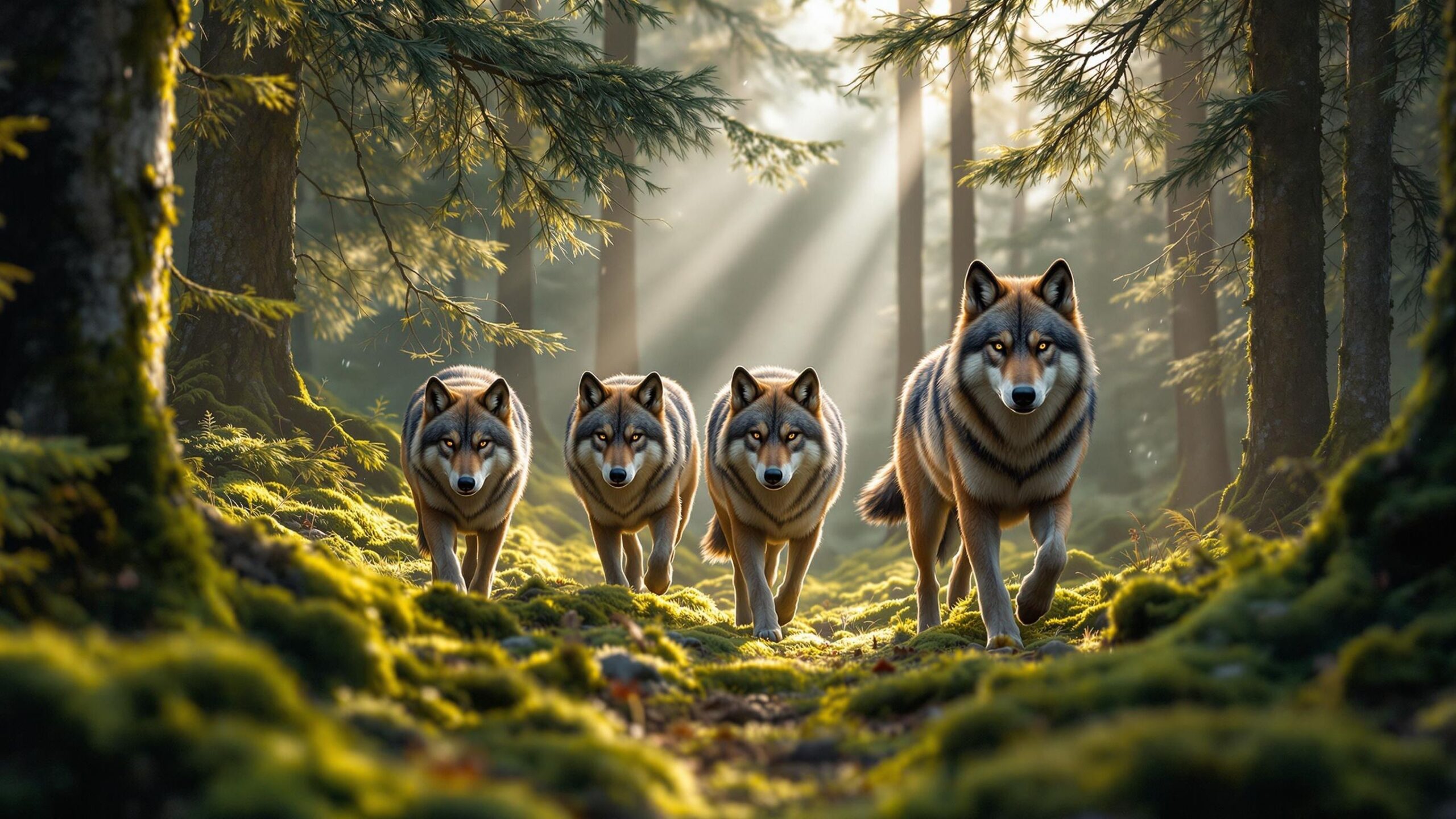
The Eurasian wolf, Canis lupus lupus, is the nominate form of the gray wolf, rooted in northern Europe and Russia. Its life combines long-distance travel with close family cooperation: adults hunt, exchange scent and vocal messages, and carry food back to growing pups in landscapes ranging from boreal forest to inhabited countryside.
Wolves obtain meat through individual and cooperative hunting as well as scavenging. Deer and wild boar are important in many European territories, with local prey communities shaping the menu. Families share feeding places and provide food for pups while the young remain near dens or rendezvous sites.
Canis lupus lupus Linnaeus, 1758 is a subspecies of Canis lupus, in the genus Canis, family Canidae, order Carnivora and class Mammalia. The nominate name is tied to Sweden. Subspecies borders across Eurasia remain incompletely resolved; Indian and Himalayan lineages and Iberian and Italian populations retain distinct geographic or lineage labels.
A wolf’s messages remain in the landscape after it moves on. Białowieża packs concentrated urine marks and ground scratches near territory edges and important interior places. Their spontaneous howls also helped separated relatives communicate and families assemble before hunting.
Is the Eurasian wolf a gray wolf?
Yes. The nominate Eurasian subspecies belongs to the gray-wolf species. The broader phrase ‘wolves of Eurasia’ also includes other named populations and lineages.
Does a wolf pack always stay together?
Family members can separate temporarily, and young wolves eventually disperse at varying ages. Some remain with their parents for several years.
Can one pawprint distinguish a wolf from a dog?
Often it cannot. Large dog tracks overlap wolf tracks in size and structure; a trail and observations of the animal provide additional clues.
Are all Eurasian wolves endangered?
No single regional category applies throughout Eurasia. The gray wolf has a global Least Concern classification, while Norway’s 2021 national assessment classifies its wolves as Critically Endangered.
A Eurasian form of the gray wolf
The name Canis lupus lupus places the Eurasian wolf within the gray-wolf species, Canis lupus. It is the nominate subspecies, associated with the species’ name-bearing locality in Sweden. Northern Europe and Russia form the core of its geographic attribution. A 2022 taxonomic review also places it in Mongolia, Kyrgyzstan, Kazakhstan and the lowlands of northwestern China, while discussing competing historical names for Asian wolves.
Geography alone cannot settle every subspecies boundary. Iberian and Italian wolves retain their own population labels, while Indian and Himalayan wolves represent distinct lineages. Even within the broader Eurasian range, a study identifying wolves as Canis lupus does not necessarily identify their subspecies genetically. The Khentii dietary findings from Mongolia, for example, describe the wolves of that locality without establishing a nominate-subspecies diagnosis.
European conservation work also distinguishes connected populations such as the Scandinavian, Karelian, Baltic and Carpathian units. These groupings follow breeding connections and geography across national borders. The Baltic population spans Estonia, Latvia, Lithuania and Poland; the Carpathian population includes wolves in Slovakia, Poland, Romania and neighboring countries. A national boundary can divide the records of wolves belonging to one connected population.
Recognizing the body beneath the coat
A central European wolf has a broad head, powerful neck, strong chest and conspicuously long legs. Regional profiles give approximate shoulder heights of 60–90 centimetres and head-and-body lengths of 100–140 centimetres. The bushy tail ordinarily hangs below the back. Small triangular ears can look particularly compact against the thick winter coat, whereas summer fur reveals a much leaner outline.
Yellow-gray, brown-gray and dark gray tones occur in European coats, with a paler lower muzzle and throat and darker markings on the legs or tail tip. Dense underfur insulates the body in cold weather. Seasonal changes in fur therefore alter apparent bulk as well as warmth: two views of the same wolf in different seasons can give very different impressions of its build.
In DBBW’s April 2017 compilation of German measurements, adult females older than two years weighed 25–35 kilograms and adult males 33–43 kilograms. The measurements came from captured and dead German wolves. Yenisei Siberian research published in 2017 found larger forest wolves than southern forest-steppe wolves. Russian research also shows that tundra animals are not consistently the largest, with locality, sex, age and population history contributing to variation.
Large dogs can resemble wolves in outline and leave overlapping paw impressions. A sequence of tracks, gait and body proportions provides more information than one isolated print. Golden jackals, Canis aureus, create another identification challenge where their expanding European range overlaps wolves. Their typical adult masses, 9–15 kilograms for males and 8–12 for females, are substantially below the German adult wolf measurements.
Jackals also live in territorial groups, howl and use farmed landscapes, so these behaviors alone do not distinguish them from wolves. Small mammals, carrion, human food remains and fruit commonly feature in jackal diets. In an overlapping landscape, the combination of an animal’s adult scale, proportions and movements gives a stronger identification than gray-brown coloration or a distant call.
Teeth, feet and senses at work
An adult wolf normally has 42 permanent teeth with several distinct jobs. Incisors nip pieces of tissue, long canines puncture and hold prey, and the opposing carnassial teeth shear flesh. Farther back, molars crush and grind tougher material.
Long, flexible toes accommodate uneven ground, and broad feet support travel over variable terrain and snow. Wolves commonly cover ground at a sustained trot. During direct-register trotting, each hind foot lands in the corresponding forefoot print, leaving a relatively narrow trail. This economical traveling gait suits animals that must move between feeding places, resting cover and dependent young.
Smell, hearing and sight supply complementary information. An extensive olfactory sensory surface supports scent detection, while abundant retinal rod cells suit vision in low light. Scent can reveal food or another wolf after the animal responsible has departed. At close quarters, posture, facial expression and vocal signals convey social information without requiring the family to remain in constant physical contact.
Forests, working landscapes and secluded refuges
Eurasian wolves occupy landscapes with very different vegetation and human use. Scandinavian feeding research took place in boreal forests dominated by Norway spruce and Scots pine, with deciduous trees, clear-cuts and regenerating stands. Forest roads connected this managed mosaic. In northern Mongolia, Khonin Nuga lies where Siberian mountain taiga meets Mongolian-Daurian mountain forest steppe, at roughly 900–1,600 metres elevation in the West Khentii valley.
Western Poland’s Notecka Forest supports wolves alongside villages, tourism and grazing. Roe deer, red deer and wild boar inhabit the same forest landscape. Wolves returning to such places need sufficient food and room for reproduction, but their territories can include land used regularly by people. Germany’s renewed reproduction in 2000 followed natural immigration into historical native range after prolonged persecution.
Within occupied landscapes, wolves use space selectively. A central European telemetry study published in 2024 found residents favoring less disturbed forest patches within a broader landscape of grassland, cropland and settlements. They crossed built-up areas mainly at night, using quieter cover and more exposed parts of their home ranges differently. Białowieża research covering 1986–2000 found den and rendezvous sites farther from villages, forest edges and heavily used roads than randomly available sites. Dry coniferous stands were favored for dens, although wolves also used other forest types.
What local wolves eat
Wild hoofed mammals supply much of the food in several well-studied European populations. In Notecka Forest, analysis of 261 scats collected during 2008–2021 attributed 95.2% of estimated consumed biomass to wild ungulates. Roe deer contributed 47.8% and red deer 25.1%. These estimates reconstruct food mass from scat remains and digestibility coefficients; they describe dietary contribution rather than numbers of prey killed.
Smaller mammals supplement those large prey. European hare supplied 2.8% of estimated biomass in Notecka, and Eurasian beaver supplied 1.9%. The main dietary composition was similar between the sampled spring–summer and autumn–winter periods. A broader German survey published in 2024 found roe deer and wild boar prominent, with red deer or fallow deer important in particular territories. Even neighboring territories could differ in their principal foods.
The German survey also found seasonal variation and preferential taking of juvenile ungulates. Livestock formed a small component of food in the surveyed established population, although wolves can exploit accessible domestic animals. A diet dominated by wildlife across many territories can therefore coexist with serious losses at particular farms where stock are vulnerable.
In northern Mongolia, the 2008–2012 Khonin Nuga study found Siberian roe deer to be the leading prey and positively selected relative to estimated availability. Red deer and wild boar also appeared in the diet, together with voles, lagomorphs and birds. This taiga–forest-steppe community offers a different set of feeding opportunities from a central European deer forest, including small vertebrates that an individual wolf can obtain.
Hunting and finding carrion
Wolves hunt alone or with family members, locate food through scent and encounters, and scavenge animals that died from other causes. They can also take food from other predators. A successful capture of large prey gives several wolves access to one carcass, while smaller prey can feed a solitary hunter.
In Białowieża predation research published in 2002, red deer accounted for 63% of identified ungulate prey and wild boar 28%. These proportions describe prey events, unlike the estimated food masses from Notecka scats. Larger hunting groups took larger prey more often. Among groups of two to six wolves, food acquired per wolf was similar because larger captures compensated for sharing among more animals. Red deer were killed more frequently as snow increased and juvenile deer condition deteriorated in late winter. Boar predation increased in spring and summer when piglets became available.
Scandinavian research spanning 2001–2019 separated fresh wolf kills from older kills, scavenged wild ungulates and carcasses originating from human activities. Wolves spent most consumption time at fresh kills; scavenging accounted for an estimated 6–13% of consumption time under alternative classifications. Solitary wolves scavenged more than packs, and scavenging increased in winter. These time estimates describe feeding behavior, without equating minutes at a carcass with the mass eaten.
The managed boreal landscape supplied carrion from human activities alongside live ungulates. Solitary wolves’ greater use of scavenging shows how feeding strategies change with an animal’s social circumstances.
Family life and the use of space
German packs usually comprise parents and offspring from recent years. Older young can remain while another litter is raised, bringing siblings of different ages together. Some adult daughters also reproduce, adding variation to this family structure. Births, departures and changes in breeding partnerships continually alter membership.
Related pack members in the 2024 central European telemetry study overlapped strongly in their space use, while neighboring resident ranges were usually distinct. Estimated resident home ranges extended from approximately 50 to 570 square kilometres, with many between 100 and 220. These tracked areas measure where residents moved during particular periods; a home-range estimate is not an exact map of a defended boundary.
Breeding females used their smallest monthly ranges in May or June, when young pups restricted travel around the den. The two recorded breeding males showed smaller seasonal fluctuations and earlier minima. Nonbreeders varied more.
Howls and scent messages
Wild Białowieża wolves howled between temporarily separated family members, after reunion and before departing to hunt. Calls commonly came from territory cores, and evening calling coincided with increased movement. In the Polish research published online in 2006, 58% of recorded spontaneous howling events fell between July and October, with an August peak. Separately studied replies to simulated howls also peaked in August. This late-summer peak coincided with the pup-rearing season, when family members gathered at seasonal sites.
Urine, scats and ground scratching leave messages along travel routes. Tracking four free-ranging Białowieża packs showed stronger urine marking and scratching in the cold season, peaking around the local January–February mating period. Wolves increased these behaviors per kilometre near territory edges. Marks also accumulated in heavily used central areas, including breeding sites.
Leaving home and forming new partnerships
German accounts place common departure ages around 10–22 months, although some offspring stay for several years. Some young wolves settle close to their natal territory; others travel hundreds of kilometres before establishing elsewhere. Dispersal brings potential mates into contact and allows reproduction to resume in landscapes beyond existing family ranges.
Genetic monitoring in southwestern Finland, published in 2017, reconstructed breeding positions inherited by sons or daughters, females moving between known local packs and breeding males likely arriving from beyond the sampled area. Partnerships changed over time while family connections persisted. The pedigree also included reproduction between a male and his granddaughter. Access to unrelated immigrants is particularly consequential when a recovering population begins with few founders.
From a sheltered den to the first winter
Central European wolves typically first reproduce around two years of age and usually have one litter annually. Female gray wolves have a single annual estrous season, and breeding pairs commonly maintain their bond across reproductive seasons. Gestation lasts about 63 days. BfN describes usual litters of four to six pups born in late April or early May; Brandenburg’s regional account gives a usual range of two to six in April or May. Across the gray-wolf species, northern populations breed later than southern ones.
Females may prepare several potential dens in secluded places. Shelter can be excavated or found beneath rocks, fallen trees or other cover. Brandenburg newborns weigh around 500 grams and are blind and deaf. Newborn wolves have dark fur and rounded heads; taste and touch function before sight and hearing develop. They depend on milk, warmth and close maternal attendance, because they cannot regulate body temperature effectively.
Eyes generally open at roughly 11–15 days. Standing, walking and more varied vocalizations emerge as pups become active participants in family contact. Brandenburg pups first appear outside at about three weeks and begin receiving regurgitated meat alongside milk. Youngsters solicit food by licking around adults’ mouths, prompting the transfer of swallowed meat brought back from distant feeding sites.
Parents and previous-year siblings can provision pups. If disturbed, a mother may carry them individually to another den. Later, growing youngsters gather at rendezvous sites, including clearings or meadows near water and concealing vegetation. Adults can leave to forage while returning food to young that cannot yet undertake comparable journeys.
Play develops coordination and social interaction as pups learn odors and tracks. Weaning is gradual, milk teeth are replaced, and juveniles increasingly accompany older wolves. By their first winter, Brandenburg youngsters can join family hunts. Food shortage and disease remain important hazards, particularly during their first autumn. An exceptional wild female in Saxony reached 13 years, but many wolves die long before such an age.
Predation within a larger food web
At Białowieża, wolves limited red deer increase by removing a substantial share of population production. Lynx predation and human hunting also affected deer numbers. Snow, prey condition and hunting-group composition changed the circumstances of predation, so its consequences depended on more than the presence of wolves alone.
Remains of wolf prey fed ravens, red foxes and pine martens in Białowieża carcass research published in 2005. Ravens and white-tailed eagles scavenged more frequently in open habitats, while pine martens had greater access within forest. Scavenging generally increased as temperatures fell.
In Alpine wolf landscapes, research in Italy’s Pesio valley, Slovenia’s Jelovica plateau and France’s Les Bauges found roe deer generally using forest and rugged ground by day and more open, flatter areas at night. Hunting pressure, settlements and wolf presence differed among sites. Scattered buildings sometimes coincided with apparent refuge from risk, while larger settlements imposed other disturbance on deer.
Regional recovery and continuing vulnerability
Persecution can affect wolves even where prey and breeding habitat remain available. European conservation specialists identify poaching and hunting as major influences on populations. Conflict involves both livestock losses and competition over wild ungulates sought by hunters. For a small, isolated population, the loss of a breeding animal can occur alongside the longer-term pressure of limited genetic exchange.
The gray wolf is listed globally as Least Concern, including in the IUCN assessment dated 30 August 2018. Regional circumstances differ sharply. Norway’s 2021 national Red List classified its wolves as Critically Endangered because so few reproductive individuals occurred within the country, while accounting for connections to Sweden.
Protection under European agreements
Extinction-risk assessments and legal protection answer different questions. Under the Bern Convention, the wolf moved from Appendix II, for strictly protected fauna, to Appendix III, for protected fauna, on 7 March 2025. The change does not apply to Czechia, Monaco or the United Kingdom, which objected. Its application to other parties remains subject to their treaty reservations and declarations.
Within the European Union, Directive (EU) 2025/1237 was adopted on 17 June 2025 and published on 24 June. It deletes the wolf entry from Annex IV of the Habitats Directive and replaces the Annex V entry with Canis lupus, without population exceptions. Member states have until 15 January 2027 to implement the amendment and may retain stricter national protection. These treaty and EU changes therefore do not establish one identical domestic protection regime throughout the wolf’s European range.
Winter 2025–2026 monitoring documented 55–58 wolves with wholly or partly Norwegian occurrence, including animals associated with the Swedish border. Across Scandinavia, monitoring recorded 41 family groups and 30 scent-marking territorial pairs that winter. These social units occupy a shared population founded by few immigrants. High inbreeding persists, making successful arrivals from the Finnish–Russian population valuable sources of genetic variation.
A DBBW database query on 12 November 2026 recorded 222 packs, 52 pairs and 15 territorial single wolves in Germany for the 2024–2025 monitoring year: 289 territories in total. Reproduction was confirmed in 206 territories. The query incorporates later evidence about that monitoring year; it is not a count of wolves alive in November 2026.
A 2025 Asian synthesis identified uneven monitoring, persecution, livestock conflict and pressures from free-ranging dogs across several wolf lineages. Dogs can compete for food, transmit infections and interbreed with wolves. Eurasian genomic research nevertheless finds continuing wolf–dog differentiation alongside gene flow. Where wolves have few available mates and roaming dogs are numerous, contact can have both health and genetic consequences.
Sharing land with livestock keepers
A September 2024 LIFE WolfAlps EU report describes intervention teams working with Alpine farmers. Electric fences reduce wolves’ access to stock, guardian dogs associate with the flock, and shepherds supervise grazing and night enclosure. Alpine terrain constrained fencing in some Austrian cases, requiring assistance suited to individual pastures. Some farmers received temporary electric fences during emergency interventions. Slovenian work combined guardian dogs with experienced breeders and husbandry support.
Across Asian carnivore landscapes, programs have also used predator-resistant corrals, improved herding, livestock insurance and community support. Wolves share different parts of this region with snow leopards, leopards or tigers. Measures that account for all the predators encountering a herd can address more of the pressures on livestock keepers. The 2025 Asian synthesis links these programs with local tolerance, while highlighting the value of conserving shared prey systems and movement habitats for several carnivores.
Animal Product Reviews
Dive into Animal Streets’ Animal Product Reviews – your guide to the best gear, gifts, books, and gadgets inspired by the animal kingdom. From land-roaming lions to ocean-gliding whales, from household pets to prehistoric giants, we explore top-rated products for enthusiasts, educators, and animal lovers alike. Whether you’re shopping for toys, decor, field gear, or fun collectibles, we’ve sniffed out the best so you can discover it all in one wild place!