

Goliath Grouper
A clear Goliath Grouper guide covering identification, habitat, feeding behavior, life stage, and taxonomy context.
How to Read This Fish
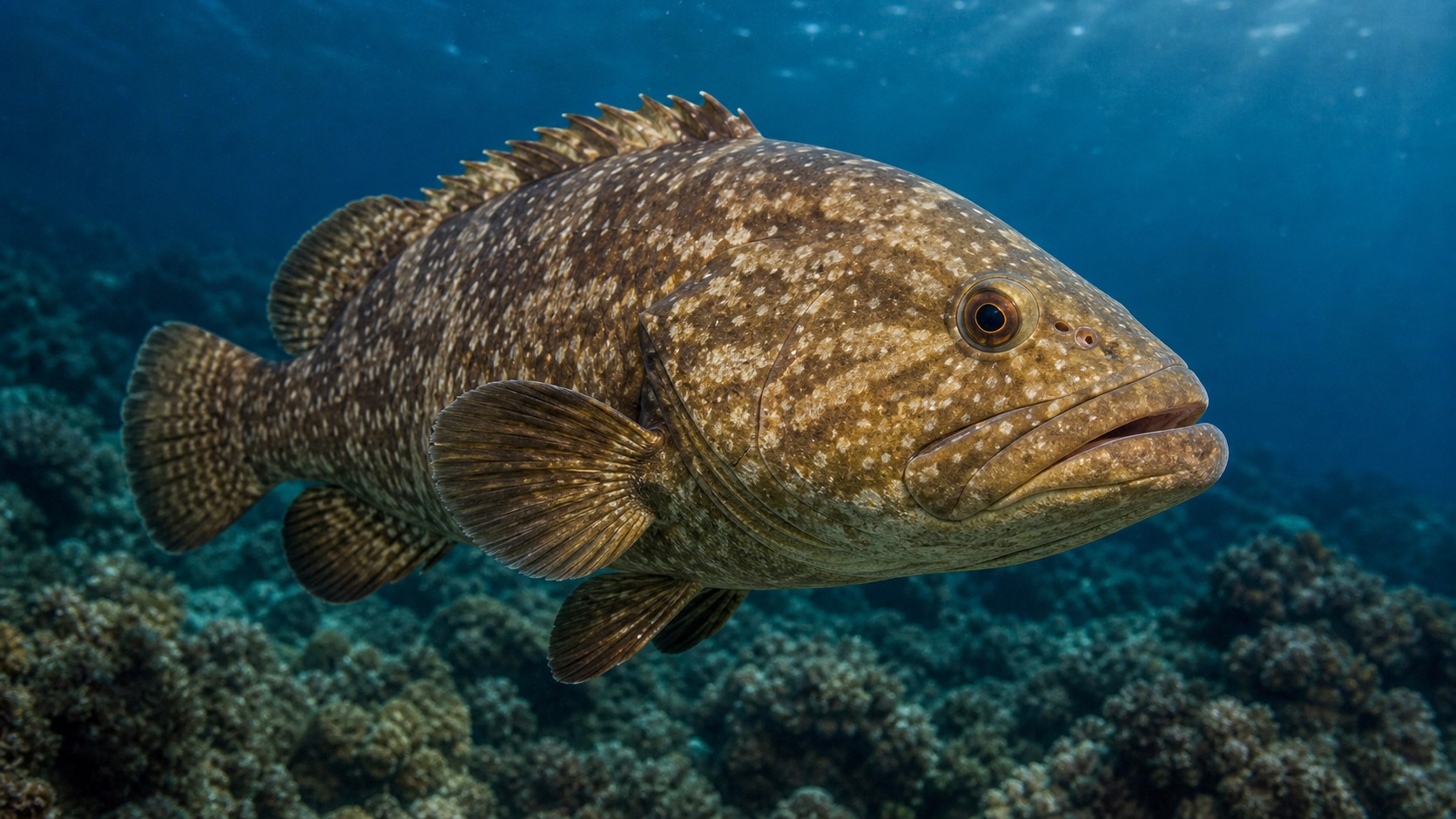
Grouper should feel different from Snapper as soon as the reader sees the body. The fish is heavier, thicker through the head, and defined by a broad mouth that changes the feeding story. It is not a sleek open-water hunter and not simply another structure fish with a different name.
This page is a parent because Grouper is broad. Goliath Grouper and Black Grouper will need separate pages, but readers first need the shared pattern: heavy body, mottled camouflage, structure habitat, patient positioning, and short-range feeding power.
Body Form and Recognition
The grouper body is built around mass and mouth. A thick head and broad jaw make the fish look capable of sudden, close-range prey capture. Rounded fins and a deep body help it maneuver near reefs, ledges, holes, and hard-bottom structure rather than racing across open water.
Color can help, especially mottled or dark patterns, but it should not be the lead clue. Many structure fish use disruptive patterns. Grouper becomes clearer when readers look at body weight, mouth width, head shape, fin shape, and habitat together.
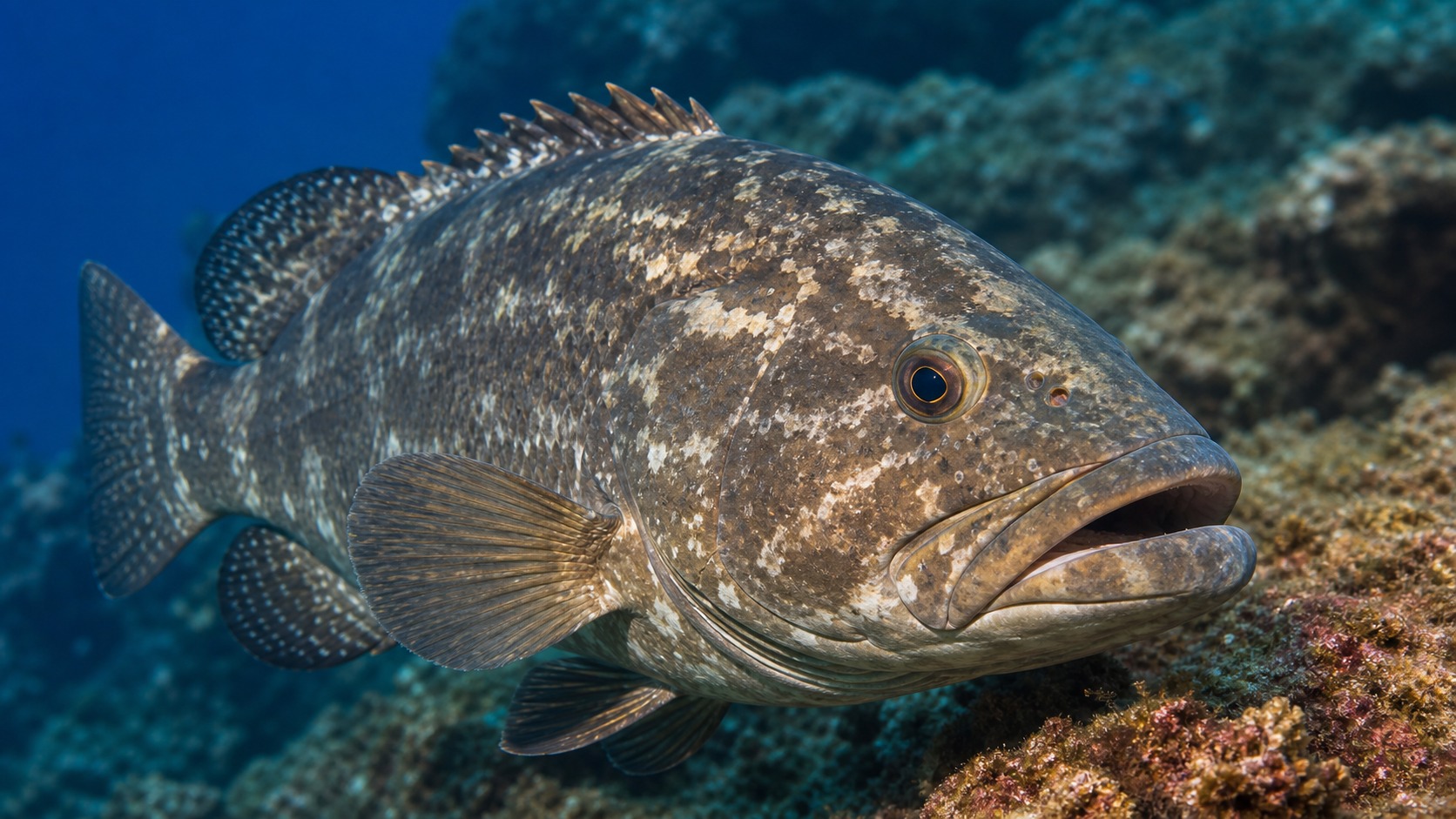
A good editorial image should let the fish feel powerful without making it monstrous. The broad mouth and eye should be sharp, but the full body matters too because body mass is part of the identification.

Reef, Ledge, and Hole Habitat
Grouper habitat is best described as structure that can be used. Reefs, ledges, holes, wrecks, rocky edges, and hard bottom can provide shelter, hunting position, and territory. The setting is not just scenic; it explains why the fish is shaped the way it is.
A grouper near a ledge can conserve energy, watch openings, and strike over short distances. That relationship between body and place is the heart of the page. Without structure, the heavy body and broad mouth lose some of their meaning.
Feeding Style and Short-Range Power
Grouper feeding often feels patient until it is sudden. The fish may hold near cover, then use a broad mouth and quick movement to take prey at close range. That feeding style differs from a mackerel chasing bait or a cod searching cold bottom.
The broad mouth is therefore not just a field mark. It is a functional clue. It tells readers that prey capture can involve suction, timing, and short-range force. A heavy fish can still be fast over the distance that matters.
Diet varies by species and size, so the parent page should avoid one rigid prey list. Fish, crustaceans, and other animals can all fit the broader feeding picture, depending on the grouper being discussed.
Life Stage, Size, and Reproduction
Life stage matters strongly in Grouper. Juveniles may use different shelter and prey than large adults, and some species grow to impressive sizes that change their ecological role. Size is not trivia; it influences vulnerability, feeding, movement, and human attention.
Some grouper species also have reproductive details that require species-level care, including sex change in certain groups. The parent page should introduce the idea that grouper life histories can be complex without trying to explain every species at once.
This complexity prepares readers for Goliath Grouper and Black Grouper. One page may focus on giant size and conservation, while another may focus on darker markings, reef habitat, and fishery context.
Comparison With Snapper
Snapper and Grouper can both be structure-associated, so the comparison matters. Snapper often feels sharper-eyed, cleaner-bodied, and more quick-strike around structure. Grouper feels heavier, broader-mouthed, and more ambush-oriented. The difference is not only color; it is body plan and feeding style.
A reader who understands Snapper will have a good starting point, but Grouper asks for a different emphasis. Look at the mouth, head thickness, body mass, and relationship to holes or ledges. Those clues make the parent page distinct.
Human Connections and Conservation
People know grouper through reefs, diving, fishing, seafood, and conservation stories. Those connections can be useful, but the article should keep the fish's biology first. Human value should explain why exact species and life history matter, not replace them.
Conservation context depends heavily on species, region, size, maturity, and harvest pressure. A parent page can responsibly say that groupers often need careful species-level discussion without pretending one status applies to all.
What the Images Should Teach
The featured image should show the heavy body in motion without making the fish look like a slim predator. The stillness image should make the broad mouth, thick head, and mottled pattern easy to inspect. The third image should show the fish near reef or ledge structure.
Together, the images should teach weight, patience, and structure. Grouper should look powerful and calm, not frantic. That visual distinction keeps it from blending into Snapper or mackerel pages.
Reader Practice
A useful reading order is mouth first, then body mass, then structure. The broad mouth is the clue that changes the feeding story. The heavy body explains the short-range power. The ledge or reef context explains why that body plan works.
Readers should then ask which grouper. Goliath Grouper and Black Grouper will not be interchangeable, and the parent page should prepare that expectation. Broad recognition is only the beginning.
Why the Parent Page Matters
Grouper needs a parent page because the shared body plan is obvious, but the species stories can become very different. A Goliath Grouper page will not have the same emphasis as a Black Grouper page. Size, markings, habitat, regulations, vulnerability, and public awareness can all change with the species.
The parent article should therefore teach the common reading method. Look for the heavy body, thick head, broad mouth, mottled pattern, rounded fins, and structure relationship. Once readers have that base, child pages can become more specific without repeating the same foundation every time.
What Readers Should Not Assume
Readers should not assume every grouper is huge. Some species become enormous, but size varies widely, and even a large group has juveniles that live differently from adults. Treating all groupers as giants makes the parent page less accurate and makes later species pages harder to write.
Readers should also avoid assuming that a big mouth alone is enough. Many fish have strong mouths, and reef habitats hold many predators. Grouper identification should combine mouth width, head mass, body depth, fin shape, mottled pattern, and relationship to ledges or holes.
Branch Role
Grouper gives the Saltwater Fish branch a heavier structure-based turn after Snapper. Snapper introduced strong-eyed, deeper-bodied reef and mangrove fish; Grouper pushes the structure idea toward ambush, mass, and short-range power. That makes the sequence feel like a real taxonomy path rather than a list of unrelated names.
The page also prepares readers for Goliath Grouper and Black Grouper. Those child pages can explore scale, conservation, markings, and species-specific habitat with more care. The parent page's job is to make that future narrowing feel natural.
Image Interpretation
The image set should make Grouper feel heavy without making the page visually dull. The motion image can show that a large-bodied fish still moves actively through reef water. The stillness image can slow the reader down and emphasize the broad mouth, thick head, eye, and mottled texture. The third image can add a reef ledge or hole-like context that explains the structure relationship.
This visual sequence is different from the snapper pages. Snapper images should often emphasize eye, body depth, and clean structure association. Grouper images should make the mouth and mass unavoidable. The reader should feel that the feeding strategy has changed before even reaching the text.
Conservation and Species Framing
Grouper conservation cannot be handled responsibly as one broad statement. Some species are large, slow-growing, or vulnerable to harvest pressure, while others have different management contexts. Some species also have life-history traits that require careful explanation. A parent page should introduce that complexity while saving exact status claims for child pages.
That restraint is useful because Goliath Grouper and Black Grouper will not need the same treatment. Goliath Grouper invites discussion of giant size and special conservation history. Black Grouper invites a different identification and reef-fishery context. The parent page should prepare readers for those differences.
Comparison Beyond Snapper
Grouper can be compared with Cod because both may feel heavy and structure-linked, but the comparison quickly splits. Cod is cold-water and barbel-associated, with a bottom-searching identity. Grouper is reef or ledge-associated, broad-mouthed, and often framed through ambush. The bodies are heavy for different reasons.
Against Mackerel and Tuna, Grouper shows the opposite end of the saltwater spectrum. It does not need a blade-like body or long-distance chase profile. Its success comes from cover, position, mouth size, and short-range force. That contrast makes the Saltwater Fish branch feel richer.
A Practical Memory
The useful memory is broad mouth, heavy body, reef ledge. That phrase links the visual clue, the body plan, and the habitat in one place. It also separates Grouper from Snapper, which may share structure but usually does not carry the same head mass and mouth emphasis.
Readers should keep that memory flexible because Grouper is a parent page. Goliath Grouper and Black Grouper will change the scale and details. The parent memory gives a foundation, not a final identification for every species.
Why Stillness Matters Here
The stillness prompt works well for Grouper because the fish can communicate power without dramatic motion. A calm suspended view lets readers study the broad mouth, thick head, eye, and mottled pattern. That quiet image supports the idea of a patient structure predator.
The motion and ledge images then add life and habitat. One shows that a heavy fish is still active, while the other explains why cover matters. Together they make the article's core point visible: Grouper is built around structure and short-range power, not open-water speed.
Final Comparison Note
Grouper should leave readers thinking about architecture. Reefs, ledges, holes, and hard-bottom structure are not background scenery; they are part of the fish's feeding strategy. The broad mouth makes sense because the fish is close to cover and close to prey.
That idea separates Grouper from the cleaner snapper shape and from fast pelagic fish. It also prepares the reader for Goliath Grouper and Black Grouper, where size, markings, conservation, and species-specific habitat will matter more.
Final Takeaway
Grouper is a parent page because the shared body plan is strong but the species stories are too different to flatten. Heavy body, broad mouth, mottled pattern, rounded fins, and structure habitat give readers the map.
Inside the Saltwater Fish branch, Grouper adds a powerful structure-based contrast after Snapper, Cod, Tuna, and Mackerel. It helps readers understand that fish diversity is not only about color or size, but about how body, habitat, and feeding strategy fit together.
Reader Memory
The final memory is simple: heavy fish, broad mouth, useful cover.