
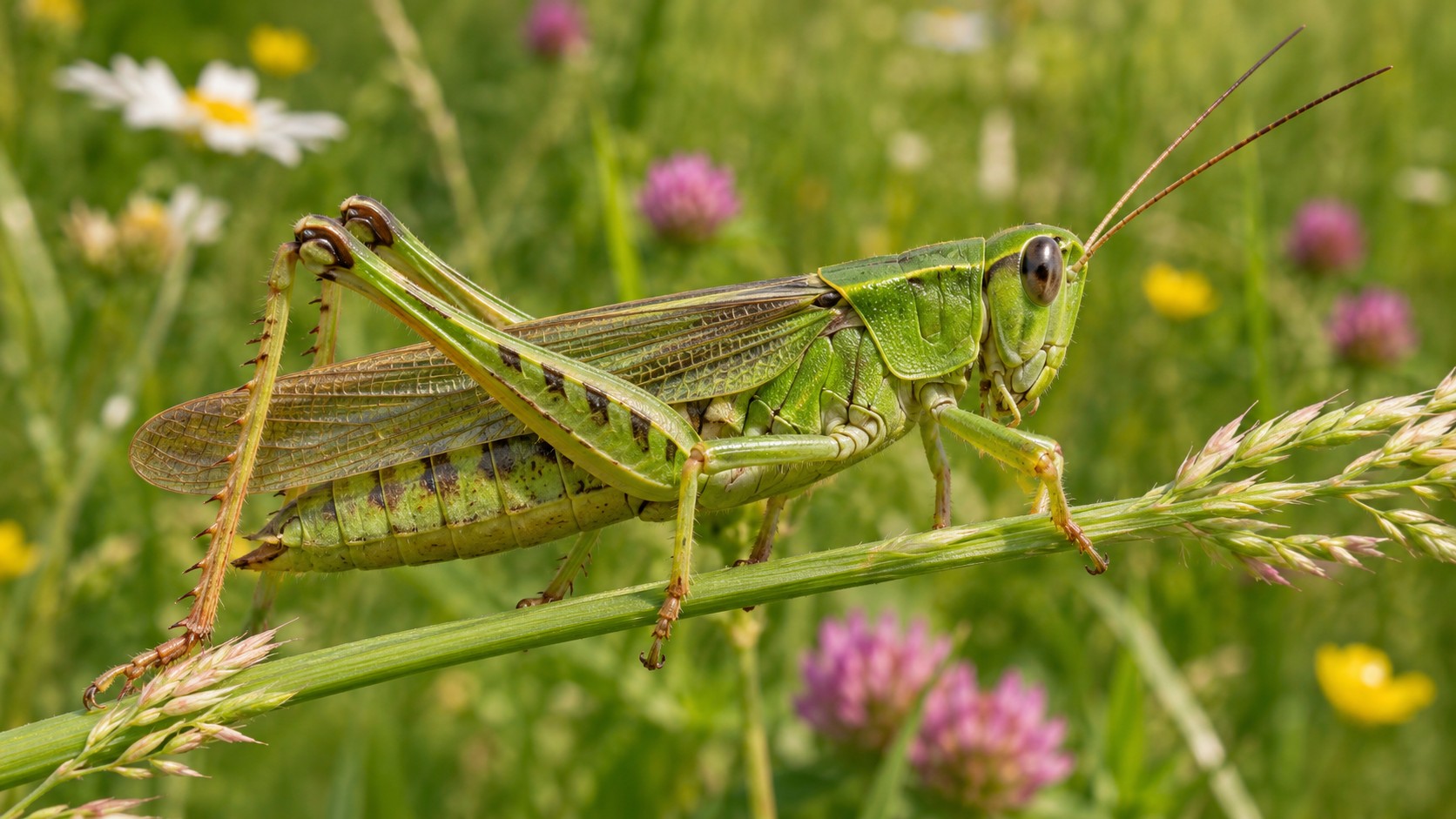
A Living World at Leaf Level
A grass stem, fallen leaf, or patch of flowers can hold several different insect worlds at once. A grasshopper chews beside a hidden caterpillar, a bee moves between blossoms, and a beetle searches the litter below. Their sizes and habits differ enormously, yet a shared body plan connects them: a head, thorax, and abdomen, with three pairs of jointed legs in the familiar adult form. Insects turn that basic arrangement into swimmers, burrowers, fliers, hunters, grazers, and social builders. Understanding the group begins with those connections, then follows each animal through the life stages and habitats that make its particular way of living possible.
A: No. Some insects are wingless, and many young stages lack developed wings.
A: Its fleshy abdominal prolegs are different from the three pairs of true thoracic legs.
A: A pupal stage occurs between the larva and adult.
A: No. Their young become adults through successive molts without a true pupa.
A: Yes. Food and habitat requirements can change substantially between stages.
A: No. Everyday usage often includes spiders and other arthropods outside the insect group.
A: No. Aggregation at a resource differs from organized social colony life.
A: Some are active at night, seasonally brief, concealed in substrates, or present as hidden immature stages.
A: Flowers help, but development, nesting, and seasonal shelter may require other resources.
A: Combine body features with its life stage, behavior, location, and immediate habitat.
Butterflies and Moths
Explore Lepidoptera through scaled wings, caterpillars, host plants, and complete metamorphosis, with practical clues for comparing butterflies and moths.
The Body Plan Beneath the Variety
An adult insect’s head carries the antennae, mouthparts, and major visual structures. The thorax provides the base for the legs and, in winged forms, the wings. The abdomen contains many internal organs and changes shape with feeding, reproduction, and the animal’s particular anatomy. These regions may be easy to distinguish on a grasshopper and much less obvious on a compact beetle.
Three pairs of thoracic legs are the familiar starting point, but identification must account for life stage and specialization. A caterpillar has true legs near its head and fleshy abdominal prolegs, while some larvae lack visible legs. An immature form should not be rejected as an insect merely because it fails to resemble the winged adult. The shared body plan is a guide to relationships, not a requirement that every stage display its features equally clearly.
An External Skeleton That Must Be Replaced
The insect’s supporting surface is an exoskeleton, a cuticle outside the body rather than a vertebrate-style internal skeleton. It protects and supports the animal while providing attachment points for muscles, but growth requires periodic molting. A shed skin can therefore be evidence of development rather than a dead insect. The new surface must expand and harden after a molt, making the timing of growth part of the animal’s survival strategy. This relationship between protection and replacement helps explain why an insect’s appearance can change during a sequence of immature stages.
Wings Are a Possibility, Not the Definition
Many insects fly, but wings do not define the entire group. Some lineages are wingless, and immature stages often lack the developed wings of adults. Even among winged insects, the arrangement and function differ. A butterfly’s broad scaled wings, a beetle’s protective forewings, and a fly’s single functional wing pair represent different versions of the same broad capacity for movement through air.
The hard forewings of beetles are especially useful as an identification clue because they often meet along a seam over the back. Flies have a different arrangement, with a hind pair modified into balancing structures. Such details can separate major groups more reliably than a quick impression of color or size. A hovering yellow-and-black insect, for example, is not automatically a bee.
Flight also changes how insects use a landscape. An adult may travel between flowers, mates, or egg-laying sites while its younger stage lived in soil, a stem, or water. The place where a flying adult is photographed may therefore be only one part of its habitat requirements. The flying adult and its immature stage can depend on different resources.
Metamorphosis Creates Different Kinds of Lives
Complete metamorphosis includes egg, larva, pupa, and adult. Beetles, butterflies, moths, flies, bees, and many other insects follow this broad pattern, though the details vary. A feeding larva can look so different from the adult that a beginner might place the two in separate animal groups. The pupal stage links them through substantial development.
Incomplete metamorphosis lacks a true pupal stage. Young forms, often called nymphs, become adults through a series of molts, with adult features developing along the way. Grasshopper nymphs resemble smaller versions of the adult, whereas the aquatic young of dragonflies live very differently from the flying stage. These patterns explain why looking for a chrysalis is appropriate for a butterfly but not a universal step in every insect life cycle.
Mouthparts Reveal the Feeding Job
Insects modify a common anatomical starting point into very different feeding equipment. Chewing mouthparts can work plant tissue or prey, a butterfly’s proboscis takes liquid food, and piercing mouthparts can reach fluids within plants or animals. The visible arrangement suggests the task without proving the exact diet of every species. Feeding anatomy becomes most informative when it is combined with behavior and habitat rather than treated as an isolated shape.
Pollination Is One Connection Among Many
Flower visitors make insects conspicuous because their movement can transfer pollen between blossoms. Bees are familiar examples, but flies, beetles, butterflies, moths, and other insects also participate in pollination. Their contributions differ with the plant, visitor, and conditions. Seeing an insect on a flower establishes an encounter, while understanding its effectiveness as a pollinator may require more evidence.
The relationship also depends on the insect’s whole life. A flower-rich area can provide adult food while lacking the plants, nest sites, or substrates needed for reproduction and immature development. A caterpillar may require leaves from particular host plants even when the adult butterfly visits many flowers. Supporting only the stage people enjoy watching can leave an important gap.
Insects also feed other animals, recycle organic material, consume plants, and influence populations of other small organisms. These roles occur in the same landscape as pollination. A meadow’s value is not exhausted by the number of bees visible at noon, and a woodland floor can support important insect activity without a blossom in sight. Looking across roles reveals a fuller community.
Life Beneath Leaves, Bark, and Soil
Many insects spend substantial time where casual observers rarely look. Leaf litter, decaying wood, soil, bark crevices, and plant stems provide food and shelter for different species and stages. A beetle searching damp litter occupies a different world from a sunlit grasshopper above it. Moisture, temperature, substrate, and cover create small-scale conditions that matter at an insect’s body size.
Decomposition involves interacting communities rather than one designated cleanup animal. Some insects consume dead organic material, others feed on associated fungi or organisms, and still others hunt the animals gathered there. Removing a fallen branch or clearing every leaf changes those connections as well as the appearance of the ground. The ecological significance depends on the location and community, but the material is not automatically empty waste.
Water Adds Another Dimension
Freshwater supports many insects, including stages whose adults later emerge into the air. Dragonfly young are aquatic predators, while other groups use water or its margins in different ways. An insect resting beside a pond may have developed within it, and its emergence can move resources from aquatic production into terrestrial food webs.
Water quality and the physical character of a stream influence which aquatic insects can persist. Flow, oxygen, temperature, sediment, and vegetation create a range of conditions rather than a single generic water habitat. The presence of one insect does not establish every aspect of a stream’s health, but communities studied with suitable methods can provide useful evidence.
This aquatic connection also changes how habitat boundaries are understood. A stream, its banks, nearby vegetation, and the air above it can serve different parts of the same life cycle. Protecting only the water channel while ignoring the emergence and adult environment may miss an important link. Small flying animals can be the visible outcome of processes that began below the surface.
From Solitary Lives to Organized Colonies
Ants, termites, and some bees and wasps make insect social behavior famous, but insects are not uniformly colonial. Many species live largely solitary lives, and even within a familiar group social organization varies. A colony can divide reproductive and working roles among individuals, while a solitary insect must solve its reproductive tasks differently. Neither lifestyle should be assumed from the fact that several animals happen to gather at the same food source. Aggregation, cooperation, and the structured life of a colony are related subjects, not interchangeable descriptions.
Distinguishing Insects From Other Small Arthropods
Spiders, ticks, centipedes, millipedes, and many other small animals are routinely included under the everyday word bug. They are not all insects. Adult spiders typically have eight legs and two main body regions, while adult insects characteristically have six legs and three main regions. Counting and locating appendages is more useful than deciding whether the animal seems familiar or alarming.
There are limits to a quick count, especially in a photograph where legs are hidden or in an unfamiliar immature stage. A damaged insect may be missing a leg, and a caterpillar’s prolegs complicate a simple six-leg rule. Use the whole set of visible features, including antennae, body organization, wings, and life stage. An uncertain identification is a useful starting point for closer observation rather than a problem that must be solved by guessing.
Read the Season Along With the Animal
The insects seen during one short visit depend on time, weather, and life stage. Some adults are brief seasonal appearances, while their eggs or immature forms persist elsewhere for much longer. Night-active moths, insects within wood, and animals below the soil can be missed by a daytime walk. A quiet-looking garden in one month may therefore hold stages that become conspicuous later. Repeated observation and attention to habitat supply a stronger picture than treating the most visible afternoon visitors as the complete insect community.
Making Room for More Than the Familiar Few
Habitat choices that retain a variety of resources can support a broader set of insects than flowers alone. Appropriate host plants, seasonal flowering, undisturbed patches, and suitable nesting or overwintering places contribute different pieces. Their usefulness depends on local species and conditions, so a single universal planting or cleanup rule is rarely an adequate description of every setting.
Understanding an insect’s role also helps separate observation from automatic intervention. Some species damage crops, transmit pathogens, or require targeted management, while many others are neutral or beneficial in the context where people encounter them. Correct identification, evidence of the actual problem, and an appropriate response are more informative than assuming every small animal must be removed. The same landscape can contain pollinators, predators, decomposers, herbivores, and species whose role has not yet been recognized by the observer.
Major Orders Offer Different Starting Points
Coleoptera contains beetles, including ground beetles, ladybirds, and fireflies. Their modified forewings provide one recognizable structure beneath an enormous range of diets. Lepidoptera contains butterflies and moths, whose caterpillars and scaled adults make complete metamorphosis particularly conspicuous. Diptera contains true flies. The functional wing pair of an adult fly contrasts with the two pairs familiar from many other winged insects, while the hindwings have become balancing organs called halteres.
Hymenoptera includes bees, wasps, ants, and sawflies. These animals are not uniformly social or equipped with the same feeding behavior. An ant colony, a solitary nesting bee, and a sawfly larva represent different ecological arrangements within one order. Orthoptera includes grasshoppers, crickets, and katydids, whose hindlegs, sound production, and gradual development provide another useful comparison. Dragonflies and damselflies belong to Odonata, connecting aquatic immature predators with aerial adults.
Order-level differences connect recognition to biology. A grasshopper nymph becomes more adult-like through successive molts without entering a pupa. A beetle larva instead develops through a pupal interval before acquiring the adult’s finished wing arrangement. The resulting contrast is visible in the habitats used: an immature grasshopper can share much of an adult’s environment, while a fly larva and adult can occupy strikingly different resources.
Breathing Through Tubes Instead of Lungs
Many terrestrial insects exchange gases through a branching system of internal tubes called tracheae. Openings known as spiracles connect that system with the outside. Oxygen can therefore reach tissues through a route quite different from a vertebrate’s lungs and blood circulation. An insect does not breathe through its mouth in the same way as a person, and covering the head alone does not describe its respiratory needs.
Gas exchange also creates a connection with water balance. Openings that permit gases to move can allow water vapor to escape. Different insects regulate their respiratory system in different ways, and activity changes the demand for oxygen. An animal flying vigorously and one resting under bark do not face identical requirements. The small body contains a working relationship among temperature, movement, air supply, and the danger of drying.
Aquatic insects illustrate further variation. Some use structures that obtain dissolved oxygen, while others carry or replenish air from the surface. The species and life stage determine the arrangement. A dragonfly nymph, a mosquito larva, and a diving beetle should not be assigned one universal underwater breathing method simply because all are insects. Freshwater creates several different physiological problems, and insect lineages have developed several solutions.
Senses Matched to Different Tasks
Antennae can detect chemical and mechanical information, but they are not the only sensory surfaces. Structures on legs, mouthparts, and the body also contribute to how an insect experiences its surroundings. A female butterfly testing a leaf, an ant following chemical information, and a cricket responding to vibration use different parts of this sensory diversity. The animal’s immediate world includes signals that a human observer may never notice.
Compound eyes contain many repeated visual units rather than one vertebrate-style lens. Their performance differs among insects, with some lineages particularly adapted for detecting motion or operating at low light. Possessing compound eyes does not mean every insect sees with the same detail, color sensitivity, or field of view. The sensory system must be understood in relation to what the animal needs to find, avoid, or pursue.
Reproduction Connects Food With a Future Habitat
Insects place their offspring in many different settings: within soil, on host leaves, in water, inside plant tissues, or in nests supplied with food. These choices are part of the life history rather than incidental locations. A female searching carefully over vegetation may be locating a suitable developmental resource instead of feeding herself. The resource needed by an immature insect can be much more restricted than the area over which an adult travels.
Generation length varies enormously. Some insects develop quickly under favorable conditions, while others spend long intervals as concealed larvae or dormant stages. Seasonal survival can involve eggs, juveniles, pupae, or adults depending on the lineage. These differences explain why a single mowing, burning, drying, or vegetation-removal event can affect different species in very different ways. Its timing may remove an active feeding stage, a protected winter stage, or the only resource available to the next generation.
Conservation Begins With Ecological Variety
Habitat loss, unsuitable pesticide exposure, altered freshwater conditions, artificial lighting, and a changing climate can affect insects through different mechanisms. A night-active moth and a larva developing inside a stream do not experience the same pressure in the same way. Conservation therefore benefits from retaining a variety of resources and conditions rather than treating insect protection as a matter of providing flowers alone.
Common generalists can remain conspicuous while specialized species disappear from a site. Protecting the wider community means considering host relationships, microhabitats, and the less visible stages as well as familiar adults. A living landscape contains places to feed, develop, reproduce, and survive unfavorable periods. The extraordinary insect body plan succeeds through that variety; preserving the variety helps keep those different lives possible.
Following the Branches of Insect Diversity
Butterflies and moths introduce scaled wings and caterpillar development, beetles reveal an enormous range of body forms beneath protective forewings, and bees, wasps, and ants lead into distinct feeding and social arrangements. Each group offers a more detailed route through the broad insect body plan. Life stage, feeding anatomy, developmental habitat, and ecological relationships distinguish the many ways insects live.
Those questions work as well beneath a fallen leaf as beside a flower. Start with anatomy, keep the life cycle attached to the observation, and let the surroundings explain the behavior. Insects then become more than a collection of tiny named objects. They reveal an interconnected part of the animal world whose activity shapes plants, water, soil, and the lives of many larger creatures.
A useful first observation needs no elaborate equipment. Watch where an insect places its feet, whether it chews or takes liquid food, and how it responds to the nearby plant or ground. Notice which features remain hidden rather than supplying them from expectation. That small change in attention makes the next encounter more informative, because a name becomes the beginning of understanding instead of the only result of looking.
Animal Product Reviews
Dive into Animal Streets’ Animal Product Reviews — your guide to the best gear, gifts, books, and gadgets inspired by the animal kingdom. From land-roaming lions to ocean-gliding whales, from household pets to prehistoric giants, we explore top-rated products for enthusiasts, educators, families, and curious animal lovers.